
THE BIRDS

By Marc S. Sanders

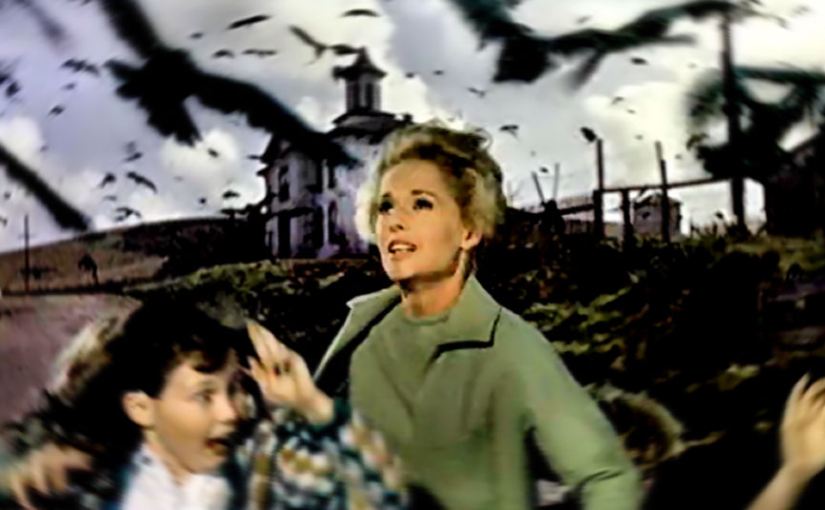
Alfred Hitchcock’s monster movie is The Birds from 1963.  There’s really not much to the piece as far as a story goes.  Characters are just given a purpose to be with one another so that they can be tormented together.  In this case, the film offers up a near hour introduction of newspaper heiress Tippi Hedren playing meet-cute with attorney Rod Taylor.  How ironic that they begin a flirtation in a bird shop of all places only to reconnect at Taylor’s harbor island home in Bodega Bay, located on the outskirts of San Francisco.  Still, as only Hitchcock can demonstrate there’s an ominous feeling sprinkled throughout before the real terror takes flight in the movie’s second half.

While I don’t rush for repeat viewings of The Birds, there’s no doubt as to its influence.  Each time there’s a shot of a bird soaring in the sky, your eyes open wider.  Something will eventually take effect.  At the beginning of the film, Hedren looks out into the San Francisco sky to see large flocks of birds soaring overhead.  Later, while taking a boat in Bodega Bay towards Taylor’s home that he shares with his mother and sister (Jessica Tandy, Veronica Cartwright), she’s attacked by a random gull.  It’ll raise the hair on your arms for sure. 

I’ve noted before how Alfred Hitchcock builds suspense.  The audience knows there’s a bomb under the table.  The characters in the film don’t. So, the audience is nervous as to when the bomb is going to go off or if the characters are even going to discover the explosive.  An outstanding sequence in The Birds includes Tippi Hedren sitting on a park bench near the jungle gym, outside of a school house.  The children are singing along inside.  One crow lands upon the jungle gym.  Then Hitch returns to a shot of Hedren calmly lighting a cigarette.  Then back to the jungle gym and there are four more birds perched just behind her.  Then back to Hedren, unaware.  Then back to the jungle gym for Hedren to turn around and there are suddenly hundreds of crows congregated together.  Effectively, other than the innocent harmonies of the children nearby, Hitchcock opts not to use any music to shock his audience as the scene develops.  The visuals lend to the fear.  The danger that threatens Hedren and the children heard off screen is at the forefront of the viewer’s mind.  No more is needed.  It’s scary, and you want to be as quiet and unalarming as Hedren so as not to instigate the monsters right next to you.

A later scene has Hedren ascend a dark staircase to open a bedroom door.  The roof has been torn open and suddenly the blackness comes alive with flapping wings from every direction.  That’ll make you shift in your seat.

Hitchcock offers plenty of set pieces for bird attacks, but another effective device is to show dissention among the ranks.  From a character perspective, the picture takes a sideways route to imply an oedipal complex between Rod Taylor and Jessica Tandy, who plays his mother.    Therefore, the script suggests Hedren as a threat to their relationship.  Before the film is over, they are likely going to have to develop a united front or it could be their undoing.  (Maybe it’s a nod to Hitchcock’s popularity with Psycho. A cute wink and nod.)

There’s also Suzanne Pleshette as the school teacher that we learn had a tryst with Rod Taylor’s character at one point.  That doesn’t spell out too well for Hedren, either.  As this bizarre epidemic becomes clearer, a scene in the town diner goes so far as to suggest that these random bird attacks didn’t start until Hedren arrived the day before.  Yes!!!!  It’s all her fault!!!! 

None of this will eventually matter though.

Other disaster films and monster movies later relied on exchanges like these, from Jaws to The Towering Inferno.  Hitchcock was wise enough to build tension.  Not a single bird in the scene, but still the fear and doubt among each other bares the strain.  There’s even an advocate for the birds with a strange elderly woman proudly debating her ornithological expertise, while a drunkard at the end of the bar declares the world is coming to an end.  All of these characters could have come from different movies, only to be pasted on to this canvas thereby lending to the frenzy.  Chaos must ensue among the masses.

Often, I get frustrated when there’s no explanation for a film’s central story.  I gave up on the TV show The Walking Dead many years ago because there never was a cause revealed for the zombie epidemic.  It became a smut of soap opera cliché accompanied with ridiculous gore.   Forgive the SPOILER ALERT, but I commend Hitchcock’s film for not providing a wrap up to The Birds.  The film ends with an uneasy final caption.  Nearly every inch of space on the screen is occupied with birds as the cast makes their way to the car to slowly drive out of town, careful not to disrupt the now dominant species of this universe.  Hitchcock provides a picture where the laws of nature declared a winner.  As intelligent as humans are considered to be, they have not won out.  They have had to surrender.  Why the birds attacked, we’ll never know.  Odd phenomena can happen.

There’s nothing thought provoking about The Birds.  It’s simply a film based on heightening your discomfort.  Often, I find the material and dialogue laughable.  The townsfolk notice a man lighting a cigarette right over a stream of gasoline and urge him to put out the flame.  Wouldn’t the dumb guy smell the diesel?????  However, then we wouldn’t get a fantastic fire ball to observe up close as well as from Hitchcock’s “God shot” in the sky with the birds looming into frame over the town below. 

The visual effects look outdated of course, but they still hold because of how Hitchcock demands they are used.  I noticed that his reliable composer Bernard Hermann is credited, but as a “sound consultant” this time.  The shrieking of the birds is what sends the chills down your spine.  Also, there’s the fact that Hitchcock offers up birds flying right at the screen or the windows.  A great sequence includes the front door of a house being gradually shredded apart by the bird masses.  The wood proceeds to splinter.  You don’t see the monsters but you know they’re right there on the other side.  Once that door breaks open or those windows shatter, then it’s likely all over for our heroes.  George A Romero exercised bits like this in Night Of The Living Dead.  Very, very effective.

The Birds is just okay for me, honestly.  The fright material is what keeps its legacy.  Yet, there’s a lot of soapy material among the cast of characters that’s not all that interesting.  Again, a purpose has to be served for these people to occupy the story.  Just offering a movie where birds hover and peck at people wouldn’t be enough.  So, we have to follow Rod Taylor and Tippi Hedren’s trajectory.  It’s fun to see screaming kids run from these animals turned menace, though.  I found it hilarious to watch a birthday party run amok.  I also yelp when I see a flock storm into Jessica Tandy’s house from the chimney turning the living room into a contained disaster area.  An especially gruesome discovery by Tandy later in the film is absolutely eye opening (pardon the pun, if you know what I mean), and clearly an inspiration to a well-remembered scream out loud moment in Jaws.

The Birds is fun, but it’s not the artistic merit you’ll find in other Hitchcock classics like Rear Window, Vertigo, Suspicion, or even Psycho. What I can promise is that once you get through the plodding character connection build up, you’re allowed to forget about any of their value to the picture and simply relish in the mayhem. 

ALIEN

By Marc S. Sanders

To be lost and alone is my absolute greatest fear.  I don’t know what to do when I find myself in situations like that.  I feel palpitations and terrible anxiety.  The only argument my wife and I had on our honeymoon was when we got lost in the Louvre in Paris.  She was relaxed.  I definitely was not.  I didn’t know in which direction to walk through the massive museum, located in a country that I’m not at all familiar with, inhabited by a majority of people who speak a language that I’m terribly limited at using for conversation.

When a person is completely, physically isolated, the only thing to depend on is his/her own wits and sensibilities.  That’s step one in constructing a scene of terror.  Step two is to lock that person away with an entity that is unpredictable, unrecognizable, smart and grotesquely frightening.  In a film, each time that entity comes into the play, the scene should not look like the last time the protagonist or the audience encountered this creature.  Whatever I learned a few minutes ago is not going to offer much help the next time around. 

I’ve just described the spine of the story that makes a horror film like Ridley Scott’s Alien so successful.

Science Fiction always works best when it can be convincing enough to lend authenticity to the fiction of its, well, science.  With Alien, a variation of biology and evolution lends to the terror of the picture and you don’t even realize it until the movie is half over. The title character is introduced in different characterizations with every scene it is called for.  First, it’s an egg, then a tentacled creature wrapped around the face of an unfortunate victim.  Later, at dinner time, it reveals itself in an unforgiving and memorable scene as a phallic shaped organism with a snake like tail and steel teeth.  Lastly, you just can’t even describe what it is except to say it is huge and its even worse than the monsters you imagined as a kid hiding in your closet or under your bed.  Credit has to go to the creature designs from H.R. Giger.  Every limb or shape of the monster seems to serve a purpose.  If that’s not enough, the animal bleeds acid that’ll burn through the hull of an enormous spaceship.  The alien in this 1979 film, later deemed a “xenomorph,” is one of the scariest and most unforgettable monsters in movie history.

A crew of seven are piloting a large ship back to the planet Earth.  Their cargo is carrying mineral ore (whatever that is).  This crew is not military of any kind.  There’s a science officer, but by and large, I’d characterize these people as truckers in outer space working on behalf of a company, by hauling a load across the galaxy.  During the long journey, they rest in a cryo-like sleep.  As the film opens, they are awakened by their transmission computer, known as “Mother,” to respond to a distress call.  Their ship has been diverted from Earth to investigate an unexplored planet.  As the piece continues, the crew brings back a plus one. They have no idea what to expect or how to handle its presence, and then they are hunted across the maze of the large ship, dispatched one by one.

The byline for Alien is marketing brilliance.  In Space, No One Can Hear You Scream.  It only scratches the surface of the terror you encounter when watching this terrifying film.  Ridley Scott uses art direction set up with long, dark hallways and warehouse size rooms that make the cast appear infantile.  His labyrinth of a spaceship offers up practically any place for a killer creature to hide and strike at an opportune time. 

It’s important to point out that Alien lends to the argument for the value of 4K resolution.  This latest print to honor the film’s 40th anniversary offers much clarity within the dark settings of the picture.  Having seen Alien countless times, I still examine each frame carefully because Giger’s designs allow the monster to blend in properly with engineering architecture of long and large pipes and cables, and immense darkness.  Chains hang from the ceilings and water drips down for no reason to be explained.  It’s just how the spaceship lives, apparently.  The atmosphere rattles you, however, when you realize there’s a dangerous bug crawling around somewhere.  Did I just catch a glimpse of the alien’s head there????  Was that his tail????  Is that a limb, like an arm or a hand????  I know all of the highlights of the picture by now, but to this day I still look for when and where the silent terror is looming, thinking I missed it from the last time I watched.  Would you believe on this last viewing, I found a caption of the alien I don’t recall ever seeing before?

Once the monster is established and we see our heroes within inescapable danger, then paranoia and mistrust can lend to their erratic nature.  The screenplay from Alien co-creator Dan O’Bannon establishes how the “grunts” of the seven (Yaphet Kotto, Harry Dean Stanton) debate what is and isn’t their responsibility and what monies they truly are entitled to on this mission.  Early on, before the threat is even considered, a divide exists within the band.  They are not always going to get along.  Later, the debate on whether to quarantine the crew members who investigated the distress signal on the strange, unknown planet comes into play.  It would be easy to simply make Alien all about blood, guts and sci fi laser pistols in a post Star Wars/Star Trek era, but it is even more effective to create disagreements and seeds of unreliability among the group.  One or two of them could end up operating in a different and unexpected direction that won’t help their cause.  Maybe it’s not just the alien we should be afraid of.

The seven members (5 men, 2 women) all have different personalities.  They like one another well enough, but they all have uncommon values and motives.  Sigourney Weaver portrays Ripley, the third in command, behind two men.  However, in outer space, does it really matter where she falls in the line?  The science officer, Ash (Ian Holm), seems to drift into his own way of thinking, separate from the rest.  Captain Dallas (Tom Skerritt) moves along the straight and narrow, only doing what’s assigned simply to move on and get things over with.  The other woman Lambert (Veronica Cartwright) does not have much dialogue to work with, but her expressions seem to be questioning why she even took this job.  Was this woman desperate for work and this is the best she could find?  She’s definitely the most unrelaxed and fearful of the crew.

Like Steven Spielberg’s Jaws, Alien does not operate on the movie monster alone.  There are other factors at play.  A popular Hollywood story is that Spielberg didn’t show the shark for a long period of time simply because the thing would not work, mechanically speaking.  Ridley Scott, however, demonstrates that he can present the animal one way and then show it in a completely different form later.  When it has reached what we can only believe is full evolution, we still don’t get a clear physical picture of the creature’s design from head to toe.  Scott will show us teeth, or maybe a shoulder blade or a tail that whips or moves at a slow and cautious pace.  The alien functions with a combination of real-life predators’ behaviors.  It hatches.  It sheds its skin.  It bites.  It runs.  It hunts a prey.  It grows and evolves…and seemingly very quickly.

Alien has been duplicated many times following its release, including a few shameless sequels.  Mind you, some of the franchise follow ups remain exceptional in their own right.  What misgivings Ridley Scott’s movie have later inspired cannot be helped.  Mr. Scott should consider it an honor, at best, that various craftspeople have attempted to top what he accomplished, I guess.  Those copycats don’t follow the recipe of Alien though.  There’s either too much of an ingredient included like blood and guts or there’s a lacking in its script, such as the eerie haunts of a dangerous setting or the overeager intelligence of its characters.  Whatever the case may be, the achievements in horror work so well in Alien, because it moves with dread, uncertainty, helplessness, a lack of knowledge, and then with only a few touches of gore and violence that are mostly left to our worst imaginations. 

Alien is not only one of the best science fiction films ever made.  It is also one of the best horror films ever made.