
NAPOLEON

By Marc S. Sanders

I never knew much about Napoleon Bonapart.  He was short.  He’s French of course. There’s that famous painting with his right hand tucked into his tunic. Or was it his left?  The big hat. I’d heard he was kind of a brat.  Ridley Scott’s latest period piece, Napoleon, confirms most of what I recall.  The painting was nowhere in sight though.

Joaquin Phoenix portrays General Bonapart, and he surely had a great challenge ahead of him. I cannot say that I was bored with any part of the film, but I did find Napoleon to be quite bland during the first act of the film.  Phoenix, doing his best with a script by David Scarpa, seems to be a stand in with nothing of much consequence to say.  It is only when the Captain all but invites a promotion upon himself to the rank of General, following the guillotine beheading of Marie Antoinette, that his arrogance begins to show.  Thereafter, he takes it upon himself to force the hands of the governing council to resign from their positions, a very entertaining sequence for sure.  Then Napoleon sees no other purpose but ongoing conquest. 

With each passing scene in Napoleon, the ego of the title character grows and grows and that is the underlying theme of Scott’s picture.  We journey to the pyramids of Egypt to witness Napoleon lead his armies towards further conquest.  Alternatively, we also trek through the raw winters of Russia and on to a blazing Moscow.  Who set the Russian city alight is a question that history may contradict of the General’s claim.

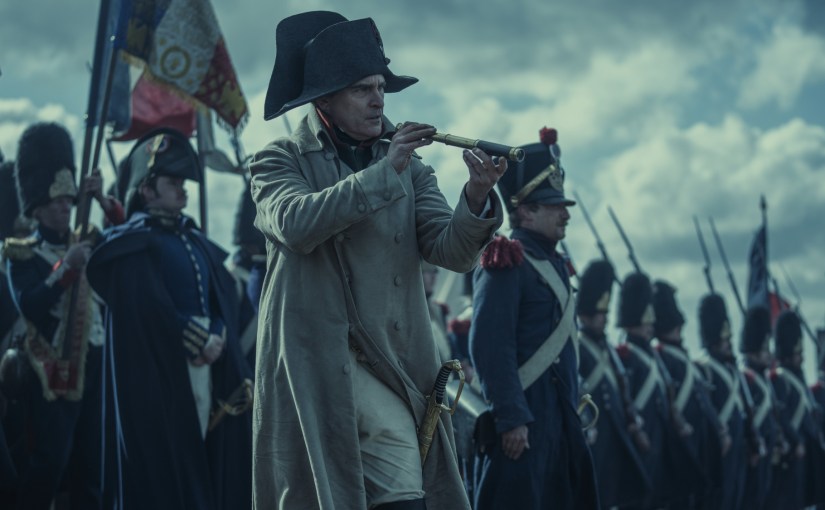
Napoleon is sure to get a slew of Oscar nominations.  However, it will likely not be in any of the major categories.  The numerous battles are outstanding in whatever setting Ridley Scott offers.  Whether it is in the desert or murky winter grounds, I could not tell if the armies were physical extras or CGI.  It all looked seamless in its construction.  David Lean would be proud.  Sound editing was also perfectly in sync.  The set designs of the many scenes throughout are exemplary from bedrooms to halls and the wallpapers, furnishings and floors and even the outdoor landscaping of the French estates.  Even Napoleon’s tent on one battlefield after another are absorbing.  The costuming always makes a statement.  Every stitch and distressed shade of blues, reds and whites tell a story.  Yes, it’s all very impressive.  However, I did not go to Napoleon to grade a college project assignment in fine arts.  Overall, it has to be the movie itself that grabs me.

Unfortunately, Ridley Scott’s film suffers from shortcomings that cannot be forgiven.  I have to lend credit to my wife who pointed out flaws that did not come to my attention until I heard her input, and thus could not deny.  There are topics brought up in the film that are either not followed through clearly or are left with questions. 

One moment in particular occurs when Napoleon opts to marry the daughter of a leader. Do not ask me to remember which leader. Characters leave the picture just as quickly as they enter.  One daughter is of proper age.  The other daughter we are told is only age fifteen and Napoleon turns down the idea of the latter, but in the scene afterwards it appears that he actually did choose to marry the fifteen-year-old.  The girl certainly looked like a teenager.  So, how did that come to be? 

A storyline I really took an interest in was Napoleon’s marriage to Josephine (Vanessa Kirby).  The widow of a dead soldier, with three children, he marries her for love.  Then he leaves to conquer some more and more around the world.  Yet, the general returns when he realizes she is happily having affairs in his absence.  The bruised egotistic response of Napoleon is very well played out. Joaquin Phoenix has his best moments in the storyline he shares with Vanessa Kirby.  However, while I thought I understood, my wife pointed out that the film does not clearly explain how the relationship continues.  There’s animosity at first but then there is a mutual love between the couple and how exactly did that flourish and change?  When was the mutual affection eventually sparked?  What works best is how the two are unable to bear a child together.  Napoleon is nothing but forceful in his moments of sex with Josephine.  He will damn well force a pregnancy even if it means he has to thrust harder and harder inside of her.  Yet, no results come of his efforts. An heir must carry on the Bonapart legacy.  Since one does not appear, it taxes heavily upon the powerful leader.

Later in the film, following the couple’s dissolution of marriage, a child is born but who exactly carried the offspring?  Details like these seem to be glossed over.

Few directors are as skillful at showing grand scenes of battlegrounds with sharp, clear edits of how the fighting progresses.  Ridley Scott demonstrates that over and over again with one scene after another.  He accomplishes fare like this so well in other films like Gladiator and his interpretation of Robin Hood.  The dark hazy cinematography works beautifully on a big screen.  However, I’m not sure if it will be as effective on a sixty-inch flat screen where there’s a risk of intrusive glares in your living room.  These magnificent scenes need to be watched on a big screen.

Unfortunately, the attention to detail is not lent to the story as effectively. Napoleon’s mark in history did not just happen in a period of a few years.  For a brief window of time, France was a superpower ahead of the likes of Egypt, Britain, Austria, Prussia and even Russia.  Two hours and forty minutes may seem like a long film and yet Napoleon likely needed at least an additional hour to serve a complete historical recount.

If you want to see Napoleon, now is your chance while it plays in theaters.  Again, I do not believe it will have the same effect at home.  Regrettably, the film does not offer enough on the plate.  No one in the cast is doing anything of Oscar caliber accomplishments.  Ridley Scott comes up short of end of the year award considerations for not inviting tighter storytelling, and that also goes for David Scarpa’s script. 

The visual marvels of this period piece are what is to behold.  Watching Napoleon, I certainly felt like I was there amid the glorious costumes, set designs and cinematic photography.  Nevertheless, while I may have been in the room, the hosts of the picture were not sharing their entire conversation with me around the dinner table.  Alas, at times, I was left to stand in the corner, feeling like an unwelcome guest.
MISSION: IMPOSSIBLE FALLOUT

By Marc S. Sanders

Mission: Impossible Fallout is the best of the so far seven films in the series.  It is carried not only by the stunts that Tom Cruise insists on risking his middle-aged self to perform, for the sake of his fans. As well, the film’s casting and the puzzle twisting script from Christopher McQuarrie, writing with inspiration from his famed Oscar winning screenplay for The Usual Suspects is a treat for the eyes and mind.  If this were a novel, I’d quickly be turning each page to see what comes next.  Like McQuarrie’s well-known invention of Keyser Soze, this movie questions Who is John Lark?  Is Ethan Hunt (Cruise) John Lark? 

Hunt chooses to accept the mission of locating this unidentified Lark who is interested in purchasing enough plutonium to wipe one third of the world population, likely in and around Pakistan and China.  However, the CIA doesn’t trust Hunt’s cavalier instincts and insists he partners up with a hulking Henry Cavill playing an agent named Walker.  Benji and Luther (Simon Pegg, Ving Rhames) are back for hacking, field work and some clever mask trickery.  Ilsa Faust (Rebecca Ferguson), the dubious British MI6 agent from the prior film (Rogue Nation) is a welcome surprise and just as perplexing with her actions.  The big bad, Solomon Lane (a snake like Sean Harris), also returns.

Like all the M:I films, Fallout operates with the same kind of formula.  We have to accept the promise that there’s a world ending MacGuffin.  Ethan and the team are assigned to find who has it and who wants to buy it and can use it.  All of this is written outside of the lines of planning out the action scenes these pictures are recognized for.  It’s as if Cruise, with his producer hat on, sketches stunts with skydives, cars, motorcycles, trucks and helicopters and then assigns his writer/director to apply words for the donut filling within the movie.  Mustn’t forget a reason to include a running sequence for Ethan to perform on rooftops.  Fortunately, all of it works best here, more than in any of the other films.

What sells these pictures, and again Fallout is the best example, is the photography and editing applied to these scenes.  Two sequential car/motorcycle chases occur throughout the streets of Paris.  (Look!  I see our honeymoon hotel, The Hotel Regina located across from the Louvre, as Ethan races by in a BMW!!!!!)  A smashing three-person fist fight in an impeccably white men’s room is a brawl for the ages. 

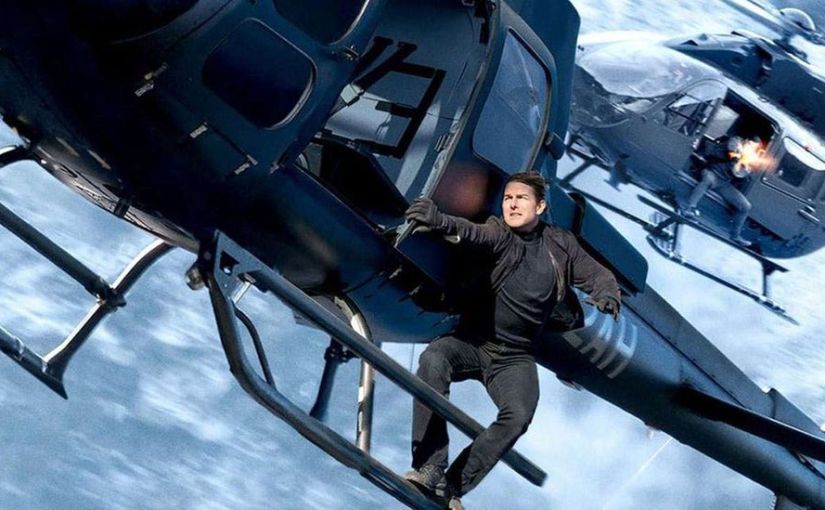
The highlight of this installment is a helicopter chase above and within a mountain valley that first focuses on Tom Cruise himself climbing a rope up, up, up to a chopper and swinging his legs onto the railing to get a foothold.  There’s time dedicated to him falling and inching his way back into the vehicle.  Then it becomes a chopper chase followed by a collision that ends with the remains wedged within a narrow mountain crevice.  What a set piece this is!  Absolutely outstanding camera work.  The wide and close editing, sound and visuals work so perfectly in sync with one another.  I don’t want to watch the making of documentary for this picture.  The trickery of McQuarrie’s camera crew is such a treat.  I’d rather savor the finished product on repeat viewings.

Juxtaposing against this chopper fight are two other scenarios involving Ethan’s teammates.  This is where I’m especially grateful for Christopher McQuarrie’s writing.  Two bombs are rigged in line with each other, and a detonator also must be retrieved by Ethan.  The whole team has to work cohesively, otherwise it is sayonara to much of the Asian continent if both devices explode.  McQuarrie’s “impossible mission” is orchestrated beautifully with suspense cranked way up.  His imagination for adventure allows a magnificently edited third act.  To date, I consider the stakes here to be the highest in the entire series.

The presence of this collection of actors is marvelous with recognition deserving of Henry Cavill donning an untrusting mustache and looking like a brutal, blunt instrument against the superspy Ethan Hunt.  Cavill also plays CIA agent wisely.  He’s got a stoic expression for most of the film but that is because he trusts the audience will assume what a dangerous threat he can be.  Cavill occupies one of the best characters in the seven films.

Mission: Impossible Fallout is truly one of the most thrilling pictures you’ll find.  What’s most important is the action serves the story.  Action just for the sake of action is tiring like in the Fast/Furious films.  There has to be a cost and a tangible feeling to the speed, obstacles and pain that good action scenes serve their characters and the story as a whole.  When Ethan falls from a helicopter or has to jump out a window, I grip both arm rests and let out a collective bellow with the audience.  Films with the grandest of adventure must draw out responses like that.  Otherwise, it’s all just a ho hum journey to the end credits.  Fallout is anything but a stroll.  It’s an absolute balls to the wall, explosive crowd pleaser.

MISSION: IMPOSSIBLE DEAD RECKONING PART 1

By Marc S. Sanders

The object of the Mission: Impossible films is not to wow its audience with thought provoking questions of politics or Cold War intrigue or even daring and uncompromisingly evil villains (apart from Phillip Seymour Hoffman).  The elements of espionage coursing through the TV series are non-existent in the film adaptations.  I’m not watching a film based on a John LeCarre spy novel.  By the time the seventh installment has arrived, titled Dead Reckoning Part 1, the goal of the film series is to sketch out the set ups for one action piece after another.  Only they must be bigger, bolder, and seemingly that much more impossible to overcome for their hero, Tom Cruise (playing a guy named Ethan Hunt).  The action is once again top notch.  The glues that bind these displays of bravado together, you know where the characters have to talk and give us a semblance of a plot, is as nil as the scotch tape that assembles a stretch of film reel into a running time length of nearly two hours and forty-five minutes.

The locales are as grand as any travel getaway. We go through a labyrinthine airport.  A techno night club works as a meeting place for a bunch of characters. There are journeys to the Arabian Desert, Rome, Venice, and a beautiful ride along the famed Orient Express.  Shot on digital, this movie is a gorgeous travelogue.

Let’s get the problems out of the way, though.  The MacGuffin that Ethan Hunt and his trusty pals Benjy and Luther (Simon Pegg, Ving Rhames) have been assigned to recover is two parts of a specially designed key.  One part is supposedly with the disavowed MI6 agent Ilsa Faust (Rebecca Ferguson).  The other half is questionable as to who possesses it, but a thief known only as Grace (Hayley Atwell) may be significant in finding it.  Put the two halves of the key together and it will unlock something that no one seems to know of, or where it is located.  Here’s my first issue.  The audience does know what the key unlocks because it is shown in the first three minutes of the film.  So, while the cast of characters act dumbfounded, we know all along.  So, there goes any curious interest I may have for wanting to follow through with this. 

The other problem is that the same conversation happens over and over and over again.  Lines like (and I’m paraphrasing here, or maybe I’m not) “If this key gets into the wrong hands…” and “Whatever this does unlock, Ethan, could spell the end of the world…” or “It’s important that both halves of the key are not put together…”  or “Whatever this does unlock…”  (See?  Even I just repeated myself in this write up.) Except, we know what it unlocks!!!!!  The same exchange of dialogue occurs over and over.  The redundancy exhausts itself.  It occurs so much in fact that it’s writer/director, Christopher McQuarrie, relied upon the repetitive dialogue to stretch this next M:I chapter into two films instead of one (Part 2 is scheduled to be released in 2024).  I don’t recall the context of any of Ving Rhames’ lines going further than what I have presented here, for example.

The film is also a little too character heavy.  I never understood why two agents (Shea Wigham, Greg Tarzan Davis) are constantly pursuing Ethan.  Just was not clear for me. Heightened suspense?  That’s the best excuse I can think of.  The White Widow from the prior film (Vanessa Kirby) also appears.  Not much purpose to her.  Cary Elwes is the deputy director, there at the beginning and later towards the end, but again I was not entirely certain of his contribution to the story.  Even Ilsa Faust does not seem to have much value, except to work as a step in Ethan’s ongoing trajectory for the key.  I think Rebecca Ferguson had no more than five lines in the whole picture.

Finally, Ethan Hunt seems to be up against an omnipotent enemy, an AI program known as The Entity.  The humans doing the bidding of this phantom program consist of a goatee wearing Esai Morales and his henchwoman, played by Pom Klementieff.  She looks straight out of a James Bond picture and makes for a good car chase through the stone cobbled streets of Rome in a tank like Hummer.  Morales is as boring as most of the other the M:I villains.

What works for the film is what Tom Cruise really wants to impress you with though.  Riding a speeding motorcycle off a mountain and parachuting his way down.  That’s actually a near sixty-year-old Tom Cruise performing that feat.  Very impressive.  The car chase with a handcuffed Cruise and Atwell in a puny yellow Fiat versus an unbeatable Hummer and an army of Italian police vehicles is fun on the level of Roger Moore’s Bond films.  Most impressive for me is the final act where the famed Orient Express train tumbles off a bridge with a gap in the middle, car by car with all the furnishings, piano included, pouring out while Ethan and Grace hold on for dear life. 

It’s the high stakes stunts that work.  Whatever smidge of a story there is fails though.  The script by McQuarrie and Erik Jendresen lacks so much that the cliffhanger the film ends on doesn’t leave me yearning for more because it only hearkens back to the beginning.  The characters catch up to what the audience has known for the last three hours.  So, I’m not losing sleep wondering with what happens next.

Of course, I’ll go see the Part 2 installment.  Tom Cruise won’t let me down in whatever daredevil achievements he’s dreaming of doing next.  However, am I going to these movies to watch Mission: Impossible, or to watch an aggressively updated version of Circus Of The Stars?