
AMERICAN BEAUTY

By Marc S. Sanders

Lester Burnham declares in less than a year he’ll be dead.  When we meet him, he’s masturbating in the shower, sleeping in the back of the family vehicle on the way to work, and declaring that his wife Carolyn used to be lovely.  Heck, he’s acting like he’s dead already.  His life has nothing new or exciting to pursue.  His daughter, Jane, doesn’t give him the time of day.  He’s threatened with being laid off from his magazine call center job that he’s held on to for nearly twenty-five years.  What’s to live for anymore? 

I guess what’s complimentary about poor Lester is that at least he’s honest with himself.  All the other neighbors, except for the gay couple known as Jim & Jim, are just as unhappy it seems and might as well be dead too.  A common theme running through the suburban landscape of American Beauty centers on a sense of mental awakening. Who revives sad, lost folks like Lester and Carolyn?  Perhaps it’s the generation sneaking up behind them, who are on the cusp of taking their place in young adulthood. 

Lester is played by Kevin Spacey, in his second Oscar winning performance.  Carolyn is portrayed by Annette Bening who is way overdue for a trophy.  Jane the daughter is played by Thora Birch.  The headliners of this cast are outstanding in how different and disagreeable they portray a broken family that is forced to live in an unstimulating home while trudging through a lifeless marriage.  Look at the set designs within this film.  There’s an endless amount of blank walls within the interiors of the homes.  Almost no artwork or pictures are to be found. 

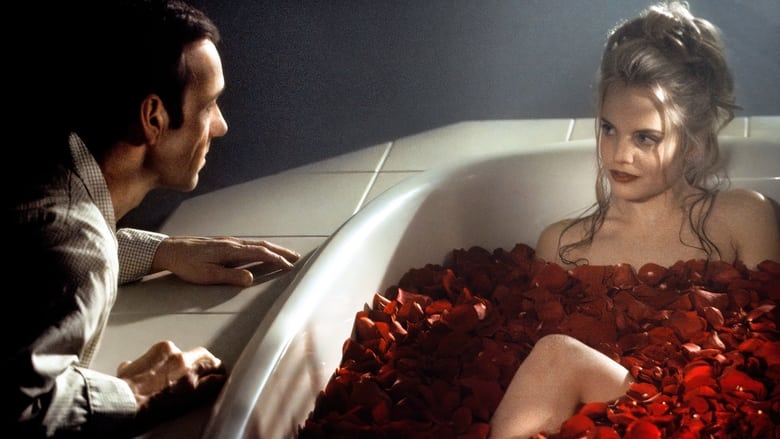
Lester pines and fantasizes about Jane’s best friend Angela (Mena Suvari) getting rained on with red rose petals while she lies naked in a pure white bathtub.  Carolyn, the real estate agent who can’t make a sale, sidles up to the dashing Buddy Kane (Peter Gallagher), her competition. Next door is Chris Cooper in a hospital cornered role as retired Marine Colonel Frank Fitts, with his near comatose wife Barbara played by Allison Janey, and their eighteen-year-old resourceful drug dealing son, Ricky (Wes Bentley). He takes advantage of his camcorder at any opportunity to collect the beautiful images found within the world he occupies and observes.  That could mean he’s capturing Jane in her bedroom window which faces his own.  Later, he’ll show you the freedom of a plastic shopping bag dancing within an autumn breeze.  An old shopping bag has more life among a breeze and brown leaves than Lester, Carolyn, Frank or Barbara.

There is a mystery to American Beauty that seems quite odd.  We know that Lester will die soon, but how and why? Maybe there’s a twist, because that outcome seems more and more impossible as we see Lester discover a spirited mindset to go after what he wants, when he wants and declare that he’s not going to allow himself to take shit from anyone particularly in his boring dead end job or from his unaffectionate wife.  Ricky, the kid with tons of money and electronics equipment, has nothing to lose because he’s not committed to anything at age eighteen and he can just quit an ordinary table-waiting job at any given moment.  Why didn’t Lester have the gumption to ever be like Ricky?   It seems so simple.

There’s a blink and miss it sign hidden in plain sight.  Pinned to the wall of Lester’s work cubicle is the message “Look Closer.”  Director Sam Mendes and writer Alan Ball gives the audience a subtle wink to dig within the cracks of suburban life sidewalks.  These homes may appear perfect on the outside, with neighborly neighbors, but if you watch with a more critical eye you’ll find an emptiness that has been unfilled for too long.  The filmmakers make it easy for you to uncover what eats away at the upper middle-class way of living.  Dinner with Lawrence Welk playing in the background is anything but uplifting.  It’s imprisoning.

When one member of this community opts to seize his moment, no matter if he’s motivated by a kid’s rebelliousness and the drugs he buys off of him, or the fact that he thinks a beautiful teenage blonde has the hots for him, he sets out to change.  He exercises and builds up his body, buys the dream sports car he’s always wanted, quits his job and grows to not caring how this may disturb his unloving wife. 

American Beauty seems to remind us how alive we can be when we are younger and not as restrained by the commitments it takes to live like adults with debts and parenthood and jobs and marriage.  Look closer though because couldn’t we live as well or more aggressively when middle age arrives?

The irony of Alan Ball’s script is that a boring guy like Lester Burnham discovers exciting things about himself just as the end of his life is approaching.  All he needed was stimulation.  He never saw his death coming, and you might forget he told you he will soon be dead, but American Beauty works to show how necessary it is to live each day to the fullest. 

I sound hokey.  I know.  Yet, that’s the direction of this film’s trajectory.  On the side, you observe those people who do not pursue what will fulfill their own lives and desperately need a modification.  Lester was limited to branch out. So is Colonel Fitts and his very sad wife.  So is Carolyn, and Jane and Angela, and maybe so is Ricky.  All of these people uphold facades about themselves to preserve a happiness on the outside when they really feel worse within. 

Sam Mendes is brilliant at drawing upon the subtle messages and insecurities of Alan Ball’s neighborhood characters.   About the only people that Sam and Alan do not dig deeper with is the gay couple.  I guess since they are happily out of the closet, what is left for them to conceal?

I could not help but compare Mendes’ Oscar winning film to Robert Redford’s.  American Beauty is more forthright than Ordinary People. Redford’s film draws out the ugly honesty of the family nucleus when an unexpected tragedy interferes.  Then it takes the entire film before the spouses take off their masks and truly declare how they regard each other.  It’s crushing to realize a sad truth. 

American Beauty rips off the layer right at the beginning, though.  A tragedy does not awaken these people to the natures that embarrass them.  Simply a hellbent, fed up mindset gets one guy going, and if that one member opens his eyes, then so will others because a simple disruption in ordinary life is next to impossible to live with.  Both films are so wise in how they criticize the very people these films were likely catered for.

What do these two Oscar winners say?  They tell the middle class, middle age American to simply look closer.
CLEAR AND PRESENT DANGER

By Marc S. Sanders

Tom Clancy’s Jack Ryan finds himself in an inadvertent private war between the United States and Colombian drug kingpins in Clear And Present Danger.  Harrison Ford returns as the heroic government operative. I like this film for much of the same reasons I liked the prior Jack Ryan pictures.  These movies give an inside view of internal politics within Congress, the CIA and inside the hallowed halls and Oval Office of The White House.  The Clancy adaptations are not just about action set ups and shootouts.  Though we are treated to plenty of that material as well.

The film opens with a luxury yacht being raided by the Coast Guard. They uncover Colombian killers that have murdered a wealthy American and his family for reasons of a failing partnership with drug dealers.  The incident can be bridged to the President played by Donald Moffat, a terrific character actor who also shared the screen with Ford in Mike Nichols’ Regarding Henry. He secretly initiates a retaliation for what has occurred while also insisting on collecting over six hundred and fifty million dollars he feels the US is entitled to, following his friend’s murder.  Henry Czerny, playing a carbon copy of his role in Mission: Impossible, headlines the covert plot and recruits a mercenary named John Clark (Willem Dafoe) to place a clandestine militant team into the South American jungles to take out the drug runners one by one.

The suit and tie formal dynamics fall on Jack Ryan when he swears testimony on the legitimacy of the country’s response.  However, the President’s armament exercises are unbeknownst to Jack.  When it finally dawns on him what has been occurring, into the field Jack Ryan goes to clean up the mess.

A lot of spinning plates structure the storytelling of Clear And Present Danger which is on par with Clancy’s thousand-page novels.  There’s an abundance of characters to address, betrayals to happen and even the mechanics of various weaponry and policy decisions that need exploring, despite the innate complexities of it all.  It can feel overwhelming.  However, with this film, as well as with The Hunt For Red October and Patriot Games, I feel included.  If you’re patient through the exposition and set ups, then these fictional controversies become very absorbing, and you feel like you’re there.  

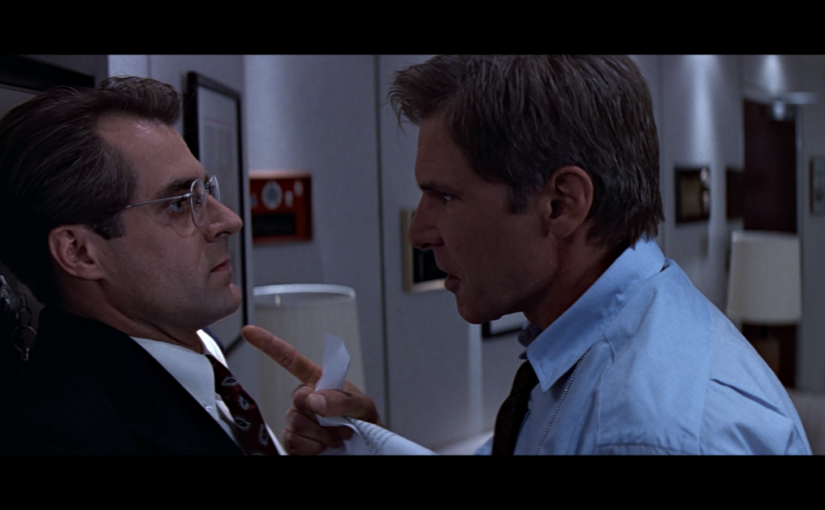
There’s a great scene between Ford and Czerny racing to download vs delete some suspicious files on a computer.  These guys are in their boring offices, dressed in their boring suits and they’re clicking on the mouse pad and typing away on the keyboard.  Director Phillip Noyce gets nail biting back and forth closeups on each guy as they are off to the races trying to get ahead of each other.  Then it becomes a yelling match in the hallway with threats of prosecution between both men, and I feel I’m in on the whole thing.

There is also a good amount of internal conversations between the main drug czar (Miguel Sandoval) and his top henchman (Joaquim de Almeida).  Almeida’s role is written very well as we witness how smart and resourceful he is while protecting the best interests of his employer.

For the most part, the action is nothing special.  However, the highlight of the whole film involves an SUV convoy getting ambushed by Colombian terrorists mounted on rooftops firing missiles at the government vehicles below.  Harrison Ford prefers to do as much stunt work as possible and it definitely helps the ten-minute sequence.  This is an outstanding part of the picture with perfect editing of sound and photography. Later on, we see Ford leap on to the landing gear of an ascending helicopter. Very impressive. Harrison Ford always does his best to invest himself in his movies.

I also admire many of the explosions that went into the Special Forces’ continuing storyline of sabotaging the drug lords’ laboratories and various locales. Nothing is miniaturized here, and the resulting blasts are really big and eye opening. This movie did not shortchange on anything it was attempting to accomplish.

The film adaptation of Clancy’s fourth book takes some major liberties.  In the novel, the story is primarily focused on John Clark and his mission, with Jack Ryan not appearing until after the midway point.  However, at this stage of Harrison Ford’s career there was no way he’d accept just a supporting role.  The notable changes hold well within the screenplay though, and a showdown between Jack Ryan and the President is one for the ages.

Overall, Clear And Present Danger was a successful picture at the box office. Critics and Clancy fans alike had favorable responses to the picture.  So, it’s disappointing that producers decided to try numerous reinventions of the Jack Ryan franchise subsequentially.  Those other movies, along with a TV show, would prove well.  Yet, it is regrettable that Harrison Ford, or at least this interpretation of the hero, did not move on through Tom Clancy’s ongoing stories transcending within other areas of government and espionage.  If you have read the books, then maybe you recall the unbelievable ending to Without Remorse.  Boy, would I have loved to see what Harrison Ford did with the cliffhanger that closed out that book. Care to know? Then this Unpaid Movie Critic suggests you pick up a book.

NOTE OF TRIVIA: James Horner conducts the music for this film and he includes samples that were used in the beginning of Aliens. Interesting to catch this as the music works for both a science fiction piece, as well as for a political thriller.

PATRIOT GAMES

By Marc S. Sanders

You may remember Patriot Games as a tense thriller featuring the favorite hero Jack Ryan doing the wherewithal action that is demanding for the adaptation of Tom Clancy’s best-selling novel.  Harrison Ford (taking over the role from Alec Baldwin) plays the guy who will thwart an assassination attempt on the Royal Family or punch out a terrorist thug invading his home or on a speed boat during a dark and stormy night.  Only a small bit of the action sequences are flawed, but that doesn’t take away from what makes the picture truly special.  In the follow up to The Hunt For Red October, Jack Ryan goes back to the CIA to investigate who wants revenge against him and who was responsible for that assassination attempt.  What the picture serves as the covert halls of the Central Intelligence Agency is what is especially convincing and most fascinating.

On the surface, the Irish Republican Army appears to be the scapegoat for attempting to murder members of the Royal Family as they are pulling out of the front gates of Buckingham Palace.  Jack Ryan is in London vacationing with his wife Cathy (Anne Archer) and daughter Sally (Thora Birch) when he comes upon the incident just in time to foil the crime.  In the process, Ryan takes a bullet to the shoulder and kills the younger brother of the most dangerous squad member, Sean Miller (Sean Bean).  A quick trial puts Miller behind bars and Jack is recognized as a hero.

However, Sean Miller escapes with his surviving comrades and vows revenge on Jack and his family.  An attempt is made on the Ryans’ lives and Jack insists on getting back into the CIA to locate Miller and his team.

The revenge plot is the main thread and its pretty ho hum.  We’ve seen all that many times before.  However, what branches off are the conflicts within Irish politics and how Jack Ryan gradually uncovers who and where this small faction of terrorists may be.  Cold War commentary is delivered by an under the radar performance from one of my favorite character actors, Richard Harris.  He attempts to deny responsibility of these attacks and offer an olive branch to Ryan.  Ford and Harris have three good scenes together, two of which are minimal on dialogue but effective in sending their messages to one another. 

As well, Harrison Ford occupies another great heroic role.  I agree with a majority who believe he was too old to play the novice Jack Ryan described in Clancy’s early novels.  Many insist casting Baldwin was perfect.  It was. Yet, I am able to look past that as the character does not have the rookie appearance or regard in this picture.  With Harrison Ford, Jack Ryan is now at a point where he looks seasoned and experienced like the character eventually becomes in the book series.

Director Phillip Noyce is good at using the mysterious and quiet orchestral accompaniments of James Horner to follow Jack as he studies photographs or reflects on the day of the assassination attempt in order to piece together random clues.  In other films, this might get boring and tedious.  However, the director captures good closeups of Harrison Ford and quick flashbacks are edited to help identify what were important blink and miss it moments necessary to assemble the puzzle.  A simple visit to the restroom for Jack Ryan and a glance at a woman’s ponytail lead to a solid conclusion.

Sean Bean has the physical and quiet intensity to his role.  He’s the muscle of the terrorist group, not the leader (played by Patrick Bergen).  Bean serves the revenge element and his physique and weapon handling work well as a nice threat to the hero of the picture.

As the story progresses, the audience follows along with Ryan.  Satellite photographs are studied and zoomed in seeking some semblance of an image in a blur.  Sometimes Jack Ryan is moving in the right direction but in other times he’s unsure.  Even though we always know how the bad guys are doing and where they are, we empathize because Harrison Ford’s character does not.  Still, it’s a thrill to witness him eventually make his discoveries.

A nice approach occurs when the CIA sends in troops to what they believe is an enemy base camp.  We watch Jack Ryan and all of the government officials stare with intensity on a big screen as little black pixels drop down and move at a running pace from an overhead satellite shot.  We don’t have to endure one more machine gun battle.  This kind of intensity is much more interesting where lives are taken as a means of protection, but still a principled man like Jack Ryan does not feel good about what has to be done.

Patriot Games works well with its plays on espionage, spy activity, traitors, and government relations between America, Great Britain and Ireland.  The select action scenes are done well and hold their suspense for quite long.  However, the final sequence is challenging to sit through. 

As the enemy prepares a covert attack on the Ryans’ Virginia home where the Royal Family are guests, there is much running around upstairs and down, in the basement, and outside the roof and so on.  It’s pouring rain with the standard thunder and lightning in the middle of the night as well.  Once the villains and the hero make their way to some getaway boats, the film unravels.  The picture shakes like crazy against the waves and rain.  There’s little light on any of the shots as well and the sound goes loud due to the boat engines and the storm setting.  All of these elements make it challenging to get absorbed in the movie’s climactic ending. 

Hollywood pictures fall back on this approach often in films like Ang Lee’s Hulk and the first installment of The Hunger Games.  It’s dark and wet and shaky and rainy. So, it is hard to decipher who is hitting who and who is shooting at who and who is driving which boat and where are they now.  It’s a shame really because Patriot Games is a taut thriller that holds your attention for nearly two hours, but then you give up in the final few minutes to simply rely on your instincts for how the story is going to wrap itself up.

Jack Ryan’s second adventure is worth watching but oddly enough, maybe wait for your restroom break until the last ten minutes of the picture.