INTERVIEW WITH THE VAMPIRE: THE VAMPIRE CHRONICLES

By Marc S. Sanders

Fantasy of the supernatural or science fiction work best when the writer can teach the reader or the viewer how its foreign worlds work and how the characters who occupy the environments function and live.  Anne Rice had her own interpretation about how creatures of the afterlife live by night.  Her vampires possessed theatricalities.  Some were charming and sophisticated, and relished how they lived immortally while satisfying a hunger for the blood of living humans.  Some struggled with the discomfort that comes from being a remorseful bloodsucker.  The first of Anne Rice’s series of vampire novels, Interview With The Vampire, runs a very wide gamut of perceptions.  By the end of the film adaptation, directed by Neil Jordan, I’ve earned quite an education.  (Frankly, Rice’s novel was tediously slow moving and bored me to tears.)

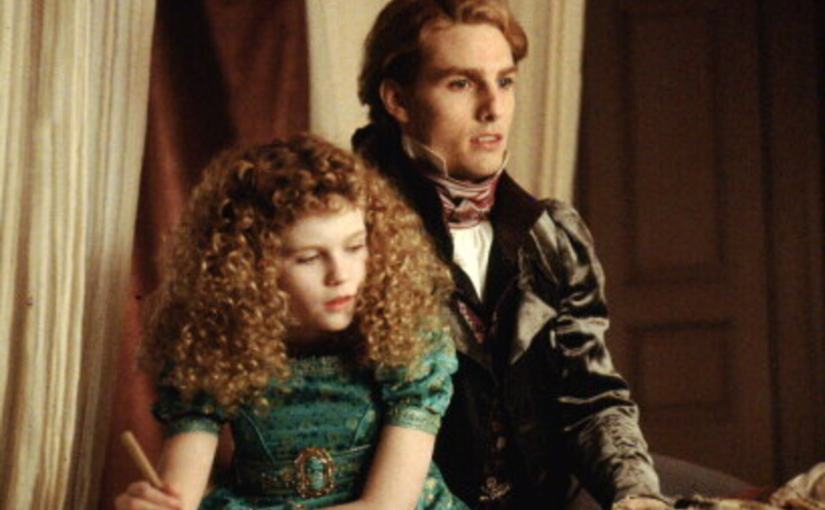
In present day San Francisco, a young man (Christian Slater) sets up his tape deck to record a conversation with a soft spoken pale faced man in a dark suit with a neat ponytail in place.  This mysterious person is Louis, played by Brad Pitt.  His story begins two hundred years earlier, in New Orleans, back to the day when he was incepted into an immortal life as a vampire. His agent of delivery is the devil-may- care and mischievous Lestat, one of Tom Cruise’s most surprising and unusual portrayals.  He gives a brilliant performance that’s as far a cry from his lawyer roles or his Maverick and Ethan Hunt heroes as possible.  

Lestat is eager to guide Louis into the benefits of vampire life.  Louis, having already been depressed following the loss of his wife and daughter during childbirth, cannot grow comfortable with Lestat’s insatiable appetite to feast on aristocratic figures or plantation slave servants.  This is not a match made in heaven and their chemistry as a couple is tested. Louis would rather miserably feast on chickens and rats, while Lestat grows frustrated by unsuccessfully swaying his partner to taste the sweet nectar of blood dripping from the wrist of a lovely young lass.  Lestat turns towards a grander extreme to maintain his embrace of the morose Louis.

Through deception, the men welcome an eleven-year-old “daughter” into their underworld.  Her name is Claudia, played Kirsten Dunst in her introductory role.  I still believe this is her best performance, worthy of an Oscar.  The life of a vampire is delightful to the child, the same as Lestat perceives it.  However, as the decades move on, with changes in fashions and industry quickly developing, so does Claudia’s understanding.  Her body never matures, destined to always remain within the shell of a preteen child, and thus she commiserates with Louis.

It appears like I’ve summarized Anne Rice’s entire story, but I have not even come close.  Interview With The Vampire is to gothic horror the same way The Godfather is to mafia gangster life.  Both communities victimize people of an innocent world, but their members are expected to follow codes of decorum and respect.  The conflict lies in living as a bloodsucking vampire or a criminal gangster.  When a peer interferes or does not cooperate, then the individuals of these respected worlds become violent unto each other.    The viewer/reader observe how their patterns of behavior all play out and how one action or policy generates one response after another.  These films are high ranked authorities on their subject matters.

Louis explains to his interviewer how Bram Stoker’s celebration of vampires is dreamed up escapist fiction, though coffins and the avoidance of sunlight are absolute necessities to carry on.  Just like any person, vampires want to live happily, but life gets in the way and that can be frustrating on any number of different levels.  

Neil Jordan’s film is a marvelous exploration into the mindset of being a vampire.  Tom Cruise perfectly exudes Lestat as a vampire ready to joyously live with sin while he savors and lives a life of eroticism and material wealth.  A child like Claudia sees the attraction of being spoiled and spoiling herself, and she cannot get enough consumption of blood. Eventually though, her mentality outgrows what becomes redundantly mundane.  Louis is relatable like many people.  He is unhappy living the life he was born into.  Lestat grows aggravated with his family’s resistance to partake of what he relishes.  There is an extensive range of emotions on display with Interview With A Vampire. To be a vampire can be a privilege or a curse. It all depends on who you interview.

The look of this film is astonishing.  I know it was shot within New Orleans, Paris and San Francisco locations.  However, I can easily recognize some sound stage locales, and I have no complaints.  The art designs from Dante Ferretti are thoughtfully crafted with lantern lit, rain-soaked cobblestone streets of the seventeenth century to mucky, moonlit swamps.  Horse drawn carriages transporting abundances of coffins serve a purpose of humor and narrative as character misdeeds are routinely committed by Louis, Claudia and especially the trickster Lestat.  The furnishings of the aristocracy are embracing too.  It’s a remarkably convincing step back in time.  

The periodic costume wear by Sandy Powell completes the settings with colorful, silk garments, white ruffled shirt sleeves and buckled shoes for both the men and women as well as for Kirsten Dunst and some cherub cheeked children who come into play.  Everything looks so rich. The whole picture feels like stepping into one of those late-night ghost walking tours I’ve taken in small southern towns like Savannah and St Augustine.  Every scene, even when the film jumps to late twentieth century, is immersive.  

Anne Rice’s screenplay adaptation tells so much within two hours.  She allows time for the characters to sail to Europe seeking out others like them.  The second half of the film teaches us more about what it means to uphold oneself as a vampire.  

Neil Jordan sometimes delivers his film like a how-to documentary because you are consistently learning new details, not so much about plot but about a people you are not as familiar with. Often, the film segues into theatrical play as you might expect from Phantom Of The Opera.  It’s no wonder since eventually Anne Rice puts us in touch with the cabal known as Theatres des Vampires. Stephen Rea and Antonio Banderas get to take center stage within a literal theater where the facade of behaving like a vampire can be executed beyond the suspicions of a – ahem- live audience.  

Rice and Jordan get playful while also performing with horrific familiarity.  The bites on the neck are known to many of us for drinking blood.  Did you also realize that a vampire can drink from a crystal wine glass? There’s an elegance to how the actors’ characters consume the blood of humans.  Cruise and Pitt begin by going in for a passionate kiss, either on the neck or the weightless wrist of a victim.  Lestat is more aggressive. Louis caresses his meals on the rare occasion he dines. Claudia gives a puppy love bite. Cruise especially finds new and titillating ways to dine with each new feast.  Both actors are deliciously homoerotic, but on different parental planes with their child. Their love/hate relationship operates like Shakespearean stage work. That’s why I really take to Neil Jordan and Dante Ferretti’s choice of soundstages.  

I’ve become so bored with zombies and vampires.  How many iterations must be churned out of the same kind of monster.  This year’s horror hit, Sinners, was superb until it stopped being eye opening with surprise.  It eventually became the same old thing and offered nothing new to show me in its final blood-shedding act.  

Interview With The Vampire is one of the best vampire films though.  The film never ceases to speak directly to its audience.  The settings describe how life is lived.  The characters grapple with both internal and external struggles.  

It’s one shortcoming is that Anne Rice, Neil Jordan and cast/crew did not follow up with the author’s subsequent tales.  The subtitle, The Vampire Chronicles, seemed to promise an extension of this universe. I know of other Anne Rice film adaptations that chose not to continue on from what was done here, and the execution was terribly poor and disappointing.  There’s a biographical intelligence to Neil Jordan’s film that many films of all genres lack.

Anne Rice’s first film adaptation set the standard on vampire culture, and I have trouble thinking of anything since its release that closely matches it.  

Interview With The Vampire is the only one with a blood curdling bite.
SOLO: A STAR WARS STORY

By Marc S. Sanders

To those who naysayed this standalone installment in the galaxy far, far away, all I say is you are trying too hard to be pleased.  Shut up and have some fun, will ya?

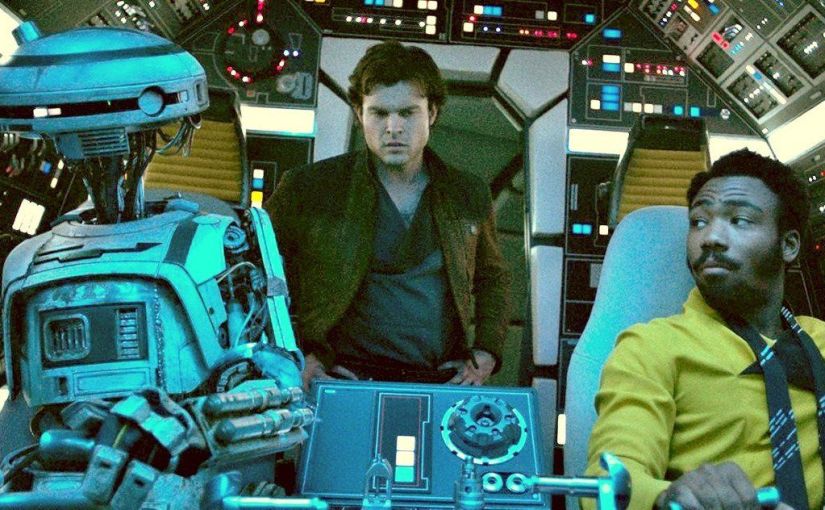
Solo: A Star Wars Story presents a film that stands on its own, relying on mysterious legendary side stories only talked briefly about for the last fortysomething years like the Kessel Run, Sabaac card games, dice and the origin of how Chewbacca met everyone’s favorite space smuggler, Han Solo, plus the Millennium Falcon and the scoundrel Lando Calrissian.  

My brother and even a few friends of mine (Joe Pauly) grew up loving John Wayne’s films. No one else epitomized a Hollywood western better than The Duke.  He was their childhood hero.  For me, it is the generation after that which introduced the space cowboy Han Solo played by Harrison Ford.  He is not anywhere near a multi-dimensional character; pretty one note if you ask me (which ironically is opposite of what I demand in any kind of storytelling these days).  

Captain Solo was the guy who would make it up as he goes; never planning ahead or considering others beyond his trusted furry partner and his beloved spaceship.  He’d poorly talk his way out of trapped situations and when that didn’t work, he was a fast draw with his blaster.  

The screenwriters for Solo, legendary Lawrence Kasdan with his son Jonathan, were all aware of Han’s placement in this space opera, while constructing this film.  Only this time they intended on showing how that devil may care came about. It reminded me of a similar approach writer Paul Haggis took with the reinvention of James Bond in Casino Royale.    A lone hero trusts very little beyond his own arrogance and self-assurance.  The Kasdsans used that technique as the spine for this story and it works.

Director Ron Howard is the right guy to fill in following a notorious director incident beforehand.  Howard keeps the film moving fast with casualties you might not expect to perish, revealing masks (an under looked theme of the original films), traitors, fast ships, fast cars, and their pursuits and chases.  A favorite scene, saluting the Western, is a thrilling train robbery across a snowy mountain that seamlessly changes its angle and vector at times.  It’s as awesome a scene as it promised in the trailers.  

Howard is best at keeping the film grounded in actors rather than tired CGI cartoons.  He definitely makes Han, Lando and the rest look convincing trying to steer a ship or carry a blaster and play cards.

The cast is great.  Alden Ehrenreich is fine in the role; young, cocky, brash, handsome.  I wasn’t looking for him to do a Harrison Ford impersonation.  That would only look like a 12:45 am Saturday Night Live skit. The guy had to do his own thing, not someone else’s much like the Batman and Bond films have done before.  Donald Glover is perfect as Lando, even adopting Billy Dee Williams own way of pronunciation (“Han” vs Ha-an”).  Still, he makes the part his own.  He’s fun to watch.  Beyond some mild makeup scarring, Paul Bettany makes for a really uncomfortable crime lord, like a suave Miami Vice drug kingpin, and Woody Harrelson is just right in the inspirational pirate role; gruff and tough and educating.  Emilia Clarke is finally directed properly in a film.  (I still haven’t forgotten her awful Terminator: Genisys Sarah Conner portrayal.). She is dangerously sexy, but smarmy and cocky like Carrie Fisher was.  She’s a great femme fatale of the 1940s beautifully incorporated into some very thick sci fi.  

This was such a fun time at the movies.  Go ahead.  Accuse me of my bias, but as well shouldn’t I be expected to be a tough demanding critic of all new Star Wars material?  I’d probably be wanting it to match the magic of the original trilogy.  Well no.  I don’t want it that way.  I want new and fresh ideas, while still recognizing George Lucas’ used universe settings.  Disney and Lucasfilm continue to move along, stretching their imagination in monies well spent while also following the rules of smart aleck characters, film western motifs, Eastern cultures and death-defying cliffhangers.  Had the Star Wars franchise remained with Fox, audiences would not be getting the treats we’ve been blessed with for these last 10 years.

Solo really only has two minor misfires.  The droid L3, Lando’s Co-pilot, does not live up to Anthony Daniels nor Alan Tudyk and their high brow robot attitudes.  Why? Because it’s hard to understand what L3 is truly saying.  The lines are garbled at times; drowned out by the robot dialect I guess, and maybe also by a mostly origninal score.

As well, there is one ending moment that’s eye opening, but puzzling with little demand for it.  It was one surprise that did not seem to be well thought out and considering this is a stand alone film, it left me unsure of what Lucasfilm hoped to gain from it.  The moment was too distracting for me.  Yet it’s in there and it’s not the worst offense.  Just very very unnecessary and perplexing.

Solo: A Star Wars Story is none other than great fun with something to think about.   I was laughing out loud.  The audience we were with was clapping and cheering.  That’s why Star Wars films continue to thrive.  Their audiences get caught up in the ride, especially when the films are relatable while not taking themselves too seriously.

MISSION: IMPOSSIBLE II

By Marc S. Sanders

Mission: Impossible II is undoubtedly the weakest installment of Tom Cruise’s series, adapted from the classic tv show. Action Director John Woo is normally regarded as “ACTION DIRECTOR JOHN WOO” because he can only direct action. He hardly ever directs story. There’s no dimension to his characters and nothing intriguing. It’s all just glitz and neon colors in his cinematography. No weight at stake in Action Director John Woo’s action.

A third act fist fight between Cruise’s Ethan Hunt and a very, very uninteresting villain played by Dougray Scott gets very tiresome, very, very quickly. Punch, kick, tackle, twirl, take off your jacket, get up in very slowwwwww motion, throw off your sunglasses, and do it again and again and one more time.

The MacGuffin of the picture is a virus and the anti-virus. Hunt recruits a sexy thief played by Thandie Newton to infiltrate Dougray Scott, her ex-boyfriend seeking to cash in on the prize at hand. Somewhere, lost in Robert Towne’s script, Scott’s character gets wise to the fact that of all the “M:I” agents out there, Ethan Hunt is the one onto him even though they never come in contact with one another until the middle section of the film is complete. So, the bad guy, at times, disguises himself as Hunt. Screenwriter Robert Towne thought he’d get one over on the audience with the disguise twists that the M:I franchise is known for. Sadly, it’s not subtle enough in this picture. All twists can be foreshadowed as early as the opening credits actually.

Action Director John Woo really fails with this effort. He makes a terrible habit of amping up the gloss of his film with an abundance of slowwwwww motion actions and reactions to accompany a mostly mandolin soundtrack from Hans Zimmer. Beautiful set pieces of music. Though none of it belongs in this film. Zimmer’s work here is better suited for something more genuinely romantic and exotic, without the revving motorcycle rides and bare-knuckle brawls in the final act of the film.

In addition, Action Director John Woo is not given much action to “action direct.” There’s a lot of bland talking in Towne’s script. So much so that we finally arrive at what the film promises, only it’s very late in Act 2, and then drags on very slowwwwwwwly in Act 3.

For a brief stint early on, you get the impression that Cruise is adopting a flirtatious James Bond approach with Newton’s character. They hide away cuddled in an empty bathtub and quickly bed one another, but Towne writes no sexual innuendo to go with Cruise & Newton’s grins, or their shiny, moisturized complexions.

There’s no humor either. There’s really no reason to like Ethan Hunt here. He has nothing to say. All he does is walk in slowwwww motion in response to Action Director John Woo.

Cruise, again as producer, makes the mistake of only allowing his hand in the cookie jar. No one gets to do anything of great importance except him. A team is assembled to just watch Tom Cruise play and walk slowwwwwly. Cruise hired his own fan club for this film, including Anthony Hopkins. Now here’s a charming chap playing Hunt’s supervisor. You see him appear for the first time early on. He returns in the epilogue, and when the film has concluded you realize that Oscar winner Anthony Hopkins next to nothing to do, really. He doesn’t debate or joke with Cruise. He, like most of the cast of the first two M:I films, just tells Hunt who to meet next. What potential for a great character played by a marvelous character actor and it’s regrettably squandered away.

Fortunately, the approach of the subsequent M:I films went in different direction following Action Director John Woo’s contribution. All elements of this short-changed story were abandoned for better material from better directors to later come.

CRASH (2005)

By Marc S. Sanders

Paul Haggis’ vignette themed script for Crash should not have won Best Screenplay. The film he directed should not have won Best Picture. Could it be that because this picture is masked as that special movie with that especially poignant message that it got the recognition I don’t think it ever deserved? I can appreciate the attempt at bringing hot button social issues like racism and injustice to light, but it does not need to be as immaturely contrived as this picture.

Crash occurs over two days within the city of modern day Los Angeles. A select group of characters of different social classes and ethnicities are covered, and the film circumvents back and forth among their perspectives. For the most part, all of these people have major social hang-ups with people outside their race. The first example shows us that if a white woman who is simply cold on a winter night hugs her husband tightly for some warmth, apparently a couple of black men will automatically believe this woman is fearful of their approach.

Especially today, I know that prejudice exists, but to this extreme and this contrived…I’m not sure. I guess I’m not sure because I have not experienced it enough to be convinced yet. When I read a friend’s testimony of falling victim to racial prejudice I lean towards believing everything they tell me. I guess it’s this movie, Crash, that left me feeling dubious and maybe that’s because the circumstances seem way too forced.

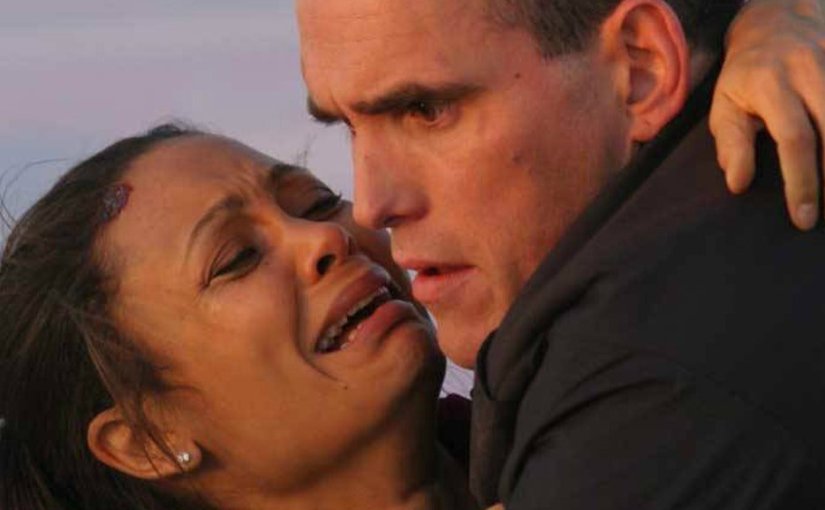
A racist cop (Matt Dillon) will pull over a well to do Muslim man (Terrence Howard) driving a high priced SUV and perform a sobriety test for no reason. Then the cop will deliberately frisk the man’s wife (Thandie Newton) with digital penetration. The next day, it’ll just happen to be that this woman will have no choice but to be rescued from a burning car by this same racist cop. Now I’m supposed to believe that the racist cop is not so bad, and the woman learns to become more tolerant. Well gee, thank heavens for coincidences!

The Muslim man (a television show director) gets car jacked the following day, and in a tense pull over moment he’s mistaken as the criminal. Fortunately, the partner of the racist cop (Ryan Phillipe) is there to subdue the situation. I’m sorry, but life doesn’t work out to be this tidy. Call me cynical, but more often than not we are not given a second chance at first impressions.

One of the real car jackers (Chris “Ludacris” Bridges) gets a moment of clarity and suddenly he’s generously giving out his last forty dollars to a group of Asian people being held in a van for human trafficking. Forgive me. If I want to begin respecting this car jacker who has held multiple people at gun point and even runs over a man, only to toss him out on the drive up to the Emergency Room, I’ll be more apt to do so if the criminal turns himself in.

I dunno. Maybe I’ve got a personal issue with Crash. It could not be more apparently preachy in how it patronizes me to simply understand the seething hate and criminal violations of its characters. I’m supposed to empathize with the racist cop because his ill father can’t get the health care he’s entitled to? I’m supposed to understand the prejudicial anger that the WASP wife (Sandra Bullock) of a District Attorney (Brendan Frasier) expresses because she no longer trusts her dedicated Hispanic housekeeper or the locksmith (Michael Pena) changing the locks on their house following a car jacking?

No. Paul Haggis didn’t earn that response from me in almost all of the short story scenarios his film offers. Maybe it’s because I tend to compartmentalize my episodes. I like to think that I don’t allow one experience with one kind of person cloud my judgement on the next person I encounter. A waiter can totally screw up my order and can even mouth off to me in a heated moment. Yet, I’ll return to the restaurant on another occasion because it’s likely I’ll run into a different waiter.

Haggis depicts people who appear to have a blanket opinion of other people with different backgrounds. These are all extremely prejudiced people with next to no understanding of where each of them stem from. An angry Persian man (Shaun Toub) puts blame on the locksmith after his convenience store is ransacked. The locksmith was only trying to explain that the back door needed to be replaced. The Persian refused to listen because his English is limited. So he just gets angry and curses the locksmith out. Haggis opts to insert a language barrier between the two men to serve up an eventual tense and dramatic moment in a neighborhood driveway with a loaded gun and a little girl. A loaded gun and a little girl! Yup, I think they teach these are the true ingredients for effective drama on the first day of screenwriting class. Again, it all comes about a little too forced.

The conveniences and ironies that bubble up at times are surprising. “Oh that guy is that guy’s brother! I see.” Things like that. However, I don’t think that is necessarily the strength of the picture.

In a film like Magnolia, we are treated to the vignettes of a handful of people too. However, not every single one of those people are sketched by means of their prejudiced natures. They are drawn by a variety of different elements whether it be a traumatic past or an inclination to do good. Then it’s kind of fun to uncover how each player is connected to one another.

In Crash, the players are only connected by the hate they carry within themselves, and Paul Haggis forces a redemption upon most of them with small gestures or a line of dialogue or the purity of a welcome snowfall to close out the film. Sorry, life is lot more messy and complicated than that. I guess I’m saying I may have learned a lot more about human nature from a downpour of frogs than a downpour of snow.