TOOTSIE

By Marc S. Sanders

Tootsie is my favorite comedy of all time.  At age ten I saw it on Christmas Eve with my family and beyond the Star Wars and Rocky films, I had yet to see an audience respond, or more specifically laugh, so uncontrollably for two hours straight.  I might not have recognized all of the innuendo and I was not yet alert to the idea of women feeling belittled while knowing they should be entitled to equal respect, but the performances, especially from Dustin Hoffman were entirely genuine.  Tootsie still remains the only film where I can forget that a man, a not so attractive or sexy man, is convincingly disguising himself as a woman who possesses internal strength and gusto.

Whether directing or acting on screen, Sydney Pollack was not someone well known for overseeing comedy at the time.  Yet, that’s an attribute to the end product of this celebrated movie.  Other than a typical Bill Murray routine in an uncredited role, no one in this picture is waving their hands in the air to insist they’re funny.  The humor of Tootsie bears from true, raw emotion, fear and desperation.  No one is doing Saturday Night Live sketches and building up to the next punchline.  Despite the cross dressing, Tootsie is not even a farce.  A guy gets a job wearing the necessary garb and modifying his verbiage, but only to earn enough money to survive.  However, it also doesn’t help that he’s falling for his co-worker.  

Dustin Hoffman is an actor living in New York City named Michael Dorsey.  He’s a great, learned performer, especially on the stage, who lives with his playwright buddy Jeff (Murray) in a crummy apartment in the meat packing district.  They need to raise enough money to put on Jeff’s play in Syracuse.  

The problem is that Michael can no longer get cast in anything.  Not on stage or even in a commercial.  His agent (Pollack) says it point blank that nobody will hire him.  He’s just too difficult with short bursts of temper and no tolerance for others who work in the field.  

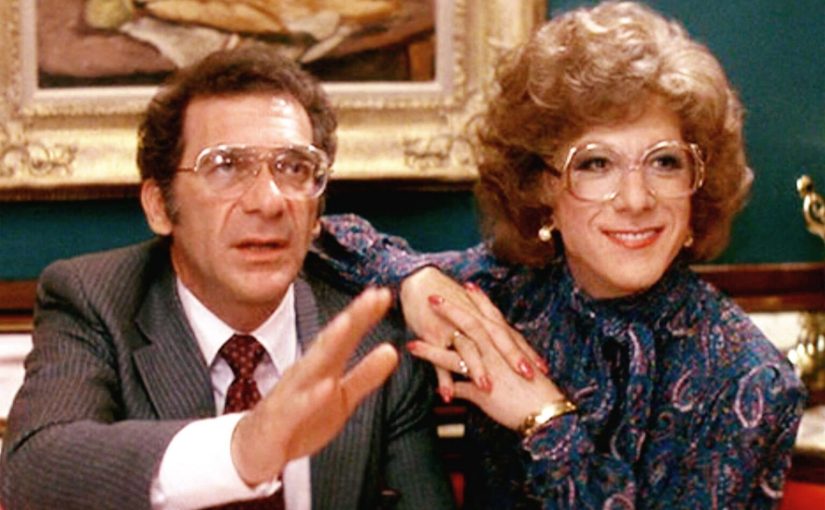
So, Michael surrenders to desperation and puts on the guise of a character actress named Dorothy Michaels.  As quick as she stands up for femininity against a chauvinistic TV director (Dabney Coleman) she is cast on the most watched daytime soap opera.  As long as Michael can perform off and on camera as Dorothy he should be able to earn more than enough money for Jeff’s play.

Complications arise though when he becomes protective of his co-star, Julie (Jessica Lange, in her Oscar winning role), against her unfaithful boyfriend, the TV director.  Julie’s widowed father, Les, is falling for Dorothy though, and then there is Michael’s friend Sandy (Teri Garr) who lost out on the part that he earned, and to keep things maintained has been seduced by Michael into a romantic relationship beyond just their friendship.

With me so far?  I hope so because there’s even more obstacles to overcome.  Tootsie is very economical in its story development, but it’s also a very crowded film.

Don McGuire and Larry Gelbart (TV’s M*A*S*H) wrote this Oscar nominated script with a brilliant collection of characters.  The blessing is while it sounds like farce, Tootsie is never delivered with a slapstick tongue.  In order for the film to work, Dustin Hoffman especially had to portray Michael Dorsey as a guy with natural ticks, motivations and fears.  He accomplishes that because Michael always ensures that Dorothy is as real as she can ever be.  When Dorothy hails a cab or shops for clothes the southern accent must hold while perusing through the city streets in heels.  Michael gets frustrated over what to wear for a dinner visit at Julie’s apartment.  Especially when Julie opens up her heart, Hoffman is precise to make sure Dorothy approaches with a low whispered approach to simply be a consoling girlfriend.  

The comedy arrives when Michael has no other choice but to break this strong powered female persona.  Dorothy will call for a cab but if it just won’t stop, then a deep voiced, bellowing New Yorker will come out of this woman’s mouth with an angry “TAXI!!!”  I like to believe that Sydney Pollack deliberately arranged for Dorothy to yank a Woody Allen lookalike out of a cab that was about to be taken from Dorothy too.  Dustin Hoffman knows Michael Dorsey is such a committed method actor that he has to convince all eight million people in New York he is strong willed Dorothy Michaels – a character actress capable of playing the new Hospital Administrator on Southwest General

There are so many fleshed out pairs of relationships in Tootsie – all going beyond the cross dressing of the film’s main character.  All of these people could get along forever if only for the fact that some characters have befriended a man while others truly believe they have made a connection with a woman.  How long can we have it both ways?  The facade has to undo itself, right?  True.  Thankfully it occurs at the end when every single character can have it explained to them all at once.  I’ve never forgotten the roars of laughter from my mom, dad and grandmother as the end of Tootsie arrived.  Well-placed close-up shots of every actor who had a speaking role in this movie is covered (well except for Sydney Pollack as Michael’s agent). On Christmas Eve in 1982, the packed movie house at the Forum Theater on Route 4 in Paramus NJ only amplified the shocking reactions.  Tootsie is a reason why you sit among a crowd at a movie theater.  

This is Dustin Hoffman’s all-time best performance.  He was nominated against fierce competition from Paul Newman in The Verdict, Jack Lemmon in Missing, and Ben Kingsley in Ghandi (who took home the trophy). Michael Dorsey/Dorothy Michaels is a much more challenging role than what Hoffman superbly accomplished in his two Oscar winning roles (Kramer Vs Kramer, Rain Man).  Robin Williams or Tom Hanks could have played Michael Dorsey who invents Dorothy Michaels.  Yet, what Hoffman emotes are the natural tics of a guy who is constantly broke while he charms an array of women at his birthday party, only with the intention of bedding them and hardly ever listening to what these ladies have to say.  When Hoffman puts Michael literally in a pair of woman’s shoes though, he begins to identify the lack of respect that women endure on a daily basis.  

Watch Dustin Hoffman’s body language.  He becomes angered with his agent upon learning that he lost out on a role which somehow leads to a debate about whether a tomato should walk or talk or sit or stand.  That back and forth is outrageously hilarious.  Having seen Tootsie hundreds of times though, I now appreciate how a schleppy looking Michael hustles across the streets of New York, avoiding traffic and then marches down the hallway to his agent’s office.  Hoffman twitches his head and shrugs his shoulders as if he’s prepping to give the agent a piece of his mind.  Hoffman is so absorbed in this guy he’s playing.  I am not recognizing any other kind of Dustin Hoffman that I’ve seen anywhere else.

Sydney Pollack is also attuned to the cutthroat atmosphere of desperate theater folk trying to survive in this concrete jungle.  Tootsie opens with a montage of quick episodes for Michael.  He is leading a workshop while being candidly ugly with his fellow thespian students about how challenging it is to get work.  In between, are auditions that he goes on where there is one reason after another why he can’t land a role.  Michael Dorsey is an incredibly skillful actor, but that means nothing for this role or that role.

On this most recent viewing I caught on to a detail that never occurred to me.  Bill Murray as Jeff, the broke playwright, is snacking on lemons and wincing while he talks to Michael.  Now I don’t know if this is in the script or if this was Pollack or Murray’s idea.  Nevertheless, it’s a brilliant detail.  These guys are so broke that they have resorted to smuggling lemon slices out of the restaurant they work at to live off of.  Another actor or filmmaker would have used an orange or cookies.  Who snacks on lemons?  Only those with nothing else to rely on.  

Makeup bottles with spirit gum, cannisters of fake blood, prosthetic teeth, props and sloppily hung costume wear are all given focus beyond the broad comedic storylines.  Sydney Pollack pans his camera over all of these items with no actors in frame because he wanted to ensure that being an actor or a playwright in New York is nothing glamorous.  It’s a world of unending torment. All of these nuances and details justify the extremes that Michael has to go through to achieve his goal.  

Jessica Lange never plays her role for laughs.  Her portrayal of Julie, the beautiful, blond celebrity of daytime television, is authentic and she inherits a new girlfriend to confide in. Finally, Julie can share what she values and holds dear.  You can’t not fall in love with someone who only treasures the best parts of her young life and yet only seeks a companion to chat with.  A humble celebrity is hard to find and that is one reason Michael falls hard for her.  Lange is outstanding while being so heartfelt.

Teri Garr’s comedy stems from the insecurities of actors.  Sandy is described as someone who wants to commit suicide at a birthday party.  Doing community theater for over thirty years I know precisely who this person is.  I’ve been this person, and I’ve encountered hundreds of these people.  It’s hard to be a big fish in the small pond of community theater.  Imagine trying to hold on to your sanity when you have to compete with all of New York.  Teri Garr was rightly Oscar nominated for what could have been a throwaway part. Like Hoffman she also has these little gestures that suggest her lack of confidence. After she sleeps with Michael and he’s getting ready to leave, Garr peaks at her naked chest hidden underneath the sheets.  It’s as if she’s wondering was I not attractive enough.  She’s hurting. No matter if she just had sex with one of her favorite people, she is still suffering.

Charles Durning is familiar for having the tough guy, intimidating persona because he’s usually so much larger than life.  However, he offers a sweetness to this guy who’s ready for companionship.  You don’t want Michael or Dorothy to let him down.  Les doesn’t deserve to get hurt.

Again, as I described any of these characterizations, none of it is funny.  They are wrapped in sensitivity. There’s a lonely sadness to people like Michael, Jeff, Julie, Sandy and Les.  Yet, when this variety of sorrow and anguish collide, while poor Michael is only trying to make some money, does it all combust in hilariously, unwinnable scenarios of tremendous proportions.

Tootsie is an amazing film.  It is one of the smartest, most insightful scripts ever written and it is blessed with a cast and director who mastered how to live in an unforgiving and unsympathetic industry.  This picture offers lessons in the human spirit while demonstrating the lengths and boundaries that must be broken in order to survive.  By practically not performing as a comedy, it only becomes that much more funnier and wiser.  

Tootsie is a perfect film!

THE CONVERSATION

By Marc S. Sanders

To watch Francis Ford Coppola’s The Conversation from 1974 is to feel the paranoia of what Harry Caul, the protagonist played by Gene Hackman, endlessly feels as a surveillance expert. Harry is so skillful at his job and yet so modest, that he only believes someone may actually be better. Even he doesn’t believe he’s that good. Still, his own expertise can drive him to insanity.

Coppola opens the picture on a wide lens that gradually zooms in, looking down on a sunny afternoon in a crowded park. There are musicians and mimes. Bums that sleep on a park bench and food vendors, and then there is a couple (Cindy Williams, Frederic Forrest) who we are drawn to to get some sound bites of their random conversation. Their voices are muffled at times. Feedback and background noise interferes as well. Harry is spotted trying to keep within a perimeter to allow his hardware to function and get every tidbit of the conversation.

Following this sequence, Harry is back at his fenced in warehouse operation that he shares with a loudmouth partner named Stan (John Cazale) attempting to clean up the recording for his client, only known as The Director. It’s a skill that only Harry has the means to do. Hackman plays the part as a quiet and reserved man, unlike his competitors who proudly boast of their next, great invention to eavesdrop and capture the actions and discussions of any subject. With an awareness of what he’s capable of, I’d argue he trusts no one, even when he’s being praised. Does he even trust Stan, who he works with?

To be good at this kind of work requires the ability to separate yourself from the content of what you’re listening to. Just get an audible recording and move on. The content should be for someone else to stew over. For Harry, this becomes a challenge. He uncovers a hint in the couple’s exchange that suggests perhaps their lives are in danger. When he goes to drop off the recordings and collect his fee, he is not met by The Director. Instead, he comes across a lackey (Harrison Ford) who insists that he was instructed by the client to make the exchange. His paranoia sets in, when the lackey keeps on appearing at random, unexpected moments with Harry. None of it feels right for Harry. So he violates what should be his own rules and investigates further. The risk is whether his own capabilities will undo his sense of humanity and decency, including his connection with God.

Coppola, who also wrote the script for his film, puts Harry to the test in nearly every scene. He writes Harry to be the best at what he does, and yet that doesn’t prevent failure from occurring. He even fails to recognize when he’s being victimized and listened to. A midway point features a party among the men who specialize in surveillance. Harry quietly flirts with a girl only to feel embarrassed when his East Coast competitor reveals that he recorded their conversation from across the room. Seems like a harmless prank, as sophomoric as playground or locker room teasing, but it’s enough to maybe drive Harry into madness.

Harry Caul is one of Gene Hackman’s best roles. It stands apart from other films he’s been in. Harry is very much a three dimensional character who values his religious connection and his sense of morality. The problem is that Harry is a specialist in something that’s really not very moral or ethical. His Catholic beliefs might suggest what he does is sinful. Sure, he goes to confession, but he still pursues actions that are deemed inappropriate in the eyes of God.

Francis Ford Coppola depicts a very telling moment as Harry tries to find a listening device in his apartment. He takes apart everything in the place by either breaking it or unscrewing it. What do you think he’ll do when he comes upon his figurine of the Virgin Mary? Is there anything left to trust? Anything of value or purity in Harry’s world? He doesn’t trust others. He doesn’t trust himself? Does he trust a higher power that he’s leaned on his entire life?

Because The Conversation does not delve too much into the now dated-very dated– technology from the early 1970s, it is a film that is especially relevant in today’s age of cell phone recordings and devices that are relied upon for everyday use. While Harry is possibly thinking he’s on a noble pursuit with his means to eavesdrop, either by servicing a client or even rescuing someone from what appears to be imminent danger, is this the right way to go about it? What will it cost Harry? As well, what does it cost our society to embark on the convenience of what we are now capable of? Does the ability to record someone’s actions contain absolute merit, or are we violating a civil mentality within ourselves and among our fellow human beings?

There’s a lot of hard questions to answer in The Conversation. I think that’s why especially now it’s an important picture to see.

THE BLACK STALLION (1979)

by Miguel E. Rodriguez

Director: Carroll Ballard
Cast: Kelly Reno, Mickey Rooney, Teri Garr, Clarence Muse, Hoyt Axton
My Rating: 8/10
Rotten Tomatometer: 90% Fresh
Everybody’s a Critic Category: “Watch a Film Starring Animals”

PLOT: After being shipwrecked off the coast of Africa in the 1940s, a boy bonds with a magnificent Arabian stallion and trains him to race after their rescue.


Horses are great, but they are not my favorite animals.  That honor goes to the great white shark.  (They fear nothing; the only things they are even cautious around are larger great whites…but I digress.)  I always hear and read about how magnificent and majestic and spiritual horses are.  I have never denied their intelligence, but I never jumped on the bandwagon with folks who believe they are angels on four legs.  And I’ve never really gotten into horse racing, at least not on an ongoing basis.

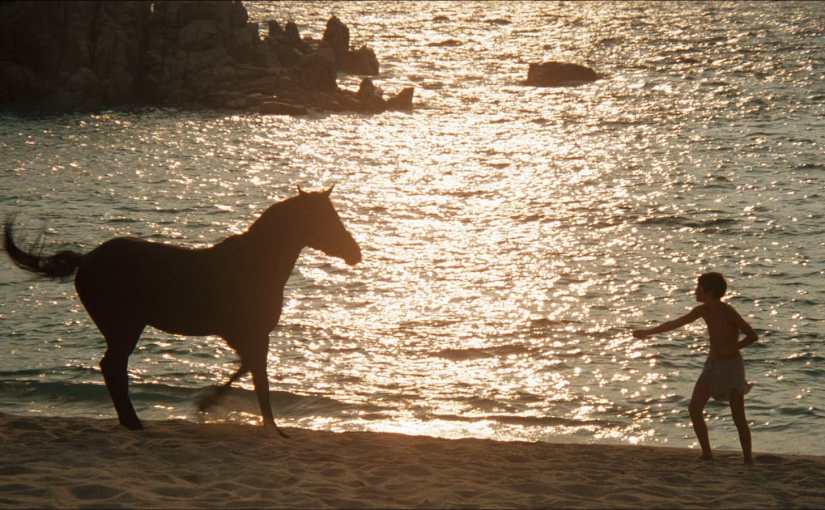
But there is one movie that combines the mystique of horses and horse racing with poetry, grace, and true art.  Carroll Ballard’s The Black Stallion is one of the most beautiful films ever made.  The visuals are so good and well-edited that fully 28 minutes of the movie are presented with zero lines of dialogue spoken.  After a fearsome shipwreck, Alec Ramsay (Kelly Reno) finds himself stranded on a desert island along with a magnificent unnamed black stallion whom he later simply calls the Black.  During this shipwrecked portion of the movie, all dialogue is dropped, and we simply watch as Alec and the Black overcome their initial fear of each other and bond.

It is in these scenes that The Black Stallion truly shines.  There is one particular sequence that will stick in my memory forever.  After some days and weeks alone, Alec tries to get the Black to eat food directly out of his hand.  In a nearly unbroken take, we watch as the Black warily approaches Alec, then turns away, snorting and stomping, then turns back, taking one cautious step after another, getting closer and closer…and it all looks completely organic.  It’s one of the greatest acting performances by any animal in any film I’ve ever seen.  In that scene, the Black exhibits more proficiency at acting on camera than I’ve seen in a few human actors I could name.

When I first saw this movie at 8 years old, I couldn’t fully appreciate the ingenuity of this portion of the film.  All I cared about was how invested I was in seeing Alec bond with the Black.  I didn’t care about cinematic theory and editorial processes and visionary cinematography.  But it’s all there in full view, presenting a visual story clearly and cleanly.  Buster Keaton would have loved this movie, I think.  (At least, the silent portions, I would imagine.)

The Black Stallion piles on one visually exhilarating scene after another involving Alec gradually gaining enough trust from the stallion to the point the Black allows Alec to ride him.  And then they are both rescued and returned home to America, and it’s here the movie seems to stumble just a bit.  After the grand vistas of their desert refuge, the white picket fences and tree-lined avenues of 1940s suburbia is a tad underwhelming.  When the Black gets spooked by garbagemen and runs off, we do get a nice contrast of seeing this semi-mythical creature of a bygone age galloping past storefronts and hurdling fruit crates.

Alec chases the Black and eventually finds him in a seemingly deserted barn owned by one Henry Dailey, an ex-jockey played to utter perfection by Mickey Rooney.  To say Rooney’s performance in The Black Stallion is “natural” is an understatement.  And to older audience members familiar with Rooney’s performance as a jockey in the 1944 film National Velvet, this must have been like seeing the remaining members of the Ghostbusters reunite in Ghostbusters: Afterlife (2021).  When he trains Alec how to ride the Black, you get this incredible sense of a man tapping a massive reservoir of knowledge for the benefit of the next generation.  I don’t know if I’m accurately describing this facet of Rooney’s performance, but if you watch the movie, you’ll see what I mean.

As do so many other movies featuring horses (not all, but many), The Black Stallion culminates with a horse race, this one pitting the Black against the two fastest horses in the country.  As we are fed information about how and why this race comes about, I particularly noticed how one phrase was repeated at least twice: “They’ll never let him run…he doesn’t have any papers.”  No doubt there are horse enthusiasts who know what that means.  I haven’t the foggiest clue what they’re talking about, but the cool thing is…it doesn’t matter.  It doesn’t matter now, and it certainly didn’t matter when I saw it as a kid.  It’s enough to know that “papers” are something other horses have, but the Black doesn’t, and that seems pretty important to some people, no matter how fast he runs.  It’s just another way The Black Stallion is constructed to appeal to audiences of all stripes, be they equestrian aficionados or rank amateurs.  There are not a lot of films that can do that, and I don’t know if The Black Stallion gets recognized enough for that accomplishment.

The climactic horse race ends exactly how you would expect it to end.  Formulaic?  Of course.  But what a race!  The cinematography, editing, Oscar-winning sound design, and carefully restrained use of the musical score all combine to create a moment every bit as thrilling as any NASCAR race.  Even now, watching the movie for this review, I fell into the moment all over again, smiling with delight as Alec and the Black pound their way around the track, hooves thundering on the dirt, pumping my fists when Alec discards that pesky helmet and goggles, and those other horses ahead of them get closer and closer…

Any lover of horses owes it to themselves to find and watch The Black Stallion.  Kids will get a kick out of it, but adults will, too, perhaps on another, more nostalgic level.  (That could just be me projecting based on my own childhood memories, but I stand by it.)


QUESTIONS FROM EVERYONE’S A CRITIC

  1. Which character were you most able to identify with?  In what way?
    Well, for me, there’s no question I identify with Alec.  I still remember how I felt watching this movie for the first time.  I mean, I didn’t necessarily want to BE Alec, but he was my entry into the world of the movie.  I knew how he felt when he was trying to convince his mother to let him ride in a race.  I knew what he must have felt at the very beginning of the movie when his curiosity about the Black overcame his very real fear of such a powerful animal.  And I thrilled when he raised his hands in triumph during the horse race.  (Kind of an easy answer, to be honest, but…there you go.
  2. If you were to make a movie starring animals, what animals would you choose, and why?
    …well, as I mentioned before, great white sharks are my favorite animals, but they are notoriously difficulty to film, as shark cinematographer “Three-Fingers” Joe will tell you.  I’d have to go with dogs.  Much easier to train, plus every day they see you arrive on set, they’ll treat you like they thought you’d be gone forever.  My film would be a comedy/sci-fi story involving a cat’s brain being transplanted into a dog’s body.  Maybe get Paul Rudd to do the voice of the dog.  …it’s a work in progress.

CLOSE ENCOUNTERS OF THE THIRD KIND

By Marc S. Sanders

Close Encounter of the First Kind – Sighting of a UFO.

Close Encounter of the Second Kind – Physical Evidence.

Close Encounter of the Third Kind – Contact.

Music is the most universal of all languages.  Steven Spielberg’s Close Encounters Of The Third Kind demonstrates that claim. 

I appreciate how Spielberg’s script, along with his direction, opens the film.  It takes place during a sun swept sandstorm in New Mexico.  At first, hardly anything but sand blowing can be seen, along with the high volume of wind breezing about inconveniently.  You are not even sure what you are looking at.  Then, headlights from a vehicle appear and a group of men assemble.  We come to find the main character of this scene is a French scientist named Lacombe (Francois Truffaut).  He only speaks French and hardly understands any English.  He is in need of an interpreter (Bob Balaban) to translate to American men who are accompanying them.  After we’ve established French and English are in the fold, we then realize that Spanish must enter the conversation amidst the overwhelming winds from the blinding storm.  An occurrence must have happened here recently, because Lacombe and crew interview some of the locals who are trying their best to define what took place the night before.  An elderly man is mysteriously sunburned on only one side of his face.  Thereafter, a grouping of bi-planes last seen flying over the Bermuda Triangle nearly forty years earlier come into focus.  No matter how you learn, communicate or understand, the confusion depicted is a perfect match for each of the men occupying this space.

A parallel story begins after this opening in the state of Indiana.  Sightings by airline pilots, as well as residents, are discovered in the skies above.  Blackouts occur everywhere.  The experiences of two residents, a young boy named Barry, and a utility worker named Roy Neary (Richard Dreyfuss), are who Spielberg uses to guide us through these strange episodes of phenomena.  They are being drawn towards a calling or an image and they become entirely focused upon what has happened to them.  Barry’s mother, Jillian (Melinda Dillon), while trying to reign her son back home has also been delivered a message from unusual spectacles in the skies. 

Soon after, these people cannot help but focus on a shape that they know they’ve seen before but can not place it.  Roy sculpts the shape in his shaving cream and his mashed potatoes.  He becomes neglectful of his work, his three children and his wife, Ronnie (Teri Garr), who refuses to take him seriously.  Barry’s young age allows him to avoid understanding the meaning of any this.  So, when the blinding “lights,” of whatever these entities could be, come towards his home in the middle of the night, he happily welcomes them, and willingly accompanies them back to wherever they came from.

I know this science fiction film is a highly regarded classic.  It’s earned the right to be considered as such, and so many have seen it.  Yet, I also know that I appear vague in my description of the film here.  I choose not to expound on everything going on in Close Encounters…  Steven Spielberg would want it that way, and I hate spoiling any movie.  A movie not seen is new to any of us. 

The residents of Indiana insist to higher governmental and military authorities that they have witnessed unidentified flying objects.  What those UFOs are, or where they came from, or why they visited their home state is unexplainable.  Spielberg intentionally avoids definitively explaining what’s occurred.  After all, if aliens are visiting our planet Earth, then who’s really to say we understand what they want or why they’ve come here?  Like the rest of the countries of the world, it’s fair to say that inhabitants of another planet in our galaxy would likely have their own way of communicating or speaking that’s entirely different from English, or French, or Spanish.

Spielberg goes even further to distance any understanding among ourselves or with these new entities that we are encountering.  A cargo sea vessel appears out of nowhere in the most unlikely place, the Gobi Desert of Mongolia.  Why?  How?  The people of a village within the continent of India are harmonizing a tune over and over again, in unison.  Lacombe along with his interpreter, and their American crew, attempt to decipher why these episodes have occurred as well.  The harmony must mean something.  What’s the message?  The world must learn to communicate with one another if they are to understand why these strange happenings continue.

Once Spielberg introduces the Indian village’s response to their experience, oddly enough Barry becomes obsessed with the tune as well.  Lacombe believes he’s recognized the tune as a means to speak with the visiting entities.  Again though, what is the message within the song?  In addition, Roy and Jillian are beginning to understand their obsession of the shape.  “This means something.  This is important.”  The script for Close Encounters… does not take for granted the repetitive significance of this line.  It is uttered a few times at different moments, by both Roy and Lacombe.

Close Encounters Of The Third Kind functions as a riddle, and yet it all makes sense in a breathtaking ending that occupies the last 30-40 minutes of the picture.   I hope there will be readers of this column who have yet to see this film.  It is better to go into it by knowing as little as possible.  Only then can you truly experience the maternal frustration that Jillian has for her young son’s insistence on going towards the lights, or Roy’s obsession with what dwells in his mind following his encounter.  With knowing as little as possible, can you become all the more curious at Lacombe’s pursuit.  When Spielberg gradually pulls the curtain away, it is such a satisfying relief and a feeling of fulfillment to have taken the journey with these characters. 

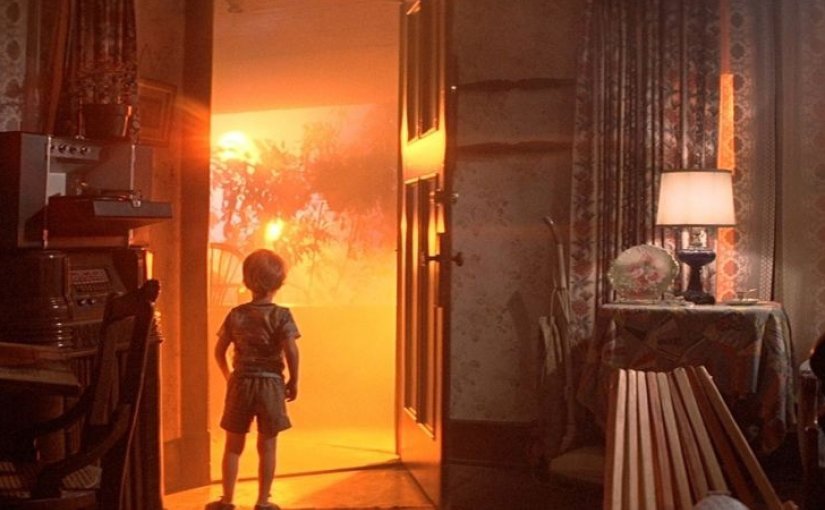
The construction of Spielberg’s first of many sci-fi films is magnificent.  It performs as if it is operating with real world science and language.  Yet, I have to draw attention to a scene that arrives in the middle of the picture.  Barry’s innocent, but youthful obsession, is tested within the home, beside Jillian’s fear.  Spielberg uses every prop and device available within the set of this scene.  Battery operated toys come alive.  The record player goes off.  The stove turns on. The dishwasher opens and closes. Blinding lights bleed through the curtains, chimney and keyholes.  The echoing sounds become overpowering.  What’s come to the house can’t be explained.  However, one person is thrilled by it while another is terrified.  It is such a well edited scene of terror at the unknown, that for me still remains as one of the most suspenseful moments in film history.  Steven Spielberg is bringing life to a “boogie man.”  When I showed my daughter this picture during a re-release in a Dolby movie theatre, I held her 11-year-old self in my lap concerned she’d become frightened of the scene.  It’s as thrilling as going on an unpredictable roller coaster for the first time.  The scene occurs out of nowhere, with no convenience of foreshadowing.  Once again, as he did with Jaws and somewhat implied with Duel, Steven Spielberg does not show you the terror or the invasive entity.  He allows the viewer’s subconscious to draw its own conclusion.  This is master craftsmanship.

Close Encounters Of The Third Kind remains as one of the best science fiction films of all time.  Nearly forty years later, despite its fiction, it still feels like it’s real.  It all feels like it means something.  It still feels like its important. 

AFTER HOURS

By Marc S. Sanders

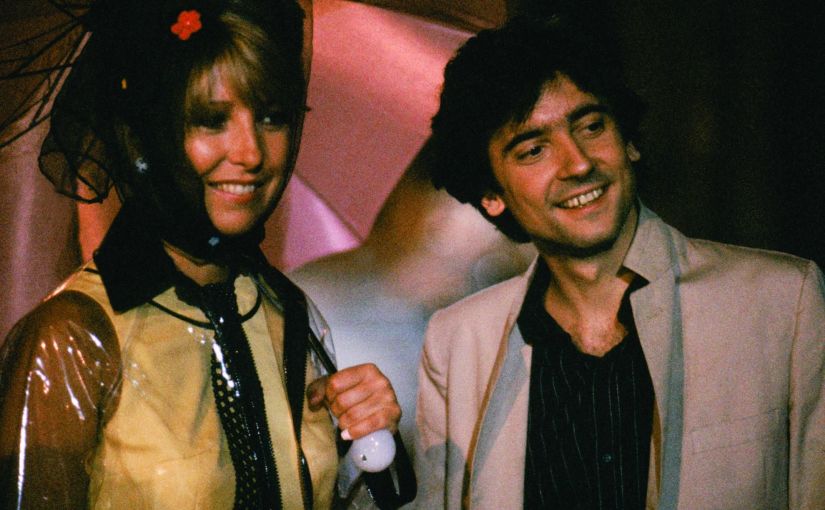
If L. Frank Baum’s classic fantasy The Wizard Of Oz were adapted in a setting of say 1985 New York City in the So Ho section, beginning sometime after 11:30 at night, then it would be a fair argument to change the name of his story to After Hours.  The story would no longer be whimsical. Instead, it would be screwball, with a disturbingly demented narrative from the brilliant but unsettling camera work of Martin Scorsese.  The protagonist would be a lonely yuppie named Paul (Griffin Dunne) who encounters one odd woman after another when all he intended to do was meet up with a kind and attractive young lady named Marcy (Rosanna Arquette) who offered the opportunity of obtaining one of her roommate’s specialty crafts of Parisian bagel & lox paperweights.  (Yes.  You read that description correctly.  Don’t overthink it.)  Unlike Dorothy from Kansas though, the oddballs that Paul meets up with become challenging to him even if they insist on welcoming him into their arms.  These women are not the comfort conveniences of a scarecrow, tin man or lovable lion.

How odd that this film from Scorsese would follow his masterpieces, Raging Bull and Taxi Driver; a major departure from themes of mental disturbance exhibited by characters like Jake LaMotta and Travis Bickle.  Here, the disturbance hinges on paranoia that eventually develops; not seeded in place at the start.  The film relies on absurd situations where Paul inadvertently gets in over his head when all he wants to do is return home and sleep. It quickly dawns upon Paul that it is likely not a good idea to go out after hours when a whole other kind of community is awake, that is uncustomary to his lifestyle.  I was waiting for the film, written by Joseph Minion, to tell me it’s all a dream.  My foolhardy mistake though.  Scorsese would never resort to such a tired, cliché.  If he is going to direct a film of the utmost ridiculous, then he’ll make certain Paul’s unfortunate outcomes are believable…even if they are hard to be believed.

If you’ve seen at least three of Scorsese’s films prior to After Hours, you’ll likely just fall in love with this picture based on his craft with the camera partnered with his always trusty editor, Thelma Schoonmaker.  Cinematographer Michael Ballhaus has his first collaboration here with Scorsese (before Goodfellas and Casino).  Conversations in offices or diners or apartments or bars occur, only they are more exciting than countless other exchanges of dialogue. You will be watching a film that does not sit still and always strives for your attention.  So, while Arquette’s character describes an ex-boyfriend’s obsession with the film adaptation of Oz, your director at play startlingly zooms in on her performance monologue and then circles back to Dunne, her listener on the other side of the table.  No standard quick cuts.  The camera circles and surrounds the players.  A set of keys dropped from a balcony straight down directly towards Dunne’s waiting face below gives an eye opening zoom thanks to Ballhaus’ techniques.

The developments that quickly fall upon Paul are not fair for him.  He loses his only twenty bill that he can rely on, gets caught in torrential downpours of rain, uncovers a suicide, becomes trapped in a punk rock club that wants to give him a tortuous mohawk, and a modern-day pitchfork mob equipped with flashlights and an ice cream truck are hungry for his head because they believe he’s a serial neighborhood burglar.  The poor guy can’t even make a phone call because a ditzy Catherine O’Hara revels in breaking his concentration to remember a phone number.  Teri Garr also appears with a bee hive hairdo as a waitress at an all-night gay diner vying for attention that Paul just can’t afford to give at three o’clock in the morning.  Paul just wants some basic help from anyone who can offer a simple gesture. None of it is that simple however, and the problems build upon one another until they are compounded upon his shoulders so much so that at one point, he literally cannot move out of the physical circumstance he ends up in.  Forgive my vagueness, but I wouldn’t dare spoil what that literally means.  You owe it to yourself to watch the film and find out for yourself.  My first instinct was to go “Come on!!!  Really!!!” Yet, then I remembered this is a film of daring escapes.  Still, Minion’s script and Scorsese’s film turn those breathless escapes into deeper depths of a So Ho hell, as the film proceeds to its inevitable sunrise.

After Hours might have been a subpar John Hughes comedy, only vaguely remembered from the decade of excess, the 1980s.  In Martin Scorsese’s hands though, it’s comedy pathos and yet frightening at times.  Only Scorsese can show us funny, yet bleak.  That’s okay.  It’s different.  I’ve seen the standard slapstick unfortunate circumstances of School Principal Ed Rooney in Ferris Bueller’s Day Off, and countless copycats thereafter.  Scorsese offers up a different, inventive, and very twisted approach for a typical victim of circumstances beyond his control.  

My recommendation for a double feature:  watch Neil Simon’s The Out Of Towners with Jack Lemmon and Sandy Dennis.  Then watch After Hours.  You may begin to understand how New York City can be a vicious and unforgiving beast with enough chutzpah to attack you, even if you never deserved any kind of punishment.  If you’ve ever found yourself in any kind of metropolitan city throughout North America, you’ll likely nod your head at what this poor guy encounters, and you might not feel so singled out.