SOAPDISH

By Marc S. Sanders

To get inside the head of a character on a soap opera would best be portrayed by someone who’s literally living a soap opera off the set.  That’s the paramount theme of every member of the cast and crew of the daytime drama The Sun Also Sets.  Everyone is living through their own checkered background from the lead actress to the returning actor to the homeless deaf/mute extra on down to the trampy nurse and the buxom doctor on the show. By default, the program’s head writer and the producer fall into this category as well. 

The hilarity found in Soapdish gave me remembrances of classic films like All About Eve and Sunset Blvd. Ego and stardom are treasured commodities above all else and an actress’s greatest fear is being aged out of fandom and replaced by the new girl in town. 

Celeste Talbert (Sally Field) is a star actress with dozens of career awards but an insecurity with becoming past her prime. A diva concern is that the stories written for her are not worthy of her importance to the show.  David (Robert Downey Jr) is the young producer feeling the pressure to come up with something to boost the ratings before his boss, the always naturally funny Garry Marshall, replaces the program with game shows.  On David’s side for her own ulterior motives is Montana Moorehead (Cathy Moriarty) who plays the resident nurse and is ready to take the reins from Celeste and make the show her own.  She’ll seductively manipulate David into getting things to work out her way. 

In the meantime, Lori Craven (Elisabeth Shue) sneaks onto the set seeking an opportunity by way of Aunt Celeste.  Best she can get is to portray a deaf/mute homeless woman extra.  Head writer Rose (Whoopi Goldberg) has devised a new plot where Celeste’s character will be tried for murdering Lori’s homeless mute character.  Lastly, at least through the first thirty minutes of the film, Jeffrey Anderson’s (Kevin Kline) character who died on the show twenty years prior by an unfortunate beheading is recruited out of dinner theater by David to return to the program.  Both Lori and Jeffrey’s unexpected arrivals do not sit well with Celeste.

Following along okay, so far? Well…

SECRETS ABOUND on Soapdish!

This film was developed by the powers who delivered Steel Magnolias to the big screen a few years prior.  The original playwright and screenwriter, Robert Harling, teamed up with Andrew Bergman, to satirize the weepy material that daytime drama promises and which he embraced seriously with his beloved play.  The director of Magnolias, Herbert Ross, also serves as an executive producer on this film.  To add some extra authentic spice, Aaron Spelling is producer.  That’s right.  The guy who produced Dynasty, 90210 and Melrose Place.  Michael Hoffman directs. 

The look of this film is so odd and has a garish blood coated red appearance to the television studio where the show within the movie is set, as well as to the offices that hover above.  The set designer for the film, Eugenio Zanetti was inspired by Dante’s Inferno.  Makes sense really because no one is ever satisfied with how The Sun Also Sets develops from one atrociously delicious storyline to the next, and how it makes them look in the public eye.  Zanetti is quoted as saying the offices of the producers and writers hover above the set for the soap opera.  So, it looks as if the powers that be are staring down into the depths of hell that the cast and crew must work and reside in.  While it looks odd, after having seen the film, I can’t help but believe Zanetti makes sense.

There are moments here that are outright hilarious.  As a community theater actor and director, I can totally relate to Kline’s character being stuck in a retirement community steak/playhouse performing as Willie Loman in Death Of A Salesman while elderly patrons call for their waiters.  Poor Jeffrey also has to project that much louder for the old folks to hear him.  This scene stands as gold on its own. A whole farcical film could be developed on this side story alone. 

Soapdish does lose some of its comedic appeal before it reaches the middle of the picture when secrets are uncovered related to Celeste, Jeffrey, Lori and so on.  Sally Field goes for great physical comedy that lands perfectly with the skeletons that Celeste pulls out of the closet.  Kevin Kline makes for a hysterical arguing scene partner, and the craziness just gets bigger from there. 

Whoopi Goldberg is also very funny as the one with common sense and brains behind her character.  For once, she’s not going for the female Eddie Murphy equivalent.  I’m with Rose when she vents to David about how she’s supposed to write a believable return from the dead of a character who was killed when he lost his head.  Maybe a brain transplant?

Cathy Moriarty does a fine job of being the conniving seductress.  She’s a full-bodied intimidator of teased, frizzy blond hair and a buxom nurse’s uniform costume against Robert Downey, Jr.’s nervous preppy producer.

There’s satisfying moments for cameos from Carrie Fisher as a casting director as well as Teri Hatcher and Costas Mandylor as bubbleheaded supporting characters.  However, the best scene stealer is Garry Marshall. I don’t think a single line he’s given would be as funny if he was not providing them.  He’s just got that Neil Simon kind of delivery as the studio boss.  “The nurse is in the restaurant?  Was there a meeting I missed?”

Other than a few F bombs, I think Soapdish works as movie the whole family could watch the next time they are snowed in or hunkering down from a blizzard or hurricane.  Soap operas are designed for escape and the outrageous comedy of Michael Hoffman’s film reaches into outrageous areas that work with surprise and big laughs. 

This nonpaid critic, who endures his loving wife’s adoration for General Hospital each night before bed, is at least a fan of The Sun Also Sets and Death Of A Salesman dinner theater. 
SMOKEY & THE BANDIT

By Marc S. Sanders

Does a comedy get much better than Smokey & The Bandit?

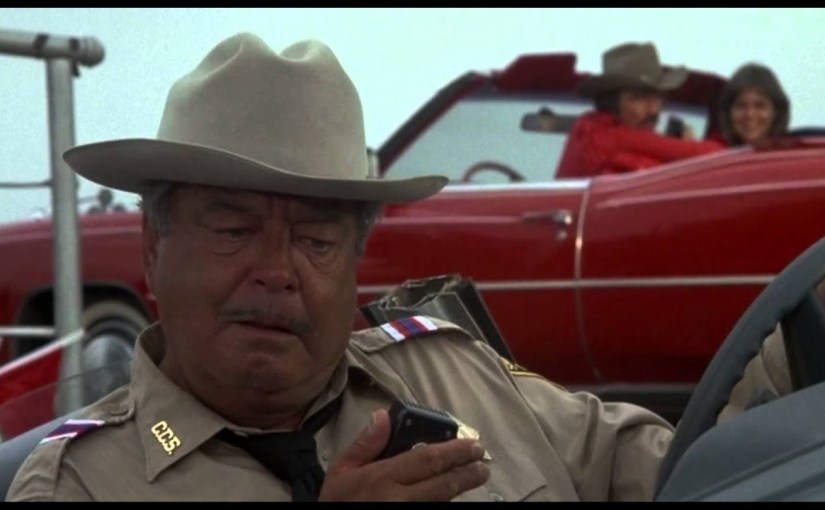
Stuntman Hal Needham re-energized the car chase comedy with this classic from 1977 featuring foul mouthed Jackie Gleason as Sheriff Buford T Justice of Portague County, Texas pursuing the charismatic, cocky and lovable Bandit played brilliantly by Burt Reynolds. It still holds up as a hilarious film.

Big Enos and Little Enos Burdette (Pat McCormick, Paul Williams), in matching cowboy hats and suits, challenge The Bandit to bootleg 400 cases of Coors beer from Texas back to Georgia in 28 hours; that’s 1800 miles total. They’ll pay him $80,000 to do it. Bandit recruits his best pal, The Snowman (the terrific Jerry Reed who also sings memorably on the soundtrack), to drive the truck hauling the manifests while he pilots the black Trans Am at 110 mph, distracting law enforcement away from the truck. On the way back from Texas, Bandit picks up a hitchhiking bride (an adorable Sally Field as Carrie soon to have the handle of “Frog”), who has fled from her wedding to Sheriff Justice’s son, Junior (a great dim-witted Mike Henry).

That’s all there is to it!

From there, it’s just one pursuit after another with the Trans Am doing ungodly stunts like jumping bridges and dodging roadblocks from state to state, while keeping Smokey Bear Sheriff Justice off his tail. A great on-going slapstick gag is seeing the excessive damage piled on to the Sheriff’s squad car. He loses the roof, the driver’s side door, the muffler and so on. The car keeps up with The Bandit, though, and Sheriff Justice never loses his hat.

This film doesn’t belong to any one member of the cast. Collectively it belongs to all of them. Every character is memorably quoted and given great comedic moments to laugh at over and over again. Even The Snowman’s basset hound, Fred has his share of laughs.

It’s impressive to think how influential this film actually became. The black Trans Am with the gold eagle spread across the hood, became a classic car much like any James Bond vehicle. The hit series The Dukes Of Hazzard made its debut shortly thereafter, and stole much of this film’s themes and gags. Tons of crash ‘em up stunt filled chase comedies attempted to duplicate the success of this film in the late ‘70s and early ‘80s, including further team ups of Needham, Reynolds, Reed and Field (Hooper, The Cannonball Run).

Hal Needham, with his cast and crew, really touched on something special with Smokey & The Bandit. As one of the first films I ever saw in theatres, it’ll always remain as a favorite movie going experience that I shared with my brother and babysitter, Mrs. Garcia. Along with late night viewings of the classic 39 episodes of The Honeymooners, Jackie Gleason will always stay on top as one of my favorite funny men. I’ll still watch and happily quote this picture endlessly for years to come.

“Now lemme have a diablo sandwich and a Dr. Pepper and make it fast. I’m in a g-ddam hurry!”

FORREST GUMP

By Marc S. Sanders

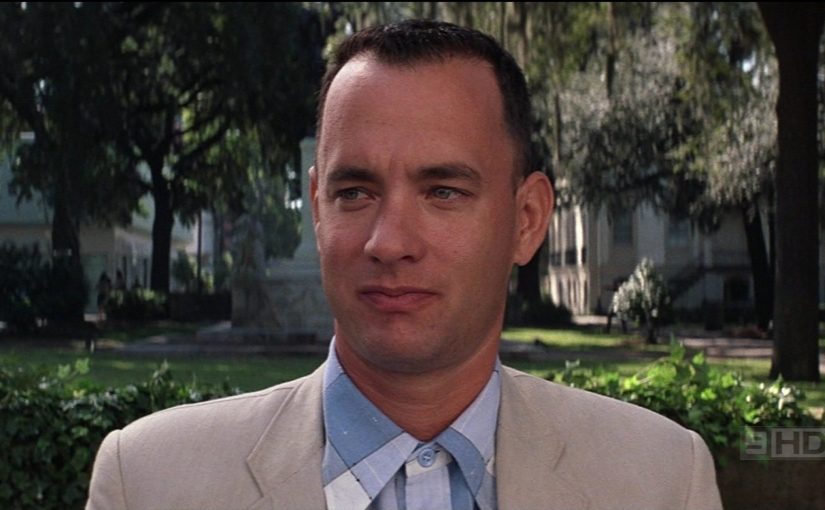
There’s not much that I can say to further praise the merits of Robert Zemekis’ Forrest Gump. It’s a film of legend though it’s a sore spot for die-hard fans of Pulp Fiction, which competed for Best Picture in 1994. Guess which film won. Tom Hanks won the Oscar for the second year in a row, following his outstanding turn in Jonathan Demme’s Philadelphia. Zemekis won Best Director. Eric Roth’s screenplay won as well.

What holds a lasting impression for me about Forrest Gump is the sweeping travel through time of a man with limited intelligence but unlimited willingness to explore and participate, whether it be as a Ping Pong Champion, a Medal of Honor recipient for heroism during the Vietnam War, a millionaire entrepreneur of a shrimping boat business, or a man who just felt like running from one corner to the next of the North American continent. Forrest Gump never knew to compromise a belief he had, probably because he was never aware of the capability to compromise in the first place.

An interesting theme occurs throughout Roth’s screenplay (adapted from the novel by Winston Groom). The people that Forrest encounters are always shouting their ideals and agendas. Yet no one seems to listen. Not just Forrest though. No one at all listens to each other. Lieutenant Dan (Oscar nominee, Gary Sinese) shouts for an immediate evacuation of a hostile territory under attack and no one on the other end of the line, appears to be listening to him. He orders Gump to leave him there, but Forrest does not listen. Forrest only focuses on rescuing his friends, Lt. Dan and Bubba (Mykelti Williamson). What exactly were Americans like the Hippie movements, the War Veterans, the Black Panther party, even the men in the burlesque nightclubs, as well as the various assassinations attempting to accomplish really? Did they accomplish anything? Did any of these parties make an impactful change, or did they just like to hear themselves talk? Did they just want the recognition for only themselves and no one else? When Forrest meets up with his love Jenny (Robin Wright), in a gorgeous caption in front of the Washington Monument (often shown during Oscar film compilations), he has just shared his thoughts over a loudspeaker, unaware that not one of the thousands of war protestors could hear him because the microphone had been unplugged. Later that day, a Black Panther participant only cares to wave his finger and shout his agenda in Forrest’s face. Is Forrest interested? Is he even listening? Is the Jenny, the hippie and her protestor boyfriend listening? Like many Americans, Forrest was only concerned with what was most important to him; Jenny. When Forrest develops a following during his cross country run, everyone is looking for his purpose and his message, and Forrest is unaware that he needed to offer one. Americans are always looking for the next best following. When Forrest passes the Grand Canyon and stops running, the parade of lost souls behind him shouts, “Now what are we supposed to do?” Forrest doesn’t listen. He just walks away and declares he’s tired. America during the mid twentieth century was lost. Forrest was not. Forrest just went in the direction in front of him.

Zemekis pulls an interesting trick of contrasting Forrest against other regulars. The nurse who sits on the bench next to Forrest is more interested in reading a mundane two dimensional issue of “People Magazine.” A man listening to Forrest’s tale of rescue in Vietnam was only concerned with the bullet that struck Forrest in the butt, not the men he saved or the loss of his dear friend Bubba. The old codgers who hang around the local barber shop in Greenbough, Alabama just watch the exploits of Forrest as the years go by. Their hair gets grayer and their skin gets more wrinkled, and life just passes them by while Forrest passes life by. It’s a subtle, yet effective, device that I appreciate on repeat viewings.

Sally Field contributes to the disregard Forrest has for menial issues. If Forrest is going to be denied going to a regular school because his intelligence level falls a few points below average, she will make certain that does not interfere even if it means pleasuring the principal. Mama Gump has the wit and intelligence. Forrest does not. However, their commonality shows in their disregard for what keeps us from living life to the fullest. Without Mama as his influence, Forrest would never have met the President again, and again, and again.

Mama reminds Forrest that “Life is like a box of chocolates…” You know the rest! It doesn’t matter what we get, as long as we get what we pursue.

ABSENCE OF MALICE

By Marc S. Sanders

Maybe more often than not, the films I see about journalism seem to convey the reporters as heroes seeking the truth despite the threats and the strict laws of the first Amendment and so on.  They meet informants in dark garages and outrun speeding cars trying to run them down before the story hits the papers.  They accept being held in contempt of court to avoid revealing a source.  They’re heroes!!!! It’s movie stuff, right?  We’ve seen it all before.  What about films where the newspaper writer gets it wrong from the start, and then sees the ramifications of the recklessness committed?  Absence of Malice, from 1981, is that kind of picture.

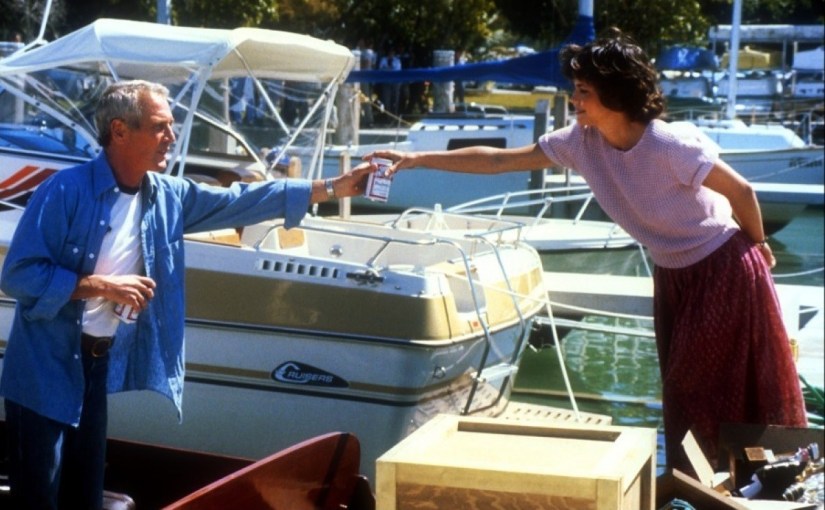
Sally Field is a hungry thirty something reporter named Megan Carter with connections in the Miami prosecutor’s office.  When she gets a whiff of a story that implies a man named Michael Gallagher (Paul Newman) is the prime suspect in the disappearance of union head, she runs with it and her editor is happy to make it front page news.  However, just because Mr. Gallagher is the son of a deceased and reputed bootlegger with mob connections doesn’t make him guilty of anything.  Also, has an investigation into his affairs even begun to happen yet?  Just because it walks like a duck, well….

Sydney Pollack goes pretty light on a serious subject matter here.  It’s just awful to see a film legend like Newman be a cold blooded killer.  Worse, it’s beyond reason to see Sally Field as a woman without scruples.  They’re too likable.  So, Pollack with Kurt Luedtke’s Oscar nominated screenplay, play it safe.  Forty years ago, when this film came out, I might have accepted what’s on the surface with Absence of Malice.  Today, however, I appreciate the conundrum, but the residual effects offered up by the film never seem to carry much weight.  The stress doesn’t show enough on Newman and Field.  A suicide of another pertinent character hardly seems monumental to either of them.  Heck, there’s even time for romance between the two leads despite the slander committed by one against the other.  Another film by Pollack, Three Days Of The Condor, committed this same mistake.  It’s hard to accept a romantic angle when the characters barely know each other and what they do know of one another is hardly favorable for each of them.  I can imagine the marketing campaign for this ahead of the film’s release.  If you got “Blue Eyes” and “The Flying Nun” in a film together, well then, they gotta hook up and never, ever make them ruthless.  Audiences would hate that!!!!

The film reserves the shiftiness of the situation for other actors in the film like Bob Balaban.  He certainly plays the part well as a manipulator in search of a guilty party, even if it means indicting an innocent person.  The best surprise is the appearance of Wilford Brimley in the big close out scene who sums what has occurred and then lays out who is responsible for what and who is not responsible.  It’s the best written role in the film and it reminds me what a shame it is that Brimley did not get any Oscar recognition during his career.  (I still say he was one of the greatest unsung villains in film for his turn in Pollack’s The Firm.)

Even the soundtrack music from Dave Grusin feels inappropriate here.  It’s too energetic and full of life with piano and trumpets.  When you consider the term “absence of malice” and what it means to a reporter questioning her journalistic integrity, and then furthermore what significance it has to a newspaper article’s bystander, it seems to hold a lot of weight with disastrous repercussions.  Grusin’s music says otherwise.

It’s always a pleasure to go back and watch Paul Newman, and Sally Field in her early career.  These are great actors.  They do fine here, but the material is not sharp enough for what they can do.  They’re too relaxed.  On the other hand, the subject matter is perfect for heightened movie drama.  I can only imagine what Sidney Lumet would have done with this picture, considering films like Network, Serpico and The Verdict.  The execution of Pollack’s film simply does not live up to the terrible dilemma of an innocent man being publicly smeared.  Think about it.  At the end of Absence of Malice, I don’t think the intent is to wish and hope and yearn for Paul Newman and Sally Field to sail away on his beautiful boat into the sunset.  Yet, that’s what Pollack and Luedtke seem to have left us with.