THE PLEDGE

By Marc S. Sanders

The Pledge is a moody and bleak crime drama that follows a retired detective’s descent into obsessive madness.

Director Sean Penn opens his film with the gruesome discovery of a murdered nine year old girl found amid the snow covered woods outside a small Nevada town.  She happens to be discovered on the evening of veteran detective Jerry Black’s (Jack Nicholson) retirement party.  Upon receiving word of the crime, Jerry leaves his celebration to explore the scene that is carelessly compromised by the local sheriffs.  His protege partner Stan (Aaron Eckhart) rushes through a possible suspect’s (Benicio Del Toro) interrogation that draws a quick conclusion along with an unnecessary and bloody outcome.

Jerry surrenders his position with the police department, but he’s not entirely convinced the crime has been solved.  He obligates himself to uphold a devout promise he gave to the victim’s parents (Patricia Clarkson, Michael O’Keefe) that he will catch their daughter’s killer.

Time passes and rather than retire into a quiet life of fishing, Jerry purchases an old gas station located within the vicinity of the crime scene as well as nearby where two other murders with similar circumstances occurred.  Jerry is going to wait out the next attempt committed by “The Wizard” or “The Racoon Killer,” and catch him in the act.

The Pledge is a brooding and lonely film.  Sean Penn’s piece offers an impressive list of who’s who actors that appear in small roles to shape out the detective’s progress.  Amidst all of these familiar names in the cast, Jack Nicholson has never appeared so isolated or despondent before.  His character is limited on dialogue.  A thin mustache and a wrinkled complexion with a smoking habit hide any humor or joy.  Jerry Black knows he’s the last capable police detective in this area.  It pains him to abandon his post to the halfwits he leaves behind.

A promise is a dangerous gesture.  If you adhere to it, all obstacles become nonexistent.  Anything will be done to uphold a pledge and conclude your wild theories, even if proof is not conveniently supplemented.   Nothing stands in the way of pledge.  

The second half of The Pledge moves at a slower pace when Jerry welcomes an abused mother (Robin Wright Penn) and her daughter into his home.  A new life seems destined for these three people but at what cost?  Is the hero of this film at least as dangerous as the psychopath that supposedly remains at large?

Would you go to the great lengths that Jerry puts himself through?  Is the expense of his own sanity, and the safety of an innocent woman and her daughter worth this pursuit?

Sean Penn’s film does not operate on suspense. What action there is only fuels Jerry’s chase at a long-shot truth.  It’s a slow burn crime drama that makes the central murder a far second priority to how the initial discovery overtakes the main character.  Again, this kind of mania is a different breed from Jack Nicholson’s other crazed portrayals found in One Flew Over The Cuckoo’s Nest, Five Easy Pieces, or The Shining.  Nicholson is not as vocal or expressive in this role.  Yet, we all know what drives this guy with what few words he uses.

Robin Wright Penn and Nicholson share some effective scenes together. Their motive to be with one another stems from a misery loves company ideal. Good casting here, and throughout the film with small appearances from Helen Mirren, Harry Dean Stanton, Sam Shepard, Vanessa Redgrave, Mickey Rourke, Tom Noonan, Clarkson, O’Keefe, Del Toro and Eckhart.

Sean Penn is very good at creating visual moods to his film. The image of Nicholson standing within the pen of a crowded turkey farm with the anguished parents of the victim is truly haunting. Animals of all kinds seem to emote a cold harshness as well. The first image to appear consists of a swarm of large, winged birds soaring above this backwoods area where the biggest thing to happen is a town parade. Otherwise, as one girl tells Jerry there’s nothing else to do here. This remote Nevada area is unprotected from greater powers, and its only guardian is forced to accept retirement, leaving his community vulnerable. This formerly decorated Marine is now a formerly decorated cop, and the unseen animals-or monsters-still roam.

I won’t spoil the ending which I commend, but there is one moment that Sean Penn includes in the final cut that is objectionable.  For the first time in the picture since Jerry Black accepted the case, one moment near the end of the movie tells the audience everything they need to know while leaving Jerry in the dark.  I think it was a poor choice to go this way.  The audience is going along with Jerry’s pursuit until they are spoon fed a resolution they didn’t earn because Jerry never arrives at this conclusion.  A better route would be to leave the audience in the same dizzying haze that Jerry must live with.  Some hanging threads should be left untied. The Pledge is a pot boiling, well-made and disturbing film, but with minutes to go before the end credits roll, a less is more approach should have been adopted.
HERE

By Marc S. Sanders

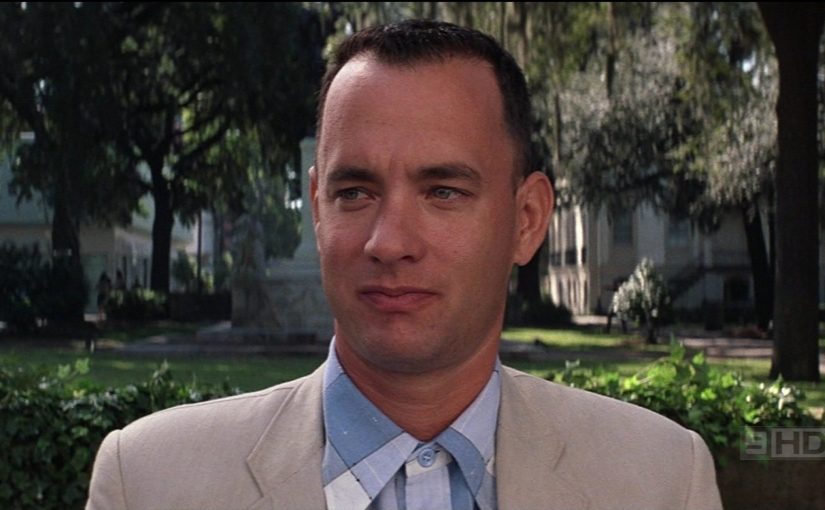
I get a thrill out of being in a location occupied by someone from the past.  Last week, I toured Paramount Studios and sat on the bench that Tom Hanks did when he shot Forrest Gump.  There’s something exciting about it.  Time capsules or a recovery of an ancient burial are fascinating to me.  Just once I’d love to hold in my possession Action Comics #1, Superman’s very first appearance.  Often, items like this are preserved behind glass in museums to witness and study.

Robert Zemekis is a “What if?” director.  What if a man was marooned on a deserted island or what if you could communicate with extra-terrestrials from another galaxy?  What if live humans could interact with cartoon characters? He reunites with Hanks as well as Robin Wright for his newest film called Here.  The picture attempts to answer what precisely happened in one specific, exact location since the dawn of Earth.  

The film opens with the violent creation of the planet, complete with molten rock and falling meteors stirring about, along with an ice age, and a prehistoric period.  Then it is on to further points in history that the script from Eric Roth will occasionally return to, such as the plight of a Native American tribe and then later close to a post-Revolutionary War era where a house with a large bay window in the living room is erected and a famed historical figurehead is referred to.  We witness the activities on both sides of this living room’s bay window, and what was there before it.

There are brief views of folks living in the early twentieth century when new technology like airplanes are fresh, and eventually a Lazy Boy becomes essential to any home.  

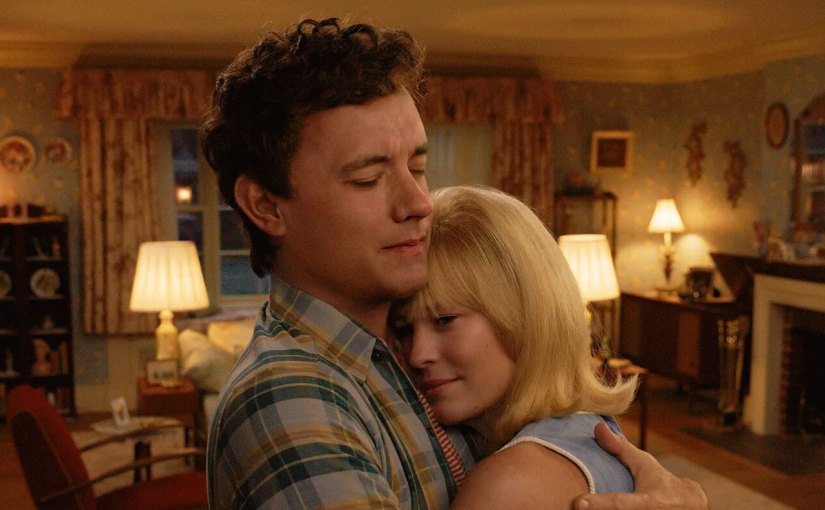
Primarily though, there are three generations of a twentieth century family lineage that starts with Paul Bettany as a PTSD alcoholic World War II veteran, and his housewife Rose (Kelly Reilly).  Tom Hanks portrays Richard, their eldest child who aspires to become a career painter before his plans are interrupted by marrying his pregnant girlfriend, Margaret (Robin Wright).  Life, however, gets in the way of his dreams.

Finally, we are brought to a more current point with an African American family living through challenging times of police brutality and Covid.

Over the course of the whole movie, Zemeckis has you believe that his camera never moves once from this specific place.  He narrates the activities that occur in this broad scope of time with pictures within pictures.  Rectangles or squares will appear to show what happened later in life or back in the past on this specific spot and then transition the scene to that new period episode he wants us to witness.  Where the fireplace is located, a squirrel climbed the bark of a tree that was once there.  Where the sofa is now, there worked a slave laborer from the 1700s, or its where a Native American smoked a pipe before then.

If Here was any longer the novelty might have worn off.  Fortunately, the characters with the most interesting storylines are given to Bettany, Reilly, Hanks and Wright.  The challenges of living long lives raising children, dealing with job security, health, love, loss and stress are carried by them.  We grow accustomed to how the family lineage evolves, particularly with Thanksgiving dinners, Christmas photos, marriage, graduations, and children growing up.  

It helps that the latest trend of visual effects, de-aging and aging the players, works convincingly in this picture.  I attended a live conversation at the 2024 AFI Film Festival between Tom Hanks and Robert Zemeckis, and the actor revealed that to get himself back to the age of seventeen and then a thirtysomething all the way to a man in his eighties required Zemeckis’ team to collect thousands of images and footage from the actors’ extensive careers.  Everything was then seamlessly assembled for effective performances.  I think the trickery works.  If it didn’t, then it’s likely Here would not succeed.

My one issue with the film is the glaring omission of substantial storytelling for the African American family compared to the amount of time devoted to the family who lived in this home before them.  The African American characters do not appear fleshed out enough.  They only serve to remind us of current, complicated times that we recently endured or are still living through.  Roth and Zemeckis did not go deep enough with this group, only to bookend it with an unimpactful death.

Here works like a warm blanket to snuggle up with.  I believe it is worth a second and maybe a third watch in order to catch all the little changes in details that vary as time travels through this piece of land that eventually became a living room.  The TVs and what’s on changes from the Beatles first appearance on The Ed Sullivan Show to The Three Stooges to CHiPs (neat wink and nod moment here; tell me if you know what I am thinking of) and Katie Couric and so on.  The furniture gets updated.  So do the phones. What occurs across the street in front of the two-story colonial house changes.  Though we are only seeing one room during the entire running time, it’s near impossible to pinpoint what was there before from left to right and top to bottom. What’s there now and what will be there later is part of embracing the experience of Here.  However, what kept my attention is how Eric Roth and Robert Zemeckis invent ways to keep different time periods connected.  It’s relative to how Zemeckis did numerous minute and detailed face lifts to Hill Valley in his Back To The Future trilogy.

By the end of Here, there’s opportunities to relate to how many of these people end up with their long lives.  They experience all the ingredients of life through love, frustration, happiness, illness, loss, anger, sadness and eventually death.

Here is a deliberate experimental film, and for most of the picture, its attempts at modifying the stage of performance truly work.  Where it falls short is not allowing equal attention to all of the stories that enter this locale.  Then again, if the movie were to go any longer, time might have come to a mundane standstill.  It’s simply a blessing that I had just enough time being Here.

FORREST GUMP

By Marc S. Sanders

There’s not much that I can say to further praise the merits of Robert Zemekis’ Forrest Gump. It’s a film of legend though it’s a sore spot for die-hard fans of Pulp Fiction, which competed for Best Picture in 1994. Guess which film won. Tom Hanks won the Oscar for the second year in a row, following his outstanding turn in Jonathan Demme’s Philadelphia. Zemekis won Best Director. Eric Roth’s screenplay won as well.

What holds a lasting impression for me about Forrest Gump is the sweeping travel through time of a man with limited intelligence but unlimited willingness to explore and participate, whether it be as a Ping Pong Champion, a Medal of Honor recipient for heroism during the Vietnam War, a millionaire entrepreneur of a shrimping boat business, or a man who just felt like running from one corner to the next of the North American continent. Forrest Gump never knew to compromise a belief he had, probably because he was never aware of the capability to compromise in the first place.

An interesting theme occurs throughout Roth’s screenplay (adapted from the novel by Winston Groom). The people that Forrest encounters are always shouting their ideals and agendas. Yet no one seems to listen. Not just Forrest though. No one at all listens to each other. Lieutenant Dan (Oscar nominee, Gary Sinese) shouts for an immediate evacuation of a hostile territory under attack and no one on the other end of the line, appears to be listening to him. He orders Gump to leave him there, but Forrest does not listen. Forrest only focuses on rescuing his friends, Lt. Dan and Bubba (Mykelti Williamson). What exactly were Americans like the Hippie movements, the War Veterans, the Black Panther party, even the men in the burlesque nightclubs, as well as the various assassinations attempting to accomplish really? Did they accomplish anything? Did any of these parties make an impactful change, or did they just like to hear themselves talk? Did they just want the recognition for only themselves and no one else? When Forrest meets up with his love Jenny (Robin Wright), in a gorgeous caption in front of the Washington Monument (often shown during Oscar film compilations), he has just shared his thoughts over a loudspeaker, unaware that not one of the thousands of war protestors could hear him because the microphone had been unplugged. Later that day, a Black Panther participant only cares to wave his finger and shout his agenda in Forrest’s face. Is Forrest interested? Is he even listening? Is the Jenny, the hippie and her protestor boyfriend listening? Like many Americans, Forrest was only concerned with what was most important to him; Jenny. When Forrest develops a following during his cross country run, everyone is looking for his purpose and his message, and Forrest is unaware that he needed to offer one. Americans are always looking for the next best following. When Forrest passes the Grand Canyon and stops running, the parade of lost souls behind him shouts, “Now what are we supposed to do?” Forrest doesn’t listen. He just walks away and declares he’s tired. America during the mid twentieth century was lost. Forrest was not. Forrest just went in the direction in front of him.

Zemekis pulls an interesting trick of contrasting Forrest against other regulars. The nurse who sits on the bench next to Forrest is more interested in reading a mundane two dimensional issue of “People Magazine.” A man listening to Forrest’s tale of rescue in Vietnam was only concerned with the bullet that struck Forrest in the butt, not the men he saved or the loss of his dear friend Bubba. The old codgers who hang around the local barber shop in Greenbough, Alabama just watch the exploits of Forrest as the years go by. Their hair gets grayer and their skin gets more wrinkled, and life just passes them by while Forrest passes life by. It’s a subtle, yet effective, device that I appreciate on repeat viewings.

Sally Field contributes to the disregard Forrest has for menial issues. If Forrest is going to be denied going to a regular school because his intelligence level falls a few points below average, she will make certain that does not interfere even if it means pleasuring the principal. Mama Gump has the wit and intelligence. Forrest does not. However, their commonality shows in their disregard for what keeps us from living life to the fullest. Without Mama as his influence, Forrest would never have met the President again, and again, and again.

Mama reminds Forrest that “Life is like a box of chocolates…” You know the rest! It doesn’t matter what we get, as long as we get what we pursue.

MONEYBALL (2011)

by Miguel E. Rodriguez

Director: Bennett Miller
Cast: Brad Pitt, Jonah Hill, Philip Seymour Hoffman, Robin Wright, Chris Pratt
My Rating: 9/10
Rotten Tomatometer: 94% Certified Fresh

PLOT: The general manager of the Oakland A’s attempts to assemble a winning team on a lean budget by employing computer-generated analysis to acquire new players.


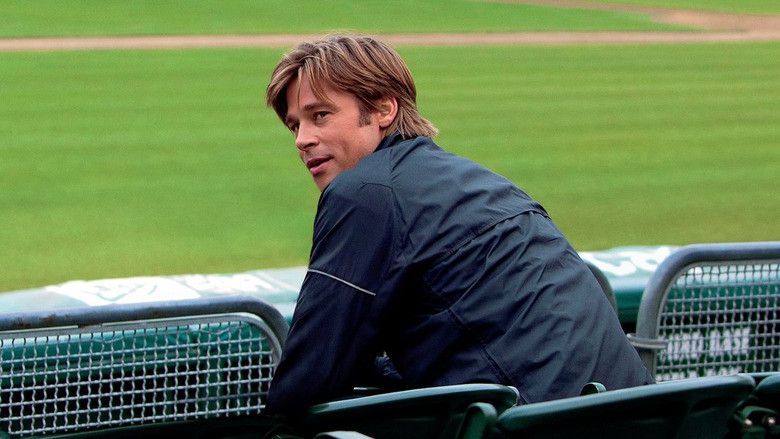
On paper, Moneyball should not work as a movie. What have you got?  A feel-good sports story about the 2002 Oakland A’s utilizing the science of statistics to assemble the right combination of players to get them into the playoffs.

I mean, really?  Specifics aside, a Cinderella story about an underdog sports team trying to make it to the big game is one of the oldest, most predictable tropes in film.  Shall I count them off? Major League, The Bad News Bears, Bull Durham, The Mighty Ducks, Little Giants, Cool Runnings, Hoosiers…need I go on?

And in Moneyball, we barely even get to see any baseball action itself.  The movie is more concerned with the behind-the-scenes action, beating the trade deadline, shaking up the scouting crew, trying to get the manager to believe in the new system.  We don’t really see any major baseball action until we get close to the finale.

[SPOILER ALERT…unless you’re a HUGE baseball fan, in which case you were already aware of this.]

And let’s talk about that finale, while we’re at it.  The A’s make it to the 2002 ALDS elimination game, and what happens?  They LOSE.  Say what???

So why, oh why, does Moneyball work the way it does?

…no, really, I’m asking.  Because I’m not 100% sure myself.  Let me just tick off my thoughts as they occur to me here.

  1. There’s the screenplay.  Here’s some good advice: when you want to make a movie about a potentially dry subject, get both Steven Zaillian AND Aaron Sorkin to write your script.  The pace of the movie is stately, even sedate, but the dialogue is crisp, clean, and precise, getting to the point as efficiently as possible without being flashy.  In one memorable scene, someone walks up to the General Manager’s office and says just one word: “Peña,” and then walks away.  The GM takes it in, says, “Okay”, and calmly stands and flips his desk over.  The whole thing is over in 15 seconds.  I can imagine another movie wasting a lot of time with extra words or edits, but not “Moneyball.”  (SPARTAN.  That’s the word I’m thinking of.  The dialogue is spartan.)
  2. There’s the editing.  The dialogue is sleek and uncluttered, but there is a lot of information that has to be conveyed to those audience members who may not know what a box score is, or what a DH is, or why Billy Beane (the GM, played by Brad Pitt) doesn’t CARE whether his new first baseman can even field the ball properly, as long as he gets ON BASE when he’s batting.  Rather than use flashy editing to generate false suspense or excitement, the Oscar-nominated editors use more of that spartan vibe, with occasional jumps to real-world film clips of the actual team or individual players.  This is especially helpful when the film’s middle section details the woeful first half of the season under the new statistics-based system.  Again, not flashy, but effective.  Very hard to pull off, and deservedly recognized.
  3. There’s the structure…which I guess points back to both the screenplay and editing, but I’m just saying.  As I said, it’s a classic, well-worn trope.  Good guys get knocked down for the count – the A’s flat-out suck for the first half of the season – but then they suddenly start winning games and crawling back into contention.  As many of these films that I’ve seen, I still found myself unwittingly getting caught up in the spirit of the comeback.  In actual fact, the 2002 season is the one where the real Oakland A’s threatened to break the American League record for longest winning streak.  And it all comes down to one at-bat in the bottom of the ninth.  Because of COURSE it does.
  4. …and that sort of brings up another point.  Is there another sport that has as much innate mythology as baseball?  Sure, football has its share of comeback stories, and so does hockey and everything else.  But with baseball…lemme tell you.  A few years ago when the Chicago Cubs were on the verge of winning their first World Series in a hundred-and-eight years, I watched Game 7, rooting for the Cubs.  For those Cubs fans who watched as well, you’ll recall: that game was unmerciful.  The Cubs blew a three-run lead, they ended nine innings in a 6-6 tie, and then there was a RAIN DELAY before the 10th inning started.  But I will never forget that moment when the Cubs made the final out, and they wound up winning 8-7.  It was glorious.  …well, watching Moneyball, watching that section when the A’s are creeping up to winning twenty games in a row, I found myself grinning and laughing spontaneously, without even realizing I was doing it, and I remembered what it was like to watch the Cubs win.  And a big part of it has to do with that unexplainable psychic connection we have to the game itself, that sense of the romantic when someone clobbers a game-winning homer, or makes a dramatic catch to save a no-hitter, or when a relief pitcher retires the side with bases loaded.  I’m not a true baseball fan, I’ll admit…but I know good drama when it happens.  Moneyball gets that aspect of the game just right.

(I haven’t even mentioned the sterling performances from the principal actors, particularly Jonah Hill, who nabbed an acting nomination for one of the most underplayed characters in history.)

In the end, Moneyball is exactly like the Oakland A’s in the film.  It’s an unlikely combination of talent that generated surprising results and was critically acclaimed, gathering six Oscar nods.  It failed to win a single Oscar…much like the A’s were eventually eliminated from the playoffs in 2002.

But in the end, it’s not the shutout at the Oscars that I remember.  It’s the fact that this is still one of the best sports movies I’ve ever seen, and definitely one of the top 2 or 3 baseball films I’ve ever seen.