
THE HUNGER GAMES: THE BALLAD OF SONGBIRDS AND SNAKES

By Marc S. Sanders

The Hunger Games: The Ballad Of Songbirds And Snakes is a stellar prequel to Suzanne Collins’ well-known franchise approach to reality television within a barbaric dystopian setting.  Francis Lawerence returns to direct this characterization of the would-be antagonist Coriolanus Snow played by unknown Tom Blyth in a blazing performance of innocence eventually corrupted by a warped environment of law.

The story takes place just over sixty years before Collins’ first trilogy that centered on the heroine archer Katniss Everdeen.  A vicious annual tournament known as “The Hunger Games” has reached its tenth year and interest in the programming has waned.  Rebellion throughout the twelve districts of Panem is getting stronger and the idea of selecting children to compete in a battle royale to the death is frowned upon. 

The elite students, which include Coriolanus and his best friend Sejanus Plinth (Josh Andrés Rivera), have been assigned to a new development in the Games.  They are to serve as mentors to the selected contestants.  Sejanus, who is the son of one of Panem’s wealthiest entrepreneurs, protests the games altogether.  He’s outspoken and determined in his efforts to put an end to the event.  Yet, his father’s wealth always bails him out.  Coriolanus does not seem to have an opinion on the matter.  He’s more curious about the showmanship of the contestant that he’s been assigned from District 12, a wildcat by the name of Lucy Gray (Rachel Zegler, giving a magnificent presence to her role).

Lucy Gray is a free-thinking troublemaker wearing a wardrobe of colors and design.  She is a bursting talent with a guitar as well and an attitude to boot.  While the other contestants appear malnourished, poor, sad and legitimately pitiful, Lucy has a guise of confidence and independence.  She certainly stands apart from her competition when they are all locked up in a zoo cage for the public and press to look upon as hype ahead of the grand tournament.  Lucy is not a skilled fighter, but even without Coriolanus’ guidance she knows how to develop a following.

Elsewhere, there are the puppet masters.  There’s Dean Casca Highbottom (Peter Dinklage), the inventor of the games, and teacher to the mentors.  He stresses a promising future for the best mentor performance, but there is to be absolutely no cheating.  As well, Viola Davis plays a devil of a villain as a Dr. Volumnia Gaul.  Think of her as the equivalent to the Nazis’ Dr. Mengele who experiments with new inventions of hideous creatures and process.  Her towering canister of colorful snakes is chilling anytime it appears on screen.

The Ballad Of Songbirds And Snakes has a long running time for a science fiction piece catered for young adults.  However, it confirms the error that was made with Collins’ film adaptation of her third novel, Mockingjay, which was split it into two films for the sake of greedy revenue commercialization to line Lionsgate’s pockets.  Because this prequel is contained as one piece, Tom Blyth is invited to perform a thrilling character arc of a poor, but intuitive, and good-natured young man who is eventually transformed into an evil personification. 

Lawrence’s film has multiple opportunities to end and roll the credits.  However, it carries on and becomes a journey for its principal characters, Lucy Gray and Coriolanus Snow are much like in the same vein as Vito and Michael Corleone in The Godfather.  Novels often have the luxury of spanning a wide berth of time to inch their way towards a protagonist’s destiny.  Movies tend to want to hurry things along.  With Francis Lawrence’s film we are granted the time to see how Lucy Gray performs during the leadup to the games as a character of confidence that a public is willing to follow and bet on, but most importantly care about.  Accompanying her is Lucy’s mentor, Coriolanus Snow, who is curious and concerned for Lucy’s wellbeing.  While being separated from one another for large portions of time, the two characters convincingly fall in love. 

The second act of the film is the sport in an arena, far from the technologically sophisticated nature found in the other films.  In this prequel chapter, it is simply an in the round stone coliseum of wreckage following a rebellion strike with barbaric weapons left in the center to grasp for advantage. 

The third act, which in another director’s hands might have been saved for a churned-out sequel, follows the aftermath of where the characters go from here.  Coriolanus becomes an infantryman in District 12 along with Sejanus.  A whole new design is introduced late into the film, and it is as if we’ve begun a brand-new episode of a franchise series.  What keeps The Hunger Games installments feeling fresh is that we are granted both the events preceding the games as well as what’s occurring thereafter. 

The cast is outstanding.  Viola Davis and Peter Dinklage have those jaded and unusual appearances suitable for this disturbing setting.  Davis especially absorbs the scenery whenever she is on screen.  Her costume wear, hair and makeup only enhance her chilling performance.  Jason Schwartzman does a superb interpretation of Lucky Flickerman, an ancestor of Stanley Tucci’s flamboyant character from the other films, and the MC for the games.

Rachel Zegler lends her talents for song and guitar to the film, and I loved every second of it.  I know she is currently not favorable in the public eye based on comments she has made.  However, if she continues to follow a course of picking smart roles and playing them as well as she does here, and like she did in Spielberg’s West Side Story, then she is destined to becoming an elite leading actor in the likes of Julia Roberts and then later Anne Hathaway.  I loved every song she performed in the film as well.  She lends a twang to her vocals that blend beautifully with her guitar strings.

Tom Blyth is so trusting with his boyish complexion and bleach blond curly mop top.  He fits well into the destitute role of the son of a dead would have been tyrant.  His wardrobes are described as hand made at home, even with small bathroom tile pieces serving as fashionable buttons on his dress shirt.  Blyth, while humble, wears everything with confidence, remaining the exact opposite of the President Snow we knew from Donald Sutherland’s performance in earlier films.  This Coriolanus is someone I can trust.  Someone I do not question.  Yet, when the end of the film arrives, I’m left surprised by the outcome of the character even though I know what’s expected of him.  It’s a positively inventive characterization from Suzanne Collins, interpreted with a subtle balance between protagonist and antagonist from Tom Blyth.  This guy might have been a better casting choice for Anakin Skywalker in the Star Wars prequel films. 

I’m angry at myself for not having yet read The Ballad Of Songbirds And Snakes.  I imagine it’s a crackling good read.  The film concludes with doors open for questions that leave me curiously thinking, four days after having seen the picture.  I can only hope there are additional films to come that explore even more deeply into Suzanne Collins’ rich tapestry of dystopia and the complex characters that occupy it.

The Hunger Games: The Ballad Of Songbirds And Snakes is one of the best pictures of the year.
WEST SIDE STORY (2021)

By Marc S. Sanders

Okay!  Let’s get the comparison out of the way first.  Steven Spielberg’s interpretation of West Side Story far exceeds the original 1961 version from Robert Wise and Jerome Robbins that won the Best Picture Academy Award.  I strongly encourage you to see this new film in theatres before it’s gone.  If you miss it, be sure that when you watch it at home, you have the highest upgraded flatscreen with the most enhanced sound system imaginable.  West Side Story of 2021 is a gift of sight and sound.

What Spielberg accomplishes with an updated and outstanding script from Tony Kushner is a more fleshed out, grittier and honest account of territorial entitlement and heated prejudice when the west side of New York City was on the brink of catering to a wealthy white populace and the Puerto Rican community had become established as Americans, even if they were never considered equals.  )The best promise the Puerto Ricans have here for a life is to live as doormen and housekeepers.)  The music and lyrics are more meaningful than ever before.  The characters are given more depth.  The settings become characters themselves.

West Side Story is another example of solid evidence that Steven Spielberg is our greatest modern director.  He not only focuses on the positions his characters hold, allowing them to act with passion and humor and heartache and despair, but he also takes advantage of the props and settings allowed to him beyond limits.  To watch classic numbers come alive not just with the outstanding vocals and dancing, but to see everything in the frame serve a purpose is so gratifying. 

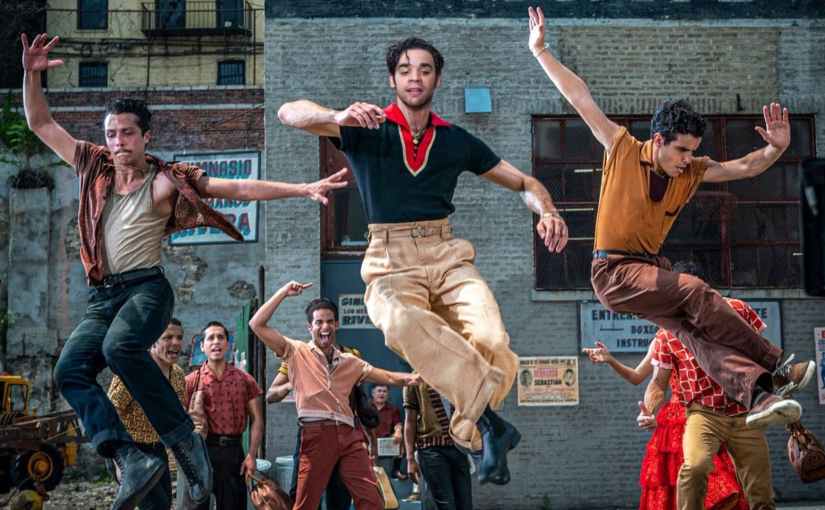
When the Jets strut and ballet down the city streets claiming their elite status in song, Spielberg makes sure these guys literally stop traffic.  Unlike the mundane placement of the winning song “Officer Krupke,” in the original film which only happens on a sidewalk, Spielberg place the boys in the police station where the props of papers and office supplies along with the furniture pieces serve to lampoon the city judge, the cops, the psychiatrists and even themselves.  Maria (20-year-old sensation, Rachel Zegler) owns her rendition of “I Feel Pretty” while the picture enhances the performance with a run through the dress department of Gimbell’s.  Clothes and accessories fly off the racks to send Maria’s enthusiasm of love and happiness into the heavens.  Kushner and Spielberg make a very wise modification to have “Cool” performed by the romantic lead Tony (Ansel Elgort) as a means to calm down his buddy, Riff – leader of the Jets (Mike Faist), before going into a head-to-head rumble with Maria’s brother, Bernardo, leader of the Puerto Rican gang known as the Sharks. Spielberg places these guys on a rickety old dock complete with wide gaps in the floor for the boys to leap over along with smooth planks to slide around on while tossing a gun around like it’s a football.  These characters teetering on manhood beautifully display their recklessness for danger and pride.

Rita Moreno is the significant attraction early on as she fills the Doc mentor role in the local drug store.  Wise & Robbins’ film never made Doc into much of a mentor.  Moreno fills that void.  She portrays a new character named Valentina, the widow of Doc, and the film’s tool of sensibility during these troubled times.  Kushner creates a fleshed-out character who explains that while she married a Gringo, she remains a Puerto Rican and there’s no room for bloodshed.  She has learned to live with others, and now Tony and Bernardo and Riff and the rest need to do so as well.  In another writer’s hands, this might come off preachy.  Not with Kushner’s dialogue though.  The background of Valentina is paved out early on and her elderly physicality can only do so much.  She can’t disarm the toughies, but she won’t stand for their stupidity either.  It’s Moreno’s presence that brings the chaos to a halt even if she knows it’ll never end the senseless war.  She is sure to get an Oscar nomination and like her win as Anita in the original film, she’s likely to win the award here as well.  (The only Hispanic woman to win an Oscar since 1961, and she’s likely to repeat that accomplishment again.)

Another fleshed out character that I really appreciated is that of Chino (Josh Andres Rivera), the nerdy student and best friend to Bernardo.  He’s studying accounting and calculator repair, but Chino wants to join the Sharks and fight for their cause. Bernardo, the tough guy boxer, wants none of that for his friend.  He wants Chino to date Maria.  There’s multi dimension to Chino now that I never saw before, and it is so very necessary.  The character puts a heartbreaking seal on the end of the film or play, whichever you are watching.  With Spielberg’s film, we get more of Chino’s motivation.  We now can understand why it is Chino that really delivers the final punch of the show.

Ariana DeBose plays Anita, Bernardo’s wife, and she’s spectacular as well.  I could watch her lead “America” through the colorful, daylight city streets over and over again.  In her yellow dress, with red lace underneath, and her magnificent energy, she’s a powerhouse of magnetism.  She leads a company of dancers with such a drive.  Again, Spielberg uses the environment of these characters to build them up and Anita dueling with Bernardo during this song in broad daylight (as opposed to just an evening rooftop from the original) is sensational.  Clotheslines and soft fabrics of pink, yellow and blue even sway to the pounding drum of the number from Leonard Bernstein, along with Stephen Sondheim’s original lyrics.

Having seen this film twice, I now recall when I watched it the first time how inappropriate it really was to have Natalie Wood cast as Maria in Robert Wise’s film.  Beyond the fact that she was never an accomplished singer or dancer, she is certainly not the correct ethnicity.  Her skin complexion was actually bronzed for the role and she lip synched her dialogue and singing.  Obviously, she was a marquee name at the time and the bills had to be paid while profits were collected.  Still, what an insult to point of the piece.  West Side Story’s conflicts hinge on racial and ethnic divides.  With Spielberg’s film, he went so far as to not even include subtitles for the Spanish dialogue.  I don’t speak Spanish, and yet while I can not translate, I could understand the emotions and motivations among the Puerto Rican populace.  Why should subtitles be provided?  Why should whites play Hispanics?  It’s a disgrace to consider, especially in a film that relies on ethnic identity.  Often, the Puerto Ricans are reminded by the cops or among themselves to speak in English.  Yet they continue on with the primary language.  Bravo.  Just because the soon to be famed Lincoln Center will be erected on these grounds doesn’t erase a heritage.  You can not whitewash a culture within a melting pot, and you cannot change a mentality that really doesn’t need to be altered.  Puerto Rico is America and Puerto Rico, within the confines of this film’s New York is here to stay.  Spielberg, the Jewish, typically non-musical director, ensures an equal playing field among the divided cast.

The chemistry among the cast has to be celebrated.  The Jets and Sharks work in pitch perfect precision with one another.  You only need to watch the high school dance to recognize that.  Moreover, look at the balletic fight scenes among the Jets in blue and the Sharks in red.  Elgort and the physically much shorter Zegler work beautifully as a couple forbidden to love, much less talk with one another.  Spielberg makes up the odd height differential by placing Tony on a ladder below Maria, who stands assuredly on a balcony or simply by seating Tony while Maria stands, thereby allowing their duets to work nicely in sync as they beautifully gaze upon one another.

2021’s version of West Side Story is an absolute masterpiece.  It is one of Steven Spielberg’s best films.  It’s entertaining, funny, celebratory and authentically heartbreaking. It’s the film I never, ever realized was needed to be conceived again.  West Side Story was the very first stage musical – Broadway musical – I ever saw and it always remained my favorite.  Yet, until I finally saw what Steven Spielberg could do with West Side Story, I actually never realized I hadn’t seen all of West Side Story.