
THE PLEDGE

By Marc S. Sanders

The Pledge is a moody and bleak crime drama that follows a retired detective’s descent into obsessive madness.

Director Sean Penn opens his film with the gruesome discovery of a murdered nine year old girl found amid the snow covered woods outside a small Nevada town.  She happens to be discovered on the evening of veteran detective Jerry Black’s (Jack Nicholson) retirement party.  Upon receiving word of the crime, Jerry leaves his celebration to explore the scene that is carelessly compromised by the local sheriffs.  His protege partner Stan (Aaron Eckhart) rushes through a possible suspect’s (Benicio Del Toro) interrogation that draws a quick conclusion along with an unnecessary and bloody outcome.

Jerry surrenders his position with the police department, but he’s not entirely convinced the crime has been solved.  He obligates himself to uphold a devout promise he gave to the victim’s parents (Patricia Clarkson, Michael O’Keefe) that he will catch their daughter’s killer.

Time passes and rather than retire into a quiet life of fishing, Jerry purchases an old gas station located within the vicinity of the crime scene as well as nearby where two other murders with similar circumstances occurred.  Jerry is going to wait out the next attempt committed by “The Wizard” or “The Racoon Killer,” and catch him in the act.

The Pledge is a brooding and lonely film.  Sean Penn’s piece offers an impressive list of who’s who actors that appear in small roles to shape out the detective’s progress.  Amidst all of these familiar names in the cast, Jack Nicholson has never appeared so isolated or despondent before.  His character is limited on dialogue.  A thin mustache and a wrinkled complexion with a smoking habit hide any humor or joy.  Jerry Black knows he’s the last capable police detective in this area.  It pains him to abandon his post to the halfwits he leaves behind.

A promise is a dangerous gesture.  If you adhere to it, all obstacles become nonexistent.  Anything will be done to uphold a pledge and conclude your wild theories, even if proof is not conveniently supplemented.   Nothing stands in the way of pledge.  

The second half of The Pledge moves at a slower pace when Jerry welcomes an abused mother (Robin Wright Penn) and her daughter into his home.  A new life seems destined for these three people but at what cost?  Is the hero of this film at least as dangerous as the psychopath that supposedly remains at large?

Would you go to the great lengths that Jerry puts himself through?  Is the expense of his own sanity, and the safety of an innocent woman and her daughter worth this pursuit?

Sean Penn’s film does not operate on suspense. What action there is only fuels Jerry’s chase at a long-shot truth.  It’s a slow burn crime drama that makes the central murder a far second priority to how the initial discovery overtakes the main character.  Again, this kind of mania is a different breed from Jack Nicholson’s other crazed portrayals found in One Flew Over The Cuckoo’s Nest, Five Easy Pieces, or The Shining.  Nicholson is not as vocal or expressive in this role.  Yet, we all know what drives this guy with what few words he uses.

Robin Wright Penn and Nicholson share some effective scenes together. Their motive to be with one another stems from a misery loves company ideal. Good casting here, and throughout the film with small appearances from Helen Mirren, Harry Dean Stanton, Sam Shepard, Vanessa Redgrave, Mickey Rourke, Tom Noonan, Clarkson, O’Keefe, Del Toro and Eckhart.

Sean Penn is very good at creating visual moods to his film. The image of Nicholson standing within the pen of a crowded turkey farm with the anguished parents of the victim is truly haunting. Animals of all kinds seem to emote a cold harshness as well. The first image to appear consists of a swarm of large, winged birds soaring above this backwoods area where the biggest thing to happen is a town parade. Otherwise, as one girl tells Jerry there’s nothing else to do here. This remote Nevada area is unprotected from greater powers, and its only guardian is forced to accept retirement, leaving his community vulnerable. This formerly decorated Marine is now a formerly decorated cop, and the unseen animals-or monsters-still roam.

I won’t spoil the ending which I commend, but there is one moment that Sean Penn includes in the final cut that is objectionable.  For the first time in the picture since Jerry Black accepted the case, one moment near the end of the movie tells the audience everything they need to know while leaving Jerry in the dark.  I think it was a poor choice to go this way.  The audience is going along with Jerry’s pursuit until they are spoon fed a resolution they didn’t earn because Jerry never arrives at this conclusion.  A better route would be to leave the audience in the same dizzying haze that Jerry must live with.  Some hanging threads should be left untied. The Pledge is a pot boiling, well-made and disturbing film, but with minutes to go before the end credits roll, a less is more approach should have been adopted.
SHE SAID

By Marc S. Sanders

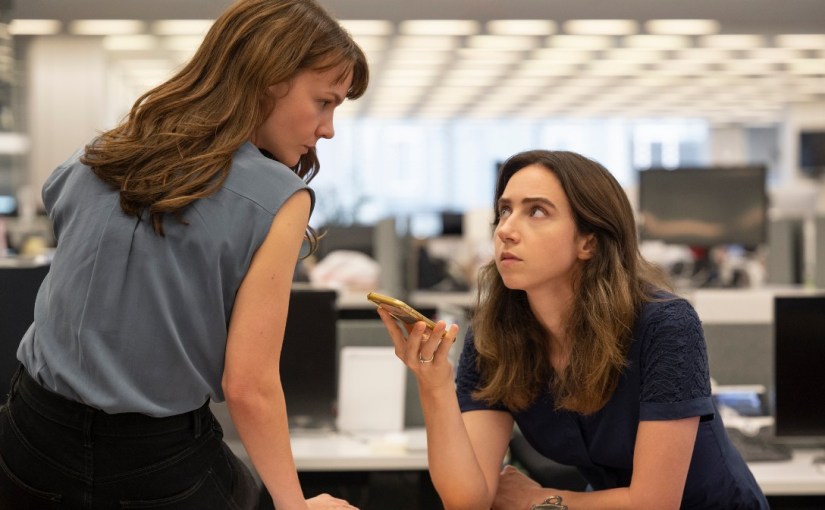
I get high off movies about journalism.  All The President’s Men and Spotlight are at the top of this pillar.  The main characters seem to be moving a hundred miles per hour even if they are reserved to their cluttered desks and phones, or if they are talking delicately, and slowly, with empathy as they carefully approach a potential, yet frightened source.  She Said is a 2022 film about how the New York Times reporters, Megan Twohey and Jodi Kantor (Carey Mulligan, Zoe Kazan), exposed the systemic process of sexual harassment and rape that was running rampant through Miramax Films.  The accused was always its CEO, Harvey Weinstein.

It’s extraordinary that this film got produced so soon after the MeToo movement and Weinstein’s downfall occurred.  All of it seems like it just happened yesterday.  In fact, Harvey Weinstein is still going through court procedure and trials for sexual crimes he’s accused of that occurred in London, New York and Los Angeles.  There might even be more locations.  New developments hit the internet all the time.  This guy just never stopped.  So, there’s much for the courts to process and try.  This was a terrible black eye, not only for Miramax’s reputation (at the time owned by Disney), but on the entire film industry in Hollywood.

She Said explores not only Twohey and Kantor’s relentless pursuit of the truth and various descriptions of Weinstein’s method with young women, but also how corrupt non-disclosure agreements (NDAs) were used.  The NDAs contained unreasonable demands for hush money provided.  Mandates such as speaking with a therapist or other professionals and close-knit relatives were never allowed lest they suffer consequences.  The victims would get paid, but would also be denied of a copy of the contract, and thus Weinstein found a way to allow his constant grooming and sick pleasures of perversion to carry on. 

The reporters concluded that these victims had no money or resources to stand up to the kind of bullying and harassing that Weinstein’s power exerted.  Quitting or getting fired for fighting for their rights or just refusing his advances left these women out of an industry in which they were trying to elevate their careers.  They lacked proof of the occurrences.  They had to fight a he said/she said scenario.  They were victimized by a man who associated with some of the most powerful people in the world.  It happened to known actresses like Rose McGowan and Ashley Judd (who plays herself in the picture).  It nearly happened to Gwyneth Paltrow (providing her own voice on the phone) as well.  Even worse, it happened to women who didn’t even have the luster of celebrity brand name recognition to help them in their cause.    Nevertheless, it practically destroyed McGowan’s reputation in Hollywood altogether as she was labeled a crazed pariah for declaring her truth.  The tolerance and strategic payoffs were perhaps just as overwhelming as the attacks by Harvey Weinstein.  (Forgive me, I say perhaps because there is no way I am qualified to empathize, measure, or relate to what these victims endured or continue to survive through.)

Maria Schrader’s film does a good job at explaining the risks these reporters take.  A brief prologue shows Megan Twohey getting death threat calls for her write up of Donald Trump’s accusations of sex crimes.  A very convincing Trump vocal impersonator even calls her to tell her she’s a disgusting human being and how he must be innocent simply because he does not know any of these women.  Reader, it bears repeating that many rapists and harassers never know their victims.  When Twohey teams up with Kantor, the intimidations don’t stop and their supervisors and editors in chief (Patricia Clarkson, Andre Braugher) lend support.

Paltrow’s ex-boyfriend, Brad Pitt, was a producer on this film and it’s gratifying to see him lend the support.  I recall reading how he confronted Weinstein following attempts of harassment upon Paltrow shortly after they began dating and making the film Seven together.  Looking back to those years of the mid-1990s, I’d argue that Pitt and Paltrow were taking enormous risks with their careers.  They were just becoming marquee names. Yet, they could have still been ruined within the industry.  This is an environment synonymous with putting blinders on to systemic offenses that occur while lending praise to those that’ll eventually grant them potential Oscar winning roles or twenty-million-dollar paychecks.  

When Matt Damon, Ben Affleck, George Clooney, and Quentin Tarantino say in interviews that I’ve seen that they had no idea what was occurring with Harvey behind closed doors, my reaction has always been skeptical to these claims.  At one point in this film, Twohey and Kantor refer to Harvey’s antics as the worst kept secret in Hollywood. It is sad to say that these marquee names will always owe their careers and success to Harvey Weinstein, criminal rapist or not.

I do have some reservations with She Said, though.  Often the reporters are typing and quick close ups or glances at their monitors are edited into the film, but I can’t read what they are documenting, and I believe the film was assuming I could.  At one point, Braugher’s character announces that Weinstein spoke to Variety magazine and another competitor to share his side of the story and declares “This is bad.”  Yet, we never find out what Weinstein said, and we just get the “Oh shit!” expression from Twohey and Kantor.  Why leave us in the dark on subjects like this?  Why is this so bad? 

The film is fast paced, but many of the scenes are identical to prior ones.  As the reporters speak with victims, they break down their own story.  I believe Weinstein practiced a similar method each time, but the dialogue in these accounts seems redundant.  I get that we are to understand how excessive his predatory actions were, but I was hoping for fresh angles to their ongoing investigation.

The cast is spectacular, particularly Mulligan and Kazan who make a great pair. I really like the dialogue written and delivered by Andre Braugher.  I always thought I don’t see that actor enough in films.  He’s sensational in everything he does, and he carries a real strength to his authority in the New York Times offices.  A championing moment occurs when he cuts in on Harvey’s call with the reporters to give an ultimatum and hangs up.  He just told Harvey, “ENOUGH ALREADY!”

She Said relies on prior knowledge that you must have before watching the film.  You must know who Harvey Weinstein was and the large space he occupied within Hollywood and the film industry.  You need to know who these actresses were, and you have to be familiar with the overwhelming female response to Donald Trump’s agendas which set up the picture.  Unless you’ve been hiding under a rock, it’s hard not to be aware of what’s occurred in the last 5-6 years. 

However, as this film is discovered by future generations, long after Weinstein and Trump, and these victims are passed on, future generations like our children’s children may not fully understand the terrible conspiracies that transpired. 

She Said is a good movie and it holds significant importance.  However, I imagine the book written by Twohey and Kantor provides more details and exposition that I wish the film adaptation offered.  The pace and performance of the picture work very well.  I’m just afraid the script relies a little too much on assuming we know the whole backstory as the film carries on to its triumphant ending.

Watch it anyway, though.  It’s a bravely daring film to say the least.

THE DEAD POOL

By Marc S. Sanders

Sometimes five is too much.  It was for Clint Eastwood as Inspector Dirty Harry Callahan.  The Dead Pool was the fifth and final entry in the famed crime drama series.  Eastwood moves slower this time.  He does not come off as much of a rebel any longer.  Most notably, the story doesn’t have the feel of a Dirty Harry film.  The cop who was infamous for questioning the laws set in place seems to be just slotted into this film. 

The Dead Pool is directed by Buddy Van Horn, who had a long career as a stuntman and assistant director for many of Eastwood’s films, and other actors like Charlton Heston and Henry Fonda.  He does a ho hum job with the picture.  I don’t need to be treated to inventive shots or camera angles to enjoy a movie.  I have yet to visit San Francisco, but at least Buddy Van Horn provides enough locales to feel like I’m getting a serviceable tourist view.

A twisted game is being played in the underground scene.  People are making lists and betting on local celebrities they expect to die soon.  One name includes a heavy metal rock star played by James Carey, later to be known as Jim.  There’s also a snobby film critic who is a deliberate inspiration of Pauline Kael.  (Kael’s reviews were not too kind to many of Eastwood’s films over the years, particularly the original Dirty Harry.)  At the bottom of the list is Harry himself, who is surprisingly favored by the police department officials – first time that has happened – for putting away a powerful mob boss.  A side story consists of the boss giving orders out to his crew to take revenge on Harry and provide some escapist shootouts to move the film along. 

The police department want Harry to cooperate as their hero poster boy.  Harry doesn’t care for fame, though.  It’s not his style.  Yet, a persistent television reporter (Patricia Clarkson) wants his story.  A little romance is implied but Harry is not one for gossip fodder.  Unfortunately, Eastwood and Clarkson are really lacking chemistry here.

The rock star and the movie critic are murdered.  Harry must be next, and a horror film director (Liam Neeson) seems like the prime suspect because his dead pool list had included all three names. 

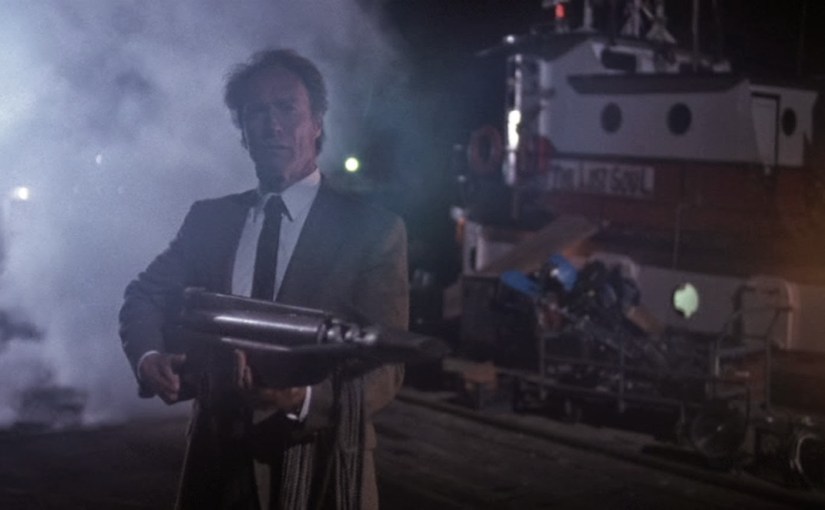
The Dead Pool is not a terrible movie, but it does not live up to other Dirty Harry installments. Primarily because it does not follow the character’s familiar mantra against the bureaucrats and the flawed system of prosecution and law enforcement that he’s always been challenged with.  At times, I’m looking at Eastwood and I’m asking myself who is this guy?  Sure, he’s got a few one liners of dry wit.  The famed eyebrow stare is there too, and the .44 Magnum as well.  However, Harry doesn’t seem to stand apart so much from everyone else as he did in the other films.  Beyond the giant gun, that is what made Harry Callahan so famous on screen. 

The investigation that Harry is assigned to with a Chinese American cop (Evan C Kim) is very bland.  We hardly get to know any of the victims or what they stand for, and when the true killer is revealed, it turns out to be a last-minute introduction of someone we’ve yet to see.  There’s no surprise to the culprit behind all of this. 

The series is also well known for the partners that Harry is forced to work with.  In The Enforcer, Tyne Daly brought out Harry’s regard towards women working in his dangerous field that demonstrated his initial frustration followed by his reluctant acceptance.  In the first movie, Remi Santori came about when it was okay to say that Harry took issue with all kinds of demographics, including Mexicans.  A chumminess nicely developed between those two guys as they tracked down the killer, together.  The second film, Magnum Force, offered a partner to also care about.  These are good side performers that colored in much of the Harry Callahan lore.  In this movie, Evan C Kim has one standout moment in the first ten minutes where he surprises everyone, especially Harry, with how he disarms a robber by use of martial arts.  It’s a great scene.  After that, though, he’s given nothing to do.  This actor had promise for more interactions with Eastwood.  It just never delivered.

The series started in the gritty times of 1971 when political correctness was not ever considered.  By the time the last two films were released in the 1980s of Ronald Reagan, who famously adopted “Go ahead.  Make my day,” for Gorbachev, there was a new wave of sensitivity abound.  I like to believe with the prior installment, Sudden Impact, Harry Callahan learned something new about himself with regards to the rights women had or were denied of while still applying his own code.  With The Dead Pool, the writing seems reluctant to go anywhere near a potential debate, and so it drips itself into a stale slasher movie with the cop ready to fire his six shooter.

The grand highlight of the film is a car chase on the hilly streets of San Francisco, which is the best place for a car chase, always.  What separates this one from the others is a little remote-controlled car that pursues Harry and his partner, ready to activate its equipped detonator at just the right moment.  The editing of this sequence is really fun, and it’s a great salute to Bullitt and other gritty, urban cop films, particularly the Dirty Harry movies.  This toy car flies over fruit stands and careens through sidewalks and over sewer holes.  Meanwhile Harry screeches down one hill after another trying to evade this pesky rapscallion.  It’ll definitely put a smile on your face while the moment lasts.

I recall being eager for another Dirty Harry movie.  I grew up loving many of Clint Eastwood’s films.  Dirty Harry is a favorite character of mine.  Yet, I also remember feeling really let down when my dad and I walked out of the theatre.  The Dead Pool just doesn’t have the same flavor as the other Eastwood products.  Again, it’s not the worst picture.  It’s standard cop fare coming in at a lean ninety minutes.  Eastwood and the rest of the cast are okay with what they’re doing.  I just would’ve changed the name of the main character listed at the top of the cast list.  He could have been Dirty John Doe for all I care.

QUICK TAKE: Good Night, and Good Luck. (2005)

By Miguel E. Rodriguez

Director: George Clooney
Cast: David Strathairn, Patricia Clarkson, George Clooney, Jeff Daniels, Robert Downey Jr., Frank Langella
My Rating: 8/10
Rotten Tomatometer: 93% Certified Fresh

PLOT: In the early 1950s, broadcast journalist Edward R. Murrow (Strathairn) looks to bring down Senator Joseph McCarthy.


I feel eminently unqualified to discuss the historical merits of Good Night, and Good Luck.  I am no history scholar.  What I know about the Hollywood blacklist and the HUAC hearings can be traced to sources such as movie reviews, the movies themselves, documentaries, and The Manchurian Candidate.  (The original, not the remake.)

As such, all I can report is that this movie is solidly well-made, photographed in gorgeous black and white, and is an immensely satisfying experience, because a bully gets what’s coming to him, on national television.  If there are times when it lags a little, well, civics lessons can’t be fireworks all the time.

David Strathairn is not quite a dead ringer for legendary newsman Edward R. Murrow, but he’s close enough, and he’s never less than convincing, especially when delivering Murrow’s broadcasts in that inimitable deadpan that somehow sounds more informed than the average reporter.

I especially enjoyed the segment where McCarthy appears on Murrow’s program to defend himself against charges made by Murrow on a previous show.  Shortly thereafter, Murrow goes over McCarthy’s rebuttal line by line, identifying each falsehood and inaccuracy.  That took guts back then, but Murrow stood for truth, as corny as that sounds, and he wasn’t about to let McCarthy’s lies slide.

All in all, Good Night, and Good Luck is a great film, maybe even an IMPORTANT film, because of our ever-shifting political climate.  You never know if another McCarthy will rise up, and you wonder if anyone will be around, like Murrow, to put them in their place.

[TRIVIA NOTE: look fast for Simon Helberg (Wolowitz on “The Big Bang Theory”) in what amounts to approximately five seconds total screen time.]