
BLOW OUT

By Marc S. Sanders

Brian DePalma’s Blow Out is an inventive approach to the political conspiracy thriller.  In 1981, following a mask of innocence the United States lost with the assassination of President Kennedy, later his brother Bobby, plus the drunken, liable carelessness of their brother Ted, and then finally the Watergate scandal, DePalma capitalized on newsworthy incidents to make a paranoid thriller of present day while incorporating what he likely knows much about which is sound effects editing.  Despite the cheesy music soundtrack that is highly intrusive and poorly composed, Blow Out is a good blend of hysteria and suspense.

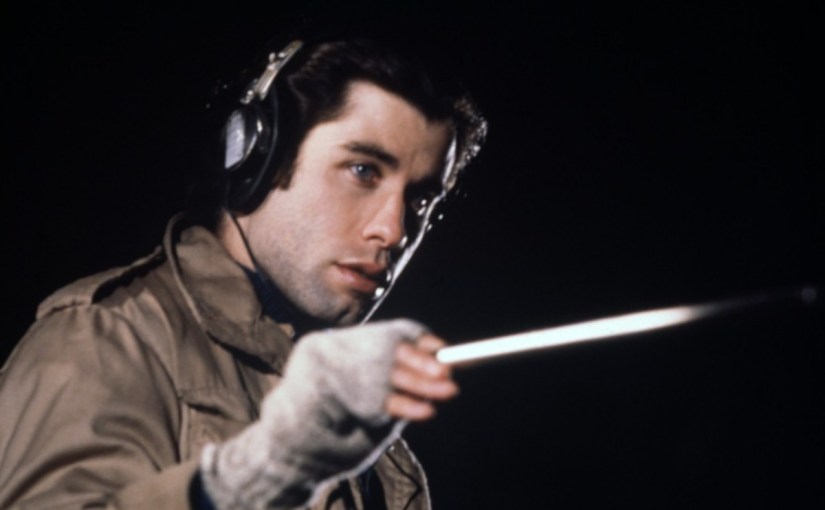
John Travolta plays Jack Terry, a Philadelphia sound effects recording artist for b-grade schlock horror movies.  One night, while out in a park trying to pick up sounds of outdoor nature, he witnesses a car suffer a blown-out tire and crash into a nearby river.  Jack is able to rescue a woman named Sally (Nancy Allen) but cannot save the Pennsylvania governor who was driving the car.

As he is about to leave the hospital, he is specifically instructed to never speak to Sally nor acknowledge to anyone about any of his own involvement in this incident.  However, Jack cannot help but recount the sequence of events in his head and as new details come to light, he knows that there is a cover up at play.

Blow Up operates like a how-to kind of picture.  The expertise of a sound effects recording artist is demonstrated as Jack replays every sound that his equipment picked up. Later he’s able to manufacture his own film by assembling a series of published photographs that also captured the crash.  Sync up the sounds with the sights and a new theory surfaces.  Other mysteries change the course of the riddle through dialogue.  This character has to work by himself using the skills he’s acquired to learn the truth.  He hardly has anyone to commiserate with.

John Travolta is convincing within this occupation that’s not as common as a cop or a private eye.  I like how I can pick up how he uses his recording equipment and even the minute details like labeling what he has preserved within his inventory.

It took a little bit of patience to get used to Nancy Allen’s damsel in distress who plays it up like Judy Holliday or Jean Hagen with the squeaky, dingbat voice.  When we first meet her, she is in an intoxicated stupor that goes on a little too long. Nevertheless, I came around because the tension of the film builds quite well.

John Lithgow is the sadistic adversary – a serial killer and assassin rolled into one.  He’s got the weird, unwelcome appearance like any bad guy in a Hitchcock film.

DePalma is known for his split screen cuts that he offered in Carrie and later in Mission: Impossible.  More well known is his reliance on bringing a character in zoom close up, while in the same frame, another object will be zoomed out at a distance.   During an outdoor evening in the park, an owl hoots and stares us down while John Travolta is far in the background standing on a bridge. Within this same moment, DePalma does it again with a toad ribbiting up close with the actor again positioned out. It’s a disorienting approach that works well at maintaining the perplexity of his story.

I think the final act of Blow Out falls apart a bit.  Travolta is on the heels of rescuing Sally by rampaging his jeep through a crowded parade.  The scene is shot so aggressively that it was hard for me to believe he would survive much less not run down a cop, spectator, or the entire marching band.  DePalma could have tightened this up a bit.

Blow Out ends on a bleak irony that’s quite surprising and definitely against formula.  There’s a running gag for Jack and a film director as they edit a silly problematic issue for a new slasher flick.  I guessed early on how this was going to resolve itself.  Though I was right, I didn’t expect how the conclusion arrived at my predication.  

As well, there are some notable questions left unanswered.  I had to roll back and see if I missed something.  I didn’t.  DePalma’s script neglects some key points with unfinished resolutions. So, I was not entirely satisfied. Still, the how-to procedures along with the pursuit of the truth, while also evading demise, are very engaging.

When I conduct workshops on playwriting, I always recommend keeping up with the news.  An unending wealth of ideas are there to be discovered.  As a sincere compliment to Brian DePalma, it could not be more apparent where his creativity took off with this film.  As a skilled and educated filmmaker, he also writes what he knows.  

Blow Out is very close to being a smart nail biter that echoes the sad truths of political rule breaking by means of savage crime. I wish modern films would be as risky today.  There are so few of these kinds of thrillers being made anymore.
1941

By Marc S. Sanders

Steven Spielberg’s first critical and box office flop, 1941, is a splattered mess of slapstick hysteria set a week after the Japanese attack on Pearl Harbor.  Residents of the California coast line prepare to be the next target.  Ahem!!!!!  Well, that’s it for the story…Goodnight.  Tip your waiters.

Just a year ahead of the Zucker brothers with Abrams comedy team that’ll deliver Airplane!, Spielberg opted to direct a spoof script penned by Robert Zemeckis and Bob Gale (Back To The Future).  1941 is full of gags galore beginning with a reference to the director’s most successful film to date, Jaws.  For me, seeing actress Susan Backline on screen again for another ocean skinny dip only to be intruded upon by a rising Japanese submarine was the second best joke of the film.  Once that was over, I had two hours left to go.  A long two hours. 

I’ve noted before that satire or spoofs are the riskiest genres to produce.  They can succeed with a picture like Dr. Strangelove…, or Network or Airplane!  Satire can be divisive too though, and thus only one half of your audience will appreciate the poke and prod.  Even worse, satire can just be unfunny across the board no matter which side of the aisle you lean on.  That’s 1941.  It plays too much like a Three Stooges series of slapstick violence.  Reader, even Steven Spielberg cannot capture the magic of the Three Stooges.

Zemeckis and Gale opt to poke a little fun at the Puerto Rican zoot suit riots vs the Enlisted men ahead of America’s entry into World War II.  So, when army soldier Treat Williams gets jealous of one handsome zoot suit dancer flirting with his girl, a fight breaks out which eventually populates two thirds of the film as it escalates all the way over to Hollywood Boulevard. Now thousands of stooge wannabe extras are walloping each other from one side of the street to the next. 

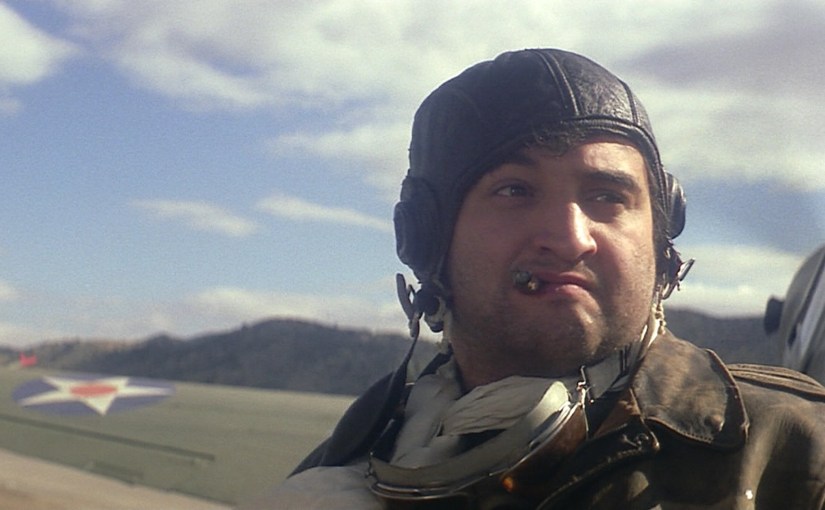
To allow a breather from this, the writers sidetrack over to Tim Matheson and Nancy Allen getting frisky in an out of control bi-plane while being mistaken for the enemy by John Belushi doing a very poor resurrection of his Bluto character from Animal House.  As Captain Wild Bill Kelso, Belushi’s pursuit fires upon everything else in sight, especially Hollywood Boulevard, but misses the plane occupied by Matheson and Allen.

The third point of this rectangle concerns Dan Aykroyd with John Candy and a whole platoon opting to set up a military cannon along the ocean view property belonging to Ned Beatty and Lorraine Gary in anticipation of the Japanese invasion.  Ned Beatty is the best stooge of the entire cast as the nerdy resident determined to protect his home while exercising his patriotic duty.  Gary’s response to Beatty’s ineptitude cracked me up as well.  The house wreckage of The Money Pit has nothing on what occurs in 1941.

The fourth storyline focuses on the enemy with a German speaking Nazi portrayed by Christopher Lee debating with the captain of a Japanese submarine (Toshiro Mifune) plotting to bomb Hollywood.  Somehow, each foil understands the other’s language.  These guys are just here to scream at one another.  There’s nothing funny about them.

Oh yeah.  Robert Stack is the Army General who watches Dumbo in the movie theatre while Hollywood Boulevard gets demolished outside.  Ho! Ho!

Often, I compliment Spielberg for his reliance on the sets he provides.  Everything you see on the screen serves a purpose to his films.  It happened as recently as with his remake of West Side Story in 2021, and it’s effectively used in Close Encounters…  He uses the same approach with 1941.  In this film though, there’s no pulse or significance to the props and pieces that are used.  The house is demolished.  So is the storage shed.  So is the movie theatre.  So is the Ferris wheel.  Yes.  What you’ve already seen in endless Looney Toons cartoons occurs here with a miniature model.  The Ferris wheel comes off its hinge and rolls across the beach side dock into the water along with Murray Hamilton and Eddie Deezen in tow.  When it happens, you’ll tell yourself I was waiting for that to happen.  What you expect to happen, happens, but you’re not laughing at it.

None of what you see in 1941 are terrible gags.  If you watch one scene out of context on a four minute You Tube channel, you may chuckle.  The problem is that every scene is treated like throwing spaghetti at a wall and seeing what will stick.  Mashing all of this together is not appetizing.  I like ice cream and I like steak.  I don’t like my ice cream on my steak.  Any idea of development is completely ignored.  The film can’t even work like a collection of skits.  Even Airplane! had a romantic storyline trajectory to perform with.  Here, two jealous guys have a fist fight and it more or less stretches that fight for an entire two hours.  The Three Stooges knew when to eventually quit.  Spielberg, Zemeckis and Gale didn’t. 

As soon as I saw Belushi on screen, I laughed.  It’s Bluto again.  Yet, the appearance wears off very quickly.  He has little dialogue and is limited to chomping on a cigar while grunting and groaning as the fighter plane he occupies wobbles around shooting at everything in sight.  When he eventually crash lands, Belushi continues to chomp on the cigar and grunt and groan.  Only now, he pratfalls as well…badly.

Ned Beatty is the real star here.  The ultimate nerd is also limited in dialogue. Still, to watch his body language with his glasses and bow tie and pear-shaped physique, accompanied with Lorraine Gary’s helpless gasping wife responding to the damage he commits with the cannon is hilarious.  Absolutely hilarious.  Tape all of their scenes together and make it a short to present ahead of the main attraction in a movie house. The audience will have a great time.

Otherwise, the only other fun I got out of 1941 was spotting the stars that were relevant at the time of its release.  Candy, Aykroyd, Frank McRae, Slim Pickens, Christopher Lee, Robert Stack, the cute blonde daughter from Eight Is Enough.  Even Penny Marshall has a quick blink and you miss it moment.  Oh, and look, there’s Lenny and Squiggy!

I think Zemeckis and Gale were on to a real smart idea here.  They maybe should have consulted with Harold Ramis and his National Lampoon’s crew however, because that’s the direction Spielberg’s film was aiming for.  What sets a film like Animal House apart from a 1941 though is in the set up.  Dialogue also helps.  1941 lacks set up.  1941 lacks dialogue.  It’s all visual and noise and more noise and more noise. 

1941 begins at letter A, and stops at letter A, never making it to B, and definitely never reaching Z.  An idea with potential was put down on paper.  The problem is these guys stopped writing after the first sentence.