
SIXTEEN CANDLES

By Marc S. Sanders

John Hughes became a pop culture pioneer of the 1980s when he directed his first film, Sixteen Candles. The movie adopted a slapstick approach to teen anxiety related to love, cliques and high school popularity. Had Hughes waited much longer, it’s fair to say the picture may not have ever gotten produced. In a current age of political correctness and “Me Too” movements, Sixteen Candles is more shocking than originally intended.

There is no way this film would be made with a character like Long Duk Dung as a run-on gag Chinese foreign exchange student with a stereotypical Asian accent of mispronunciations, presumptions of mental retardation, and an accompanying “GONG” each time the film circles back to him. It is fair to say this is equivalent to when Buckwheat would wipe the sweat off his brow against a nearby wall and it would appear as ink stains in a random Our Gang/Little Rascals film. Actor Gedde Wantanabe who plays Dong has gone on record saying he was vilified for the role since the release of the film. Likely he was also quite embarrassed. I wouldn’t blame him.

Date rape is also a common element of the film. Dong is implied to be a victim by a butch high school girl. In another storyline the hot guy Jake Ryan (Michael Schoeffling), who drives a cherry red Porche, implies to the geek, Farmer Ted (Anthony Michael Hall), an offer to have his way with Jake’s intoxicated girlfriend. Freshman nerd Ted takes as much advantage of the opportunity as he can by taking photographs with the girl and then even forgetting what exactly occurred the next morning but making hopeful assumptions nevertheless, simply to bolster his reputation.

I don’t draw attention to these tropes to celebrate and guffaw though. The film continues to have a staying power with Hughes’ name labeled on the picture as well its recognition for making Molly Ringwald an ongoing cover photo for Teen Beat and Rolling Stone magazines during the MTV Generation.

Perhaps John Hughes had no idea at the time that his material would carry a shock element beyond plain silliness. I’m almost convinced of that. It’s fair to say Sixteen Candles is a byproduct of the raunchiness delivered by Animal House. I’m content with that because it is very, very funny in spite of the offending and inappropriate material.

Molly Ringwald is Samantha who is beside herself when everyone has forgotten her sixteenth birthday while gorgeous Jake seemingly doesn’t even know she exists. The family’s focus is drawn to her older sister’s upcoming nuptials the next day. It’s a lot to deal with for a high school sophomore. Ringwald embraces the frustration nicely as she doesn’t try for the comedy but often becomes the embarrassing victim of Hughes’ set ups: invasively touchy grandparents, Long Duk Dong, Farmer Ted’s obsession with her, and even giving up her underpants as a special favor. Samantha is the straight character among all the clowns in the cast, including her jerky younger brother played by Oscar nominee Justin Henry (Kramer vs Kramer). Paul Dooley, known for a career as a notable schlub, offers a nice scene or two with Ringwald as her father. John Hughes allowed himself to demonstrate how much he respects the characters he’s invented even if he spent the first two thirds of the picture humiliating them.

The transitional arc of the script almost parallels Hughes’ method of writing in his career. The comedy is sketched primarily in broad strokes. I said earlier it is rife with prejudiced humor, raunch and slapstick. That is until the end arrives with a mature, candle lit first kiss over a birthday cake accompanied by the sweet, soft melodies of the Thompson Twins. It’s adoring, sensitive, and Hughes closes the book on Sixteen Candles with the love and care he awarded most of his characters during his filmography. In one film, John Hughes approaches a level of maturity by the time the story’s end arrives.

The tenderness Hughes shows in the concluding scene of Sixteen Candles would become more evidently special in his later films like Ferris Bueller’s Day Off, Pretty In Pink, (not directed, only written by him), The Breakfast Club, and Planes, Trains & Automobiles.

John Hughes’ legacy is unmatched. Sixteen Candles is proof of that, and though some today would be dismissive of its ingredients, it remains a defining film of what the 1980s provided, culturally. If you grew up during the decade of excess or likely the grunge of the ‘90s, chances are you attended a sleepover with friends watching Molly Ringwald as the lovestruck, but crushed Samantha. She had to survive the most awful night of high school, coincidentally occurring on the day of her sweet sixteen, while making wonderful memories of laughter, tears, love and bonding.

NOTE: I waited to post this review for over two years until the eve of my daughter Julia’s 16th birthday. Happy Birthday Jules. I didn’t fucking forget your birthday!

THE BREAKFAST CLUB

By Marc S. Sanders

The outcry of teen angst in the 1980s comes through predominantly in the dramatic talking piece called The Breakfast Club.  I look at the film as a mature interpretation of Charles Schultz’ Peanuts Gang actually, and maybe an extension of some of the themes found in Steven Spielberg’s E.T. The Extra-Terrestrial.  The children are heard.  The adults are present but are mostly muffled and out of consideration.  Writer/Director John Hughes wanted the five teenagers destined to occupy a Saturday in the school library for detention to completely undo their armor.  With adults in the way, kids can never truly be themselves.  Lies, exaggerations and attempts at acceptable image come first but as his script progresses, the teens are reduced to expressing how they value themselves and each other. 

Having grown up watching The Breakfast Club by myself on many Friday nights after some challenging weeks of school, I was always looking to sit on the floor with this pack and share my own demons and fears.  Sometimes it worked.  Sometimes I felt as if the brain (Anthony Michael Hall, as Brian), the athlete (Emilio Estevez as Andrew), the basket case (Ally Sheedy as Allison), the princess (Molly Ringwald as Claire) and the criminal (Judd Nelson as John) spoke back to me and told me when I was wrong or when I was justified for having felt like I did. 

Nearly forty years later, some of the thought processes the five endure of themselves seems outdated and inappropriate, however.  For example, in Hughes’ film the female characters are sexually harassed, harshly criticized and/or they succumb to stepping outside their comfort zone and changing their appearance to please a male character.  Had this film been released in a post Me Too era, I think both sides of the political aisle would protest its content.  The Breakfast Club is certainly a movie of its day where it’s treated as comedic escapism to have Nelson’s character commit a fellatio act upon Ringwald’s panty covered crotch.  Do not mistake me.  I am not crying foul and demanding censorship or calling for torches and pitchforks.  The contents of The Breakfast Club should certainly remain preserved and viewed upon as what was a mindset of films in the 1980s, and perhaps how the opposite sexes treated one another then.  Sadly, it is still happening all too often.

The success of the film relies upon the differences in the characters.  None of them have the same interests.  Yet, if you allow them to live among themselves without any outside influences, they will open up to one another.  Hughes’ film begins where the characters hardly speak.  John gets the ball rolling as the troublemaker looking for shock value as he attempts to urinate on the floor in front of the others and then succeeds in unifying the students when he causes the library door to remain shut keeping Mr. Vernon (Paul Gleason), the teacher/antagonist, out of reach of them.  Why should the five work together against Mr. Vernon?  They don’t know or have respect for each other.  Why?  Because one generation will stand arm and arm against another generation, specifically a domineering entity. 

Now that they are isolated, Hughes writes in set ups allowing the five to shed their skin.  In one scene, the ladies empty the contents of their purses while the men’s wallets are exposed.  John sleeps around.  Allison may be mentally ill.  Claire lives off the vanity that comes with makeup and perfumes.  Brian’s middle name is revealed.  (“Ralph, as in puke.”)  The kids lie about their sexual conquests only to be cornered into telling how little experience some of them actually have.  Maybe the most common plane they share are their home lives.  Each uncovers how they relate to their parents and none of them have an ideal upbringing.  Rather, they are disregarded or abused or forced into an appearance they really are not passionate about.  Before the film ends, the five will have their battle cry of dancing individually first, and then lined up together, unified, to a song titled, We Are Not Alone

Hughes even allows enough time and subtlety to demonstrate how Mr. Vernon seems to suffer.  There’s a quick moment, where Vernon commits John to two months of detention.  As Vernon storms out of the room, John screams out “Fuck You!” and Hughes keeps a closeup on Vernon letting out a weary sigh.  His exhaustion of being the authoritative adult is wearing on him.  Yet, after twenty-two years of teaching it is also the only pedestal he has left to stand on; to rule over five misfits on a boring isolated Saturday.  Later, he’ll only feel his most powerful when he has John imprisoned away from the others and he can antagonize and threaten him with the intent of elevating his stature over a punk kid.  (Ironically, this moment also reveals how weak John is and not the intimidating bully he holds himself to be in front of the others.)  Later, Vernon tells the janitor how he’ll have to worry about these kids growing up to look after him when he is elderly.  He’s been so occupied with being sadistically cruel, he has not allowed time to carve out a balanced future.

The Breakfast Club is an important piece to watch for uncovering teenage mentality and the subconsciousness.  How do teenagers function by themselves, with outsiders, with their peers, and with their parents?  What’s best celebrated in many of John Hughes’ films are when he allows his characters not to hinder how they truly regard one another.  While I won’t spoil how these five consider each other by the end of this particular Saturday, as an adult and one who analyzes story more carefully than I did at age fourteen, I am disappointed with how Hughes concludes his film.  At least for four of the characters, it doesn’t seem right.  While I’m let down though, that doesn’t mean the movie is wrong. 

Teenagers will not always act upon what is right or more precisely what they know to be right or just.  Our teenage years are an opportunity to commit and then learn from our mistakes.  In our adolescent years, we explore what is forbidden with misbehavior and risk whether it be rebelling against authority, daring to drink and do drugs, acting upon sexual impulse or exacting bullying and peer pressure.  Even sneaking through the hallways around school is a game of cat and mouse where the goal is not to get caught by the teacher.

I’m inclined to recommend that parents watch The Breakfast Club with their kids when they are mature enough for the material.  Yet, I really don’t want to.  The whole point of the film is to cut off these kids from the outside world of parents and teachers and peers who expect something different of them than how they truly see themselves.  If my daughter were to watch this movie with mom and dad sitting right next to her, then she might not unequivocally respond to what Andrew, Claire, Allison, Brian and John really have to say.  To get in their minds, my daughter would have to watch without any outside influence where the conversation she has with the film is private between The Breakfast Club and her.  Perhaps, then she’ll see another teenager’s honest point of view.

PRETTY IN PINK

By Marc S. Sanders

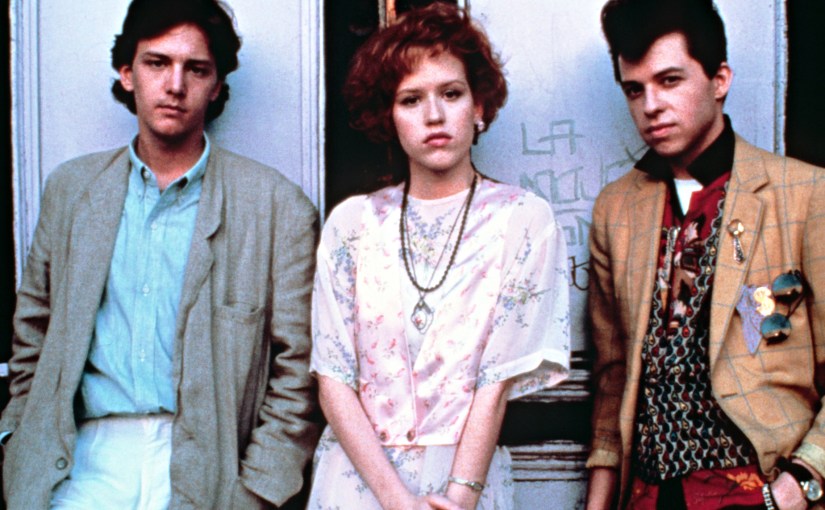
Director Howard Deutch directs John Hughes script, Pretty In Pink, by adhering to the familiar themes quickly recognized as Hughes’ signature touch from prior films. Deutch and Hughes maintain a vibe of alternative rock music amid a Chicago public high school community that could never be possible. Did I have this much independence in high school like Molly Ringwald as Andie, her adoring rich boy crush Blaine (Andrew McCarthy), or weirdly annoying (and lovable at the same time) Duckie played by Jon Cryer? And, oh yeah, a high school senior asshole named Steph played by asshole character perfectionist James Spader with his long cigarettes, Italian suits and barely buttoned shirts would never exist in an institution of education. So, there’s that too.

The kids at this school are divided among two different sides of a track-poor (Andie & Duckie) and rich (Blaine & Steph). Never meant to socialize or get along, the conflict of the film occurs when Andie and Blaine fall for one another.

This is Molly Ringwald’s 3rd Hughes film and looking back maybe it was a mistake for her career as she was outgrowing the roles she was getting pigeonholed for. Still, who else could you envision in the role of the aspiring dress designer who is responsible for her schlub of a father she lives with (Harry Dean Stanton), and friends with a weirdly eccentric, 80s punk/alt dressed co-worker played by Annie Potts?

Hughes’ is quite serious here, though the setup is not acceptably realistic, even back in 1986. These characters are competitive with one another for status in a high school setting. What other environment could the outline for Pretty In Pink take place in, though? Prom is on the minds of these “adults.”

Pretty In Pink was never a perfect movie. It has a perfect soundtrack, and I like the cast a lot as well as Hughes’ characterizations. Its glaring imperfection, however, is that these characters fit like a circle in the square setting of high school. The elements clash big time.

Still, I’ve always had an unusual affection for the film. I guess it is because I look past its inaccuracies and accept a playing field and the positions that Hughes and Deutch defiantly assign to the four characters. How does the intrusion of background and status overcome an affection between two people, and can this ever be happily resolved?

The ending was supposed to be different, very different. Yes. I should agree with the original conclusion because the math of the story adds up to that point. However, Reader…I am as defiant a viewer as Hughes and Deutch were as filmmakers. It’s wrong!!!! Nevertheless, I loved the ending that was eventually tacked on. So don’t judge me.