
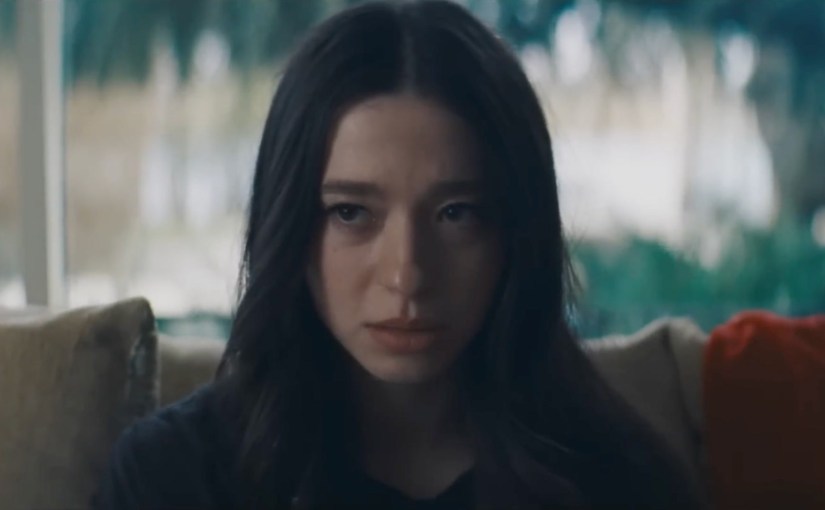
ANORA

By Marc S. Sanders

Anora, or Ani as she prefers to be called, had to have been a character that writer/director Sean Baker always intended on loving.  Not in an intimate way though.  Sean Baker had to deeply care about this twenty-three-year-old girl who has no connections or family or solid friendships or kinships.  Baker wrote about Anora, wanting her to be appreciated by someone who would finally embrace her. 

Anora—sorry…Ani…has a good heart.  She may be an exotic dancer at a New York City strip club, but she is someone who has every right to be respected and valued. If you choose to watch the film you’ll know why, as a pertinent prop referenced earlier in the picture suddenly resurfaces when you least expect it.  A minute or two later the closing credits appear amid the sound of flapping windshield wipers and there is no music to cue your emotional response.  You likely will have spent the last two and a half hours laughing loudly, dropping your jaw, and gasping in shock at what unfolds for Ani. In the end though, you’ll realize that you want the best for her, like her creator did when he originally drafted this script and shot the film about Ani’s episodic escapades.

Sean Baker’s film is eye opening right from the start.  Club music blares within the HQ, the name of Ani’s strip joint where she collects an exorbitant amount of dollar bills while she strategically flirts with middle-aged men and frat boys looking for an evening of debauchery.  She has a talent for one on one charm with any customer, as she repeatedly bares her chest and reveals her thong, but she also delivers a very satisfying service.  A young man named Ivan, sometimes it’s Vanya (Mark Eydelshteyn), specifically requests a girl who speaks Russian to cater to his needs.  Ani is the only one who can comply.  Ani and Ivan get to talking, mostly in Russian but limited English too.  She gets invited to his private, deco mansion, which is really owned by his Russian aristocratic parents, and a slap happy relationship of sex and more sex, and money, and drugs and drinking and partying and New Year’s Eve partying and money, and clothes and expensive coats, and travels to Las Vegas ensue.  (Yes! I know that was a run on sentence.  My elaborate text does not even come close to what these twenty-somethings indulge in though.  It must be seen to be believed.)

Anyway, since they’re in Vegas, why not get married?  Vows are taken, the bride is kissed and Ani is emptying her locker at HQ for a promising future of being a spoiled, but loved, aristocratic wife.

In the few times that Ivan calms down, he is only engrossed in his online video games while Anora lies on his chest with an expression of wanting more than to come in second to Call Of Duty. Baker focuses on Ivan’s childish habit a few times.  So be sure to observe how Ani sadly looks upon an inattentive Ivan.

A problem occurs though that neither character could ever expect.  The tabloids have reported that Vanya, this spoiled brat son of a Russian oligarch, has up and married a prostitute. Now the family image is at risk of being shamed.  Mom and dad are on their way back to the states and have summoned Toros (Karren Karagulian), an Armenian Catholic priest and the son’s Godfather, to round up Vanya and the so-called whore to get the marriage annulled immediately.  Not divorced!  Divorce does not happen within the legacy of this family.  An annulment is what is needed. 

Toros rounds up Igor and Nick (Yura Borisov, Paul Weissman) to get over to the house right away, get the marriage license and bring the kids in for the quick annulment at the courthouse.  If only it were that simple.

Watching Anora allowed me to reminisce about other films that catered to outrageous debauchery and led to a domino effect of problems.  Doug Liman’s Go for example, or True Romance written by Quentin Tarantino, or even a super ridiculous comedy known as Very Bad Things with Christian Slater and Cameron Diaz.  The first two examples are very good films because the dialogue is sharp with eclectic casts who elevated simplistic material.  Let’s not talk about the third one, but I will say it is delicious junk food.  With Anora though, just when you think you know where this story should be going it doesn’t.  You think it will turn right, but then it makes a sharp left and Sean Baker knows he just needs to keep the fighting and the screaming and the cursing at an organic natural level.  What do you do when the wards you are put in charge of will not cooperate?  What if one of them goes missing and simply won’t answer his cell phone?

Well, on a cold winter night you may get a broken nose, car sick, and your car might get towed.   Anora is not about big stunts or gratuitous violence.  It’s not mobster movie material either.  Anora works naturally for people in desperate situations, from a handful of different perspectives.

Oh yeah.  Anora—sorry Ani, is played by Mikey Madison and she is bound for marquee attraction over the next twenty or thirty years.  This performance is so concentrated in moments of natural glee, anger, and maybe despair and sadness.  You applaud her character’s strength.  Ani talks like an updated version of Judy Holliday from Born Yesterday, but she’s no dummy and she never succumbs to intimidation.  I’ll confess it right here.  If two hulking Armenian thugs approach me, I’ll do whatever they want me to do. Ani gets all my props though.  She will never settle.  She’s a married woman and no one will deny her of her rights.

Mikey Madison has such wonderous chemistry with Sean Baker’s camera.  There must be over a hundred and fifty close-ups on this young actor and each one is unique.  I was sad for Anora when Ivan would not give her attention.  I was cheerful when the two were overindulging in carefree sex and sin city fun.  I was on Anora’s side when she was restrained. I was admirable of her giving a good fight to the giants that enter her space.  I was exhausted with her as she was forced to sit in Toros’ car while brainstorming where her husband could be.  I was supportive when she makes appeals with the family to offer a good first impression.  She hates her name, but she introduces herself as Anora to Vanya’s steely mother. Ani is willing to make all of this work. Finally, I was angry—very angry–alongside of her whenever she was unfairly treated like garbage. 

Amid all of the chaos that ensues, Sean Baker works like the eyes of the film’s audience. We keep guard over Ani’s condition and state of mind as she’s coerced into looking all over Brooklyn and Coney Island for her new husband that the Armenians need to find before the boy’s parents arrive by noon the next day. 

None of the dialogue is crafty like Quentin Tarantino’s or Neil Simon’s.  I could not quote a single line.  The yelling and conversations and overtalking and interruptions are natural and raw.  Sometimes, the exchanges feel pointless until you arrive at another scene that demonstrates with brilliant insight why certain throwaway moments are preserved in the final print of the film.  It makes complete sense that Sean Baker did not just write, produce and direct this film.  He edited it as well. 

The whole way through the picture I kept wondering how this story would end.  I spelled out variations of doom for any one of the characters.  I considered gratuitous violence or swashbuckling adventure and daring escapes.  Man o’ man, have I become cliché.  Because just as you arrive at the picture’s conclusion, a meaningful prop puts the period at the end of the story and the last audible expression before the picture goes to black comes from Anora. You now realize that this girl, who is as self-reliant as many exotic dancers must be, has feelings too.  As defiant as Anora can be, she can also get pricked and bleed and the big laughs you responded to for most of the film are distant memories. Anora can feel pain like any of us.

When I drove home, I was hurting.  I was hurting for Anora, and my one wish is that I hope Anora will be okay.

Roger Ebert once gave a seminar that lasted for eleven hours as he commented on practically every shot and piece of dialogue in Tarantino’s Pulp Fiction.  My long shot wish is that on a subsequent viewing of Anora, I can deliver a similar kind of observational lecture to others who had already seen the film too.  I believe I could reveal sincerity and perception related to every close up, every chaos-stricken scene of panic or decadence, and especially when that one prop reappears. I’d likely spend a half hour simply discussing the value that this prop carries and what it means to Sean Baker’s film, and especially to Ani.

As messy and gritty as Anora may appear, it is also one of the most adoring and perceptive films to be released in a long time. 

Anora must be in my top five favorite films of 2024.  It might just be my favorite.  There are a few other candidates, but I left feeling so satisfied with Mikey Madison’s performance and Sean Baker’s sloppy, yet astute, little film. 

This is superb filmmaking.

ONCE UPON A TIME…IN HOLLYWOOD (2019)

by Miguel E. Rodriguez

Director: Quentin Tarantino
Cast: Leonardo DiCaprio, Brad Pitt, Margot Robbie, Timothy Olyphant, Dakota Fanning, Bruce Dern, Luke Perry, Al Pacino, Kurt Russell
My Rating: 10/10
Rotten Tomatometer: 84% Certified Fresh

PLOT: A fading television actor and his stunt double strive to achieve fame and success in the film industry during the final years of Hollywood’s first Golden Age in 1969 Los Angeles.


Quentin Tarantino’s ninth film is a little bit like Beethoven’s Ninth Symphony.  It’s big, bombastic, and goes the long way around the barn to get to the finale, but in the end it all makes sense and is a transcendent experience.

Let’s see, where do I start?

First of all, the film’s evocation of 1969 Los Angeles is like Mary Poppins: practically perfect in every way.  I’m no fashion scholar or visual historian, but every exterior shot of the city was pretty convincing to my layman’s eyes.  The movie theatres, the movie posters, the restaurants (anyone else remember “Der Weinerschnitzel”?), the cars, those HUGE sedans sharing the road with VW Bugs and M/G’s…it’s clear they did their homework.

There’s the performances by the two leads.  Tarantino once said he considered himself the luckiest director in modern history because he was able to get DiCaprio and Pitt to work on the same film.  Can’t argue with him on that score.  They carry the film in a way that few other tandems could have.  (Newman and Redford come to mind.) Mind you, DiCaprio and Putt don’t look much like each other, considering one has to be the other’s stuntman, but you get the idea.

Above all, there’s the story.  DiCaprio plays Rick Dalton, a former leading man from ‘50s TV westerns who is now playing colorful bad guys in ‘60s TV westerns.  Brad Pitt plays Cliff Booth, the stuntman who’s been taking the dangerous falls for Dalton for years.  Dalton happens to live next door to Roman Polanski and Sharon Tate on Cielo Drive in the Hollywood Hills.

All the trailers, and all the industry buzz, reveal that the Manson family and Sharon Tate play a part in the film.  That’s no spoiler.  Given what we know about those events, the movie plays like Gimme Shelter, the landmark documentary about the ill-fated concert at Altamont that was actually due to take place a few months after the events of this film.  It’s all very suspenseful, in the sense that we know what’s coming, but we’re just not sure how the movie is going to approach it.  So every scene with poor Sharon Tate in it is overshadowed by the fact that we know her ultimate fate in history.

It’s like the famous Hitchcock analogy of suspense.  Two people are eating at a restaurant when a bomb suddenly goes off under their table…that’s surprise.  Put those same two people at the restaurant, where the audience knows there’s a bomb under the table, but it doesn’t go off right away as the two people eat and converse and have dessert, and we’re wondering will they leave BEFORE the bomb goes off or not…?  That’s suspense.

And that’s the genius of this movie, with Tarantino’s sprawling, winding screenplay.  We get to know Rick Dalton and Cliff Booth intimately, we get the rhythms of their relationship, of Dalton’s mood on set, of Booth’s quiet acceptance of his role as Dalton’s sole support system.  We are treated to lengthy scenes showing Dalton at work on the set of a TV western, so we can appreciate the vast differences between an actor and their characters.  There’s a brilliant backstage scene between Dalton and a child actor who is impossibly, hilariously advanced for her age, and who winds up giving Dalton some goodhearted advice.

And interspersed through it all is Sharon Tate.  Sharon Tate bopping to music at home.  Sharon Tate picking up a female hitchhiker on her way into town.  Sharon Tate almost passing, then backing up to admire with youthful excitement, her name on the marquee of a movie theatre, right next to (gasp) Dean Martin’s name!  Sharon Tate dancing, walking, smiling, drinking…living.  She’s the diner at the restaurant, and the Manson family is the bomb we know will eventually go off.  It casts a pall over the proceedings, but not in a bad way.  It’s an interesting way to bring the reality of the situation into focus from time to time.

And now I have to end this review before I inadvertently give away certain, ah, plot elements that elevate Tarantino’s film from a mere character study or period piece into the heady heights of cinematic transcendence.  I have not myself read any reviews of the film, so I can only guess that whatever negative reviews are out there probably center on the film’s finale, or perhaps on its meandering script.  All I can say, or will say, is that I am firmly on Tarantino’s side on this one.  The way the conclusion was written and filmed is the kind of thing that people will still be talking about years from now.

So just take it from me.  If you’re a movie fan, and ESPECIALLY if you’re a Tarantino fan, this is right up your alley.  It’s easily his most slowly paced movie since Jackie Brown, but that just gives you time to e-e-e-ease into the characters, like putting on a tailored suit piece by piece.  This film, like Beethoven’s Ninth, is a masterpiece.

ONCE UPON A TIME IN…HOLLYWOOD

By Marc S. Sanders

There’s no question the most different of Quentin Tarantino’s directorial efforts is his latest film, Once Upon A Time In… Hollywood. Already described as his “love letter to cinema of the late 60s,” his 9th effort also implies the end of the Hippie Era by devoting a portion of time to B movie actress Sharon Tate, infamously murdered by Charles Manson’s followers when she was 8 months pregnant with Roman Polanski’s child.

Margot Robbie plays a near, gorgeous exact replica of Tate. She’s deliberately short on dialogue and I like to believe it’s because Tarantino treasures her as an innocent angel who was loving the atmosphere of Hollywood. She’s preserved of being nothing but likable. She dances with glee in her bedroom in the Hills or in public at the Playboy Mansion. One day she visits the local cinema to see her performance in “The Wrecking Crew” with Dean Martin. Tarantino shoots close ups of Robbie loving her footage as a pratfall klutz while listening to the audience reaction. She’s loving every second of the experience. People love her and she sees the love she has for people. Critics took issue with Robbie’s lack of dialogue. Not me. The performance is all there. Robbie is wonderful to look at with responses of pure happiness and celebration.

The main focus of the film is on Rick Dalton played by Leonardo DiCaprio with a huge range of drama, comedy and well intentioned over acting when Tarantino is wanting to spoof the TV western for fun. We see a collection of Dalton’s work, most especially on the fictional black and white TV western that airs Sundays at 8:30 on NBC (cue Dalton’s cowboy hat close up accompanied with “BONG, BONG, BONG!).

Rick is realizing he’s becoming past his prime. Marty Schwarz, his agent and a producer, played by Al Pacino warns Rick that he’s at a point where he’s only going to be the villain of the week on The Green Hornet and Batman. Rick does not take this well. Using his stunt double pal, Cliff Booth (Brad Pitt) to talk to, Rick is consumed with insecurity and alcoholism.

Tarantino wants to depict an era in Hollywood on its way out. A fictional character like Rick and the well known fate of Sharon Tate symbolize this turning point.

A third example is with Cliff. Rumored to have killed his wife, Cliff has trouble finding stunt work on a set. So he’s happy enough to just drive Rick around in his Cadillac, and fix his antenna. A great moment occurs when Cliff antagonizes a cocksure fist of fury Bruce Lee to a fight. Bruce doesn’t do so well against Cliff. Bruce Lee maybe not be what he once was, or what audiences ever perceived. Times they a changin’.

This is not the aggressive film that Tarantino is mostly known for. It’s primarily calm as we see these characters navigate around Hollywood locals, listening to The Rolling Stones and the Mamas & The Papas, and various product advertisements. Rick and Cliff are suffering a little. Suffering at the loss of what they were and the world they are forced to enter, nor what they are accustomed to. Sharon is ready for what’s next. Yet, will she get the opportunity to carry on?

The ending is bound to leave people divided. It’s different and very, very unexpected. It makes no difference how you feel about it. What matters is if it generates a response, and based on the theatre where I saw the film, yes! Yes, there is a massive response to what occurs.

Tarantino’s Once Upon A Time In… Hollywood is not his best film. There were moments where I thought it was a little slow and the film lacks the dialogue punch that many know Tarantino for. There’s really not one memorable line that stayed with me. I guess that’s what the trade off is when you finally are served multi dimensional characters that Tarantino has hardly offered before.

It’s the best non Tarantino film that Quentin Tarantino has ever directed.