
ANOTHER WOMAN (1988)

by Miguel E. Rodriguez

DIRECTOR: Woody Allen
CAST: Gena Rowlands, Mia Farrow, Ian Holm, Blythe Danner, Betty Buckley, Martha Plimpton, John Houseman, Sandy Dennis, Philip Bosco
MY RATING: 8/10
ROTTEN TOMATOMETER: 59%

PLOT: Facing a mid-life crisis, a woman becomes drawn to the plight of a pregnant woman seeking psychiatric help from the shrink next door.


Woody Allen’s Another Woman is the first movie I can remember that compelled me to do a little background research before writing about it.  It is moody, somber, theatrical, and by far the least funny of Allen’s films that I’ve seen (and I’ve seen Blue Jasmine).  It falls in that part of his career when he was delving into more dramatic fare; September had been released the year before, and Crimes and Misdemeanors would come a year later.  There is none of the charm and lightness of his earlier comedies, which may account for why I’ve never seen it mentioned alongside his other films whenever his filmography is discussed.  And yet, I was curiously drawn into this story to such a degree that when two revelations arrive almost on top of each other, I gasped.

Another Woman tells a brief chapter in the life of Marion (Gena Rowlands), a middle-aged woman married to Ken (Ian Holm).  Marion is Ken’s second wife; she was literally the “other woman” that caused Ken to divorce his first wife, Kathy, played by Betty Buckley in a single devastating scene that vividly showcases the guilt that Marion and Ken have both learned to live with in different ways: Ken gently accepts Kathy’s “condemnation”, while Marion buries the guilt deep.

Marion is a professor of philosophy at a local university.  To work quietly on a new book, she rents a small one-bedroom flat nearby and uses it as her office.  However, through a trick of acoustics, she realizes she can hear voices coming from the flat next door through an air vent on the floor.  It’s a psychiatrist’s office, and she is suddenly privy to intensely personal conversations with his patients.  (I was reminded for a minute of Rear Window.)  One such patient is Mia Farrow, playing a character whose name I won’t reveal because it’s barely mentioned in the film for a reason.  She is pregnant, and during her sessions, she reveals doubts about her identity and/or purpose in life.

For Marion, who has always been sure about everything and everyone in her life, Farrow’s confession strikes a nerve, and the rest of the film consists of Marion’s struggle to reconcile her perception of herself and her well-constructed life with how everyone else truly sees her.  Throughout the movie, people are telling her how wrong she is about her relationships with her divorced brother, with an old friend, with her own husband, with her best friend, even with the Mia Farrow character.  Has she been deceiving herself her entire life?

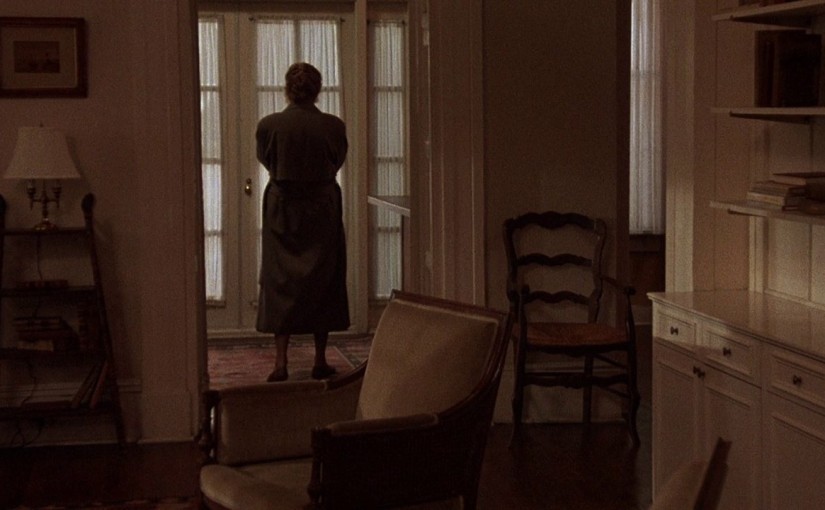
Okay, so this subject matter isn’t exactly a barnburner.  But consider how the movie looks and moves, and the performances from Gena Rowlands and her supporting cast (it’s Rowlands’s movie to win or lose).  Look at the warm, yet subdued lighting schemes, shot by Ingmar Bergman’s favorite cinematographer, Sven Nykvist.  (Allen is a huge Bergman fan – indeed, this film is actually a loose reinterpretation of Bergman’s film Wild Strawberries [1957].) Interiors look, not sad, exactly, but…lived in.  Bright sunlight is only ever seen from inside through a window.  Exteriors look as if Allen specifically waited for overcast days to shoot.  Everything matches Marion’s internal gloom as she re-examines her life.

At the center of the film is a dream sequence that feels more like a foreign film than anything I’ve ever seen from an American film.  Marion dreams she is in an old stage theater, where figures from her circle of family and friends are rehearsing a play based on moments in her life.  Is this self-indulgence from Allen?  Maybe.  The dialogue in this sequence is so formal and, I guess, elliptical at times that it almost feels as if it were something translated into English from another language.  Vincent Canby of The New York Times called this out, saying, “The rounded sentences sound as if they’d been written in a French influenced by Flaubert, then translated into English by a lesser student of Constance Garnett.”  I’ll probably understand this criticism more when I learn who Constance Garnett is, but I get his point.  However, while it was noticeable, I did not find it distracting.  I thought it was a fair interpretation of how our dreams rarely follow strict logic.  Marion’s dream is structured, but the content is skewed.  I was fascinated by it.

Do I think this is a movie you need to see?  Who can say.  I’m glad I saw it, at least.  It shows a side of Allen’s directorial psyche I had never seen before, even though I had read about it from many other sources.  And it inspired me to do a little introspection of my own, which is something, I guess.  The movie’s final scene includes a beautifully loaded question: “…I wondered if a memory is something you have or something you’ve lost.”  Marion has been asking herself this question the whole movie without realizing it.  I wonder if my answer would be the same as hers.  Or yours.

THE PURPLE ROSE OF CAIRO (1985)

by Miguel E. Rodriguez

DIRECTOR: Woody Allen
CAST: Mia Farrow, Jeff Daniels, Danny Aiello, Dianne Wiest, and…Jeff Daniels
MY RATING: 10/10
ROTTEN TOMATOMETER: 93% Fresh

PLOT: In 1935 New Jersey, a movie character walks off the screen and into the real-world life of a lonely, unhappily married woman.


I can imagine that it would be absurdly easy to poke holes in The Purple Rose of Cairo.  The premise is outlandish, taking place in the real world but firmly in the realm of fantasy.  It stretches the suspension of disbelief to the breaking point, then goes a little further.  It asks the audience member to forget cynicism and snark for eighty-two minutes and give in to the kind of hopeless romanticism that exists only on the movie screen.  And then, amid all that glorious make-believe, it abruptly confronts you with the knowledge that, yes, this kind of thing really does only happen in the movies, and the real world can be messy and unforgiving and sad.  Yes…but at our lowest points, we can always turn to Fred and Ginger, and Bogey and Bacall, and Luke and Leia, and Gene Kelly, and Hogwarts and the Emerald City.  The Purple Rose of Cairo reminds us that the movies allow us to escape reality for an hour or three.  Sign me up.

This movie’s plot is the embodiment of the “high-concept pitch.”  What if a movie character walked off the movie screen and tried to live in the real world?  I don’t have any statistics to support this, but I’m pretty sure there are at least 18,337 other films with variations of this fish-out-of-water scenario, most memorably Splash, Last Action Hero, and Who Framed Roger Rabbit.

In this version, Mia Farrow plays Cecilia, a semi-depressed housewife in 1935 New Jersey, living in a small town still in the grips of the Great Depression.  Her husband, Monk (Danny Aiello), claims he’s looking for work, but we only ever see him pitching pennies with his buddies or making life miserable for Cecilia at home.  Her wages from her waitressing job go directly to rent and groceries, and anything left over goes to Monk.  Amid this bleakness, Cecilia goes to see the new film opening at the local theater, The Purple Rose of Cairo, starring a dashingly handsome actor named Gil Shepherd in the supporting role of archaeologist Tom Baxter (both roles played by a young Jeff Daniels).  She is swept away by the glitter, glamour, and romance of the film.

Imagine her surprise when, during one of the many screenings she attends, Tom Baxter abruptly stops mid-sentence, breaks the fourth wall, and speaks directly to Cecilia from up on the screen.  “My God, you must really love this picture…I gotta speak to you.”  And he simply walks off the screen, much to the consternation of the movie audience, and walks out of the theater, arm in arm with Cecilia.  The wit with which Woody Allen handles the reactions of the audience AND the movie characters Tom leaves behind is priceless.  The characters and the real people react with perfect logic, so the effect is not one of slapstick (I can see an Adam Sandler version of this movie beating the joke to death), but one of a strange mixture of high and low comedy.  To relate the scenes here word for word would ruin the magic.  (An African-American maid steals every scene she’s in.)  Tom and Cecilia go off together, and the rest of the film is, from a plot perspective, fairly predictable.

What makes this movie unique is how it tells the story.  Tom knows what an amusement park is, but he has no clue what popcorn tastes like.  (“Been watching people eat it for all those performances.  When they rattle those bags, though, that’s annoying.”)  He has fallen instantly in love with Cecilia…love at first sight.  Tom hides in the city, and Cecilia lies to Monk to go back and see Tom the next night.  A nice touch comes when calls start coming in to RKO that the Tom Baxter character in prints being shown in other cities is also trying to escape his gilded silver-screen cage.  (“He almost made it in Detroit.”)  There’s the inevitable showdown between Tom and Monk.  Tom only knows the moves he uses on film, but Monk fights dirty.  However, the fight still doesn’t end quite as I expected…another nice touch.

The real crisis occurs when the studio calls in Gil Shepherd, the actor who PLAYS Tom Baxter, to New Jersey so he can try to wrangle his creation back into the movie where he belongs.  There is the expected confusion when Cecilia bumps into Gil, mistaking him for Tom.  The plot thickens even more when Gil starts falling in love with Cecilia herself, and she finds herself in a pickle.  She tells Gil, “I just met a wonderful new man.  He’s fictional, but you can’t have everything.”

The commentary being made here regarding our fascination with movie characters (and the movies themselves) as opposed to the actors who play them seems simple, but in trying to analyze it like a “real” critic, I feel helpless in the face of the ingenuity of the situation.  My words aren’t doing justice to the almost poetic elegance on display.  The more you love movies, the more you’ll appreciate what I’m desperately trying to convey.

There are two moments/sequences that elevate The Purple Rose of Cairo from a dramatic exercise into the realm of genuine movie magic.  One is when Tom wants to show Cecilia a night on the town, but they have no money (Cecilia is broke, and all of Tom’s movie money is fake).  But he remembers that, in the “fake” Purple Rose movie, the scene coming up after the one he abandoned takes all the characters to the Copacabana.  It’s here that the viewer simply must suspend what little disbelief remains and give in to the simple but grand gesture of watching Cecilia herself appear on the black-and-white screen with all of the people she’s been watching night after night.  They go to the Copa, and after watching the singer who’s supposed to be Tom Baxter’s love interest, Tom and Cecilia head out for a night on the town, as only 1930’s movies could provide.  (The maître d’ provides one of the movies biggest laughs when he suddenly realizes he can do whatever he wants…and does.)

But the greatest moment is the very ending, which I will try desperately not to spoil here.  It’s here where we get to the heart of what Woody Allen is really trying to say: The movies are here and real life is there, and never the twain shall meet.  Is this a depressing point of view?  Well, I mean…yeah, a little.  But it’s also indisputably true.  If we walked around like we were actually in a movie, we’d never lock our doors behind us when we walked into our apartment.  Everyone’s phone numbers would begin with “555”.  We’d turn on the light when answering the phone at night (who does that, really?).  But in the real world, none of that is true.  In the real world, hearts get broken, sometimes for good.  We get fired.  People die.  WE die.  Love the movies, Allen is saying, but never forget that you’re flesh and bone, and that actions have consequences.  I’m reminded of a good line from Ready Player One: “As terrifying and painful as reality can be, it’s also the only place that you can get a decent meal.”

The final shot of the movie, of Cecilia smiling through her tears, moved me like I’ve rarely been moved before.  It reminded me, perversely, of some of the worst times in my life because it was at those dark times that the movies came to my aid.  I went through a fair episode of depression in my twenties; a friend showed me Harold and Maude, and it literally changed my life.  During the Covid lockdown, I was furloughed, and the maddening Florida unemployment website sapped my will to live, figuratively speaking; my best friend, out of the blue, bought me a copy of Star Wars: The Rise of Skywalker just to cheer me up…and it did.  During that same period, several different films were in constant rotation in my movie room, all of which provided spectacular ways of escaping real life: Blade Runner 2049, Prometheus, The Martian, Interstellar, Gravity, and Sunshine [2007].  Not all laugh riots, to be sure, but they were excellent tonics against the constant worry of unemployment and disease.

And in 2017, Hurricane Irma threatened Florida.  For the first time, I was genuinely frightened that we would finally see real danger from a hurricane.  Miraculously, a local multiplex chose to stay open until almost the eleventh hour, and to get our minds off the approaching storm, I took my girlfriend to see the new remake of Stephen King’s It.  For two hours, we got scared out of our wits in the best way possible.  We escaped reality, and collectively we had our real-world fears literally exorcised.  I cannot tell you how grateful we were to have that brief respite from our troubles.

Those are the memories that came back to me in the final sequence of The Purple Rose of Cairo.  Yes, the real world is still the only place to get a decent meal, and it remains imperfect and sometimes painful.  But the movies are as close as a button click or a car ride.  They’re implausible and sometimes unrealistic and not always perfectly written.  But The Purple Rose of Cairo just wants to remind us of their power to cheer us up and transport us.