
By Marc S. Sanders
Film remakes can go either way. It’s even more of a challenge for it to succeed artistically if the original interpretation is such a favorite among the masses. The 2023 updated version of Disney’s The Little Mermaid directed by Rob Marshall is fair, but it also never overcomes the challenge.
The new film primarily repeats the same story that many are familiar with. A youthful mermaid girl named Ariel dreams about living among the humans above the surface. Her father refuses the idea as he finds humans to be vile and dangerous. Ariel makes a deal to trade in her beautiful voice to Ursula, the sea witch, in exchange for becoming a human. She is granted three days to fall in love with Prince Eric. If at the end of the three days she has not kissed the prince with a means of true love, she will turn back into a mermaid and will remain a prisoner of Ursula forever.
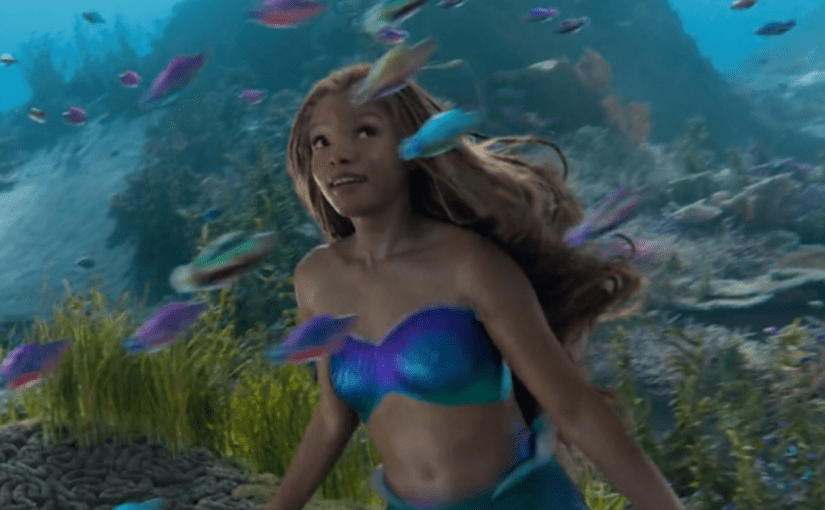
To call this new film adaptation of the Hans Christian Anderson fairy tale a live action film is only partially true. If we are to witness the undersea life of mermaids and talking fish, well then, it’ll have to be animated somewhat, even if it is done digitally. Therefore, to have the freedom to animate the sequences set to unforgettable numbers like “Part Of Your World” and “Under The Sea,” I wish the filmmakers were paying a little more attention.
Consider some lyrics to “Under the Sea:”
Down here all the fish is happy…
Up there all the fish ain’t happy
They’re sad, cuz they’re in the bowl
It doesn’t win my attention if Sebastian the singing crab is singing about fish while the heroine of the story, Ariel, is swimming among dolphins who are scientifically regarded as mammals!!!!!! You can show me any number of different colorfully prancing ocean dwellers, and you show me dolphins????? In a musical number, the choreography must serve the purpose of the song. In the original 1989 film, every animated image of any particular song lines up with the lyrics of numbers written by Alan Menken and Howard Ashman. Regrettably, Rob Marshall seems to have turned the sound off while reinventing this moment.
Sadly, I didn’t care for the updated composition of “Under The Sea” (an Oscar winning number) or “Part Of Your World.” Why alter the notes and vocal delivery of some of the most famed pieces in Disney’s musical library? Steven Spielberg’s update of West Side Story didn’t do that. Spielberg knows that if ain’t broke, don’t fix it. These are favorites!!!! I can’t be the only one who doesn’t like it when the artists change everything about his/her/their greatest hits when I’m at their concerts. The same accounts here.
Still, it’s not all bad in this new The Little Mermaid. Most of the cast is quite good. Newcomer Halle Bailey (sure to be memorable in the upcoming musical version of The Color Purple) is sensational and she’s wonderful to look at as either the mermaid or the human version lacking a voice. She has a wonderful singing voice and she’s a terrific actor against a CGI world of complicated water shots and imaginary creatures serving as her companions. Melissa McCarthy is unrecognizable as Ursula, the sinister squid sea witch. Her voice has a gruff intimidating edge to it and her torso and head donned in purple texture flow nicely with the CGI tentacles. Javier Bardem is not doing his best work here because the script doesn’t demand it of him, but he fits in nicely as Triton, king of the undersea and father to Ariel.
Jacob Trembley lends a preteen personality to Flounder whose role is significantly diminished in this update. That’s a mistake. Instead, we get more of Scuttle who doesn’t look like a pelican any longer but is a bird who can somehow hold his breath under water for long periods of time to carry on panicked conversations with her pals. Awkwafina voices Scuttle, and though I heard some laughter from the audience in response to her performance, it just didn’t win me over. I found this Scuttle to be a nuisance that took me out of the film with each appearance. The hip hop rap number (written by Lin Manuel Miranda) she performs was a very underwhelming substitute for comedy. What was sacrificed was the hilariously silly, slapstick number from the original, where the French chef enthusiastically sang “Les Poisson,” as he torments poor Sebastian in a kitchen full of knives, boiling water and searing hot stoves.
Sebastian, the well-known sidekick, is just okay. Daveed Diggs is a talented vocal performer, but I don’t think the final product served him well. Often, I looked at this little guy and was not impressed, as remembrances of disappointment came back to me when I saw Jar Jar Binks for the first time. Just like that Star Wars character, the googly eyes are detached from the head and Sebastian only evokes expression in that one area. Nothing is done with the tiny mouth or cheekbones or ears. Not even his claws or tiny legs offer much to do. This crab lacked life. As my colleague Miguel simply put it, the crab was not funny. He just wasn’t funny in the slightest.
A nice surprise comes from Jonah Hauer-King as the dashing Prince Eric, rescued from a shipwreck by a mysterious woman with a hypnotically, sensuous voice. Eric’s role is thankfully expanded with the inclusion of his mother the island Queen (Noma Dumezweni). Grimsby, the Prince’s aid, is also a welcome appearance (Art Malik) with more to do this time around.
I know for sure that I preferred the second half of the film over the first where new surprises are offered. Rob Marshall’s film switches the influence of the story to a calypso/Caribbean vibe which is different from the slightly implied Greek environment of the 1989 piece. This change allows a variety of different people of color and cultures to blend nicely together with believability. After Ariel transforms into a human and Eric guides her across the island for a day of fun and escape, the story and settings come alive in color and calypso harmony. In this area of the picture, much of the script is concentrated on Eric and his debates with his mother and her disapproval of the undersea colonies. Confidant conversations also arise between Eric and Grimsby that I liked. There’s more innocent flirtations between him and Ariel. Hauer-King has good scenes with all of his co-stars from Halle Bailey to Noma Dumezweni and Art Malik. The first half of the film is where much of the underwater life takes place, and it only convinced me so far, really taking me out of the film with the reinvention of the movie’s most famous songs.
Ultimately, like the live action interpretations of Aladdin and Beauty And The Beast this new version of The Little Mermaid is not a must watch and as much as I’m impressed with Melissa McCarthy, Halle Bailey and Jonah Hauer-King, I can’t recommend seeing it at $15 a ticket. Why should you when the easily accessible and wholly original film is available? This is just an unnecessary venture.
I’ve grown up as a Disney fan, but once again the Mouse House is demonstrating a lack of will to broaden its imagination. They’d rather run in with another cash grab at the box office by issuing a substandard product repeat.

 2 UNPAID MOVIE CRITICS!!!!