
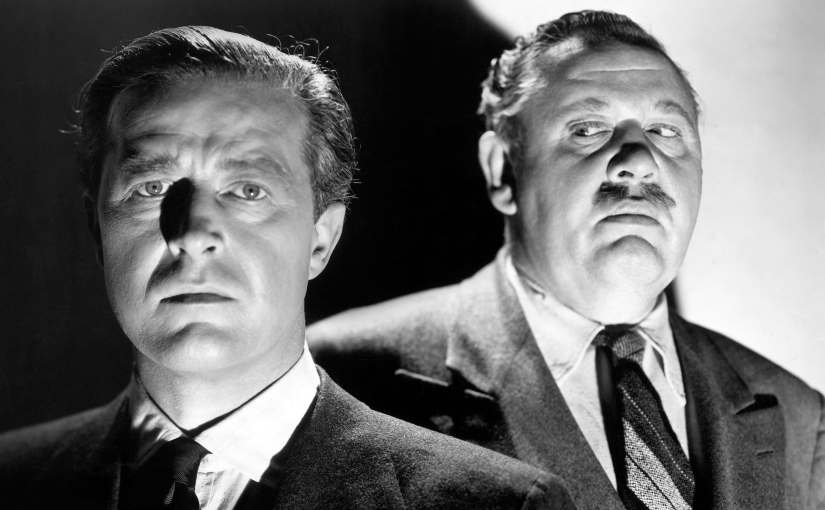
by Miguel E. Rodriguez
DIRECTOR: John Farrow
CAST: Ray Milland, Charles Laughton, Maureen O’Sullivan, George Macready, Elsa Lanchester, Harry Morgan
MY RATING: 10/10
ROTTEN TOMATOMETER: 100%
PLOT: A harried magazine editor finds himself in the unique position of trying to track down the person who murdered his boss’s mistress…when all the clues lead back to him.
I have been a fan of 1987’s No Way Out since first seeing it on cable umpteen years ago. The marvelous twists and turns in the script – yes, including that improbable ending – kept me guessing from the moment of the murder to the final pull-away shot. Having seen it multiple times, I always noted the fact that it was based on a book with an odd title: The Big Clock. Since No Way Out takes place mostly at the Pentagon, I always wondered what the story has to do with a clock, but I wasn’t motivated enough to track down the book, so I just let it go.
Imagine my surprise when years later, I discovered that No Way Out is not just based on a BOOK called The Big Clock, it’s also a reboot of an earlier film-noir from 1948, also called The Big Clock. For years I had never been able to track down an affordable copy of the movie until recently. I just finished watching it a couple of days ago, and wow. It has all the snappy pacing of a Howard Hawks screwball comedy, the witty dialogue of a Thin Man film, and the coiling suspense of Hitchcock at the height of his powers. The Big Clock is a forgotten film that deserves to be rediscovered by the public.
The story opens in typical noir fashion with our hero, George Stroud (the dour-but-likable Ray Milland) avoiding security guards before hiding inside a giant mechanical clock located in the lobby of the office building where he works. His voice-over narration wonders how he got into this mess and tries to figure out where it all began…and we’re on our way. So far, pretty stereotypical, not very promising. But once the prologue ends, the surprises start rolling in.
George’s boss is Earl Janoth (Charles Laughton), a clock-watching, penny-pinching tyrant who doesn’t hesitate to fire an employee who leaves a light on in a broom closet, for example. George is the editor of a magazine called Crimeways, one of many magazines in Janoth’s publishing empire. Crimeways specializes in investigative reporting like tracking down murder suspects, allegedly to assist law enforcement, but mostly so they can publish attention-grabbing headlines about captured criminals to boost circulation.
Through a series of events too circuitous to list here, George winds up missing a very important train (he was supposed to finally give his wife a long-delayed honeymoon) and spends a drunken night carousing with Pauline York (Rita Johnson), a blonde bombshell who also happens to be Janoth’s mistress. He winds up passing out on her couch at her apartment (having NOT slept with her, mind you), but is forced to skedaddle when Janoth unexpectedly shows up. Janoth catches a glimpse of George in the hallway but cannot see his face. When Janoth confronts Pauline, things get heated, and Pauline winds up dead. Instead of going to the police, Janoth confides in his second-in-command, Steve Hagen (George Macready, whom you may or may not remember as the slimy general in Paths of Glory [1957] who charges three men with treason for not following a suicidal order). Hagen returns to the scene of the crime, “amends” the crime scene, and comes up with a brilliant plan: use the magazine’s considerable resources to track down the mystery man Janoth saw outside Pauline’s apartment.
And who better to lead the investigation than George himself, whose investigative skills are second to none?
There is a delightful thrill of suspense when George receives his assignment and realizes that he cannot reveal the truth of his whereabouts without implicating himself, but he is compelled to lead the investigation as thoroughly as possible. There is an amusing but highly-charged moment when an investigator reaches a witness on the phone and starts dictating the suspect’s vital features…and they match George almost to a T.
The beauty of the film is the head-fake. We are shown the details of the drunken night George spend with the dead woman, but we are never tipped off that what we’re watching will eventually come back to haunt him. Green mint martinis. The hunt for a green clock. A sundial. An antique painting. An eccentric painter. A radio actor. All disparate elements that are almost thrown away while they’re happening, but all of which come back to neatly bite George in the ass at just the wrong moments.
I cannot stress enough how ingeniously the screenplay is constructed. One of the greatest joys of watching The Big Clock is admiring how airtight it is, how George is forced to fly by the seat of his pants from one moment to the next, putting on a show of doing his job while simultaneously trying to find a way to sabotage the investigation without showing his hand in any way. I won’t give away how he manages this high-wire act, but it’s brilliant screenwriting.
Eventually, the building gets locked down with George still inside and two or more witnesses who can identify him prowling the hallways, including one who is drawing a sketch of his face. At this point, even though I’ve seen No Way Out many times, I was 100% sucked into the story: “How can this guy possibly get out of this?” The answers will be just as unexpected to you as they were to me.
(I should mention a small role played by an impossibly young Harry Morgan. It’s one of the most sinister performances by a mute character that I’ve ever seen. One shot in particular feels out of time, like it was shot in a movie from the ‘60s or ‘70s. Creepy stuff.)
The Big Clock deserves a place among the great noirs like The Maltese Falcon, Out of the Past, and The Big Sleep. It’s filled with great performances, the visuals are suitably moody and shadowy when necessary, and the plotting is impeccable. What more can you ask from a great film noir?
 2 UNPAID MOVIE CRITICS!!!!