ANOTHER WOMAN (1988)

by Miguel E. Rodriguez

DIRECTOR: Woody Allen
CAST: Gena Rowlands, Mia Farrow, Ian Holm, Blythe Danner, Betty Buckley, Martha Plimpton, John Houseman, Sandy Dennis, Philip Bosco
MY RATING: 8/10
ROTTEN TOMATOMETER: 59%

PLOT: Facing a mid-life crisis, a woman becomes drawn to the plight of a pregnant woman seeking psychiatric help from the shrink next door.


Woody Allen’s Another Woman is the first movie I can remember that compelled me to do a little background research before writing about it.  It is moody, somber, theatrical, and by far the least funny of Allen’s films that I’ve seen (and I’ve seen Blue Jasmine).  It falls in that part of his career when he was delving into more dramatic fare; September had been released the year before, and Crimes and Misdemeanors would come a year later.  There is none of the charm and lightness of his earlier comedies, which may account for why I’ve never seen it mentioned alongside his other films whenever his filmography is discussed.  And yet, I was curiously drawn into this story to such a degree that when two revelations arrive almost on top of each other, I gasped.

Another Woman tells a brief chapter in the life of Marion (Gena Rowlands), a middle-aged woman married to Ken (Ian Holm).  Marion is Ken’s second wife; she was literally the “other woman” that caused Ken to divorce his first wife, Kathy, played by Betty Buckley in a single devastating scene that vividly showcases the guilt that Marion and Ken have both learned to live with in different ways: Ken gently accepts Kathy’s “condemnation”, while Marion buries the guilt deep.

Marion is a professor of philosophy at a local university.  To work quietly on a new book, she rents a small one-bedroom flat nearby and uses it as her office.  However, through a trick of acoustics, she realizes she can hear voices coming from the flat next door through an air vent on the floor.  It’s a psychiatrist’s office, and she is suddenly privy to intensely personal conversations with his patients.  (I was reminded for a minute of Rear Window.)  One such patient is Mia Farrow, playing a character whose name I won’t reveal because it’s barely mentioned in the film for a reason.  She is pregnant, and during her sessions, she reveals doubts about her identity and/or purpose in life.

For Marion, who has always been sure about everything and everyone in her life, Farrow’s confession strikes a nerve, and the rest of the film consists of Marion’s struggle to reconcile her perception of herself and her well-constructed life with how everyone else truly sees her.  Throughout the movie, people are telling her how wrong she is about her relationships with her divorced brother, with an old friend, with her own husband, with her best friend, even with the Mia Farrow character.  Has she been deceiving herself her entire life?

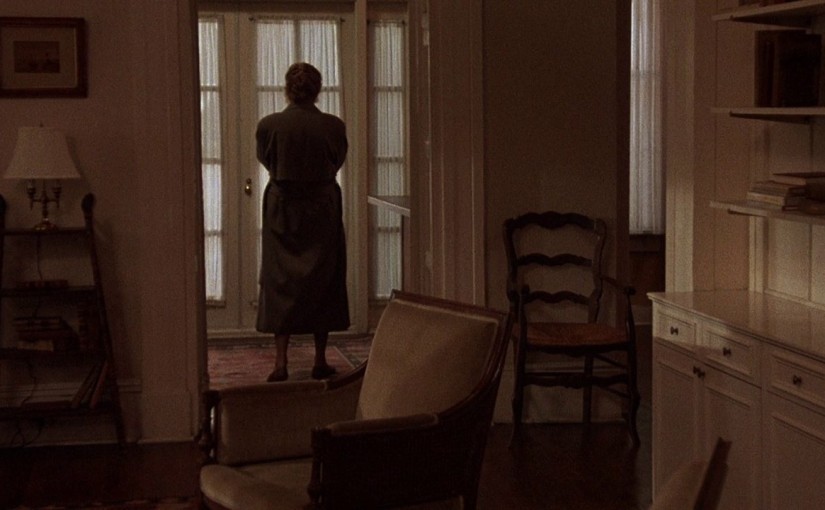
Okay, so this subject matter isn’t exactly a barnburner.  But consider how the movie looks and moves, and the performances from Gena Rowlands and her supporting cast (it’s Rowlands’s movie to win or lose).  Look at the warm, yet subdued lighting schemes, shot by Ingmar Bergman’s favorite cinematographer, Sven Nykvist.  (Allen is a huge Bergman fan – indeed, this film is actually a loose reinterpretation of Bergman’s film Wild Strawberries [1957].) Interiors look, not sad, exactly, but…lived in.  Bright sunlight is only ever seen from inside through a window.  Exteriors look as if Allen specifically waited for overcast days to shoot.  Everything matches Marion’s internal gloom as she re-examines her life.

At the center of the film is a dream sequence that feels more like a foreign film than anything I’ve ever seen from an American film.  Marion dreams she is in an old stage theater, where figures from her circle of family and friends are rehearsing a play based on moments in her life.  Is this self-indulgence from Allen?  Maybe.  The dialogue in this sequence is so formal and, I guess, elliptical at times that it almost feels as if it were something translated into English from another language.  Vincent Canby of The New York Times called this out, saying, “The rounded sentences sound as if they’d been written in a French influenced by Flaubert, then translated into English by a lesser student of Constance Garnett.”  I’ll probably understand this criticism more when I learn who Constance Garnett is, but I get his point.  However, while it was noticeable, I did not find it distracting.  I thought it was a fair interpretation of how our dreams rarely follow strict logic.  Marion’s dream is structured, but the content is skewed.  I was fascinated by it.

Do I think this is a movie you need to see?  Who can say.  I’m glad I saw it, at least.  It shows a side of Allen’s directorial psyche I had never seen before, even though I had read about it from many other sources.  And it inspired me to do a little introspection of my own, which is something, I guess.  The movie’s final scene includes a beautifully loaded question: “…I wondered if a memory is something you have or something you’ve lost.”  Marion has been asking herself this question the whole movie without realizing it.  I wonder if my answer would be the same as hers.  Or yours.
THE GOONIES

By Marc S. Sanders

You know how there are some movies designed for that unexpected thunderous rainy, Saturday afternoon?  Maybe a Star Wars flick or an Indiana Jones.  James Bond or Marvel?  For me the best candidate is probably The Goonies, where the rascally kid in all of us comes alive, yearning for adventure like riding our bikes through the paths of the sleepy town we live in over to a hiding spot on the other side of the woods where a once long lost treasure map begins an unknown journey.  Quick on our tales though are the bad guys with the humped back, crooked nose and clicking revolver.

Richard Donner did more for The Goonies than I think a lot of people realize.  It’s no wonder to me that the film is officially inducted into the National Film Preservation Archives since 2017, the same year that pictures like Guess Who’s Coming To Dinner, Ace In The Hole and Titanic also received their recognition.  Maybe Donner had help from producer Steven Spielberg and screenwriter Chris Columbus.  Granted, ahead of the age of cell phone addiction, these guys knew how twelve and thirteen year old kids ticked.  The Goonies bond over insulting each other, shoving one another, telling each other to shut up and freely dropping the s-word.  It’s a rite of passage.  It’s how I bonded with my buddies at that age.  Heck, I still maintain contact with my best friend at the time, Scott, and we still trade barbs like that even if we live over a dozen states away from each other.

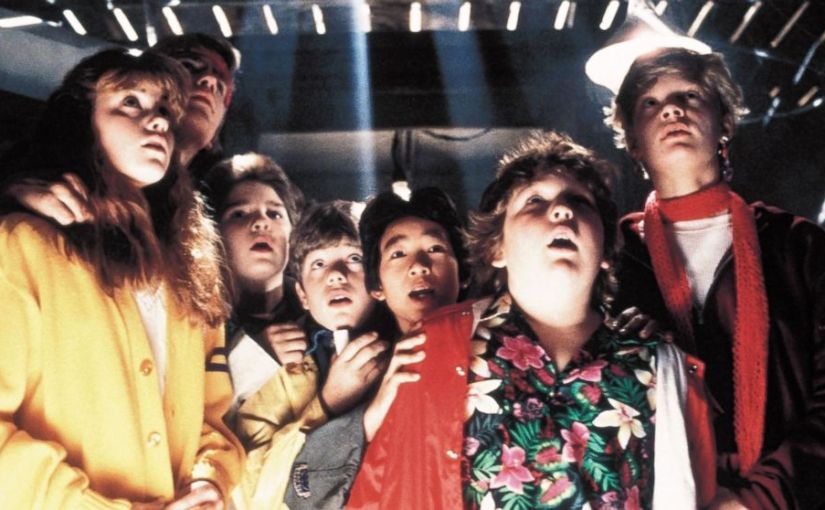
Sean Astin plays the asthmatic leader of the gang, named Mikey.  A son of actors Patty Duke and John Astin, he made his film debut with The Goonies, and I think it holds as one of the best child performances to grace a screen.  He’s such a genuine little guy, who is passionate about making any last ditch effort to save his house and home town from being bulldozed by greedy golf course developers.  On a rainy Saturday afternoon, Mikey’s buddies ritually come over to the house and with his older brother Brand (Josh Brolin, another celebrity son making his film debut) make their way into the attic and uncover a treasure map written by the infamous pirate from the 16th century, One Eyed Willie.  Soon after, Mikey along with Mouth, Data and Chunk (Corey Feldman, Ke Huy Quan and Jeff Cohen) embark on adventure that leads them to the underground caverns of an old restaurant off the Pacific coast.  Two high school girls, Andy and Stef (Kerri Green, Martha Plimpton) join the gang.  Andy and Brand have adorable puppy love crushes on each other. 

One Eyed Willie’s map supposedly leads to a treasure of enormous wealth that Mikey and the gang believe can save their small town of Astoria from being razed.  However, there are inventive booby traps along the way, and the nasty Fratelli brothers with their cranky old mother (Robert Davi, Joe Pantoliano and Anne Ramsey) are hot on their trail.  The Fratellis are straight out of those old Hardy Boys and Nancy Drew mysteries.  They are hilarious with their bickering, and scary at the same time. Anne Ramsey was a special kind of character actor with her ugly appearance and craggily voice. It eventually even got her an Oscar nomination (Throw Momma From The Train).  

We may know how the story will end up, but Donner, Spielberg and Columbus advance with one unpredictable scene after another.  Reader, when I feel the height of suspense in a film, I actually tear up and I get a very nervous laugh.  The shootout scenes in Heat (1995) and Lethal Weapon will do that to me every time.  The lightsaber dual in The Empire Strikes Back and the snake pit scene in Raiders Of The Lost Ark!!!!  I’ve been watching The Goonies since I was the age of most of these characters.  I still get this natural reaction when Andy has to play the correct notes on a skeletal piano to open a passageway.  Each time she plays the wrong note though, a tease of impending doom appears.  It works so well in the ensemble performance of the cast bellowing “Oh no!” and “Oh shit!” and “My God!” and “Hurry up!”  Edited with the quickly advancing villains getting closer, and the pulse beat music accompanied by composer Dave Grusin, and you are so caught up in their escapades now, that it feels like you are there.

All these kids become your best friend quickly.  Data is the inventor with the tripped out gadgets, inspired by James Bond, ready to set his own booby traps.  Mouth is the Spanish interpreter who gleefully causes trouble and mischief, but Feldman the actor is allowed some tender moments as well.  Jeff Cohen is like the Curly of The Three Stooges who gets sidetracked on his own adventure with a monstrous but loving, and sadly rejected son of the Fratellis.  A chained-up ghoul named Sloth (John Matuszak).  Cohen might have the best comedic moments in the film.  When I moonlight in Community Theater, I still must remind myself that just once I’d like to audition with his hysterical crying monologue where he confesses to stealing his uncle’s toupee to use as a beard to dress up as Abraham Lincoln, while another time he used fake vomit to sicken an entire movie house.  Hilarious stuff! 

There are dropping boulders, rattling pipes, a waterfall wishing well, scary skeletons, that creepy piano, and fun water slides to circumvent around One Eyed Willie’s maze onward to his legendary treasure aboard the most spectacular pirate ship ever seen.  Rarely are kid’s adventures constructed like this anymore.  I dunno.  Maybe it’s the script.  More likely, maybe it is the cast of kid actors doing one of the best ensemble performances together on screen.  Their timing could not be more perfect among the seven Goonies. 

The Goonies is a much more honest and transparent look at how kids behave with one another than you might find in a bleached-out Disney flick.  These kids get dirty and unsophisticated, yet thoughtful.  They are not age 21 playing age 14.  They don’t have fashionable haircuts and designer clothing. They are not pop singers trying to be actors.  Most importantly, the conversations among the gang are more natural in pal around rudeness.  You’re not really a friend unless you are telling the kid next to you to shut up and exclaiming “Oh shit!” when another encounter with danger lurks ahead. 

The Goonies is just a fun ride to watch over and over again. It succeeds with its own interpretation of The Little Rascals, and it’ll give you all the feels as you watch Mikey plead with One Eyed Willie for the next clue, or when he stops to remind his Goonies that there’s more at stake than just a play date on a Saturday afternoon. 

My advice is to keep the rose colored glasses off your children’s eyes.  Let them know it’s okay to get in trouble and make mischief.  Make sure your kids know they should be the best Goonies they can be.

PARENTHOOD

By Marc S. Sanders

Once you’re a parent, you’re always a parent.  You’re also always a child to someone.  No matter if you are close with your mom and dad, or estranged and not on speaking terms, or your parents have passed on, you are always a child to someone.  Parenthood from 1989 demonstrates that you never clock out from being a parent or a child.

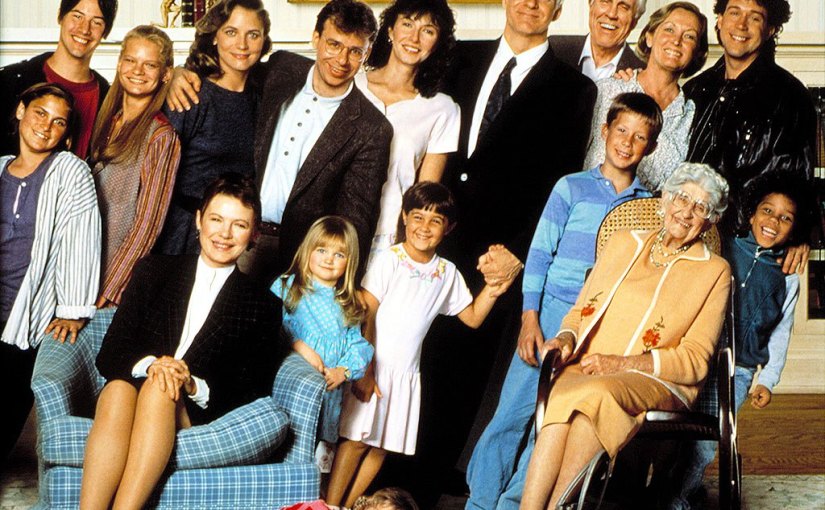
The Buckmans consist of four adult children portrayed by Steve Martin, Dianne Weist, Harley Kozak and Tom Hulce. They all got little ones to tend to with respective partners (Martin with Mary Steenburgen, Kozak with Rick Moranis and the other two are currently on the single status).  Their parents are portrayed by Jason Robards and Eileen Ryan and even the generation before them is represented by Helen Shaw.

With a cast of characters this large, there are various storylines and dynamics of raising and supporting children to go around.  Each child, or in other words, each parent has daily struggles to deal with.  The nuclear family of Steve Martin and Mary Steenburgen’s is given the most attention when it is uncovered that their eldest child of three is struggling with anxiety.  Elsewhere, Robards finds himself trying to rescue his immature, lying twenty-seven-year-old son, Hulce, from gambling addiction and debt.  Weist is doing her best to survive a sexless life after her letch of an ex-husband has left her to deal with a daughter (Martha Plimpton) pregnant and married to a stock-car racing airhead (Keanu Reeves) and a quiet, distant teenage son (Leaf, later known as Joaquin, Phoenix).  Kozak’s storyline really belongs to Rick Moranis as her genius, nerdy husband determined to raise their three-year-old daughter as a virtuoso prodigy.  Kafka is a bedtime story.

Wow, that’s a lot of baggage to unload in two hours’ time.  Yet, it works so efficiently in a film directed by Ron Howard.  I’ve used this compliment before, but it bears repeating.  You can write a full-length screenplay about any one of these characters.  I guess that is the goal you strive for when you produce a film featuring an all star cast filling the slots of a large collection of characters.  A film like Boogie Nights and Love, Actually accomplishes this feat so well.  Parenthood just the same.

Favorite moments for me occur with Jason Robards’ character.  It is evident that he was not the best father, particularly to Martin’s character, and his admiration is likely misdirected towards the kid who hasn’t made the best choices in life, played by an aloof Tom Hulce.  I really like the story arc of Robards and Hulce’s relationship when the truth rests like an ugly slime on the surface that just can’t be filtered away.  Suddenly, a man prepared for retirement and rest, has to acknowledge that his adult son needs help but is he worthy of support and love any longer?  This movie is arguably not even the highlight of Jason Robards career, but you can not deny what a gifted actor he was.  His timing and delivery are so recognizable as a hard-edged retiree parent.

Dianne Weist, the only cast member to be nominated for an Oscar for this film, has a couple of good storylines as well.  Much of her performance stems from all too common drama where a spouse leaves her and abandons any relationship he had with their children.  It’s so unfair for the child.  It’s hard on the mother who has to maintain a career while raising teenagers who are entering a new phase with regards to love and sex.  Plimpton gets into an argument with Reeves, her boyfriend, and Weist starts to swat him away.  Then Plimpton unexpectedly announces they just  got married and Weist turns to swatting Plimpton.  Weist is funny while the material holds dramatically.  It’s a real nice balance.  

Steve Martin has a good storyline as well.  He’s a hard working white collar executive who wants to prioritize attention for his son though it kills him to lose out on a promotion he knows he’s entitled to.  At the same time, he battles with how his own father (Robards) treated him at a young age.  He makes sure that his son’s birthday party is the best.  He encourages the boy to play second base on the little league team.  He attempts to do everything denied of his own childhood for his son, now.  Still, it’s not enough.  Parenthood can often feel like a winless battle. 

Martin also has good scenes with Steenburgen, and they remind me of my relationship with my wife.  She’s the sensible one.  I’m the one who gets trapped in insecurity and anxiety and low self esteem as a worker, a friend, a husband, and especially as a parent to our teenage daughter.  I excel at taking care of the bills though. 

Why am I making this personal all of the sudden?  Well, perhaps it is to call out the true nature of family and marriage that exists within the script for Parenthood, written by Babaloo Mandell, Lowell Ganz and Ron Howard.  There are some moments where Martin’s character daydreams of scenarios for his son.  One time the boy becomes a valedictorian with a speech offering complete recognition towards his father.  In another moment, he’s a rooftop sniper blaming dad for making him play second base and missing the game winning out.  When I get trapped listening to the thoughts in my head, I envision what could be.  More often than not I’m predicting dread, which almost never arrives.  Yet, I believe parents yearn to raise the perfect child that they never were.  It’s an impossible stretch.  I write that here and now, and still, I’ll try and try.  So what, though! While I’m working for perfection and absolute happiness for my daughter, I must remind myself that my efforts are contributing towards a successful path for her full of fulfillment and happiness.  More importantly, while at least half of my efforts could lead in failure on my part, my intentions are always done with absolute love and care for her.  That’s what I see in the here and now.  I’m blessed. My whole family is blessed.  So many families have it so much worse and I wish them well.  I have to remind myself not to take what I have for granted.

Ron Howard’s film is not entirely perfect.  I could have done without some of Steve Martin’s recognizable schtick from his stand-up routines.  I always like his material.  I just think some of it doesn’t belong here, the same way Robin Williams would let his known antics creep into some of his films.  Some scenes are also spliced into the film jarringly, like when a dentist’s office is suddenly vandalized.  Thematically, these break away moments should have remained on the editing floor.  Fortunately, the movie isn’t anchored by these plot points for too long.

There’s much to relate to with Parenthood.  Kids who gleefully sing about diarrhea, to parents mired in regret and doubt.  Teenagers who think they have found love to the absence of father figures.  Grown-ups who just haven’t grown up and parents who are just getting a little too ambitious in their child’s upbringing.  This is not a film, necessarily about the love a parent has for a son or daughter.  Rather, I appreciate how it questions the role these characters serve towards their fathers, mothers and children. 

Love is only one dynamic in fatherhood, motherhood, and childhood.  Parenthood focuses on everything else.

RUNNING ON EMPTY

By Marc S. Sanders

Director Sidney Lumet’s 1988 film, Running On Empty, depicts Judd Hirsch and Christine Lahti as former radicals against the Vietnam War. They have been running from the authorities for 15 years after bombing a Napalm laboratory as part of their cause. They have two sons, one of them played by River Phoenix with a chance to attend Juilliard. His opportunity does not seem likely however as it would mean he could never see his family again, and his family is reluctant to set him free.

In a film about criminals, this is a story lacking in crime or violence. Lumet’s film is a narrative of a family and how they live by constantly changing their identities, backgrounds, and residences. It’s not a life for an innocent child, especially one with a promising future.

Phoenix was nominated for an Oscar for his conflicted role. He’s quiet, but he’s torn and he’s accepting of what fate brings him. Sadly, he prevents himself from making his own destiny. A bright element comes in the form of fellow student Lorna, played beautifully by Martha Plimpton. This is her best role as Phoenix’ girlfriend who falls in love with him and shows him pure happiness. She’s the fulcrum that introduces him to what possibilities are available, but he’ll have to sacrifice his current life for a better one, and his parents will have to accept his decision.

There’s no easy wrap up in screenwriter Naomi Foner’s Oscar nominated script. A painful outcome is inevitable. Yet, that’s what makes this a great drama. The conflict is too great for an easy resolution.

What a terrible shame that 5 years after this film, at age 23, River Phoenix died of a drug overdose. Imagine what he would evolve into as an actor. Here in this role, as well as films like The Mosquito Coast, Stand By Me, and even as a young Indiana Jones, he was more than just a child actor or a teen magazine cover. He performed with a mystery to his characters where he would never reveal every dimension that his parts possessed. In a film like Running On Empty you almost wish his real life fate never came true.