THE ASPHALT JUNGLE (1950)

by Miguel E. Rodriguez

DIRECTOR: John Huston
CAST: Sterling Hayden, Louis Calhern, Jean Hagen, James Whitmore, Sam Jaffe, Marilyn Monroe
MY RATING: 8/10
ROTTEN TOMATOMETER: 97% Fresh

PLOT: A major heist goes off as planned (almost), but then double crosses, bad luck, and solid police work cause everything to unravel.


On the Criterion Blu Ray of John Huston’s The Asphalt Jungle, noir historian Eddie Muller says you can draw a straight line from Jungle to the French heist film Rififi on through to the Tom Cruise Mission: Impossible franchise and Three Kings.  To that list I would add the crime films of David Mamet.  At the moment, I can’t think of another movie in Asphalt Jungle’s era in which the dialogue is so flat, menacing, and uncluttered.  The story is exciting without being flashy, the characters are sharply drawn, and the cinematography creates the underbelly of a city almost Blade Runner­-ish in its gloom.  Even the planned jewelry heist, while detailed, is almost like a Hitchcock MacGuffin: the heist itself hardly matters, only the results…like Reservoir Dogs.  Another descendant.

Doc Erwin Riedenschneider (Sam Jaffe) has just gotten out of prison.  After evading a police tail, he visits a local clip joint looking for help in putting together a heist he had worked on before he was imprisoned.  (I like how Doc and his colleagues rarely refer to “jail” or “prison”; it’s always “behind the walls.”)  He eventually enlists Gus, the wheel man (James Whitmore); Louis, the safecracker (Anthony Caruso); and Dix Handley, the muscle (Sterling Hayden, as shambling as ever, even in 1950).  Doc dismisses Handley as a hooligan.  “Violence is all they know, but they are, unfortunately, necessary.”  Throughout the film, Handley will do nothing to prove them wrong.

They need a bankroll for the heist, so the team goes to a crooked lawyer, Alonzo Emmerich (Louis Calhern), who agrees to their terms, but eventually reveals himself to be even more crooked than they are.  (Emmerich has a mistress, Angela, played by a young, gorgeous Marilyn Monroe in the role that made her a star.  She calls Alonzo “Uncle Lon” and steals every scene she’s in.  John Huston reportedly said Monroe was “one of the few actresses who could make an entrance by leaving the room.”)

The Asphalt Jungle is not so much about the heist as it is about the characters and their behaviors.  We watch how Dix Handley treats the one woman in his life, the appropriately named Doll (Jean Hagen).  She shows up on his doorstep the day after he’s released from a police lineup.  He grudgingly acknowledges her existence and allows her to crash at his place for a couple of nights, “but don’t you go getting any ideas, Doll.”  We see the money man, Emmerich, as he sweats about his planned double-cross, but still has to find the time to placate his bedridden wife.  There’s a great scene with Gus, the wheel man, who also owns a greasy spoon.  A rude cabbie takes cruel jabs at Gus’s hunched back, crippled gait, and scrawny pet cat; Gus reveals his true colors when he handily throws the cabby out of his restaurant while Dix looks on, amused.

Everyone gets their character-driven spotlight, even a crooked cop, Lt. Ditrich, who is assigned the task of finding Doc Riedenschneider, but when he does see him inside a clip joint, he simply turns around and walks away.  Later, Ditrich has a brutal scene with the weak-willed owner of the clip joint where he slaps him around several times to get him to spill his guts.  Watch the scene carefully, and it certainly looks as if Ditrich is really slapping this guy around.

Behavior is everything in this movie, not necessarily the plot.  Without giving too much away, behavior is what gets two characters killed, gets one arrested, drives another to suicide, and leads one to meet his fate in a horse pasture.  Nothing feels artificial or melodramatic.  There is an inevitability to what happens, a tragic undercurrent, that causes us to empathize with these hardened criminals.  These are not nice people.  But when one character unwisely stays seated in a diner when he really should have left, we are disappointed.  When one character’s lies to the police come back to haunt him, we shake our heads in resignation.  Their nature got the best of them.

Sterling Hayden is the headliner of The Asphalt Jungle, and he does get one or two scenes that are “juicier” than the rest, but this is a true ensemble piece.  It takes its time to make us familiar with each key player, with who they are, so we will understand why they do what they do at every turn.  That may seem like Storytelling 101, but you’d be surprised how many movies get that wrong.  Here’s one that gets it right in spades.
GENTLEMEN PREFER BLONDES (1953)

by Miguel E. Rodriguez

DIRECTOR: Howard Hawks
CAST: Jane Russell, Marilyn Monroe, Charles Coburn
MY RATING: 7/10
ROTTEN TOMATOMETER: 88% Certified Fresh

PLOT: A couple of showgirls on a cruise to France get themselves involved in a plot involving a private detective, a diamond tiara, and the occasional musical number.


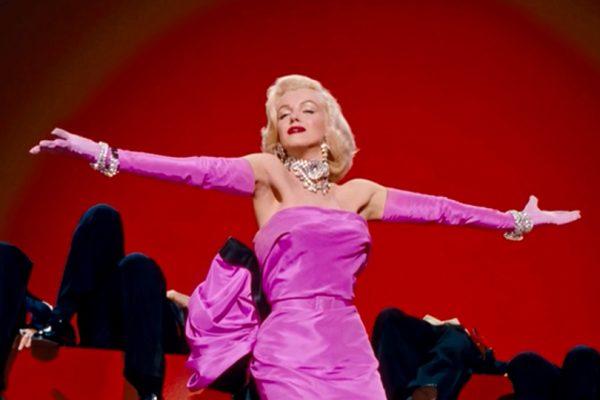
Why did I watch Gentlemen Prefer Blondes, a musical from 1953 featuring Jane Russell and Marilyn Monroe?  Well, it happens to be listed in the movie compendium 1,001 Movies You Must See Before You Die, for one thing.  And there’s the uber-famous production number “Diamonds Are a Girl’s Best Friend” performed by Marilyn Monroe in that iconic pink dress that showcased her shimmy like nothing else I can think of.  And it’s directed by Howard Hawks, one of my favorite directors from Hollywood’s golden years (His Girl Friday, The Big Sleep, Bringing Up Baby, many others).

While the song and the actors and the direction are competent, I didn’t quite get involved in the story as much as I hoped I would.  There’s no denying the wattage generated by Monroe whenever she’s on screen, and the screenplay by Charles Lederer provides some amazing little zingers, some of which I’m shocked got past the 1953 censors.  (When a man is asked which girl he would save from drowning first, Russell or Monroe, the man replies in admiration, “Those girls couldn’t drown.”)  But the plot, which I won’t even bother describing here, is merely a nail on which to hang those visuals of Jane and Marilyn strutting their stuff in exuberant Technicolor dresses and the occasional song or three.  Make no mistake, from a narrative standpoint, Gentlemen Prefer Blondes is pure farce, top to bottom.  (And no wonder, it’s based on a stage musical.)  You either give in to the formula or you don’t.  And I’ll admit, there were times when I didn’t.  There’s a song and dance number at a Parisian café which I thought was unnecessary, and the tortuous route traveled by the tiara, especially its final hiding place, stretched the logical part of my brain to the limit.

But, on the other hand…yeah, it was fun.  Set logic aside and surrender to the sights and sounds, and Gentlemen provides substantial eye and ear candy.  And there are some genuine laughs.  Like the subplot about Monroe looking through the passenger manifest looking for gentlemen traveling “with valets”, who must therefore be rich.  She finds one, Henry Spofford III, and arranges for him to be seated at her dinner table.  The revelation of Mr. Spofford’s true nature is one of the comic high points.

Or the bit towards the end where Jane Russell gets to have her cake and eat it, too.  Thanks to the machinations of the plot, Russell not only gets top billing for the movie, but she also gets to lampoon her sexy costar by impersonating Marilyn Monroe.  (In fact, if I didn’t know any better, I’d say that her appearance in a courtroom wearing a fur coat that conceals all until she crosses her fishnet-clad legs may have provided at least SOME inspiration to that one scene in Basic Instinct.  YOU know which scene I’m talking about, perv.)

But when it comes down to it, if for nothing else, you’ve got to watch Gentlemen Prefer Blondes just to see Marilyn Monroe singing “Diamonds Are a Girl’s Best Friend.”  She may play ditzy and dumb for the whole rest of the movie, but in this number, Monroe is totally and fully in command of her body, the camera, and the audience in that strapless pink dress which looks like it’s held up by sheer willpower.  For several minutes, she coos, struts, bumps, shimmies and shakes, and there’s nothing you can do but just watch in awe.  Almost as much as she did in Some Like It Hot, she simply embodies sexual…sexual…you know what, she just embodies sex.  I suppose there’s a more literary way to describe it, but I’m too tired to think of it.

Gentlemen Prefer Blondes may not feature the dancing feet of Gwen Verdon or Gene Kelly, or the vocal stylings of Debbie Reynolds or, well, Gene Kelly, or the literary complexity of West Side Story or A Star Is Born.  But when you have a song and dance number that is literally inimitable (sorry, Madonna, nice try), who cares?  I can think of plenty of worse ways to spend an evening than watching Jane Russell and Marilyn Monroe for 90 minutes.

[Side note: Penni was NOT a fan of how Monroe’s character constantly called her fiancé “daddy.”  Not sure why I’m mentioning that, but it just made it funnier to me every time Monroe said it.]

ALL ABOUT EVE

By Marc S. Sanders

Today’s actresses can lobby and vie to be Wonder Woman or Black Widow or Jane Bond. Yet, what so many filmmakers and actors fail to recall are the powerhouse performances of yesteryear that didn’t require guns and magic lassos. Movies shouldn’t simply be super heroes and villains in spandex and leather. No movie is a better example of this argument than Joseph L Mankiewicz’ 1950 Best Picture winner All About Eve.

This is also the only film in history to have four actresses nominated for acting awards – Bette Davis, Anne Baxter, Celeste Holm and Thelma Ritter. What an accomplishment!!!

Davis is Broadway legend Margo Channing, a sexy, tough, cigarette smoking broad who grew up and keeps her social life within the limelight. She’s a warrior among the Hollywood and New York elite. When her friend Karen Richards (Holm) welcomes a mousy young girl in a raincoat backstage to meet the famous Miss Channing, it becomes more than just a quick hello. This girl is Eve Harrington who proudly admits to following Margo’s career from San Francisco all the way to Broadway waiting outside the theatre on each performance night for that opportunity to meet the legend in person.

Upon introduction, Eve shares her tragic story of growing up poor and losing her husband in the war. Margo and Karen are taken with Eve, and now the young ingenue has wielded her way into the upper crust life among the pomp and circumstance. Margo’s test of her own celebrity seems to come unexpectedly as it occurs to her and her smarmy personal assistant Birdie (Ritter) that maybe Eve is angling for a way to fill Margo’s big shoes along with her wardrobe and stage costumes.

The elite are intruded upon by this outsider. Karen’s friendship to her playwriting husband Lloyd (Hugh Marlowe) and her friendship to Margo is tested by Eve’s surprising manipulations. As well, Eve is making herself more aware to Margo’s younger lover and stage director Bill (Gary Merrill). Eve also finds ways to build an acting career on the shoulders of these show biz upper class by eventually winning the opportunity to be Margo’s understudy.

The outsider who narrates these developments is the famed theatre critic, Addison DeWitt (a charming and cultured George Sanders who won the Oscar). DeWitt might not get welcomed to every exclusive black tie party in town as he’s “the critic” but that’s fine for it’s how he survives in his career. He’ll recruit a young naive actress like a newcomer played by Marilyn Monroe to maintain a stay within the social circle, and soon he’ll ride along on Eve’s journey for personal gain.

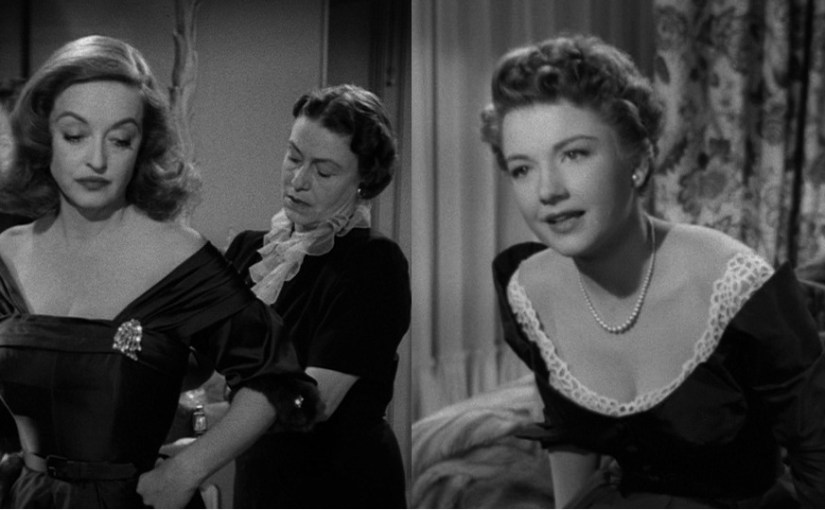
Mankiewicz’ script is brilliantly witty, absolutely biting and sharp. One of the best moments in film belongs to Bette Davis wearing a gorgeous dark evening gown designed by the legendary costumer Edith Head, and used as Margo’s armor ready for social battle. Davis declares “Fasten your seatbelts. It’s going to be a bumpy night.” No line could be so forthright in what to expect of a film like “All About Eve.”

This picture is ranked at the top of many “greatest film” lists. As it should be. This is not a sweeping biographical epic. Rather, it’s a lot of story branches that begin at the introduction of one character and expand in various directions among a handful of others who become disarmed by her ongoing presence. It’s not even that simple as Mankiewicz writes about Eve’s duplicity and how she manages to collide one piece of her destruction with another kind of destruction elsewhere, and the victims are simply blindsided.

Anne Baxter certainly had me fooled as Eve. She’s sweet and innocent on the surface and soon an inner and more evil shell emerges. Bette Davis looks spectacular and delivered one the best female performances of the last hundred years. She can carry herself and keep her guard up and authority in place. There’s a rich and commanding history about Margo that seems easy to believe. She is the queen of Broadway at the film’s beginning. Yet, for a moment her guard is let down and Mankiewicz gives us that window of time for his showcase.

Mankiewicz effectively opens his picture with Eve winning a very exclusive show biz award. She graciously approaches the podium to accept and deliver her speech. However, there are a select handful of individuals who withhold their applause of celebration. Then he flashes back to how we’ve come to this particular moment. It’s a great opening leaving me curious with a bunch of why questions. To watch this sequence the first time leaves you curious. To watch it on a second or third time is to be in on Addison DeWitt’s exclusive story of show biz scheming and diva one-upmanship. I only wonder if Joseph L Mankiewicz was as keen as George Sanders’ character to foresee how much life will come from Eve Harrington’s intrusion upon the lives of Margo & Bill and Karen & Lloyd. Before the age of desperate “if it bleeds, it leads” gossip rags, All About Eve was the real storyteller.