
By Marc S. Sanders
Ever hear of a guy named Lorenz Hart? He was a lyricist. I’ll bet a few of you know some of the songs he was responsible for like My Funny Valentine and Blue Moon. Yup! That guy, Larry Hart, wrote hundreds of songs that might have established an ongoing pop culture lexicon. His partner was Richard Rogers. Surely you know him. Of Rogers & Hammerstein fame. After a twenty-year partnership, Rogers distanced himself from Larry Hart’s substance abuse and procrastination, and went on to collaborate with Oscar Hammerstein II. On March 31, 1943, their first effort together premiered on Broadway, receiving endless critical praise. That production was Oklahoma! (Yes. To poor Larry’s chagrin the exclamation point was included in the title.)
On this celebratory evening, the producers, cast, crew and theatrical big wigs are planning to catch up at Sardi’s after the curtain call. Larry, played with shrimpy, raspy, hyperactive, bitterness by a sensational Ethan Hawke, left the performance early to saddle up at the bar and regale the tolerant bartender, Eddie (Bobby Cannavale), with his bygone accomplishments and resentment towards his friend Richard (Andrew Scott) and now the replacement, Oscar (Simon Delaney). He insists Eddie bring him a shot of whiskey-only to gaze upon, not consume. We’ll see how far that goes. Wouldn’t you know it, but trying to keep to himself, in the corner, is E.B. White (Patrick Kennedy), the writer who’s working on a children’s book about a mouse.
Writer/Director Richard Linklater once again partners up with his go to leading man, Ethan Hawke. Together, they’ve done several films, some of which occur primarily over the course of one night (Before Sunrise, Dazed And Confused, and now Blue Moon). This loose boxed-in, and theorized biography relies so much on the individual performance of Hawke.
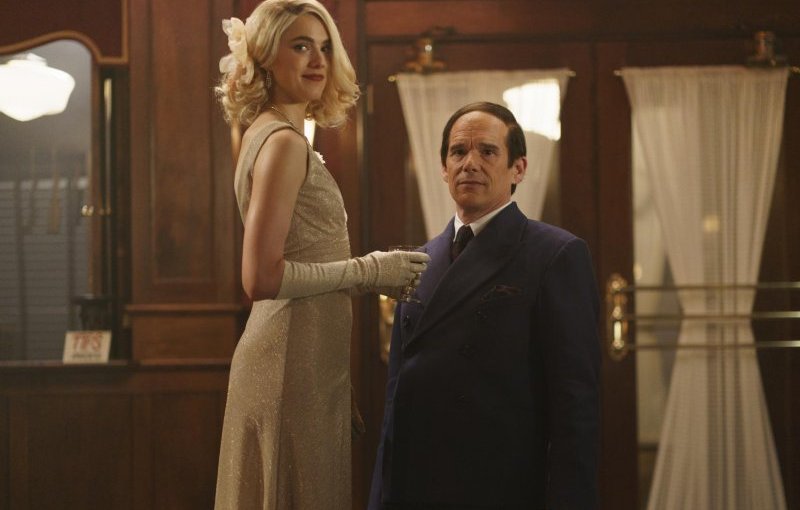
Nearly the whole script of dialogue belongs to the actor. As expected from most resentful and bitter artistes, Larry does not shut up. Eddie and the piano player and later E.B. White may be his designated listeners, but schlubby Larry, with his balding combover and squat height is only talking to himself. I read that Linklater had to modify his cameras and set design to more accurately capture the real subject of this film. Ethan Hawke has a much taller height than Larry Hart. I think the actor and director pull off the illusion quite well. Compared to everyone else in black tie evening wear, Larry looks like a reject from Middle Earth Hobbit-town in an old blue suit.
Like any good writer of such adored classic numbers, little Larry has a muse. She’s a twenty-year-old blond bombshell named Elizabeth, played with alluring exquisiteness by Margaret Qualley. I must compliment the actress’ hairstylist for getting the blond coiffed hair to perfectly cover Qualley’s left eye, while the green right one draws us in, complimented by an hourglass hugging, glittery white evening gown.
Larry is plagued. Elizabeth is grateful for all of his attention and his guidance with getting her into the limelight. However, is he in love with her, or is his suspected penchant for men a reason why he lives through this young adult’s recent sexual conquests? There’s a magnificent scene when Larry and Elizabeth hide in the restaurant’s cloak room, crouching down on the floor. In a series of great talkie scenes for Ethan Hawke, his best moment might be when he’s squatting down on his haunches like a child, with little to say, and absorbing the whispered narrative delivered by Qualley. It almost doesn’t matter what she’s describing. It’s more about how she tells the story and how her acting partner responds with his hands clenched together under his chin.
Larry Hart was a real artist with a magnificent talent that in no way reflects his image, personality or physique. His song lyrics are ALIVE and timeless, adoring too. On the other hand, he’s stand offish and exhausting to be around, even if everyone at Sardi’s finds a moment to express what an inspiration he’s personally been. A guy named George Hill looks up to Larry and is advised to make films about friendship (you know, like The Sting or Butch Cassidy And The Sundance Kid). Then again, there’s also a snot nosed, know-it-all kid named Stephen who thinks Larry’s lyrics are pedantic at best. This brat named Sondheim will probably go nowhere.
I knew nothing about Lorenz Hart. Never heard of the guy. Wouldn’t recognize his picture if I saw it on Sardi’s wall. Don’t remember seeing it the last time I was there. He’s a Saliere to Richard Rogers’ Mozart. This poor guy had demons that ended his life at a young age.
The best that can be said is that he provided so much cheer to the world during is forty three years on this planet. It’s sad, but interesting to capture Richard Linklater’s one evening in this sap’s life that can sum up who he was and how he was regarded only to be quickly dismissed.
Larry Hart put everything in the spotlight but never had the opportunity to stand there himself.


 2 UNPAID MOVIE CRITICS!!!!