
By Marc S. Sanders
Bruce Willis is a time traveler from an ugly dystopian future in 12 Monkeys. His name is James Cole and his mission is to uncover why all but one percent of the world’s human population perished from a mysterious virus in the year 1996.
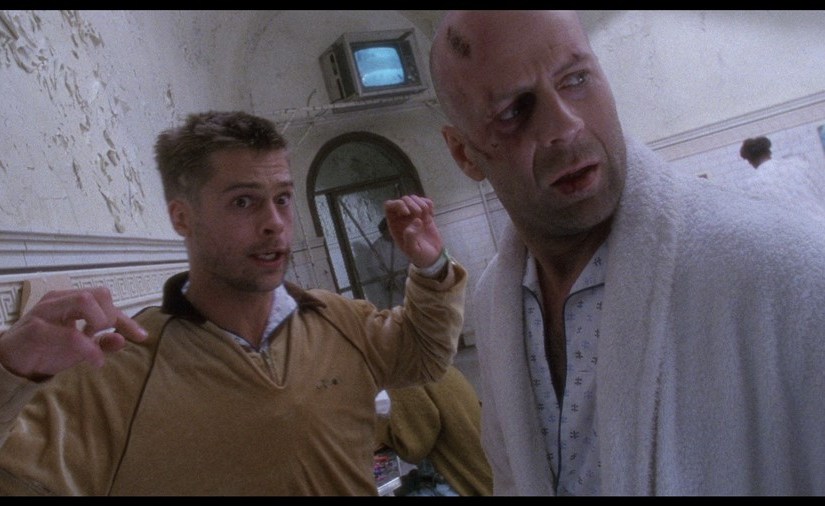
Director Terry Gilliam specializes in disorienting his films. No shot or closeup is well defined. He’ll position his camera on a slant or he’ll turn it on an uneven axis so that nothing appears completely clear. In 12 Monkeys, the viewer is as confused as the protagonist, James Cole, along with a psychiatrist he periodically encounters named Kathryn Railly (Madeleine Stowe). Beyond the camera trickery, the script of the film offers up oddball characters in both Cole’s present time period (the “future”) and in his past. Jeffrey Goines (Brad Pitt, in his first Oscar nominated role) is one particular weirdo, residing in a mental institution that Cole is entered into when he time traveled back to Baltimore, Maryland in the year 1990. During his stay in the loony bin, Cole is talking gibberish to Dr. Railly and her team. Jeffrey has his own language of nonsense.
Cole’s dreams of himself as a child are intermittently weaved into the final edit of the film. There’s a woman running after a man, a rapid beep, beep, beep and a gunshot. Later returns to this dream will provide more clues fleshing out its significance.
It would be easy to have a five-minute conversation and spell out what occurs in 12 Monkeys, but that would be defeating the cleverness of the film. The achievement of its story relies on the sum of its parts. Terry Gilliam strategically lays out breadcrumbs with fractional pieces of dialogue, words and pictures that quickly flash in front of you. It may even hinge on a news story or memorable pieces of music playing on a radio. Still, he also unnerves the characters and the viewer with uncomfortable and sometimes grotesque imagery.
The first time you watch the film your attention may turn to the long stream of bloody drool hanging from Bruce Willis’ mouth when he shares his first scene with Madeleine Stowe. Repeat viewings, which I believe only enhance the picture, will have you focus on the nonsensical dialogue that James Cole is continuously uttering. Other characters are seemingly disruptive to your concentration, particularly the herky jerky behavior of Brad Pitt’s character, but their purpose is essential to a mystery that has left the world of the future in a tailspin where the last of the human race lives underground while animal wildlife roam the cities above. Furthermore, who or what can explain the enigma behind a team of people perhaps known as The Army Of The 12 Monkeys?
12 Monkeys is a very weird and very unusual kind of science fiction film and that is its crowning achievement. I have spoken before of how sometimes a movie can not be determined as a success until it reaches its climax, say the last five minutes of its running time. Terry Gilliam’s picture is one such example. Gilliam has a keen sense of foreshadowing with tactical layering of complexity. He is wise with how everything neatly unravels at just the right moment. The answers to the mysteries that James Cole pursues eventually rise to the surface, reminding us that everything was right under our nose the whole time.
I recall the elation I had the first time I saw the film in theaters. On repeat viewings, I grin at how the movie is assembled. Quick references that seem like blink and you miss it moments add up to a satisfying conclusion in Terry Gilliam’s film. My colleague, Miguel, and I both agree on the time travel motif in 12 Monkeys. It is one of those rare occasions where the science built within the story’s fiction seems to make sense. Too often time travel movies paint themselves into a corner and can’t escape the gaping plot holes they leave behind. Yet the different time settings of 12 Monkeys cooperate with themselves. Because the film doesn’t color outside of its lines, its worth applauding how ingenious the picture truly is from beginning to end.
12 Monkeys may require your patience the first time you watch it. It’s not a comfortable journey. However, you’ll be glad you stayed with it as the story answers its own questions.

 2 UNPAID MOVIE CRITICS!!!!