
By Marc S. Sanders
I get a thrill out of being in a location occupied by someone from the past. Last week, I toured Paramount Studios and sat on the bench that Tom Hanks did when he shot Forrest Gump. There’s something exciting about it. Time capsules or a recovery of an ancient burial are fascinating to me. Just once I’d love to hold in my possession Action Comics #1, Superman’s very first appearance. Often, items like this are preserved behind glass in museums to witness and study.
Robert Zemekis is a “What if?” director. What if a man was marooned on a deserted island or what if you could communicate with extra-terrestrials from another galaxy? What if live humans could interact with cartoon characters? He reunites with Hanks as well as Robin Wright for his newest film called Here. The picture attempts to answer what precisely happened in one specific, exact location since the dawn of Earth.
The film opens with the violent creation of the planet, complete with molten rock and falling meteors stirring about, along with an ice age, and a prehistoric period. Then it is on to further points in history that the script from Eric Roth will occasionally return to, such as the plight of a Native American tribe and then later close to a post-Revolutionary War era where a house with a large bay window in the living room is erected and a famed historical figurehead is referred to. We witness the activities on both sides of this living room’s bay window, and what was there before it.
There are brief views of folks living in the early twentieth century when new technology like airplanes are fresh, and eventually a Lazy Boy becomes essential to any home.
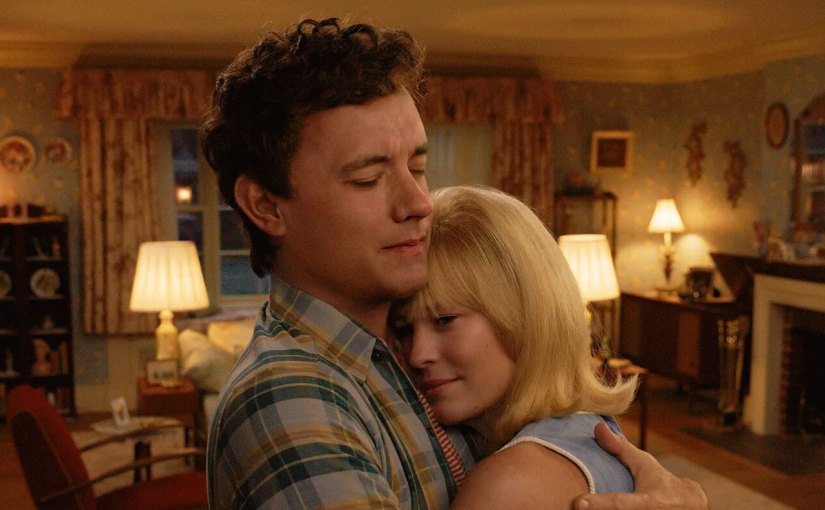
Primarily though, there are three generations of a twentieth century family lineage that starts with Paul Bettany as a PTSD alcoholic World War II veteran, and his housewife Rose (Kelly Reilly). Tom Hanks portrays Richard, their eldest child who aspires to become a career painter before his plans are interrupted by marrying his pregnant girlfriend, Margaret (Robin Wright). Life, however, gets in the way of his dreams.
Finally, we are brought to a more current point with an African American family living through challenging times of police brutality and Covid.
Over the course of the whole movie, Zemeckis has you believe that his camera never moves once from this specific place. He narrates the activities that occur in this broad scope of time with pictures within pictures. Rectangles or squares will appear to show what happened later in life or back in the past on this specific spot and then transition the scene to that new period episode he wants us to witness. Where the fireplace is located, a squirrel climbed the bark of a tree that was once there. Where the sofa is now, there worked a slave laborer from the 1700s, or its where a Native American smoked a pipe before then.
If Here was any longer the novelty might have worn off. Fortunately, the characters with the most interesting storylines are given to Bettany, Reilly, Hanks and Wright. The challenges of living long lives raising children, dealing with job security, health, love, loss and stress are carried by them. We grow accustomed to how the family lineage evolves, particularly with Thanksgiving dinners, Christmas photos, marriage, graduations, and children growing up.
It helps that the latest trend of visual effects, de-aging and aging the players, works convincingly in this picture. I attended a live conversation at the 2024 AFI Film Festival between Tom Hanks and Robert Zemeckis, and the actor revealed that to get himself back to the age of seventeen and then a thirtysomething all the way to a man in his eighties required Zemeckis’ team to collect thousands of images and footage from the actors’ extensive careers. Everything was then seamlessly assembled for effective performances. I think the trickery works. If it didn’t, then it’s likely Here would not succeed.
My one issue with the film is the glaring omission of substantial storytelling for the African American family compared to the amount of time devoted to the family who lived in this home before them. The African American characters do not appear fleshed out enough. They only serve to remind us of current, complicated times that we recently endured or are still living through. Roth and Zemeckis did not go deep enough with this group, only to bookend it with an unimpactful death.
Here works like a warm blanket to snuggle up with. I believe it is worth a second and maybe a third watch in order to catch all the little changes in details that vary as time travels through this piece of land that eventually became a living room. The TVs and what’s on changes from the Beatles first appearance on The Ed Sullivan Show to The Three Stooges to CHiPs (neat wink and nod moment here; tell me if you know what I am thinking of) and Katie Couric and so on. The furniture gets updated. So do the phones. What occurs across the street in front of the two-story colonial house changes. Though we are only seeing one room during the entire running time, it’s near impossible to pinpoint what was there before from left to right and top to bottom. What’s there now and what will be there later is part of embracing the experience of Here. However, what kept my attention is how Eric Roth and Robert Zemeckis invent ways to keep different time periods connected. It’s relative to how Zemeckis did numerous minute and detailed face lifts to Hill Valley in his Back To The Future trilogy.
By the end of Here, there’s opportunities to relate to how many of these people end up with their long lives. They experience all the ingredients of life through love, frustration, happiness, illness, loss, anger, sadness and eventually death.
Here is a deliberate experimental film, and for most of the picture, its attempts at modifying the stage of performance truly work. Where it falls short is not allowing equal attention to all of the stories that enter this locale. Then again, if the movie were to go any longer, time might have come to a mundane standstill. It’s simply a blessing that I had just enough time being Here.
 2 UNPAID MOVIE CRITICS!!!!