THUNDERBOLTS*

By Marc S. Sanders

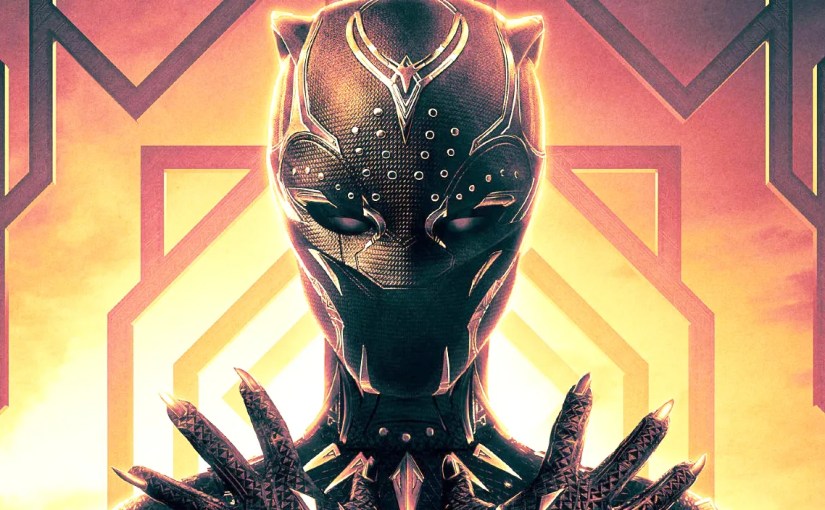
Thunderbolts* is the next Marvel movie out of the assembly line, the second of 2025 (after Captain America: Brave New World).  A new team is haphazardly assembled and the witty lines come through that poke fun at their idiosyncrasies and their origins.  Yelena (Florence Pugh) is the Russian assassin with a daredevil streak.  John Walker (Wyatt Russell) is the wannabe Captain America known formally as U.S. Agent.  There’s Ghost (Hannah John-Kamen) who can teleport in and out of places, and Red Guardian (David Harbour), the Soviet equivalent of Captain America with a shaggy beard, a beer belly and an adorably estranged father/daughter relationship with Yelena.  Bucky, The Winter Soldier (Sebastian Stan) is back too.  We’ve talked enough about him though.

Marvel and Disney are advertising this cast as the anti-heroes, or anti-Avengers and the film lives up to that mantra.  However, it still has the witty banter of those other superhero team up pictures.  What sets this one apart though is that eventually the characters and the story use their brain and a little welcome psychosis for a thrilling final act that leaves you alarmed while welcoming you to empathize. 

The strongest actor and most dimensional character portrayal belongs to Florence Pugh.  No doubt that she carries the film as she leads us into an unexpected underground trap where the other members of this cast are all trying to kill each other at the assigned behest of Valentina Allegra de Fontaine (Julia Louis-Dreyfus).  Yelena quickly figures out Valentina’s deceit while overlooking an innocent looking Frankenstein’s monster of a young man named Bob (Lewis Pullman).  The others are there to just exercise their skills for some cool action scene edits, and tag along with Yelena and Bob.  An escape out of the underground structure might overstay its welcome, but fortunately the characters are fun.

Once the escape is complete, the action gets better from there with explosions and fire power and such.  Cars and a limo go boom.  Bullets deflect everywhere.

Naturally, disaster eventually has to arrive in New York City and it is up to these Thunderbolts* to save the city.  Honestly, as the citizens kept on disappearing into blackness, I kept asking myself why Dr. Strange or Spider-Man didn’t show up.  That’s the become the unwelcome problem with the Marvel films and their ongoing connections to each other.  Why would I expect a teleporter and a group of acrobatic fighters who carry shields and handguns to stop a godlike entity that is destroying New York City?  Last I recall, Stephen Strange was not dead.  I had to look past the obvious though because there’s interesting material that harbors itself during this third act. 

Florence Pugh and Lewis Pullman steer the reins to triumph, and it is more so done with an underlying, bordering hokey message that these two capable actors balance quite well.  There’s punching and running and screaming and superpower stuff, yes.  However, the win works on an emotional level too, setting itself apart from the various Avengers movies.  There’s good editing to be found here as the characters jump from one room to another as personal demons are confronted.  The room jumps make you feel like you are in that inflatable wonder wheel you would walk on in the swimming pool. It certainly keeps you alert. All the while, Yelena, the skilled martial arts assassin, uses her brains and instinct to rescue her teammates and especially Bob.

The debate rages on the oversaturation of superhero movies and how they might be destroying cinema.  I’ve never been so quick to surrender to that argument.  The box office of these films keep jobs in place for a large multi-billion dollar industry and the profits to be made allow for small more arthouse like films to be produced.  Also, they are still so fun and entertaining if you allow yourself not to be such a film snob. So, stop complaining so much. 

As for the material of these pictures, Thunderbolts* is a good, up to date example of not simply relying on special effects and city destruction with another villain of the week.  It has a Ghostbusters/Men In Black humorous vibe to it while still catering to intrinsic insecurities and personal baggage that all of us carry through life.  Sometimes, when we want to escape to the movies, it helps to uncover someone telling a story that gets me, gets you…gets all of us. 

TUESDAY (2023)

by Miguel E. Rodriguez

DIRECTOR: Daina Oniunas-Pusic
CAST: Julia Louis-Drefyus, Lola Petticrew, Arinzé Kene (voice)
MY RATING: 10/10
ROTTEN TOMATOMETER: 82% Fresh

PLOT: A mother and her teenage daughter must confront Death when it arrives in the form of an astonishing talking bird.


Movies about death are a dime a dozen.  Movies about “Death” with a capital D, as a character, are a bit rarer, and for a movie to make its mark in this subgenre, the personification of Death incarnate must be something interesting or unusual.  Terry Gilliam’s The Adventures of Baron Munchausen portrayed Death in the expected way, a skeletal figure cloaked in black and carrying a scythe, but it could also disguise itself.  Meet Joe Black dressed Death in a tux and gave it Brad Pitt’s face and body – perhaps unlikely, but good for ticket sales.  And in the most famous movie version of Death, it was a pale man in black who played chess with Max von Sydow in Ingmar Bergman’s uber-classic, The Seventh Seal.

But no movie that I’ve ever seen has ever approached the character of Death itself the way Tuesday does.  In this film, Death is a bird.  A parrot with dirty gray feathers.  A parrot that can change size at will, sometimes as tall as a house, sometimes as tiny as a toad (or smaller), and sometimes just parrot-sized.  And, as we eventually discover, it can talk and mimic voices.

Tuesday looks and feels like an early Spike Jonze film, back in the days of Being John Malkovich and Adaptation.  It is filled with imagination and unexpected plot turns and laden with meaning, but it never feels pretentious or preachy.  It tells a familiar story – we must make peace with Death one way or the other – but the uniqueness of Death’s form and what happens after it reveals itself had me riveted for the entire running time of the film.

In this film, Tuesday is a 15-year-old girl (Lola Petticrew) who is dying of an unspecified disease that has relegated her to home-hospice care with an attentive, if slightly impersonal, nurse (Leah Harvey) and her mother, Zora (Julia Louis-Dreyfus, giving the performance of her career).  Zora has not seemed to get past the first stage of grief, denial.  She literally sneaks past Tuesday’s room so she can leave the house just as the nurse arrives, without having to speak to her.  Instead of going to work, Zora spends her day going to pawn shops and coffee shops and sleeping on park benches.

On one such day, Tuesday looks up and sees…this parrot.  The overall vibe of this parrot is hard to describe.  It looks beat up, it’s dingy, it’s blind in one eye, but there is a sense of menace to it.  Tuesday immediately intuits what the parrot is and why it’s there.  As it approaches her to perform its duty, Tuesday stops it by telling a joke.  (It’s the one about the cop who stops a guy who has twelve penguins in his car.)  The parrot takes it in and…laughs.  I’ve never been in the same room with a laughing psychotic, but I would imagine it would sound pretty much the same as when Death laughs.

And then the parrot opens its mouth and talks to Tuesday.  They have a conversation.  And suddenly Death seems to suffer some kind of panic attack, as the voices of all the creatures on Earth whose time has come assault Death’s ears.  Tuesday instinctively coaches it through a breathing exercise.  The voices go away.  She recommends a bath.  They bond.  She pages through a history book and gets Death’s commentary on dead historical figures.  Stalin: “An absolute prick!”  Jesus: “Oh, He LOVED irony.”  It mimics Jesus’ voice.  Whatever you think Jesus’ voice really sounded like, I promise you will be surprised.

Also, don’t get the idea that this is an all-out comedy because of the above dialogue.  Keep in mind that this is Death we’re talking about.  Death’s voice, when it speaks, is low, gravelly and menacing, even when it’s cracking jokes.  At one point, Tuesday plays an old song on her computer, and Death, being eternal, is familiar with it.  It even sings along and dances.  At least, as far as any parrot CAN dance.  Yet even in this moment of levity, there is still that sense of menace in the offing because of that brilliantly chosen voice, provided by an actor named Arinzé Kene, who is unknown to me, but if I ever see that he recorded an audiobook, I’m buying it.

This whole time, I’m watching the movie thinking to myself, WHERE is this GOING.  I was fascinated by this exceedingly odd couple.  The direction by first-timer Daina Oniunas-Pusic is just as assured and risky as anything by Spike Jonze or Sofia Coppola.  I was worried that it was going to veer off into a weird tangent where Death falls in love with Tuesday, but nothing like that happens.  Death knows its function, and so does Tuesday, so the problem now is how to deal with Tuesday’s mother, who is clearly not prepared to deal with Tuesday’s death, imminent or otherwise.

…and from here on out, I am going to give no more story specifics.  To say that I went into this movie cold is an understatement.  Trust me, the colder you are, the better it will be.  The ultimate message of the film, as I said, is not that far removed from any number of other films.  I would even compare it to the first Inside Out from Pixar, which demonstrated that sadness is an ultimately necessary part of becoming who we are.  Tuesday also uses a CG character (in the real world) to remind us that the only way to make peace with who we are is to make peace with where we’ll all be in 100 years.  The final words of the film are a call to action to everyone watching.

[Ed. Note: Tuesday is one of those so-called rarities, a completely original studio film, released in movie theaters before heading to a streamer, that’s not a sequel or insanely high-budget.  It’s intelligent, compelling, and non-stop surprising.  And it had absolutely zero publicity, at least in my area.  I saw no trailers, no posters, no internet hype.  According to boxofficemojo.com, it has grossed a little over $320,000 since its domestic release on June 7th.  Not exactly setting attendance records.  If you’re interested in seeing it in theaters, I’d say your window is extremely limited at this point.]

YOU PEOPLE

By Marc S. Sanders

You People has me wondering how we could have stepped so mind bogglingly far back in social tolerance and understanding.  I give people far more credit than the foundations that Jonah Hill and Kenya Barris, who wrote the film together, describe in this movie.  (Barris directed, as well.) People cannot be this cruel and stupid, can they?  Someone give me hope! Give me assurances, please!!!!!

You People is a send up of the Meet The Parents formula, or more specifically Guess Who’s Coming To Dinner? In the latter example, an African-American doctor is brought to the home of his Caucasian fiancée to be introduced to her parents.  Later, the woman meets his parents.  There is an understandable sense of surprise for the characters in both scenarios.  Yet, none of the parties carry the instinct to embarrass each other or allow them an opportunity to lie just to impress and speak with moronic naivety.  The film was never catered for big laughs, but rather more towards awareness and understanding. 

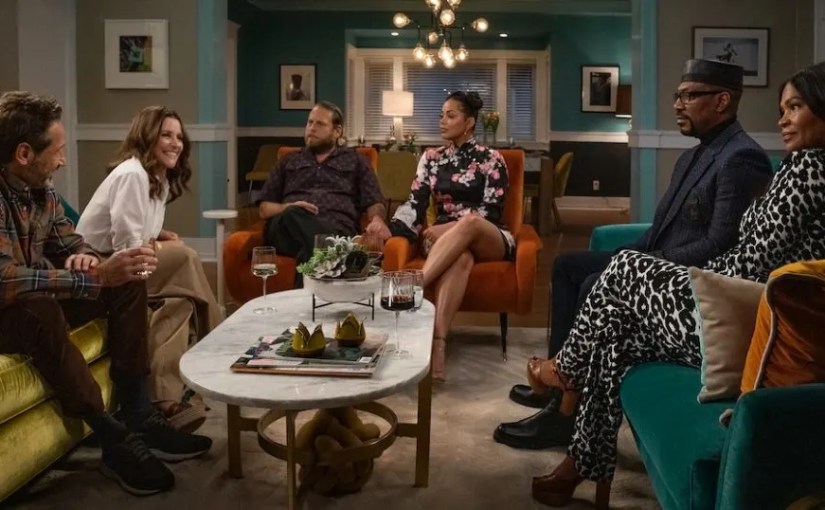
With a cast that includes Jonah Hill, along with Julia Louis-Dreyfus and Eddie Murphy, all well known for huge comedic achievements, You People is designed for the laugh out loud moments.  That’s great.  It sounds very promising, and it was a movie I was looking forward to watching.  However, did the comedy have to come at the expense of stereotyping Black Muslims as angry and intimidating and freely dropping the N-word, while White Jews are dumb, ill informed, clumsy lying cocaine users?

The pattern of Barris’ film is very structured.  For every scene of father-in-law to be Eddie Murphy paired with Jonah Hill, there is also a scene on the other side of mother-in-law to be Julia Louis-Dreyfus paired with Lauren London, portraying Hill’s fiancé.  Murphy does his comedic best in expression and stature with or without dark sunglasses on, while Hill sits very uncomfortably next to him, whether it is in the car or at his bachelor party getaway in Las Vegas where his buddies ask him to call his cocaine dealer.  Cuz, you know, all Jewish guys have a go-to cocaine dealer on speed dial. 

Julia Louis-Dreyfus does her comedic best trying to impress Lauren London by acting aware of what a black person has had to endure and over-complimenting her hairstyles and appearance.  She’s ready to go all “Karen” at the front desk of a luxury spa when she suspects racial discrimination towards London’s appearance.  Later, she will commit slapstick sin by accidentally pulling off the hair weave extensions of one of London’s friends.

I refer to comedic best because the two SNL alumni are so good on camera even if their script is nothing but insulting junk, devoid of validity.  Their expressions are reminiscent of Murphy’s best stand up routines and Louis-Dreyfus’ hilarious sitcom portrayals.  However, these collection of scenes are written with an obnoxiously overabundance of cringe and discomfort.  How these characters treat one another is utterly disgraceful.

Upon an initial meeting at the dinner table, a comparison of suffrage by means of black slavery vs the Holocaust is brought up.  You know what?  Neither incident within our world history is worse than the other.  They’re both horrendous and could never merit comparison.  Yet, here they are being presented as punchlines for outrageous comedy in terms of one upmanship.  Murphy’s character, along with Nia Long as his wife, will announce their admiration for Louis Farrakhan, while Julia Louis-Dreyfus will point out the speaker’s antisemitic doctrines.  In response, she will accidentally light fire to Murphy’s prized Muslim hat gifted by the minister.  If I were to translate this mathematically, Black Muslims celebrating antisemitic gospel equates to White Jews as insensitive klutzes. 

You People is nothing but one insulting moment after another.  In every scene, someone is the punchline at the expense of the writers’ unfair and incorrect blanket approach categorization for what these two demographics must be like. What a huge misfire. 

These are some of my favorite comedic actors.  Lauren London even looks like she can hold her own in scenes with her co-stars.  The potential for talent is hard to match here.  There could have been debates as to who should officiate the wedding and what themes the reception should have, or what the bride and groom should wear. Imagine an argument over the cake topper.  Actually, as I recall there are moments like this in the film.  Nevertheless, they dwindle into conclusions that demonstrate Black Muslims should be feared while White Jews are clueless morons. 

As a conservative Caucasian Jew myself, none of what is depicted in You People could be further from the truth.  I’ve known a few Muslim people and I never caught this kind of vibe from them or who they associate with, or what they practice.  I’ve also never felt uncomfortable in their presence.

The failure of this film lies within the insensitivity of its ignorant script.  This movie could have demonstrated a clash of cultures.  Instead, it relies on moments to squirm at uncomfortably with some of the worst people any of us could ever know.

The next time Jonah Hill and Kenya Barris want to make a movie, they need to read a book and speak with who they select for their subject matter.  Even better, just turn on the camera and let Eddie Murphy and Julia Louis-Dreyfus start talking…about anything!  They are far more intelligent and creative than anything on display here.

BLACK PANTHER: WAKANDA FOREVER

By Marc S. Sanders

Marvel does it right.  DC doesn’t.  Black Panther: Wakanda Forever  is not a perfect film, but it’s not Black Adam.  The latest Marvel production offers sharp visual effects and action scenes, along with thought provoking moments that reflect on loss.  Black Adam offers a crusty, yellow lightning bolt on the chest of The Rock.

Director Ryan Coogler was faced with a terrible challenge to make the follow up to his smash hit, Black Panther.  The star at the center of the film, Chadwick Boseman, unexpectedly passed away from colon cancer.  A screenplay for the film’s sequel had to suddenly be rehashed.  A unified cast had to work with a hole in its structure.  Coogler opted not to recast the role of T’Challa, the King of the fictional African nation, Wakanda.  That was a smart choice.  Boseman’s portrayal was so embraced in that film, as well as three other Marvel chapters, that he was seemingly irreplaceable.  T’Challa was not just another James Bond or Batman.

I liked most of Wakanda Forever.  First and foremost, the primary cast is mostly female and Marvel’s early reputation with female characters left a lot to be desired when all they would do is flirt with the action star and scream for help.  As well, none of the women characters were very diverse.  The African influence of the Black Panther characters demonstrate that the Marvel universe is unlimited in appearance and style.  (Star Wars productions of late prove that as well.) 

The design of the picture is also gorgeous.  I still yearn for Wakanda to be a real locale that can be toured.  I’m sure Disney is already giving this some thought.  At times, it was hard to know what overhead locations were mere CGI and what was real.  The backdrops are seamless.  The whole movie is gorgeous. 

The sensitivity to the loss of Boseman is especially handled beautifully.  The opening sequence is a ceremony we have all been waiting for since the actor’s death two years prior to the release of the film.  Some of the customs and practices might be fictional, albeit inspired by what has been researched in other factual nations and observances, but it is also endearing.  The silence of the Marvel logo montage will especially grab you.

Wakanda Forever is carried primarily by Letitia Wright as Shuri, T’Challa’s sister.  The film takes place one year after T’Challa has passed away from a disease and she is not ready to burn the funeral garb she wore when his soul was sent off to the ancestors.  However, while Wakanda was once thought to be the sole resource of Vibranium, the most powerful element in the world, a new character is introduced from under the ocean.  Namor (Tenoch Huerta) is the mutant who leads a nation of underwater dwellers with their own source of Vibranium.  He proposes that his nation works in conjunction with Wakanda to protect what they possess from other nations (like the United States and France; though why must Marvel show these countries in a bad light?) who could potentially use this commodity for nefarious purposes. 

From this seed in the storyline, subplots are branched out.  They just don’t work, though.  Wakanda’s American ally, Agent Everett Ross (Martin Freeman), is brought back into the fold.  He only adds unnecessary running time to a very long film.  First, he provides a lead on to a new character, that’s expected to fill the hole left by Robert Downey Jr’s Iron Man.  A character named Riri Williams (Dominique Thorne) who I have learned becomes the super hero Iron Heart with a new Iron suit.  After that Ross is left to watch Anderson Cooper on CNN as we have already seen the plot unfolding for ourselves, and have conversations with a character named Valentina Allegra de Fontaine (Julia Louis Dreyfus, looking at her most uninteresting and boring).  I know. This character serves as teaser fodder for what the MCU promises in future installments, but why is it necessary?  I believe this is her third appearance between the films and Disney + shows.  All she does is drag the stories down.  Wakanda Forever is a 2 hour and 40-minute film, that could have saved thirty minutes without the characters from Freeman and Dreyfus, and likely Thorne as well.  Let’s just stick with the Wakandans and forget about advertising what’s coming next from the Marvel factory, please.

Another issue with the film is the delay of showing the new Black Panther.  That’s what we ultimately paid for.  The middle section of this long running time had me yearning for when I could see the new suit in action, and who was going to wear it.  When it finally arrives in the third act, I gotta say I was let down.  While there’s a newly inventive design, like each time there was with Iron Man, we don’t see much of what’s new in action and there’s hardly anything that’s novel about it.  Does this Black Panther suit offer any new tricks? 

What’s fortunate for the film is the cast.  Letitia Wright has a good balance of youth segueing into maturity as she toils with loss.  I love this angle in the same way I appreciated the cancer storyline written for Natalie Portman in Thor: Love And Thunder.  Superpowers do not shield us from what slowly dwindles our lives away.  Angela Basset remains a very strong actor after an over forty-year career as the surviving Queen of Wakanda.  She commands a powerful presence of authority.  Danai Gurira as the spear wielding acrobatic Wakandan warrior Okoye is absolutely cool in action scenes.  She also has well written scenes to perform with the other two leads, as her character’s commitment to country is tested. 

Ironically, the Namor character is one of the oldest Marvel characters in print, introduced long before Spider-Man or the Hulk came on the page.  I was never a fan of the character though.  He just didn’t have a cool enough costume for me as it was only a bathing suit and he had wings on his ankles.  Meh.  I feel the same way here.  The back story of the character is altered to fit the mold of the script, and that’s okay, but I didn’t feel for this antagonist’s plight.  In the prior film, I was more on the side Eric Killmonger’s (Michael B. Jordan) cause than I was on T’Challa’s.  In this film, Namor is just a guy to do battle with while he flies and swims.

Ryan Coogler is a detailed director.  When I’m in Wakanda, I want to explore every building and hop aboard each vehicle that hovers overhead.  He leaves no stone unturned.  I would have chosen for some of the action scenes to be shot in the daytime so I could get a better look at what goes on.  I feel that way about all action and adventure films.  However, a darkened action scene in nearly any Marvel film is much more articulated than any scene, daylight or otherwise, in Black Adam from DC.

Black Panther: Wakanda Forever is a good film, but not great, mostly due to its overstayed running time.  What should have been cut from the final reel is obvious.  Yet, good writing and acting allows for the film that many Marvel fans needed after one of their heroes left us.  Losing Chadwick Boseman likely equates to how we lost our Superman, Christopher Reeve.  It seemed so unfair that someone who offered such heroic optimism and joy could be taken from our reach so early in life.  At least, the loss of Boseman was thankfully not washed over with a replacement that could never fill his void.

ONWARD

By Marc S. Sanders

I’m thinking director Dan Scanlon could very well be the next Chris Columbus or JJ Abrams or maybe…well maybe not Spielberg. But still! His new film Onward from the genius labs of Disney/Pixar is better than I ever expected.

Think about it. The imagination of the film all goes in reverse. Magic and sorcery once ruled in a land of mythical creatures. But then the automobile was invented, along with cell phones, video games, exercise machines and every other every day to day invention known to mankind. Who needs magic anymore?

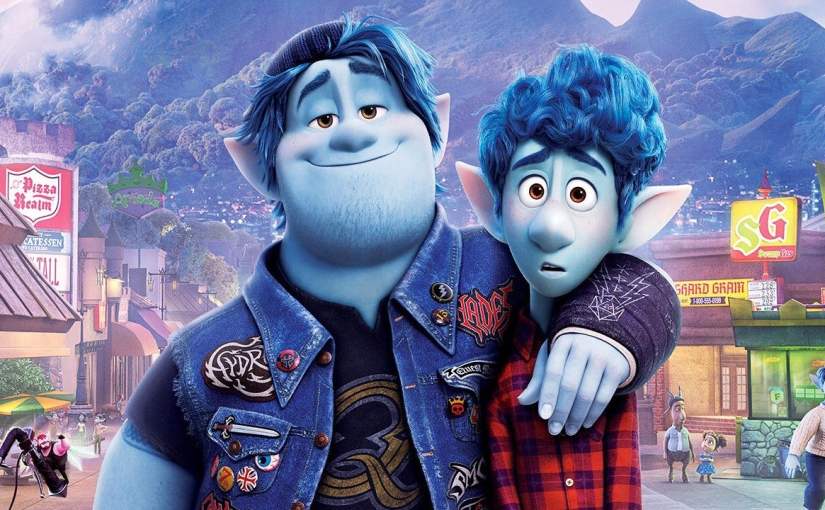
When two elf brothers, Ian and Barley, voices by Tom Holland and Chris Pratt, come upon their deceased father’s magical staff, they realize that as nerdy as he was, he was in fact a wizard. Some exposition allows them one day to revive him and spend only that particular day with him. It’s an opportunity for older brother Barley to reconnect and Ian to meet him. Something goes awry though when dad is only resurrected up to his waste, legs dressed in khakis with chino shoes and black leather belt. Hilarity and adventure ensue as they must embark on a quest to find a precious gem that will complete the resurrection before time runs out and the sun sets.

As the boys hop into Barley’s van called Guinevere. Adventure inspired of the level of The Goonies fare takes place. There are caverns with booby traps, maps and Holland and Pratt give up good vocal chemistry as they sort out their brotherly issues.

Julia Louis Dreyfus is mom and basically doing the typical Pixar mom but she has a great sidekick. Octavia Spenser as Corey the monstrous Manticore who runs a restaurant. To give side story filler, Dreyfus and Spenser are brought in to be on the trail of the boys. They have some good moments.

Onward has good, often funny and sentimental writing from Scanlon along with Keith Bunin and Jason Headley. It’s ironic actually. So many films from Harry Potter to Star Wars to Marvel focus on mysticism and magic that as movie goers we’ve become inundated with the gimmicks. Onward reminds us that ordinary dependence in a more grounded reality can actually lead to adventure too.

I liked it.