ARLINGTON ROAD

By Marc S. Sanders

Arlington Road is a disturbing and all too real glimpse into how domestic terrorism in the United States operates.  The film from director Mark Pellington becomes more intriguing with repetitive views. Evening news shows and commentators’ programs airing nightly on outlets like FOX, CNN and MSNBC will delve ad nauseam into the hows, whys, and whos of a startling attack upon a populated area within the country.  Theories are pronounced, explored, and fault is found with someone, somewhere.  The protagonist of the film suggests that a name and face must be declared to ensure the country is at peace once again and punishment is rightfully delivered.

What surprises me about Pellington’s film is that it was released in 1999, two years before 9/11.  The worst, modern tragedy at that time was the Oklahoma City bombing.  School shootings were not even as prominent; practically unheard of.  We were only on the brink of Columbine High School’s terrible massacre.  At this precursor moment in time, I have to believe it was especially complex and required meticulous strategizing to bomb a government building.  

When I watched Arlington Road for the first time in theaters, I went with a last resort option for a ritual Sunday movie outing with dad.  We had seen everything else that was playing.  Title is lousy.  (Really lousy – Arlington Road??? That’s the best name they could come up with???) The marquee actors are meh to my twenty-seven-year-old psyche.  (Where’s Harrison Ford or Tom Cruise or Schwarzenegger???). Who’s the director????  Well, for dad and I this film was a huge surprise because of its taut, compelling screenplay and magnificent performances from Jeff Bridges, Tim Robbins and Joan Cusack.  The acting is what stands out the most while you forgive all of the conveniences that intersect to keep the story on its tracks.  

However, when I watch the picture on repeat viewing every couple of years, I realize that other than a random encounter in a parking garage for two characters, everything had been well planned ahead by the villains.  Roger Ebert and even the other unpaid critic, Miguel, took issue with minor happenstances that occur at just the right time.  Well, sorry to disappoint them but Arlington Road has an explanation for nearly every detail that seems contrived when in fact it was all part of a villains’ orchestrated construction.  The bad guys are especially smart in this movie.

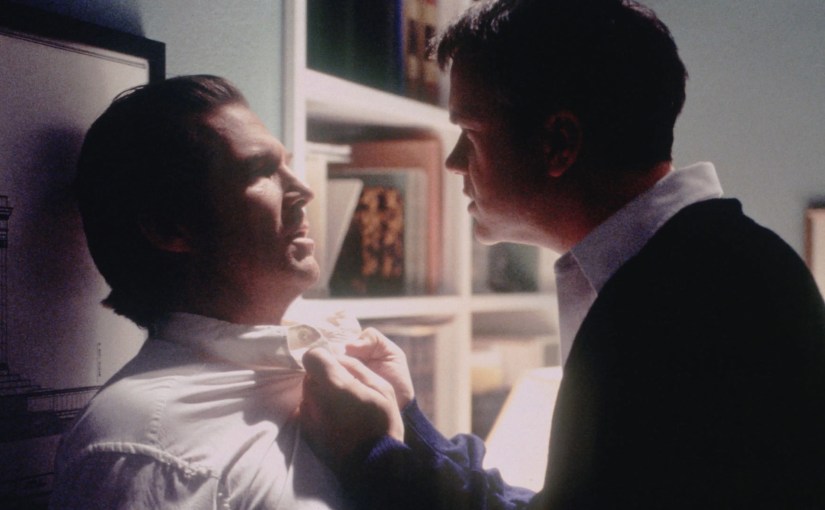
Jeff Bridges plays Michael Faraday, a college professor who teaches a history class about domestic terrorism in relation to bombings, shootings, and assassinations.  He lectures his students about the faults and responsibilities of the FBI and other law enforcement departments.  He also provides insight into the people responsible for these heinous acts and often questions if these nefarious figures were lone wolves capable of such madness or were they scapegoats or were there others involved to help carry out these acts.  

Michael is a widower and a father to a ten year old son named Grant (Spencer Treat Clark).  After his FBI wife is killed in the line of duty, Michael has not fully come to grips with the loss.  He is dating Brooke, a former graduate student (Hope Davis), but he is clearly obsessed with what went wrong on that fateful day when his wife perished.

Oliver and Cheryl Lang (Tim Robbins, Joan Cusack) are the happy neighbors who recently moved in across the street.  Michael becomes acquainted with them when he saves their son’s life following a fireworks accident.  The Langs quickly become enmeshed within Michael’s space with child sleepovers, barbecues and evening dinners.  However, the friendlier the Langs seem the more suspicious Michael feels about them.  

Oliver’s backstory seems inconsistent with what Michael observes.  Soon, the professor’s hysteria becomes increasingly amplified.  As wholesome as Oliver and Cheryl are with big, toothy grins and neighborly charm, could they actually be plotting for an act of violence to occur?  As Michael becomes more skeptical around them, Grant, Brooke, plus his wife’s former FBI partner, seem all the more dismissive.  Whatever Michael is beginning to believe is nowhere near as apparent as his own expressive paranoia with big outbursts and unkempt appearances.  Jeff Bridges delivers a manic performance that leaves you breathless and uncomfortable.  He’s so focused on how unhinged this guy is even when he’s just trying to move on with a new normal as a surviving spouse and parent.

One of the many strengths of Arlington Road is reliant upon its ongoing build.  More is learned with each passing scene.  When you feel like you’ve grasped everything, new material presents itself and the actual truths may be more disturbing than what’s already been revealed.  

Joan Cusack is freaky frightening.  She performs to the camera with wool over the viewers’ eyes and she says so much by doing so little.  Before you die, the last thing you want to see is a Joan Cusack with a crooked, unwelcome grin. I salute the simple costuming of Tim Robbins character.  He dresses like Mr. Rogers with a lanky, thin build covered by earth tone sweaters and khakis.  He’s so plain and corny that its terribly awkward. These friendly neighbors hide in plain sight.  

On a first view, Arlington Road may feel like a paint by numbers formula with a few jump scares as the hero sneaks around for clues along with a high stakes chase through Washington DC.  However, I encourage anyone to watch Mark Pellington’s thriller more than once.  The first time you are focused on Bridges, Robbins and Cusack.  The second time you are likely to find what explains the conveniences of the characters and the story.  Then you realize that Pellington and screenwriter Ehren Krueger have done thorough research into what realistically upholds the actions of these characters and situations.

Arlington Road only suffers from a terrible and misleading title.  It’s simply unattractive.  However, the film is compelling and authentically conceived long before a dark trend of American terrorism and mass violence dominated social media and evening newscasts.  It’s a mixed compliment to suggest that the cast and filmmakers got so much right with a topical story that was not yet so commonplace.  

This is an absolutely engaging thriller that I only wish was more fictional and exaggerated than it actually is.

SIXTEEN CANDLES

By Marc S. Sanders

John Hughes became a pop culture pioneer of the 1980s when he directed his first film, Sixteen Candles. The movie adopted a slapstick approach to teen anxiety related to love, cliques and high school popularity. Had Hughes waited much longer, it’s fair to say the picture may not have ever gotten produced. In a current age of political correctness and “Me Too” movements, Sixteen Candles is more shocking than originally intended.

There is no way this film would be made with a character like Long Duk Dung as a run-on gag Chinese foreign exchange student with a stereotypical Asian accent of mispronunciations, presumptions of mental retardation, and an accompanying “GONG” each time the film circles back to him. It is fair to say this is equivalent to when Buckwheat would wipe the sweat off his brow against a nearby wall and it would appear as ink stains in a random Our Gang/Little Rascals film. Actor Gedde Wantanabe who plays Dong has gone on record saying he was vilified for the role since the release of the film. Likely he was also quite embarrassed. I wouldn’t blame him.

Date rape is also a common element of the film. Dong is implied to be a victim by a butch high school girl. In another storyline the hot guy Jake Ryan (Michael Schoeffling), who drives a cherry red Porche, implies to the geek, Farmer Ted (Anthony Michael Hall), an offer to have his way with Jake’s intoxicated girlfriend. Freshman nerd Ted takes as much advantage of the opportunity as he can by taking photographs with the girl and then even forgetting what exactly occurred the next morning but making hopeful assumptions nevertheless, simply to bolster his reputation.

I don’t draw attention to these tropes to celebrate and guffaw though. The film continues to have a staying power with Hughes’ name labeled on the picture as well its recognition for making Molly Ringwald an ongoing cover photo for Teen Beat and Rolling Stone magazines during the MTV Generation.

Perhaps John Hughes had no idea at the time that his material would carry a shock element beyond plain silliness. I’m almost convinced of that. It’s fair to say Sixteen Candles is a byproduct of the raunchiness delivered by Animal House. I’m content with that because it is very, very funny in spite of the offending and inappropriate material.

Molly Ringwald is Samantha who is beside herself when everyone has forgotten her sixteenth birthday while gorgeous Jake seemingly doesn’t even know she exists. The family’s focus is drawn to her older sister’s upcoming nuptials the next day. It’s a lot to deal with for a high school sophomore. Ringwald embraces the frustration nicely as she doesn’t try for the comedy but often becomes the embarrassing victim of Hughes’ set ups: invasively touchy grandparents, Long Duk Dong, Farmer Ted’s obsession with her, and even giving up her underpants as a special favor. Samantha is the straight character among all the clowns in the cast, including her jerky younger brother played by Oscar nominee Justin Henry (Kramer vs Kramer). Paul Dooley, known for a career as a notable schlub, offers a nice scene or two with Ringwald as her father. John Hughes allowed himself to demonstrate how much he respects the characters he’s invented even if he spent the first two thirds of the picture humiliating them.

The transitional arc of the script almost parallels Hughes’ method of writing in his career. The comedy is sketched primarily in broad strokes. I said earlier it is rife with prejudiced humor, raunch and slapstick. That is until the end arrives with a mature, candle lit first kiss over a birthday cake accompanied by the sweet, soft melodies of the Thompson Twins. It’s adoring, sensitive, and Hughes closes the book on Sixteen Candles with the love and care he awarded most of his characters during his filmography. In one film, John Hughes approaches a level of maturity by the time the story’s end arrives.

The tenderness Hughes shows in the concluding scene of Sixteen Candles would become more evidently special in his later films like Ferris Bueller’s Day Off, Pretty In Pink, (not directed, only written by him), The Breakfast Club, and Planes, Trains & Automobiles.

John Hughes’ legacy is unmatched. Sixteen Candles is proof of that, and though some today would be dismissive of its ingredients, it remains a defining film of what the 1980s provided, culturally. If you grew up during the decade of excess or likely the grunge of the ‘90s, chances are you attended a sleepover with friends watching Molly Ringwald as the lovestruck, but crushed Samantha. She had to survive the most awful night of high school, coincidentally occurring on the day of her sweet sixteen, while making wonderful memories of laughter, tears, love and bonding.

NOTE: I waited to post this review for over two years until the eve of my daughter Julia’s 16th birthday. Happy Birthday Jules. I didn’t fucking forget your birthday!

KLAUS (2019)

by Miguel E. Rodriguez

KLAUS (2019)
Directors: Sergio Pablos, Carlos Martínez López
Cast: Jason Schwartzman, J.K. Simmons, Rashida Jones, Norm MacDonald, Joan Cusack
My Rating: 10/10
Rotten Tomatometer: 94% Certified Fresh

PLOT: The origin story of a certain jolly fellow in a red suit is told with beautifully enhanced hand-drawn animation in a film that deserves to be ranked with the best holiday classics.


I was not prepared for this.

Netflix’s Klaus from 2019 is one of the most beautiful, magical, and relentlessly original holiday films I’ve ever seen.  And heart-rending.  There are emotional beats in Klaus that rival anything in Pixar’s catalog, from the opening sequence of Up to the finale of Inside Out.

Short review: Go. Watch it now. Why are you still reading this?

Long review:

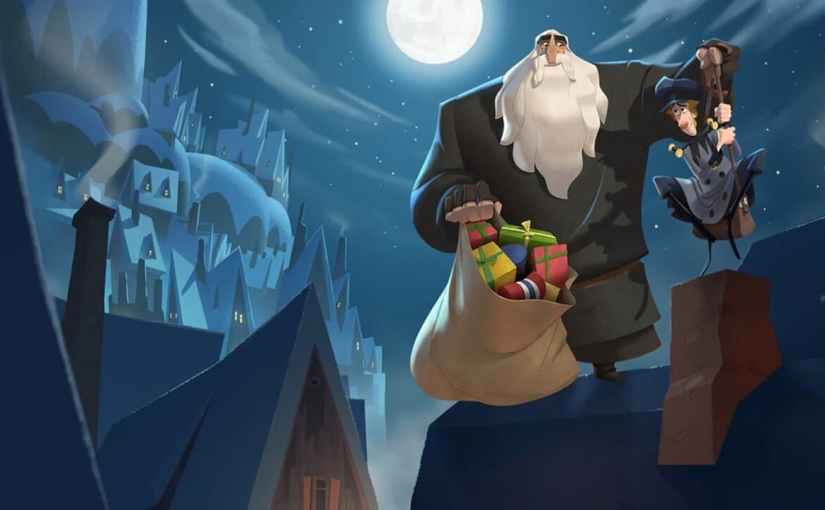
It starts an unspecified number of years ago somewhere in what appears to be Scandinavia, but it could be anywhere.  Or nowhere.  Jesper (Jason Schwartzman) is the ne’er-do-well son of the postmaster general, or something like that.  Determined to make a man out of his son, Jesper’s father assigns him a task: start a post office in a remote northern village on a desolate island and generate 6,000 letters in a one-year period or get cut off from his family’s substantial wealth.

The visuals in this forbidding village could warm the surrealist cockles of Tim Burton’s heart.  Rooftops aren’t so much pointed as sharpened.  Wide-eyed children make snowmen that would give Calvin nightmares.  A generations-long feud between two families on either side of town seems to be their only purpose for staying in town in the first place.

(So far, I’m thinking, okay, kinda weird, not sure where they’re going with this…is this scrawny dude gonna be Santa?)

One thing leads to another and Jesper travels to the other end of the island to visit the isolated house of someone known locally only as the woodsman.  Here he discovers shelves and shelves of handmade toys, gathering dust.  One of these toys finds its way into the hands of a child back in town who wrote a letter asking for a toy…

And here is where the story’s streak of inspired originality really took off.  Virtually every aspect of the legendary Santa Claus is given its own special origin story, from the reindeer to the sleigh to the concept of a Naughty List, right down to getting coal in your stocking instead of a present.

Aha, you say, but this has already been done!  I liked it better when it was called Santa Claus is Comin’ to Town, on TV in 1970, with Fred Astaire, Mickey Rooney, and Keenan Wynn!

True enough.  But Klaus ups the ante by imagining this tale in a way I’ve never seen before.  I’m finding it difficult to express my admiration without giving away key aspects of the film that make it such a delight.  It’s all done so organically, so naturally, that something happens, and you think, “Well, of course they think reindeer can fly, after seeing that!”  I found myself laughing out loud due to the sheer ingenuity on display.

I think it’s a great companion piece to that much-maligned holiday classic, The Polar Express.  Both films approach the Santa legend from different angles, but neither one talks down to its intended audience.  Here is a mystical figure, possessed of magical abilities beyond mortal man.  Both films treat him with the kind of childlike reverence he deserves, and if he’s a little scary sometimes, well…he is always watching…

But none of that would be enough to achieve perfection on its own.  What makes this movie perfect are the heart-rending emotional beats that come as complete shocks to the viewer.  You may notice that I haven’t mentioned Mrs. Klaus, nor is she listed on IMDb.  There’s a very good reason for that, but you won’t get it out of ME.  You may also be asking yourself, well, if this hermit woodsman turns into Santa Claus, what’s the deal with the postman?  Great question!  Watch the movie and find out.

(Pay attention to the wind…that’s all I’ll say.)

These and other surprises pop up here and there, like searching through old clothes and finding folding money in the pockets.  The finale might make you cry like a baby if you’re not careful.  You’ve been warned.

Klaus is buried treasure, lost amid the hubbub of many other films from that year that have been forgotten.  This one does not deserve to be forgotten.  It belongs on any list of classic holiday films, old and new.  If you’ve made it this far in the review, congratulations, thanks for reading, but now it’s time to GO WATCH THIS MOVIE.

Now available on Netflix.

TOY STORY 4 (2019)

by Miguel E. Rodriguez

Director: Josh Cooley
Cast: Tom Hanks, Tim Allen, Annie Potts, Keegan-Michael Key, Jordan Peele, Christina Hendricks, Keanu Reeves, Joan Cusack
My Rating: 9/10
Rotten Tomatometer: 98% Certified Fresh

PLOT: A new toy called “Forky” joins Woody and the gang, and a road trip with old and new friends reveals how big the world can be for a toy.


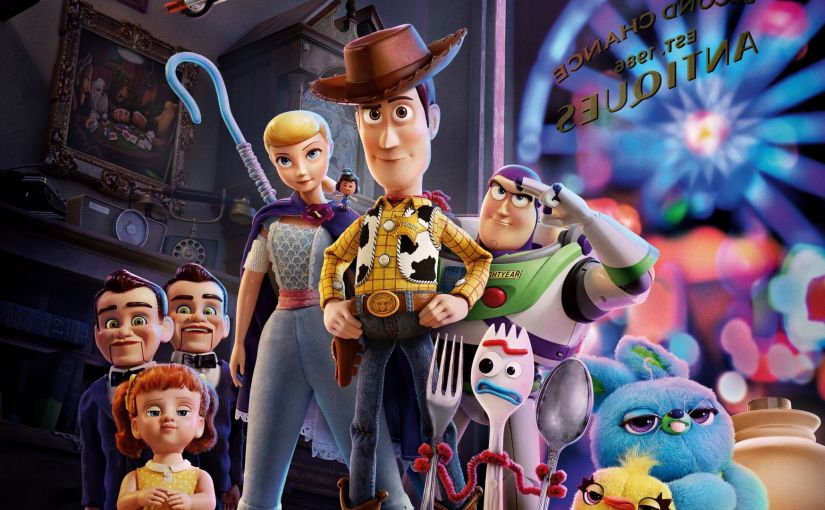
Frankly, one of the best “perks” of Toy Story 4 is the return of Bo Peep.  I had always wondered what had happened to her in Toy Story 3 that had Woody so sad.  I’m glad we got to see why she was no longer around, and I’m glad we get to see how she’s fared in the intervening years.  Just wanted to get that out of the way.

Toy Story 4 is not quite the pinnacle of perfection that is Toy Story 3, especially when it comes to the heartstring-tugging, but it’s a marvelous film on its own, and the ending is a fitting curtain call to the franchise.  Woody, Buzz, and the gang have gone through more hair-raising, death-defying adventures than Indiana Jones, it sometimes seems, and the fact that they reach the start of truly new chapters in their lives by the time the credits roll is comforting.

This fourth film introduces an intriguing element in the form of a doll named Gabby Gabby.  She’s one of those dolls that every girl seems to have owned at some point in her life…at least, every girl born before the year 2000, I’d guess.  She resides in an antiques store, and she has a problem: her voice box is defective.  When you pull her string, instead of a little girl’s voice, you hear what sounds like a 45 being played at 33 1/3.  (You older readers can explain that to the younger ones.)

Her potential salvation: Woody’s voice box is in perfect working order.  All she has to do is somehow exchange voice boxes with Woody, and she’ll have the chance to get a little human girl to love her enough to take her home.

This is…creepy.  There’s something unsettling about this Gabby Gabby character because she’s a cute little doll who essentially wants to perform an organ transplant whether Woody wants to or not.  She’s just so…matter-of-fact about it.

I’m doing a lot of simple play-by-play, and not really giving a sense of the movie itself.  That’s because, while it’s skillfully made and emotionally engaging, it’s not like this movie breaks new ground, exactly.  I think it’s a good thing this will finally be the last Toy Story film.  It’s becoming much harder to imagine what else Pixar can put these characters through, and I’d hate for them to push things too far like they did with the Cars franchise.

But don’t get me wrong, it was incredibly entertaining, and I loved every minute of it.  If you liked the first three movies – heck, if you love ANY Pixar movie – you won’t be disappointed by this one.  It’s just…you’ve gotta see it for yourself.  At this point, any further reviewing of the movie would involve spoiler alerts and scene descriptions and re-telling my favorite lines, and that’s not really a review anymore, that’s just a synopsis.

Suffice to say: “Toy Story 4” delivers the kind of movie we’ve come to expect from Pixar.  It’ll make you laugh, jump, laugh some more, give you a couple of hanky moments, and it’ll look GREAT doing it.