
By Marc S. Sanders
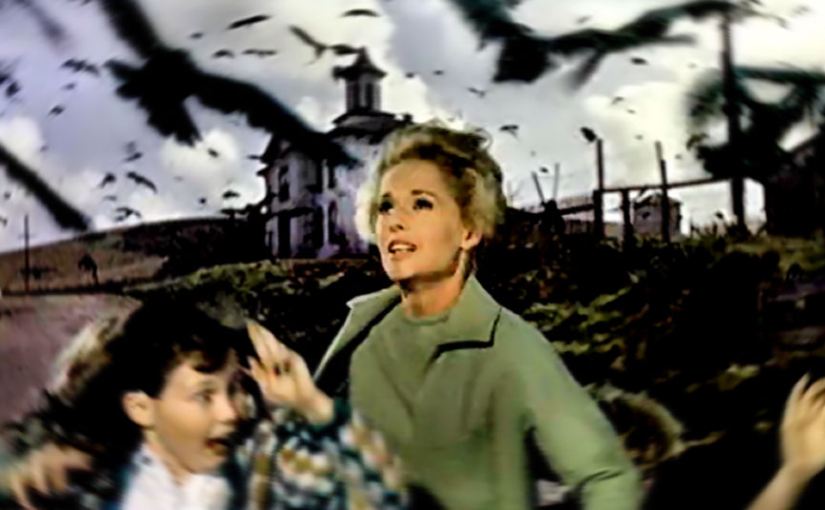
Alfred Hitchcock’s monster movie is The Birds from 1963. There’s really not much to the piece as far as a story goes. Characters are just given a purpose to be with one another so that they can be tormented together. In this case, the film offers up a near hour introduction of newspaper heiress Tippi Hedren playing meet-cute with attorney Rod Taylor. How ironic that they begin a flirtation in a bird shop of all places only to reconnect at Taylor’s harbor island home in Bodega Bay, located on the outskirts of San Francisco. Still, as only Hitchcock can demonstrate there’s an ominous feeling sprinkled throughout before the real terror takes flight in the movie’s second half.
While I don’t rush for repeat viewings of The Birds, there’s no doubt as to its influence. Each time there’s a shot of a bird soaring in the sky, your eyes open wider. Something will eventually take effect. At the beginning of the film, Hedren looks out into the San Francisco sky to see large flocks of birds soaring overhead. Later, while taking a boat in Bodega Bay towards Taylor’s home that he shares with his mother and sister (Jessica Tandy, Veronica Cartwright), she’s attacked by a random gull. It’ll raise the hair on your arms for sure.
I’ve noted before how Alfred Hitchcock builds suspense. The audience knows there’s a bomb under the table. The characters in the film don’t. So, the audience is nervous as to when the bomb is going to go off or if the characters are even going to discover the explosive. An outstanding sequence in The Birds includes Tippi Hedren sitting on a park bench near the jungle gym, outside of a school house. The children are singing along inside. One crow lands upon the jungle gym. Then Hitch returns to a shot of Hedren calmly lighting a cigarette. Then back to the jungle gym and there are four more birds perched just behind her. Then back to Hedren, unaware. Then back to the jungle gym for Hedren to turn around and there are suddenly hundreds of crows congregated together. Effectively, other than the innocent harmonies of the children nearby, Hitchcock opts not to use any music to shock his audience as the scene develops. The visuals lend to the fear. The danger that threatens Hedren and the children heard off screen is at the forefront of the viewer’s mind. No more is needed. It’s scary, and you want to be as quiet and unalarming as Hedren so as not to instigate the monsters right next to you.
A later scene has Hedren ascend a dark staircase to open a bedroom door. The roof has been torn open and suddenly the blackness comes alive with flapping wings from every direction. That’ll make you shift in your seat.
Hitchcock offers plenty of set pieces for bird attacks, but another effective device is to show dissention among the ranks. From a character perspective, the picture takes a sideways route to imply an oedipal complex between Rod Taylor and Jessica Tandy, who plays his mother. Therefore, the script suggests Hedren as a threat to their relationship. Before the film is over, they are likely going to have to develop a united front or it could be their undoing. (Maybe it’s a nod to Hitchcock’s popularity with Psycho. A cute wink and nod.)
There’s also Suzanne Pleshette as the school teacher that we learn had a tryst with Rod Taylor’s character at one point. That doesn’t spell out too well for Hedren, either. As this bizarre epidemic becomes clearer, a scene in the town diner goes so far as to suggest that these random bird attacks didn’t start until Hedren arrived the day before. Yes!!!! It’s all her fault!!!!
None of this will eventually matter though.
Other disaster films and monster movies later relied on exchanges like these, from Jaws to The Towering Inferno. Hitchcock was wise enough to build tension. Not a single bird in the scene, but still the fear and doubt among each other bares the strain. There’s even an advocate for the birds with a strange elderly woman proudly debating her ornithological expertise, while a drunkard at the end of the bar declares the world is coming to an end. All of these characters could have come from different movies, only to be pasted on to this canvas thereby lending to the frenzy. Chaos must ensue among the masses.
Often, I get frustrated when there’s no explanation for a film’s central story. I gave up on the TV show The Walking Dead many years ago because there never was a cause revealed for the zombie epidemic. It became a smut of soap opera cliché accompanied with ridiculous gore. Forgive the SPOILER ALERT, but I commend Hitchcock’s film for not providing a wrap up to The Birds. The film ends with an uneasy final caption. Nearly every inch of space on the screen is occupied with birds as the cast makes their way to the car to slowly drive out of town, careful not to disrupt the now dominant species of this universe. Hitchcock provides a picture where the laws of nature declared a winner. As intelligent as humans are considered to be, they have not won out. They have had to surrender. Why the birds attacked, we’ll never know. Odd phenomena can happen.
There’s nothing thought provoking about The Birds. It’s simply a film based on heightening your discomfort. Often, I find the material and dialogue laughable. The townsfolk notice a man lighting a cigarette right over a stream of gasoline and urge him to put out the flame. Wouldn’t the dumb guy smell the diesel????? However, then we wouldn’t get a fantastic fire ball to observe up close as well as from Hitchcock’s “God shot” in the sky with the birds looming into frame over the town below.
The visual effects look outdated of course, but they still hold because of how Hitchcock demands they are used. I noticed that his reliable composer Bernard Hermann is credited, but as a “sound consultant” this time. The shrieking of the birds is what sends the chills down your spine. Also, there’s the fact that Hitchcock offers up birds flying right at the screen or the windows. A great sequence includes the front door of a house being gradually shredded apart by the bird masses. The wood proceeds to splinter. You don’t see the monsters but you know they’re right there on the other side. Once that door breaks open or those windows shatter, then it’s likely all over for our heroes. George A Romero exercised bits like this in Night Of The Living Dead. Very, very effective.
The Birds is just okay for me, honestly. The fright material is what keeps its legacy. Yet, there’s a lot of soapy material among the cast of characters that’s not all that interesting. Again, a purpose has to be served for these people to occupy the story. Just offering a movie where birds hover and peck at people wouldn’t be enough. So, we have to follow Rod Taylor and Tippi Hedren’s trajectory. It’s fun to see screaming kids run from these animals turned menace, though. I found it hilarious to watch a birthday party run amok. I also yelp when I see a flock storm into Jessica Tandy’s house from the chimney turning the living room into a contained disaster area. An especially gruesome discovery by Tandy later in the film is absolutely eye opening (pardon the pun, if you know what I mean), and clearly an inspiration to a well-remembered scream out loud moment in Jaws.
The Birds is fun, but it’s not the artistic merit you’ll find in other Hitchcock classics like Rear Window, Vertigo, Suspicion, or even Psycho. What I can promise is that once you get through the plodding character connection build up, you’re allowed to forget about any of their value to the picture and simply relish in the mayhem.
 2 UNPAID MOVIE CRITICS!!!!