ZURAWSKI V TEXAS

By Marc S. Sanders

The topic of the harrowing documentary Zurawski V Texas is abortion.  However, the debate is a different angle than I believe either side of the ongoing argument is accustomed to. 

Filmmakers Maisie Crowe and Abbey Perrault provide extensive up to date coverage on attorney Molly Duane who represents a growing contingent of women who suffered complications during their pregnancies.  The diagnoses might have varied but the commonality was that in most cases these circumstances became life threatening to the point where medical professionals deemed the best resolution was to follow through with an abortion so that an unhealthy child is not delivered and forced to suffer a brief life in agony.  At least just as pertinent is to preserve the health and often save the lives of the mothers.

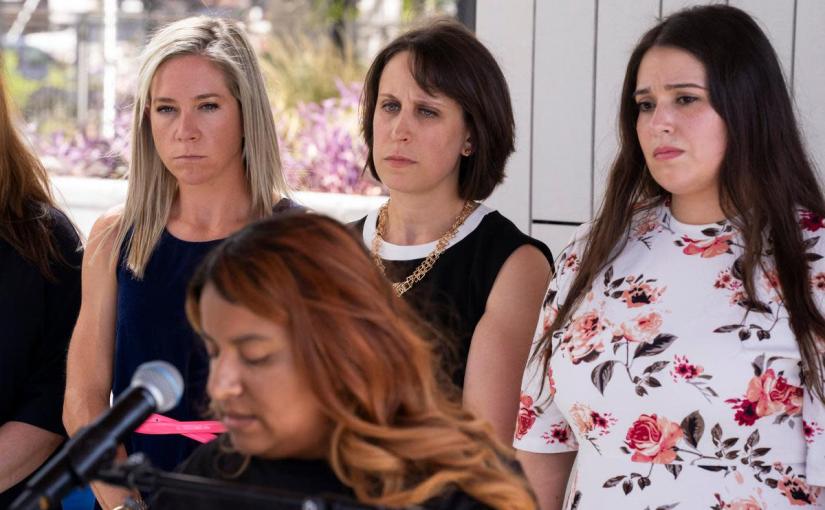
Amanda Zurawski from Austin, Texas is the first mother to make a claim. Thereafter, a parade of other women sought out her attorney, Molly Duane, to testify of their experiences and plead with the Texas courts to make exceptions to the state’s altogether blanket outlaw of abortions performed within the state.  As soon as the prologue begins, we see Amanda testifying of her suffering at a congressional hearing.  Close ups jump to the expressions of the government officials who appear intent on listening to Amanda’s plight where she describes having gone into septic shock with her life in serious jeopardy.  It’s a very sad story, but Amanda demonstrates that she’s a stronger warrior than these men that she is facing.  They can do nothing but sit there speechless.  Who knows if they are even listening to the woman on the stand.

Later, as Amanda and Molly take their case to another court, the want to be mother describes how one of her fallopian tubes had to be closed up and her uterus needed to be reconstructed.  Because she was not permitted needed abortion, she is unable to try again with another pregnancy. 

Two other women are also focused on in the documentary. 

Samantha Casiano is forced to carry to term, and then at the end of nine months, deliver an anencephalic baby with no chance of living.  The experience comes at a cost of Samantha’s mental health and her marriage when her husband becomes withdrawn.  Following this incident, Samantha follows through with a tubal ligation to avoid the risk of going through this ordeal again.

Another plaintiff is Austin Dennard, an OB-GYN doctor, who as a patient left the state of Texas to terminate her pregnancy following a risk-laden diagnosis.  She eventually becomes a mother, but now she is a doctor not permitted to aid her patients with their ordeals. 

A struggling roadblock continuously reiterated in Zurawski V Texas is the threat that any medical professional faces should they perform or assist in an abortion, regardless of the reasoning behind it.  Molly Duane and her clients are arguing that if there any exceptions to Texas’ unreasonably strict laws that forbid abortions, it is unclear.  The ladies are petitioning for a clarified explanation which never comes.  Can’t they just get a straight answer on why exceptions for continued health care can not be executed?

I watched this documentary after I have already done my early voting ahead of the 2024 election.  Amendment 4 is on the state of Florida ballot and it’s a clear Yes or No vote of whether abortions should be made legal.  Zurawski V Texas goes beyond the typical Pro Life vs Pro Choice debate that will never satisfy this entire country.  This age old argument is split down the middle, and now politicians and lawmakers seem to weaponize the topic to earn constituents’ favors and votes.  In fact, it is the only reason I can figure for why Ken Paxton, the State of Texas Attorney General is always on the trail of each Molly’s wins within the Texas courthouses. 

Molly will win her arguments while standing in front of one judge after another, but then the uncompromising Paxton will overrule the judgment literally within hours afterwards.  Just as you are about to clap for her success, “Five hours later” appears on the screen.

The documentary covers the ladies’ families and friends who ask how can someone be Pro Life, while outlawing a medical procedure to save a life.  Ken Paxton is the villain of this frightening story because any shred of reasoning from him is never provided while he exercises his stubborn authority.  It’s monumentally unfair.

In the film, when Molly Duane takes the case to the Texas Supreme Court, it is astounding to see members of the court question why Molly and her clients are not going after the doctors who are denying the care that is needed.  It’s a direct insult to the intelligence of these women who are suffering physically, mentally, professionally and even domestically.  There are plenty of health care providers on the side of committing abortions to save the lives of the mothers and avoid any further suffering of embryos and newborns that cannot survive.  However, how can doctors be expected to perform when the state threatens them with criminal charges, license suspensions, fines and incarcerations? 

These professionals have earned the training to save lives.  Yet a governing body is not allowing them to make fundamental, ethical and appropriate decisions for best interests of their patients. 

Most documentaries will at least tell you in a byline that the producers reached out for comment from the other side, and usually that contingent declines to speak on the subject.  I cannot assume that the filmmakers reached out to the opposition of this topic.  People like Ken Paxton or even Governor Gregg Abbott and Senator Ted Cruz of Texas.  The film makes no claim to that idea.  So, I wish there was an attempt to get an answer from the opposing parties.  Still, we get footage of the naivety with governing figures asking questions that lack merit or substance, and worse, we get Paxton’s closeminded and unexplained reasoning for his overturning on cases legally ruled in favor of Molly Duane’s clients. 

Maisie Crowe and Abbey Perrault have assembled an informative film that hopefully will influence votes and ongoing petitions for this important argument.  The day after I post this article is Election Day, November 5, 2024.  Abortions do not just fall exclusively into the category of reproductive rights and the right for women to decide what they want and do not want to do with their bodies.  There’s even more at stake than that.

Zurawski V Texas presents a health crisis that never, ever should be a predicament.  Our doctors have the knowledge and experience to do what is necessary to save the lives of mothers who carry with no fault or mistake or lack of sound judgment.  They are women who chose or planned to become pregnant.  Sadly, complications interfered like it can in any kind of health situation.  Complications can occur during an appendectomy.  Are doctors supposed to stop what they’re doing and check to be sure they won’t go to prison before they proceed any further?  The same could be said with heart surgery or brain surgery.  There are resolutions for these patients to escape terrible, life threatening risks.  Yet, the weaponizing of a political argument for campaign wins stands in firmly in their way and disregards the simplicities of what can save human lives.

Last week, I declared one of the film’s at the 2024 AFI Film Fest was the best I’d seen this year, so far.  That was Clint Eastwood’s Juror #2.  Days later however, Zurawski V Texas stands at the top of the list.

This documentary might focus solely on the state of Texas, but the scenarios warn of a nationwide epidemic if the stringent rulings of our governing bodies continue to neglect basic health while the figures of authority work to prolong their political careers, at the cost of their constituent’s lives. 

Zurawski V Texas is without a doubt the most important film made this year. 

NO HARD FEELINGS

By Marc S. Sanders

Jennifer Lawrence goes the route of Farrelly Brothers comedy with No Hard Feelings.  She’s a thirty something gal named Maddie Barker who gets by sleeping around with the men of Montauk, New York while being an Uber driver and a bartender on the side.  It’s easy enough to do because her mother left her with a completely paid for house.  What she didn’t account for was taxes, and now that her car has been towed away (and shortly after totaled – just watch) and the past due bills start arriving, she’s got to find some means to uphold her Uber career so she doesn’t lose her house.  Problem is the best Uber drivers drive cars.

A seasonal annoyance of Montauk occurs when the ultra-wealthy WASPS come to reside in their summer homes.  A lot of these folks are helicopter parents for their spoiled kids who have futures awaiting them at Ivy League universities.  One such couple is portrayed by Laura Benanti and an especially flaky Matthew Broderick.  (Yes!  Ferris Bueller!)  Maddie answers the ad to literally get their dweeby son primed and ready for Princeton college life by sleeping with him and breaking him out of his shell of just video games and volunteer work at the homeless pet shelter.  In return, they will transfer the title over to a run-down Buick sedan that Maddie can own outright and catch up on her bills.  If life were only this easy.

The kid is Percy Becker played by newcomer Andrew Barth Feldman.  He’s quite good in this role and I imagine when he started on the first few days of filming he felt as awkward as he appears next to the confidence and experience emulating from Oscar winning Jennifer Lawrence.  You could never imagine pairing these two up in a film.  I mean, like they wouldn’t even work as a brother and sister.  Still, the comedic premise is so absurd like a Farrelly Brothers movie, that you just have to go with what this picture offers. Thankfully, the situations are hysterical.

It’s not easy for Maddie to break Percy of his introverted personality.  Poor kid doesn’t know how to drink or how to dress at an island bar.  He has no friends. He definitely doesn’t know how to talk to girls and even a naked Maddie accompanying him on an empty beach in the middle of the night for skinny dipping has disastrous results. 

Like a lot of romantic comedies, Maddie believes she just has to quickly lay this kid, collect the prize car and no feelings of love or like will ever get in the way.  Not so fast.  Soon, we get to see the attributes Percy possesses, and he’s hard to get off Maddie’s mind.  I read that Feldman played the title character in Dear Evan Hanson on a stage tour for a year. I can completely envision that after witnessing Percy perform a sultry rendition of Hall & Oates “Maneater” on the piano.  Close ups go over to Lawrence watching from across the room and I don’t believe she was acting.  This kid is a talented performer.  Suddenly, Lawrence and Feldman are great scene partners doing some very fine work together.

I hope to see Andrew Barth Feldman in more films.  He can do both drama, and of course comedy.  Moreover, Jennifer Lawrence has officially widened her range.  Her resume is certainly eclectic and this film only enhances her record.

The premise of No Hard Feelings is near impossible to swallow.  Fortunately, the gags that follow and especially the chemistry between the two leads allow for a sweet story with broad, raunchy,  slapstick R-rated material.  Many of the more successful comedic films followed this formula like Coming To America and There’s Something About MaryNo Hard Feelings has just enough substance to be grouped within that fraternity. 

THE HUNGER GAMES

By Marc S. Sanders

Some of the worst atrocities in history have often spawned some of the greatest stories.  I’d expect it would at least leave us feeling melancholy, but I hope it shapes a future that learns from humanity’s worst offenses.  That’s what came to mind as I watched the film adaptation of Suzanne Collins’ dystopian best-selling novel The Hunger Games.

In what was once a supposed North America, the continent is now called Panem and it is divided into twelve districts, with each specializing in some means of living.  Districts 1 and 2 are the upper-class wealthy.  Districts 11 and 12 are the starving destitute.  To maintain a semblance of order, President Snow (a chillingly older Donald Sutherland) oversees the nation’s Annual Hunger Games where a boy and a girl from each district is selected to compete in a dangerous competition of being the last one to outlive their competitors.  May The Odds Be Ever In Your Favor!  In the 74th edition, expert hunting archer Katniss Everdeen (Jennifer Lawrence in her most celebrated role) volunteers herself from District 12 to spare her younger sister from danger and selection.  She is paired up with the District 12 boy, Peeta Malark (Josh Hutcherson). 

Like any sporting competition, Collins’ story takes time to hype up the event.  The youths are fashioned up in the most glamourous adornments and interviewed for television by Caesar Flickerman portrayed by a delicious, yet unsung Stanley Tucci in bright blue hair and sparkly suits, doing his best Griffin, Carson, Letterman, Leno, and O’Brien.  With every white molar revealed in Tucci’s broad smile, he appears even more sinister in the purpose he serves for the Games, Panem, and President Snow.

Jennifer Lawrence gives a faithful portrayal to the Katniss character found in the pages of Collins’ series of young adult novels.  A new hero has been conceived – the rebel who stands along other well knowns like Luke Skywalker, Robin Hood and Harry Potter.  Katniss is not looking to be a savior but with influence from a prior Hunger Games champion (Woody Harrelson, doing his drunken best) and a calm, but humble fashion designer (Lenny Kravitz) she finds herself elevated towards a promising future.  Katniss Everdeen inherits the moniker known as “The Girl On Fire” with a three finger salute and a somber three note battle cry harmony.

I’ve likened the setting of The Hunger Games to the Holocaust and the early twentieth century European Nazi occupation.  (It seems more apparent in the next film, Catching Fire.)  If I had to compare the real-life period to this fictional one, then they are not anywhere close.  Yet, Suzanne Collins and director Gary Ross’ film depict hardship and oppression from a ruling upper class gleefully using their young for savage sport entertainment, while being forced to dwell in concentration camps with no permission to escape or run free, lest they suffer terrible punishments for themselves or those they care most about.

The Hunger Games values the themes of sacrifice while some characters inadvertently become heroes for a people against a domineering force.  It’s fantasy.  It’s adventurous.  It’s sprinkled with romanticism for Katniss and the triangle she’s pitted within for her care of Peeta but also her loving affections for another District 12 resident named Gale (Liam Hemsworth).   Frankly, the romance angle is a little weak in the films and books.  Ultimately though, it is harsh for the young characters in the story, which is why my wife refuses to invest her time.  I empathize with her position.  However, I find the story inspiring.  It’s also a hell of a thriller.

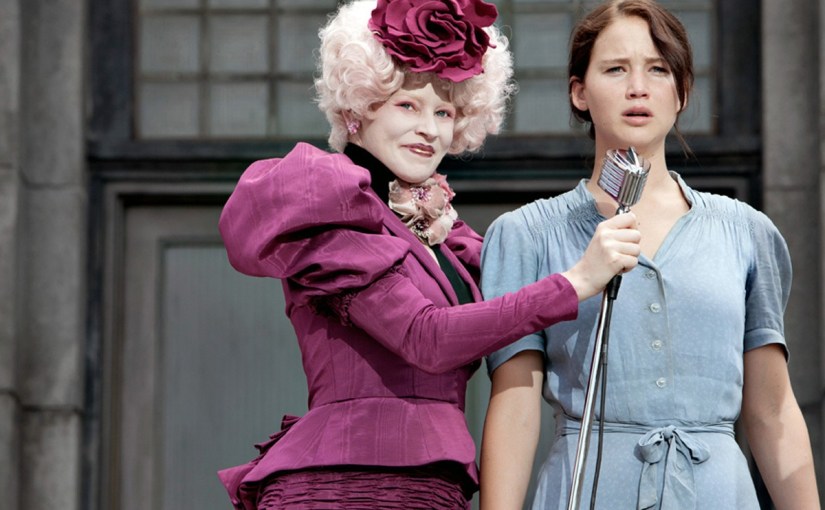
As a film, Gary Ross assembled a strong and alive production of gaudy, bright colors within the capital against morose grays found in District 12.  The clash of the two settings is no more apparent than when squeaky Effie Trinkett in her garishly loud facial makeup and wardrobes arrives in District 12 to host the Reaping, also known as the selection of the child contestants.  So many actors in this cast are memorable.  An unrecognizable Elizabeth Banks is no exception.  As Effie, her personality that publicly represents a hesitant Katniss and Peeta is deliberately inappropriate and further demonstrates how demonically twisted the mentality of The Hunger Games truly is. 

When it is time to finally arrive at the manufactured arena where the contestants will do battle to the death, Gary Ross effectively incorporates the inventive surprises offered by Collins’ source material.  Some competitors are brutal in their combative skills, but environmentally speaking the forest like jungle is dangerous as well.  Especially notable is a hive of stinging tracker jackers that’ll leave the viewers shaken. 

Suzanne Collins’ first installment of her series persists in leaving its ending completely questionable.  Will all these children, some of them who are noble and good, actually die?  Could a good soul like Katniss follow through with what the Games demand of her like killing Peeta for example?  I appreciate the imagination that went into the ending, leaving a subsequent tale to be told beyond this film.  

My one complaint is common in action films.  Gary Ross does really well with the edits and filming of his movie.  However, one of the last scenes develops into a hand-to-hand combat moment taking place in darkness with very shaky camera work and uneven grunts, punches, and kicks.  I abhor when filmmakers go this route.  It’s lazy work.  I can’t tell who is hitting who or where.  I’m just supposed to accept the final struggle that the hero is having with the bad guy and feel a sense of urgency and suspense as they supposedly cast a harsh blow to their enemy and fall over. I might as well close my eyes during moments like this because it’s all just blurry streaks in midnight blackness with sound editing filtered into the sequence.  This tiring approach happens so often in movies, and it becomes a let down for me time and again.   I love a well-made, thought-provoking thriller but the filmmaker hacks it all up near the end and it looks like he’s got to meet a deadline for the final print to get out to the theaters.

There’s much to discuss and think about in The Hunger Games.  Suzanne Collins’ idea stemmed from how television viewers soaked up the drama found in reality tv shows like Survivor and Big Brother.  It’s not so much the fate of the contestants that we care about, but how do they serve the producer’s crafted storylines.  Even American Idol steers the drama of the kids who get their shot at Hollywood fame.  The Super Bowl will position a star player like Tom Brady as a focus with questions of whether this is his final season, and how the championship games affect his marriage and family.  Does he get along with his coach?  None of this has anything to do with the points on the board.  Is all of this about the games, or is it about those tasked with playing the games, and for whose benefit of control, wealth, and power?  In this fantasy film, do the people of Panem cry at the drama spurned from the horrifying death of a child they got to know from Caesar’s colorful interviews, or are they in despair at the loss of another young life?  Whether it is real or fictional, is the drama of these gladiator games and competitions focused in the right direction?

The cast and production team under Gary Ross have put together an effective dystopian and bleak future reliant upon what the world focuses on more than anything beyond who they truly love or what they stand for.  The Hunger Games might seem inconceivable, but it is frighteningly relatable. 

SILVER LININGS PLAYBOOK

By Marc S. Sanders

Bipolar disorder can be a crippling ailment, not only to the person, but to his/her family as well. That, I imagine are the limits of my knowledge on the subject. David O. Russell’s Silver Linings Playbook will have you believe a way to embrace the disorder is to be involved with people who accept it and love you regardless.

Bradley Cooper is magnificent as Patrick; a hyperactive man suffering from his own demons. He is short tempered, confrontational, and prone to exhausting and uncontrollable outbursts. Because of that, he has lost his wife, his job, his friends and when the film begins, he is being picked up by his mother from an eight month court ordered stay in a mental institution on his way to live with his parents, Dolores and Patrick Sr., played brilliantly by Jacki Weaver and Robert DeNiro. Patrick is determined to rebuild his life. He feels confident that he is now on a positive track of exercise and healthy eating, and he wants to win back his wife. It is not so easy however, when Pat refuses to take his prescribed medication and his own father probably suffers from a similar disorder and he has to share a house with him. This means dealing with Pat Sr’s obsessive compulsiveness over his beloved Philadelphia Eagles, as well as his own short temper and his insistence on using family time with Pat Jr as a means to break the “jeu, jeu” that has cursed the team. Pat Jr. wants to move on with his life and find meaning and peace. His own obsessions with winning back his wife and overcoming witnessing the affair she was having behind his back do not help.

However, then Pat Jr meets Tiffany (Jennifer Lawrence in her Oscar winning role) and her own past is tormenting her, following losing her policeman husband in the line of duty. It’s clear she has not overcome this experience and she has taken up dance, which she is teaching herself in a refurbished garage. Tiffany is not quick to accept Pat Jr, but eventually the moments necessary for any film about relationships line up despite some screaming and shoving.

It sure sounds like I’m describing a heavy, miserable drama, here. Reader, I’m not. David O. Russell offers up moments of comedy without any of his characters really trying. No one is outright normal in this film. They are all burdened with their own idiosyncrasies and diagnoses, even Pat Jr.’s therapist, who we learn is an obsessed, face painted Eagles fan himself. Russell repeatedly uses a steady cam (I believe) to rush right up into the face of his characters, individually, when a moment is overtaking him or her. It’s a way of showing that no one else in the room can see what the sufferer is seeing. Everyone else is bound by their own disorder. Russell uses this device to isolate the character that owns the scene whether it is Delores, who endures the aggravation of her husband and son, Tiffany who can not get over the loss of her husband at a young age, Pat Sr. who must live with his Eagles losing another game, or Pat Jr. who is only trying to adapt to a new way.

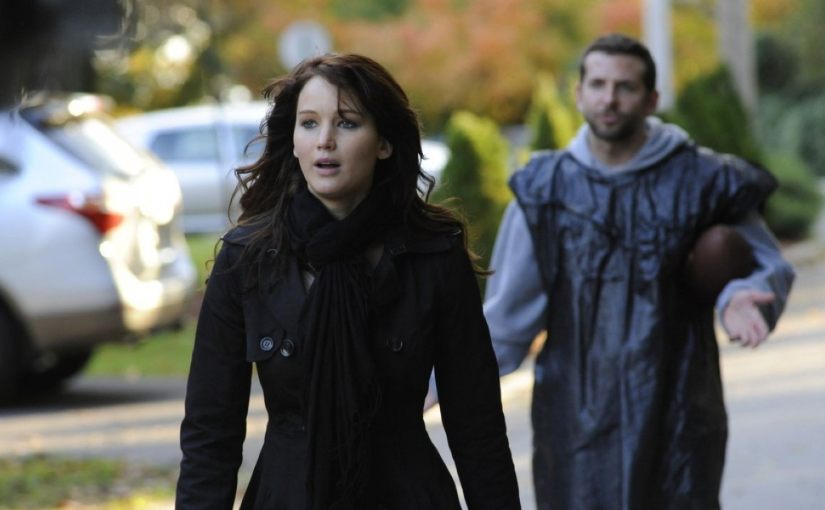
There is no calmness in the domesticity of Pat Jr’s life and it only feeds the fire of his bipolar disorder. What he needs is someone who will not shun or ignore the disorder but embrace it and Tiffany is that person. Tiffany is also the person who will beat up on Pat Jr in one scene to bring his self-involved neglect to light. A helpful gesture for Pat Jr, but not a fulfilling action for Tiffany. Then in another scene she will solely come to his defense. The best moment in the film belongs to Jennifer Lawrence as she storms through the door and quickly confronts DeNiro on his own shortcomings, basically disarming him with sports statistics of every Philadelphia team, only to prove that Pat Jr had nothing to do with the outcomes of these games. Lawrence is harboring a machine gun of dialogue and she does not let up. DeNiro, I’m sure, loves to balance scenes like this with talent of this caliber. (I’d imagine he was missing great acting moments like this when he was shooting his Focker movies.) Russell wisely captures most of this scene in one shot. He is well aware of his leading actress’ strengths.

The ending is as quirky and inspired as Little Miss Sunshine, where Pat Jr and Tiffany participate in a dance competition that has everything is on the line, not just for their own sanity, but also for that of Pat Sr and the rest of the family. At the risk of spoiling a piece of the story, I have to recognize the dance sequence in this climax. Russell and his choreographer wisely mix it up with contemporary music that quickly switches over to head banging heavy metal and back to contemporary again. I caught it as an allegory of the mood swings these characters, especially Tiffany and Pat Jr, go through. The dance is messy, unsophisticated, aggressive and most of all it is adorable and lovable all at the same time. Psychologically, there must be something eating at Pat Sr and Pat Jr, and Tiffany and the rest of the cast, but that is, in no way, a reason not to love them.