TRUE LIES

By Marc S. Sanders

James Cameron’s True Lies never had to be believable.  It only had to be fun, and it is fun for the first act and most of the third act.  Too bad the sitcom like, chauvinistic second act pretty much overthrows the whole picture.

When you watch an Arnold Schwarzenegger pic, you have to take it with a boulder of salt.  Throughout his career, he’s been pregnant (never saw Junior), he’s begged God to give him the strength to fight Satan (I’m being honest here. It happened in End Of Days), he’s been tossed out of a plane at thirty thousand feet with no parachute and lands safely in a dumpster (Eraser) and his twin brother has been Danny DeVito.  (Do I really need to share the title of that movie?) In True Lies, I have to accept the fact that the muscular body builder with an Austrian accent, and pretty good line delivery, convinces his wife and daughter, played by Jamie Lee Curtis and Eliza Dushku, that he’s simply a boring computer salesman.  It’s shocking, utterly shocking, to realize that he is actually a clandestine spy, and his family is completely unaware.  See if Bruce Willis or Harrison Ford or Mel Gibson were in this role, then I’d buy it.  Tom Arnold might have been a good pick, but James Cameron settled to make Roseanne’s ex-husband Schwarzenegger’s secondary partner with some comedy bits. He might be the best part of the movie.

A brilliant 007 inspired opening gets this adventure started off with a literal bang at a black-tie affair at a wintery German mansion. Harry Tasker (Schwarzenegger) infiltrates the party along with support from his partner Albert (Tom Arnold) who hides in a tech equipped van that’s close by.  Harry does the tango with Tia Carrere, which is charming and something new for the Terminator.  The outcome of this shoot ’em up episode puts these super spies on the trail of an Arab terrorist who has the capability of unleashing a nuclear arsenal on the United States.  When Harry is not chasing this guy on horseback and up high-rise elevators, with the equine in tow, he and Albert report to an eye patch played by Charlton Heston.  

Somehow, I sleepwalked into another movie, though.  Harry has not been the model family man and when he tries to make amends, he inadvertently hears his wife Helen (Jamie Lee Curtis) chatting with a sleezy car salesman (Bill Paxton).  Now all of the spy department’s resources change course to surveille Helen and this moron she’s been talking to because this is the episode with the misunderstanding.  James Cameron’s script makes very poor efforts to achieve sitcom level comedy.  A laugh track couldn’t even save this tripe.

Bill Paxton is a great actor, but he accepted a terrible, unfunny role as he ironically pretends to impress Helen by actual being a spy.  Ha!!!! Go figure!!!!

Jamie Lee Curtis is a great actor too, but she agreed to play one of the dumbest women to ever grace a screen.  She believes this moron’s lies as easily as she believes the one and only Arnold Schwarzenegger is just a computer nerd.

One of the most intolerable scenes I can ever think of occurs after Harry learns what is really going on. He gladly continues to play one over on his neglected and unhappy wife by believing he’ll give her a fun adventure he thinks she deserves.  Helen is convinced that she must abide by the wishes of a clandestine government group who apprehends her.  She arrives at a dark hotel room with Harry sitting in the shadows, mere feet away, and convinces his wife to do a striptease dance in front of a stranger.  This routine goes on for the longest five minutes.  It’s not funny.  It’s not sexy.  It’s eerie and perverted with sick narrow mindedness. 

At the risk of getting political and prudish, Jamie Lee Curtis has always been one of the most outspoken celebrities for equal treatment between men and women and has ostracized those in positions of power who work towards their own self advantage.  Yet here she allows herself to be objectified by James Cameron and Arnold Schwarzenegger to be a punchline for male chauvinistic pranks.  If this scene ended with Curtis breaking Schwarzenegger’s nose with a karate chop while holding him at gunpoint, then this becomes something else.  That’s a no, however.  Instead, she is a scantily clad victim of sexual deviants, and she never stands up for herself, or exudes any kind of pride.  I recall in 1994 not liking this sequence.  Over thirty years later, well after the tides of the Me-Too movement have passed, I still hate this material.  With all of the high-flying stunts and action thrown in to other parts of the movie, it is this scene that stays with me.

Once this stupid story detour is over with a cast of actors enhancing its inanity, do I sleepwalk my way back into the movie I was watching before.  Whattya know?  The Arab terrorist who has not been discussed for the last forty-five minutes, still exists. So, while being held captive, this becomes an opportune time for the unhappy couple to sort through their baggage.

True Lies starts out so fun and when the action is turned on, James Cameron and his team are offering some solid footage.  Helicopters, limos, and missiles fly over a bridge running from the Florida Keys.  Then it is ridiculous silliness with a fighter jet piloted by Schwarzenegger who uses the entire cache of weapons to wipe out the one bad guy while trying to rescue his daughter who his hanging from a crane high in the skies over Miami.  Some say the slapstick of The Three Stooges is a demonstration in violence.  I ask if those critics have seen True Lies because the mayhem is absolutely bonkers. 

I can’t endorse this movie because I think it is one of Arnold Schwarzenegger’s worst films.  It’s also one of James Cameron’s most awful efforts.  The action is marvelously over the top, but the characters are reprehensibly idiotic and the film gets hijacked by a whole other storyline that is neither funny nor worth caring about.  There are so many better options to select from this writer/director, and this entire cast. 

With an absence of untruth, I am being forthright by declaring that True Lies belongs back within the scummy cauldron from it was stirred up from.

THE LAST SHOWGIRL

By Marc S. Sanders

I dunno.  Maybe we grow up twice in our lifetime.  

Growing up is hard to do.  As a kid I loved playing with all my Star Wars, He-Man and GI Joe toys.  Now that I’m in my 50s, I see pictures of those toys online that are long gone, and I tell my wife how I wish I could escape back into that comfortable universe of limitless imagination.  Often, I miss being a child.

Beyond a boring desk job, as an adult I’ve moved on to acting to maintain my sanity, now going on close to 35 years.  Only, I do not memorize lines as well as I used to and there are fewer roles for an over middle-aged guy.  I miss many of my favorite parts that I portrayed on stage in my earlier decades.  I direct more often now, staying off the stage, and I guide actors to a point where I imagine how I would have portrayed the role.

Leaving these periods of my past behind is hard to accept and as I watched Gia Coppola’s The Last Showgirl, I could deeply relate to the anguish felt by Shelly (Pamela Anderson, in a gut-wrenching performance).  I believe anything we are good at, or that we have complete self confidence in is hardest when we are stripped of our talents.  Arthritis can mar a concert pianist, a unreliable memory can weaken an actor, bad knees can curse an athlete, and for Shelly who has been a Las Vegas showgirl for over thirty years, aging is working against her preservation.  Even worse is knowing that your performance niche carries no interest with audiences any longer.  Shelly’s show is being closed down in two weeks and an updated high-flying circus will occupy the venue.  

Coppola’s present day film appears to be shot on an 80’s camcorder.  The colors and sparkles of Vegas entertainment are glitzy only from the costume wear of Shelly and her fellow performers.  Otherwise, the cinematography is as colorless and burned out as an old home movie.  

Jamie Lee Curtis is unrecognizable at first. She plays Annette who is casino cocktail waitress and out of the showgirl business for a number of years now.  He complexion is craggily and overly tan.  Her hair is damaged, likely from years of hairspray treatments.  Her makeup is overdone in deep blue mascara and rouge.  She’s probably thirty pounds heavier and this has aged her out of her dancing career.  This is hard.  She’s a friend to Shelly, but she’s deeply mad at her newfound reality that will never match what she once was.  Total Eclipse Of The Heart could not be a more appropriate needle drop during a crushing scene among the slot machines of a busy casino.

Pamela Anderson plays Shelly as innocently naive and sweet to the younger performers (Brenda Song, Kiernan Shipka) who still have the youthful looks that will grant them opportunities after their show closes.  Shelly is affectionate and attendant to the younger girls’ insecurities.  She’s a maternal hen the young ladies pay attention to.  On the other hand, Shelly no longer looks like a blond babe who came out of the TV show Baywatch.  That is why casting Pamela Anderson in this role is so smart.  The actor ran the beaches in bathing suits while being an 80s rocker tag along with the drummer from Motley Crue.  Now she’s in her 60s and must adjust her talents and physical assets of wrinkles and crow’s feet to portray a lost soul like Shelly, a girl thrust into an immediate future of no purpose, no need and a lot less hope.  Who can Shelly turn to when her insecurity attacks?

Anderson is definitely up to the task of this role.  Her squeaky voice with a detectable girly lisp fights to uphold an optimistic extrovert.  This girl must have been a Marilyn Monroe of this industry at one point. Inside though, Shelly is in terrifying pain and Coppola’s script allows for several different scenes where her fear explodes organically.  One time it’s on a date with her stage manager Eddie (Dave Bautista, looking like a muscle head that you’d find in Vegas, but not in a showy superhero movie).  Later, Shelly has to pour her regrets out to her estranged college age daughter (Billie Lourd) who resents being placed below a risqué cheesy showgirl act while she was growing up.  

The most heartbreaking moment occurs when Shelly auditions with an unnatural and unsure toothy smile to become club dancer.  The director is unsubtle and apathetic at deteriorating whatever Shelly has left to grasp. Finally, Shelly the former, lovable showgirl must release the pain of her new reality that she’s been stabbed with.  Within a career mostly highlighted with buxom beach running and bathing suit footage, Pamela Anderson delivers her best dramatic scene anyone will ever encounter from her.  This is not just some cheapo dancer draped in stiletto heels, feathers and plastic bling with gigantic headdresses to balance.  This is a real person who has become extinct of her normalcy.  She could’ve performed elsewhere, but she’s three decades older now and on the surface, to the superficial folk of the nightlife scene, she’s not the T & A that people desire anymore.

The Last Showgirl explores the challenges of transition.  Change confronts all of us eventually.  We get older and maybe less healthier.  We are not as flexible and we move slower.  We become less intuitive and analytical too.  We also become displaced and replaced.  

Gia Coppola’s film, written with touching sensitivity by Kate Gersten, opted to follow a career that hinges primarily on aesthetics, but also on a culture that has outlived its shelf life.  Glitz and blingy glamour are not what’s sought after anymore.  Las Vegas has partly become a tourist attraction on a level of amusement park scale with nifty rides, concerts and family fare like circuses.  Shelly and Annette no longer fit in this newer design.  Yet they are not cars or buildings you demolish and replace.  These women have lives that were never prepared to be spit out and discarded.

The Last Showgirl shows a harsh reality.  The performances from its cast of current younger generations to the older material carried by Bautista, Curtis and especially Pamela Anderson are grounded in a range of reactionary authenticity.  Change arrives for each of these people.  Yet, the effects run a spectrum of differing perspectives, and the most hopeless and complex circumstance is delivered affectionately by a surprising Pamela Anderson in a heartbreaking performance.  Her work is so well done in this film. 

TRADING PLACES

By Marc S. Sanders

Dan Aykroyd and Eddie Murphy are the unaware invitees of a Prince And The Pauper R-rated, yet whimsical, scenario in John Landis’ Trading Places.  They are one of the best on screen pairings in film, and this is one of the best comedies to come out of the 1980s.

Randolph and Mortimer Duke (Ralph Bellamy, Don Ameche – another brilliant on-screen duo) are the filthy rich misers who live to make more and more money and use their wealth to cheat and make even more monies or to perhaps use those that are at their behest to test certain social experiments.  Namely, Randoph believes that regardless of a man’s environmental upbringing, anyone can become a success based on their merits.  Mortimer believes otherwise.  It’s in the blood, he claims.  Who you spawn from is how you are destined to become.  To settle this debate, they make a modest bet of switching out their protégé investment representative, Louis Winthorpe (Aykroyd), with homeless bum/con artist Billy Ray Valentine (Murphy).  Deplete Louis of all his possessions and wealth along with his sparkling reputation, his lovely fiancée, his friends and even his faithful butler, Coleman (Denholm Elliot).  At the same time, establish Billy Ray as an up and comer in the WASP Hoi Polloi and award him all of Louis’ assets, along with assistance from Coleman.  Then they will see what shakes out and who wins the bet.  A plot like this was staged in a few Three Stooges shorts during a post Great Depression phase.

The premise for Trading Places allows for a lot of gags that consistently serve the story set mostly in Philadelphia around Christmas and New Year’s.  The holidays lend an atmosphere to the picture.  The brutal cold seems to only make it downright worse for poor Louis, the suddenly accused drug dealer and petty thief.  It only looks worse for him when he’s dressed in a dirty Santa Claus suit and getting peed on by a dog just before the cold rain arrives.  For Billy Ray, the warm comforts of Louis’ home seem like a welcome respite from the chilly, damp streets he likely has slept upon night after night.  If not on the street, then in a jail cell. 

The characterizations are perfect.  I get a kick of Dan Aykroyd’s performance of Louis, the contemptible snob with not one hair out of place and the arrogant tone of his line delivery.  Eddie Murphy is basically doing his routine from all of his early work like Saturday Night Live and 48 Hrs or Beverly Hills Cop.  Yet, I have no complaints.  He’s just funny as hell and the dialogue lends to his basic schtick.  This is the Eddie Murphy I miss from most of his modern film releases.  Denholm Elliott is great at often breaking his regal character to refer to someone as a scumbag.  Bellamy and Ameche are equivalent to wicked stepsisters from a fantasy story.  They are scheming and dreadful with glee.  Paul Gleeson is that “seen that guy somewhere before” henchman working in line with the Dukes.  He’s a great jerk who gets Louis and Billy Ray into their unexpected predicament.  Jamie Lee Curtis is unforgettable as a hooker with a heart of gold, convinced to help out a poor down on his luck Louis when there’s nothing else available to his assist.  She portrays Ophelia whose got the street smarts and sometimes the Judy Holliday squeak in her voice to lend to the spoof comedy this film relies upon.  It’s hard to believe this is the same actor who was a scream queen in a couple of slasher flicks a few years before this film’s release. Never a glamourous actor, but Jamie Lee Curtis has such an amazing range that still surprises in newer films of today (see her Oscar winning performance in Everything, Everywhere, All At Once).

The imagination into this film’s story has to be admired.  When Louis and Billy Ray become aware of the ruse pulled against them, it’s suggested not to kill the villains in cold blood. Rather do unto them what they already committed. Thus, a wonderfully energetic third act is welcomed on the floor of the New York Commodities Exchange that hinges on insider trading and realistic mass hysteria for a silly, yet highly valuable commodity such as Frozen Concentrated Orange Juice.

John Landis incorporates so many side gags into Trading Places.  Imagine Billy Ray intruding upon the wealthy’s exclusive club of snobs and you get a memorable caption of ten police officers pointing their guns in his face.  Poor Louis being subjected to a strip search conducted by nerdy Frank Oz.  Randoph and Mortimer explaining how commodities trading functions to Billy Ray thereby inviting Eddie Murphy to break the fourth wall for a moment.  Even one of my favorite actors of today, Giancarlo Esposito, makes a blink and miss it appearance as Billy Ray tells a tall tale of how he got arrested after using the “Quart of Blood Technique” on ten cops at one time while two hilarious jail cell thugs listen in to his BS.  A train ride to set the victims’ plot of revenge in motion is great involving silly disguises, a New Year’s Eve costume party attended by James Belushi, and a live gorilla.  Even Bo Diddley gets a scene with Louis trying to sell his expensive wristwatch while wearing the ugliest sports jacket and tie combination.

I yearn for another comedy that reunites Aykroyd and Murphy.  We were treated to a little sampling of Bellamy and Ameche in Murphy’s later film, Coming To America.  Oh, how I wish those guys could have capitalized on that small scene.  They pair just as well as Jack Lemmon and Walter Matthau did. 

Trading Places is always a perfect holiday movie to watch in December.  It’s funny, charming, and very smart.  It remains one of the best comedies ever offered by any of the cast members listed in this film.

Looking good Billy Ray!

Feeling good Louis!

HAUNTED MANSION (2023)

by Miguel E. Rodriguez

DIRECTOR: Justin Simien
CAST: LaKeith Stanfield, Rosario Dawson, Owen Wilson, Tiffany Haddish, Danny DeVito, Jamie Lee Curtis, Jared Leto
MY RATING: 6/10
ROTTEN TOMATOMETER: 40%

PLOT: A single mom in New Orleans hires a grieving tour guide, a dubious psychic, a shady priest, and an unhinged historian to help exorcise her newly bought mansion after discovering it is inhabited by ghosts.


Writing even a mildly negative review of Disney’s Haunted Mansion feels a little like hitting “dislike” on a picture of a 3-legged puppy.  The puppy is just being a puppy.  It doesn’t know or care that it’s missing a leg.  It just is what it is.

So it goes with this new attempt at a movie based on a popular Disney ride.  It’s chock-a-block full of inside jokes and references to the ride, some in plain sight, some tucked away in the corners of the screen.  As a fan of the ride at the Magic Kingdom in Orlando (I’ve never been to the Disney parks in Anaheim), I enjoyed these little Easter eggs.  Truthfully…I enjoyed them a lot.  I especially liked the chair shaped like a Doom Buggy, and the room that stretches, and the hitchhiking ghosts, and on and on.  This movie is basically Ready Player One revolving around just one IP instead of hundreds of them.  (That’s “Intellectual Property” for all you non-nerds out there.)

But aside from all the cool references, there’s not much else to recommend, especially not for those few poor souls who are not as thoroughly familiar with the Disney ride as I and many others are.  For those people, I would imagine Haunted Mansion plays a little bit like a de-fanged version of the original Jumanji [1995] or Jon Favreau’s criminally under-appreciated Zathura [2005].  There’s a heart-tugging sub-plot about the grieving tour guide, Ben, played by LaKeith Stanfield.  (Stanfield deserves recognition for playing the absurd material absolutely straight, even pulling out the emotional stops for a touching moment as he describes his late wife, in a scene that features an absolute scene-stealing button from Danny DeVito.)  Travis, son of single mom Gabbie (Rosario Dawson), has problems with bullies at school, even when he isn’t troubled by the ghosts who have latched onto him like lice.  Then there’s the issue of who all the resident ghosts are REALLY afraid of, a big-bad known only as the hatbox ghost (Jared Leto).

(I was reminded here of Peter Jackson’s The Frighteners [1996] in which a host of ghosts were terrified of a being that can actually kill a ghost.)

The movie has all the requisite creepy hallways and creaking doors and one or two jump-scares, but everything is done so tongue-and-cheek that it’s never truly horrifying…which was, I’m sure, the aim of the filmmakers.  Certainly you don’t want to make a film, based on a theme park ride, as scary as The Exorcist.  So, to that end, the filmmakers succeeded.  The movie is harmless, even a little fun at times, Owen Wilson gets to deliver some of his trademark dry observations, and DeVito gets to play some notes that I haven’t seen him play in a very long time.  If pressed, I would be forced to conclude that, for non-fans of the ride, this movie would most likely be a bit of a slog.

…but it is cute, despite missing that one leg.

HALLOWEEN (1978)

By Marc S. Sanders

Finally, I saw it.  I had never seen any of the Halloween movies.  At last, considering the time of the year, I chose to watch the original John Carpenter classic slash fest from 1978.  Granted, I believe I have seen every scene of this picture by flipping channels or watching Netflix documentaries.  I have just never stopped to watch the film from beginning to end.  So, if the surprises didn’t grab me as much you, when you first watched, well my apologies for having an advantage.  Let’s just say I can see why the picture is still regaled so much, nearly fifty years later.  Nevertheless, I think Halloween is full of plot holes and short sightedness.

Understand reader, I know what to likely expect when I watch a slasher flick.  Man in a mask who walks at even pace while the girl victim sprints as far away as possible.  Still, the girl can’t get away, right?  Well, normally she would be able to.  This is a horror movie, though.  The suspense is heightened in any film if the storyteller elongates what you fear as much as possible.  So, yeah, it is much more effective to show the ominous killer as far away as possible while the camera cuts away to a helpless Jamie Lee Curtis fumbling with the lock on the door.  Even more effective is if you have a pulse pounding soundtrack to get you fidgeting in your chair while you bite down on your last fingernail.

I think Carpenter’s film stands as the granddaddy of the modern-day slasher film (though not besting Hitchcock’s Psycho) because of the methods he adopts with his camera work and editing.  The opening sequence is skillfully executed as we watch one Halloween night unfold in 1963 where a six-year-old Michael Myers, dressed in a clown costume, takes a kitchen knife to his naked older sister in her room upstairs.  Carpenter gives us the literal point of view from the killer kid.  We watch through his eyes from the outside of the Myers’ home, then as he enters, he picks up a kitchen knife, dons a mask and heads upstairs.  Now we are looking through eye slips in the mask. Then he moves down the stairs and out on to the sidewalk.  Carpenter then reveals we’ve been watching through the eyes of a child with murder on his mind while he holds a bloody knife by his side.  For me, one of the scariest things I can think of is a murderous child.  Children are made up of innocence, devoid of corruption.  When you poison the mind of a child, it seems like the most heinous act a writer can take with a character.  Look at The Exorcist and The Omen, as perfect examples in addition to Halloween.

Fifteen years go by to present day 1978, and Michael has escaped from a mental institution on the night before Halloween.  This is where I lose my suspension of disbelief.  He terrorizes his psychiatrist, Dr. Sam Loomis (Donald Pleasence) and a nurse driving in middle of a dark and stormy night and steals their station wagon.  Michael is now driving back to Haddonfield, Illinois where he committed his first crime.  You know I would have dismissed this trope of Michael being able to drive had I never seen the car again.  However, Carpenter uses the car as a character itself, much like the rampaging truck in Duel.  For the first half of Halloween, this car drives up and down the Haddonfield neighborhood stalking three high school girls as they walk to and from school.  Where did Michael, who has been institutionalized since age 6, learn to drive a car?????  The movie even asks the question at one point and I don’t recall getting a satisfactory answer.  Every time I see this car, slowly keeping up with the girls walking the sidewalks or riding in their own car, I can’t help but ask how Michael so skillfully pilots this station wagon.  I’m teaching my 15-year-old daughter how to drive right now.  Maybe Michael should give me some pointers, because it isn’t going so smoothly.

The structure of the film centers on three teen girlfriends, two of which are babysitting on Halloween night across the street from one another (Jamie Lee Curtis, Nancy Kyes).  The third (PJ Soles) is out and about with her boyfriend, ready to get laid.  What’s appreciative of Carpenter’s craft is that the film is not occupied with buckets of blood spilling all over the place.  Instead, the audience is repeatedly teased in a dark neighborhood, where trick or treaters appear on occasion, and these girls are being looked at from different angles.  We all know Michael is there.  His heavy breathing under his mask tells us that he is hungry for death.  What messes with our senses is figuring out when he’s finally going to strike.  Will it be when one of the girls finds herself clumsily stuck in a window?  What about when a couple is having sex upstairs?  A quick trip to the kitchen, maybe?  New tricks are pulled with each attack and Carpenter wisely stretches these episodes of terror out. 

Michael Myers never speaks.  Other than at age 6, he is masked the entire length of the film.  We really never get a sense of his physicality either.  We don’t know why he has the urge to kill.  The best we can count on is Dr. Loomis.  Donald Pleasence does a good job of heightening the terror.  He is not forgiving with his patient as he simply describes him as the worst kind of evil imaginable.  He describes the black eyes that Michael has, and I couldn’t help but think of Captain Quint describing his experience with a man-eating shark in Jaws.  The worst kinds of monsters are the ones you can’t beg and plead with; the ones who have no comprehension of compromise.  If you are caught in their sight, you will be killed.  That’s it. 

Now, I’ve already discussed the deal with the car?  I’ll never get past that.  Never.  It’s ridiculous.  There’s also the fact that the parents/homeowners these girls are babysitting for seemingly never come home.  This is one long night.  Where the hell are mom and dad, already?  I have to give up my grudge with these oversights.  It’s not fair to the strengths of Halloween

A magnificent third act involves Curtis’ character taking it upon herself to seek out what she fears may have occurred.  She goes across the street to the dark house where her friends are supposed to be.  Carpenter takes his time with his protagonist walking deeper and deeper into darkness, calling out her friends’ names.  I’ve seen things like this before, but it works all the better, the longer the sequence plays out, sometimes in silence and sometimes with music cues from Carpenter’s synthesized soundtrack.  What she finally uncovers is more terrifying than the killer we know has always been there. 

When the chase picks up from that point, a horrifying moment with Curtis taking refuge in a closet is likely the scariest moment of the film.  Carpenter focuses on the interior of the closet with the fragile wooden folding doors violently rattling and getting torn apart by the killer.  When he’s able to reach inside fumbling with the light bulb, darkness is disturbed by intermittent light to toy with your senses.  It shakes up your nerves.  How does a helpless victim escape a narrow closet with a faceless killer standing in the way?  An absolutely unsettling scene.

Michael Myers is referred to as the “boogeyman” in the film.  We all have our cognition of what a boogeyman is.  He hides under our bed or in our closet or maybe behind a bush or shrub.  Carpenter’s film works like Spielberg’s Jaws where the environment is what is really terrifying.  The ocean water is the first unsettling element before we encounter the monster that occupies it.  In Halloween, a dark neighborhood with a haunted past keeps us at bay before it comes alive with a killer in its shadows.  We know there’s a shark somewhere.  We know there’s an evil, murderous presence somewhere too.  When is it going to come out, and attack us already??????  This is where Halloween succeeds.  Imitations that were made afterwards only set up the moments, one kill after another.  Carpenter wasn’t setting up kills so much as he was preparing mood and darkness.  There’s nothing to gain symbolically from Halloween.  It’s three girls, with one having a sneaking feeling that something doesn’t feel right, a killer, and a man who dreadfully knows what’s to expect.  John Carpenter assembles the elements together and we see what’s to come of it from there. 

I’ll likely not return to Halloween anytime soon.  Slasher fests are not my style.  Yet, if anyone asks for the best of the best, I’m going to highly endorse Psycho first, and then I will turn their attention to the original Halloween.  There have been gorier releases since.  There have more jump scares since.  All of that is nothing but cheap tactics lacking imagination. 

Halloween chills you with its menacing approach.

EVERYTHING EVERYWHERE ALL AT ONCE

By Marc S. Sanders

Exploring the science fictional context of parallel universes can turn your thought process into a tailspin.  It can leave you up at night trying to find the center of a never-ending spiral.  Maybe that is why this gradually more common story line is reviving itself in current films like the next Doctor Strange installment from Marvel, or DC’s The Flash with multiple Batmans, and the unexpected surprise of Everything Everywhere All At Once.

My first experience with a multi-verse concept happened one Saturday morning in the early 1980’s.  At age 7 or 8, my favorite cartoon, Hanna Barbara’s Superfriends, explored a Universe of Evil.  Following a volcanic eruption, an evil Superman exchanged places with the noble Superman that we all know.  They each found themselves in opposite universes.  For the good Batman, there was an evil Batman, dressed in pink.  (Pink is evil????)  Evil Robin had a mustache itching to twirl.  Aquaman had an eyepatch.  Later, I hypothesized that this simple plot catered for kids was likely inspired by the famous Star Trek episode Mirror, Mirror.  (Evil Spock donned the evil goatee. Mwah ha ha ha ha!!!!!) These two storylines, which I highly recommend you seek out and watch, were very cut and dry in the concept of multiple universes.  There was a Yin and Yang structure of just black and white.  Everything Everywhere All At Once welcomes diverse complexity in its storytelling.  In this film, nothing is black and white.  Instead, everything consists of infinite shades of grey and gray.

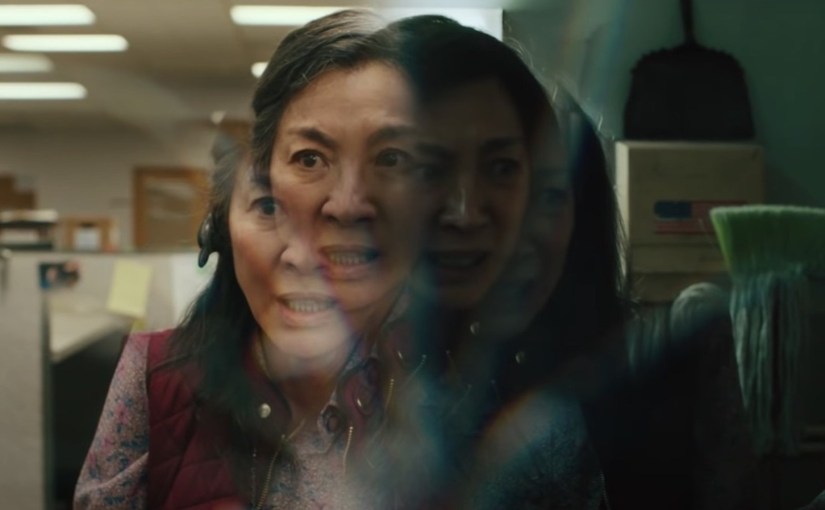
The Wang family are Chinese immigrants buried in demanding and overwhelming tax obligations from the IRS while trying to manage a California laundromat.  Evelyn (Michelle Yeoh) is the matriarch who is married to Waymond (Ke Huy Quan) and they have a daughter Joy (Stephanie Hsu).  Upon visiting the IRS agent assigned to their case, Deidre (Jamie Lee Curtis, who finally found something else to do besides another Halloween retread), odd occurrences take place.  Evelyn is warned by Waymond with suddenly a strange and very different personality to act upon their current situation, like getting off an elevator and turning to the right, not the left.  Just trust me when I say that while you will likely be bewildered for a while as the exposition unravels itself, it will all pay off satisfyingly.  Somehow in another universe that is performing parallel to the one we first see in the film Joy is a villain bent on destroying Evelyn…and that’s not even half of what’s out of place.

I saw this film directed by the “Daniels” (Dan Kwan and Dan Scheinert) with my Cinephile colleagues, Miguel and Thomas.  After it was over, it was no surprise that they knew what I was talking about when I said this film is the reason why good editing is necessary in a film.  Because the Daniels introduce not one or two parallel universes, but SEVERAL, and there is so much happening…well…all at once.  I’d argue most shots in the film last no longer than an average 8-10 seconds because the multiple universe equivalents of Evelyn, Waymond, Joy and Deidre switch on a blink of your eye.  I warn you not to make a quick bathroom exit.  Quick flashes of scenes are relevant towards something else you may see in the next minute or an hour later.

Anyway, I’ll bet you never realized that there is a universe where the people have raw hot dog like fingers.  There’s also a universe where Evelyn is a street sign twirler, and a good thing there is an Evelyn like that to help another Evelyn fend off of a bunch of attackers in a different universe.  There’s also a world where humanity doesn’t exist.  Yet the equivalent of Evelyn and Joy are represented by two rocks.  That’s right.  Rocks with no limbs, no way of speaking vocally.  Yet, the film cleverly has the characters or products of its earth communicate with one another.  There’s even a different variation of the Pixar creation, Ratatouille.  Replace the rat with a racoon and see what transpires.

So, what does this all lead to?  Fortunately, there is a reason for these different worlds to collide and it leads to a valuable lesson in love and understanding within family.  Now that may sound hokey, but the film demonstrates that none of us are the same in what we are affectionate about, or what’s important to us.  How a daughter considers a girlfriend is not going to be easy for a mother to accept as any more than a friend.  The Daniels’ film carries much profoundness among its silliness depicted on the surface.

Having only seen Everything Everywhere All At Once one time so far, I could not help but laugh often and uncontrollably at what I was looking at, and the laughter becomes contagious when watching the film in a crowded theatre.  What made my movie going experience with this film quite fascinating though is that I responded in tune with the rest of the crowd.  Once you get past looking at Michelle Yeoh and Jamie Lee Curtis (two recognizable and accomplished actors) flap their hot dog fingered hands at each other, eventually you recognize the “normalcy” of that particular universe.  You are no longer laughing with them.  Now you are accepting the people and how they function in that specific environment.  Same goes for the rock universe.  The Daniels are brave enough in their direction to just show two inanimate rocks perched on a ledge and communicating with subtitles of very aware and well written dialogue.  It looks completely crazy at first.  Later, you yearn for the impending destiny of those rocks.

Much symbolism is tucked into the Daniels’ script as well.  The most telling is that it focuses on an Asian immigrant family obligated by law to honor American tax codes.  The Deidre character portrayed by Jamie Lee Curtis is not so empathetic to the Wangs’ comprehension of resolving tax violations.  Basically, two different cultures are butting heads with no progress because they have a different viewpoint on how things function.  Wisely, this serves as a springboard to demonstrate how multiple universes will lack perfect chemistry as well when they collide.  None of this is written off as communication barriers.

I imagine on a second viewing, I likely will look at Everything Everywhere All At Once through a different lens.  I won’t laugh as much because I’ve grown acclimated to what were once very odd and strange environments for these characters that dwell within.  Instead, I’ll be even more observant and appreciative of the film as it presents different behaviors and cultures encountering one another.  This is a very good picture that is worth multiple viewings for sure.

In fact, this film is such a pleasant surprise, that I am comfortable suggesting this early on that I will consider it one of the best films of 2022.  If at least Everything Everywhere All At Once does not receive an Oscar nomination for Best Screenplay, then it would be a terrible disappointment.  The imagination of its endless devices is just so inventive.  Heck, I’ll throw my hat out there and strongly suggest nominations for Michelle Yeoh’s performance, along with Best Editing for Paul Rogers (this guy should win the award) and Best Picture of the year.

See Everything Everywhere All At Once in a movie theatre with a crowd and/or a large group of friends.  You may just have a cathartic experience of how human nature responds when getting acclimated to what at first appears to be so foreign.

EVERYTHING EVERYWHERE ALL AT ONCE (2022)

by Miguel E. Rodriguez

Directors: Dan Kwan, Daniel Scheinert
Cast: Michelle Yeoh, Stephanie Hsu, Ke Huy Quan, James Hong, Jamie Lee Curtis
My Rating: 10/10
Rotten Tomatometer: 96% Certified Fresh

PLOT: A middle-aged Asian woman tries to do her family’s taxes with mind-bending results.


Every once in a while, a movie comes along that is so daring and original that any attempt to accurately describe it feels futile.  Scott Pilgrim vs. the World was one of them.  Being John Malkovich was another.  And now comes Everything Everywhere All at Once, a sci-fi action brainteaser that feels as if it were written by Terry Gilliam and Quentin Tarantino and directed by Stephen Chow (Kung Fu Hustle, Shaolin Soccer…two movies that also meet that “indescribable” criterion).  It feels like an episode of Black Mirror crossed with Jackie Chan and a dash of David Lynch and Terrence Malick.  If you can’t find anything to like in this movie, check your pulse.

Evelyn Wang (Michelle Yeoh) opens the film trying to do her family’s taxes.  She and her husband, Waymond (Ke Huy Quan – “Short Round” from Temple of Doom!!), carry stacks and stacks of receipts to their local IRS branch and try to explain to their case worker (a dowdy Jamie Lee Curtis) how a karaoke machine can be deducted as a business expense.  However, before that can happen, after a series of very strange events involving Waymond and a pair of Bluetooth headsets, Evelyn finds herself immersed in a trans-dimensional battle between the forces of good, led by an alternate-universe version of Waymond – the “Alpha Waymond,” if you will – and someone called Jobu Tupaki, a being or person who is hunting for Evelyn in every conceivable parallel universe.  All Evelyn has to do is use these weird headsets to access the infinite multiverse and harness the skills learned by the infinite Evelyns before Jobu Tupaki can track her down and kill her.

To access the multiverse in such a way, one must commit random acts of…randomness, which leads to bizarre scenes of individuals doing some very weird things to access special skills.  What kind of weird things, you ask?  Things involving…sticks of lip balm, putting your shoes on the wrong feet, saying “I love you” to a stranger, or wiping someone else’s nose for them and…well, use your imagination.

That’s seriously just scratching the surface.  I haven’t even mentioned Evelyn and Waymond’s daughter, Joy; their laundromat; Evelyn’s elderly grandfather, Gong Gong (veteran character actor James Hong – 450 film and TV credits and counting); or the divorce papers Waymond has on his person.

This movie is a trippy, joyous, tightrope-walking masterpiece.  There are moments where you can sense it tap-dancing on the line of self-parody, then jumping over it and daring the audience to go along with it.  If there are some people that say they were unable to follow where this movie leads, I can’t really say I’d blame them.  Not many movies would ask you to take it seriously, then include a scene involving two rocks having a conversation via, I guess, ESP.  Or where the two lead characters turn into piñatas.  Or where Jamie Lee Curtis staples a piece of paper to her own head.  Or where the fate of the world might hinge on who gets their hands (in a manner of speaking) on a trophy shaped like…a very specific kind of toy.

HOT DOG FINGERS, people.  HOT.  DOG.  FINGERS.

I’m frankly amazed this movie didn’t collapse on itself.  There are so many ways it could have gone wrong, and so much it wants to say, while trying to be simultaneously massively entertaining and heartbreakingly poignant.

From a technical standpoint, I think it’s the frontrunner for the Best Film Editing Oscar for 2022.  This movie jumps from one parallel universe to the next and the next and back again so frequently that I got whiplash, BUT it was never confusing or mystifying.  It was always crystal clear what I was watching and why I needed to see it.  I could list any number of films or TV shows that have attempted this kind of thing on a much more modest scale and failed.  This is like the Who Framed Roger Rabbit of film editing.  It has been done so well and on such a grand scale that it seems unlikely anyone will try to tell this kind of story in the same way again.

Some may quibble at the mildly melodramatic resolution of the conflict among Evelyn, the “Alpha” universe, and Jobu Tupaki.  I can understand that viewpoint, but honestly, I just rolled with it when it came around.  And so did the theater audience I was with the night I saw it.  We all laughed uproariously on cue, sometimes for something funny, sometimes in sheer disbelief at what we had just seen.  But when the wrap-up started to come together, we all hushed and waited to see what would happen.  Even when it involved a parallel universe with something called Raccacoonie.  (It’s a long story…)

I hope I’ve conveyed how crazy good this movie is while preserving some of its best surprises.  I haven’t felt this urgent about getting the word out about a great movie since I saw Roma.  To call this an entertaining night at the movies does a serious injustice to the words “entertaining” and “movies.”  It’s more than entertaining and, not to get too hyperbolic, this is more than a mere movie.  It’s a masterwork, a collision of grand ambition and even grander moviemaking.  I plan on seeing it at least once more in theaters, if only just to see what I may have missed the first time around.  (And maybe also to tune more carefully into audience reactions at key moments, like the performance trophies, or those two rocks.  Who knew two rocks could be funny?  Like REALLY funny?)

KNIVES OUT

By Marc S. Sanders

Rian Johnson’s new film Knives Out is an attempt to reinvent the Agatha Christie blueprint of The Who Done It? Murder Mystery. It primarily succeeds even if it is a little cookie cutter in its screenplay.

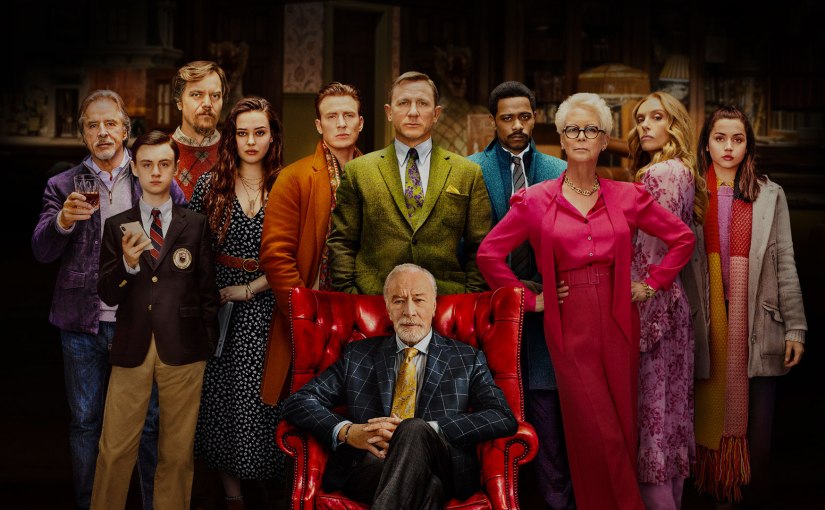
Famed best selling mystery writer Harlan Thrombley (Christopher Plummer) is discovered by his maid in his reading room to have slit his throat. All evidence points to suicide. Police follow through with simple procedural questioning of his next of kin, and yet a private detective (Daniel Craig) with an outstanding puzzle solving reputation is hired with a delivered envelope of cash from an unknown source. If it’s suicide, then why a detective, and who had reason to hire him?

Craig as Detective Benoit Blanc (great name) adopts a hilarious Kentucky southern drawl to rattle the cages of possible suspects, assuming that perhaps this wasn’t suicide. Could it have been…MURDER?

The suspects consist of family members and each is well exaggerated in their physical descriptions. Johnson wrote these connivers with possible motives to set them apart from one another-first by casting well known actors and then giving most of them a garish appearance or unusual trait. Jamie Lee Curtis as Linda with a short white as snow haircut and black circled glasses looks like no one else I can recall. Michael Shannon as Walt with a cane and exaggerated limp, not too bright but also quite discomforting. Don Johnson as Richard only with a goatee, Toni Collette as Joni putting on a bug eyed expression with ditzy delivery. Chris Evans as Ransom, with clean shaven good looks and a toothy smile in preppy, yet snobbish looking sweaters. Finally, Ana de Armas as Marta, Harlan’s nurse, who seems to be the only one devastated by what has transpired, and somehow inadvertently ends up being more involved than she ever expected. She can’t lie. If she does, she can’t help but vomit. A disadvantage perhaps but maybe a convenient advantage at times as well.

Early on, interviews are shown and it appears everyone has reason to maintain a grudge against Harlan. So if Harlan was in fact murdered, well then it’s fair to presume one of these people might have reason to commit the crime. A will is eventually read and then even more twists present themselves. Someone definitely wanted Harlan out.

Rian Johnson spells it out easily for the viewer. Each suspect has his/her own place in the film to toy around with. While I didn’t find it too challenging to predict a likely suspect that has orchestrated what’s occurred, it was more fun for me to watch how it was all pieced together. I kept asking myself what’s so important about the dogs or the baseball or the silent “Great Nana” (K Callan) who sits around the house but surely must have something to contribute.

Agatha Christie or Dashiell Hammet still hold as the much more clever writers. Still, Daniel Craig is having a blast in his role, conceived by Johnson. I’d like to see another mystery with this character. He’s funny at appearing unconcerned with new developments that could be occurring while he’s really just waiting for the inevitable fact that reveals the absolute truth.

Following leaving the scene of an arson a potential suspect makes an unexpected stop. Craig as Detective Blanc opts to wait in the car and put his ear buds on to sing show tunes. Who would do that? Yet, that’s what’s hilariously fun about this picture. A man has died but the shallowness of his surviving family and the disconnect of the detective are the entertainment factor.

Rian Johnson knows how to keep Knives Out amusingly interesting with a curiosity that does not stop.