
CONCLAVE

By Marc S. Sanders

conflict

noun

  • 1.
    a serious disagreement or argument,

conclave

noun

con· clave ˈkän-ˌklāv 

Synonyms of conclave

1

a private meeting or secret assembly

especially  a meeting of Roman Catholic cardinals secluded continuously while choosing a pope 

2

a gathering of a group or association

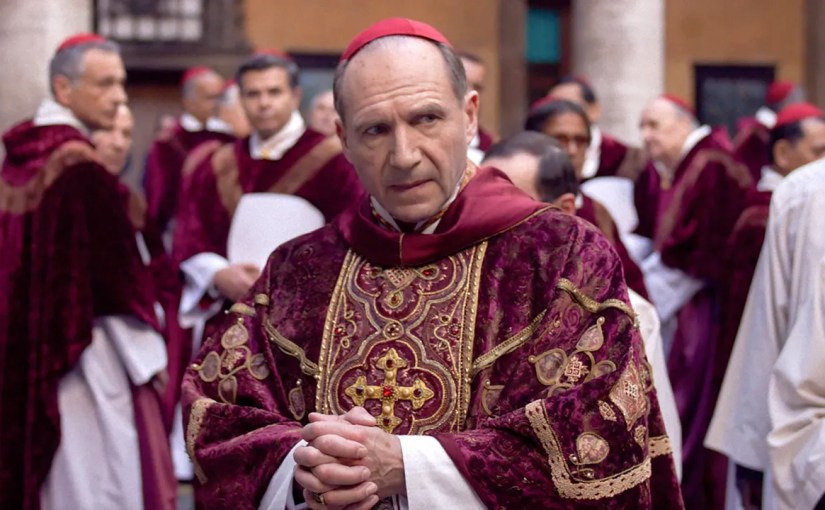
As I watched Edward Berger’s new film, Conclave, the word “conflict” came to mind based simply off of the same prefix the two terms share.  This picture does not just depict a sequestered assembly to elect a new Pope for the Roman Catholic Church.  It goes further because nothing goes as expected for the Dean of the Conclave, Cardinal Lawrence (Ralph Fiennes, doing Oscar caliber work).  

Now that the Pope has passed away, the various cardinals assemble, and all seem to have their own impressions of who should take the reins.  Cardinal Bellini (Stanley Tucci, man I love this guy) is the liberal candidate, tolerant and supportive of the gay population and accepting of women in authoritative positions.  Cardinal Tedesco (Sergio Castellitto) is on the conservative side believing the position should rightly return to an Italian with restrictions and containments of liberal ideals that have diminished what the church used to stand for.  There is also Bishop Tremblay (John Lithgow) who has an abundance of support to no one’s surprise. A few others earned some votes during the initial balloting, but it’s seemingly of no big consequence. Still, over the course of the film, multiple votes will have to be counted until the minimum majority necessary for a new Pope is collected.

The men of God convene in a formality of faith, swearing their handwritten votes before the Almighty.  Yet, Lawrence, as a dean of ethics and morality, is becoming apprised of some questionable irregularities among his peers.  While some of these men are earning more and more support with each passing tally, new developments present themselves forcing Lawrence to question if there should be some investigations to determine if some of these men are qualified to acquire the Papacy beyond an election.  Hence, the conclave is getting gravely interrupted by an overwhelming number of conflicts for Lawrence to consider.

I must stop there with my summary of Berger’s film, based on the novel by Robert Harris.  This is a top notch drama helmed by an outstanding cast.  At the very least the adapted screenplay by Peter Straughan will win the Oscar.  The dialogue is aggressive and forthright when it needs to be.  An institution like the Roman Catholic Church operates on secrecy.  However, it’s so interesting to see these devout men of God challenge one another. Just because they are the highest priests does not constitute them beyond sin or even corruption.  As Stanley Tucci’s character demonstrates, they might not be polite either.  Simply honest when their personal stance is challenged.  

The script is also quietly ponderous.  Ralph Fiennes shows an internal conflict between his duties to the church and how he truly characterizes some of his peers.  He even begins to wonder if he should continue as a priest. Has his faith remained uncompromised? Frankly, how can a priest of the highest order live satisfyingly knowing that no person is of an upmost perfection even if they swear by their faith? Still, the strict expectations of a widespread religion will demand contexts of that notion.

Constructively, Conclave has a gripping energy.  The performances from especially Fiennes, Tucci and Lithgow are magnetic as soon as they enter the piece.  Isabella Rossellini delivers an under-radar performance as a nun who works with a necessary audaciousness to her character.  She knows things that should never have occurred.  Yet, how will she confront these intimidating, stark, red-robed figureheads?  Does she even have a right or authority to speak?

The music from Volker Bertelmann could belong in Hitchcock thriller if Bernard Hermann wasn’t available.  It keeps you alert and never anchors your feelings as new developments come to light.  The composition only enhances the weight of the drama.  

Edward Berger is an observant director.  Ahead of the conclave he reminds you that even telephones are not permitted inside and tossed in a heap outdoors.  The priests are smokers. Personally, I find that surprising as cigarettes almost seem like a mild narcotic and a contradiction of how I envision a Catholic priest should behave.  Nevertheless, Berger also gives you a close up of a pile of cigarette butts tossed on the ground just ahead of being sequestered. These men turn off the world outside to focus on this important election. It’s as if they live in a submarine below the surface.

Conclave wil be a very divisive film.  Politically, it’s apparent that it favors one side (liberal vs conservative) over another.  In addition, it is not shy about showing its characters with their assortments of fault.  I am not educated in Catholicism.  Though I am well aware of the value it holds across its worshippers.   For many, their faith is held above all else and those people will find a discomfort with this picture.  I might even be understating that assessment.  Some folks of the Catholic order, and maybe other denominations of Christianity, will even take grave offense to this fictionalized depiction.

Conclave is truly conflicting.

Because I do not hold any value in Catholicism, much less any religion anymore (just a shred for the Judaic customs I was raised on), I did not hold any bias or objections to Edward Berger’s film. Rather I was engaged in how difficult it is to balance yourself as a Catholic priest.  For Cardinal Lawrence, Ralph Fiennes is neither likable nor unlikable but I certainly felt his character’s frustrations and the challenges he is obliged to navigate.  

Who is judging these Cardinals? 

God?  

Or is it each one of them?  

Conclave is built on one believable, yet shocking, surprise after another.  Still, when the big twist at the end arrives, it is completely blind siding and Straughan’s script leaves his audiences with a new question that’s practically impossible to contend or compromise.  

Again, Conclave is very, very conflicting.

Nevertheless, this is one of the best films I have seen in a very long time.  So much so, that I cannot wait to see it again.

Conclave is one of the best films of the year.
MARCEL THE SHELL WITH SHOES ON (2021)

by Miguel E. Rodriguez

DIRECTOR: Dean Fleischer Camp
CAST: Jenny Slate, Dean Fleischer Camp, Isabella Rossellini
MY RATING: 9/10
ROTTEN TOMATOMETER: 98% Fresh

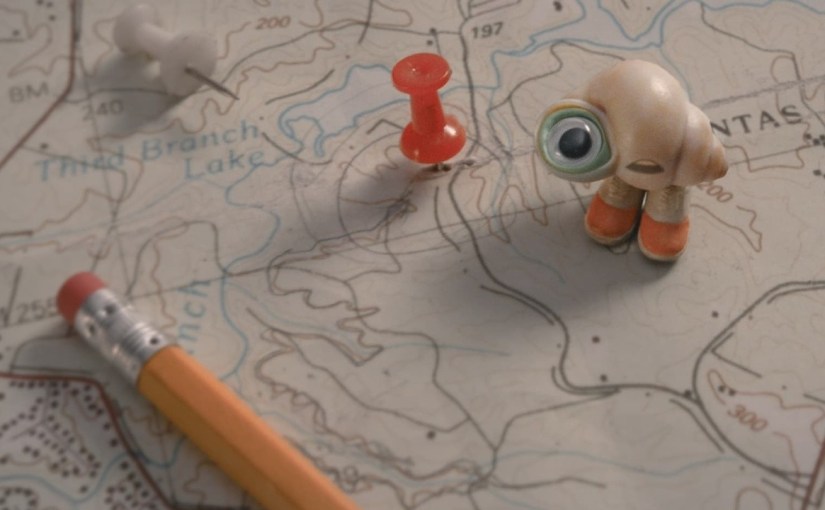
PLOT: Marcel, a tiny talking seashell with big shoes and one googly eye, becomes the subject of a documentary.


Years ago, I went to see Happy Feet.  The premise was absurd – singing penguins, give me a break – but as soon as Nicole Kidman’s character sang the first words of Prince’s Kiss, I remember thinking, “Okay, this movie is only going to work if I just give in to the concept.”  I did, and it did (for the most part).  Some movies are like that.  If you’re the kind of person who brings too much logic to the movie theater, who’s always wondering, when a movie character just orders “a beer” at a bar, how does the bartender know what to bring him…if you’re that kind of person, then Marcel the Shell with Shoes On is not for you.  Trust me.  I’m trying to give a public service message here.  If you watch a James Bond movie and sit there the whole time going, “That couldn’t happen…that couldn’t happen”…then skip Marcel and go find a Werner Herzog documentary.  Cave of Forgotten Dreams is excellent.

However, if you enjoy flights of fancy, fits of whimsy, and a gently aggressive cuteness factor balanced nicely by, not one, but two potentially tear-jerking plot developments – all centered on a talking seashell – then have I got a movie for you.

The story: A down-on-his-luck documentary filmmaker (Dean Fleischer Camp) moves into an Airbnb with his dog.  After following some odd clues around the house, he discovers his diminutive roommate: Marcel (voiced by Jenny Slate), a pebble-sized seashell with one eye – a googly eye – and tiny shoes, with a voice that sounds like your favorite childhood puppy was granted the gift of speech.  Dean discovers that Marcel has lived in this house for some time with his grandmother, Connie (voiced by Isabella Rossellini!).  There used to be an entire community, including many of Marcel’s family members, but they all vanished one traumatic night when the couple that used to live in the Airbnb got into an argument and the man stormed off with his luggage…carrying some unwitting passengers.

Now Marcel fends for himself, while Nana Connie helps in the garden.  Dean, the filmmaker, asks some excellent questions.  How does Marcel get around the house?  Why, by traveling inside a tennis ball using it like a tiny hamster ball; it’s okay as long as you don’t mind knocking some things over every once in a while.  What does he eat?  Mostly fruit from the tree growing outside.  How does Marcel get it out of the tree all by himself?  Using the mixer in the kitchen and a long length of rope, of course.  I could explain it, but it’s funnier if you find out for yourself how that works.  How does Marcel reach high places in the house?  Well, if he can’t jump it, there’s plenty of honey in the house, and honey is sticky, and that’s why there are sometimes little footprints all over the walls.  (Marcel asks Dean his own important questions: “Have you ever eaten a raspberry?  Um, and what was that like?”)

This is all unbearably cute.  I’m still not sure why I responded to it so strongly.  This is not normally my kind of material.  But the sight of this little seashell with one eye plopping down in front of the TV to watch 60 Minutes with his Nana just brought a smile to my face.  (Marcel explains, “We just call it ‘the show.’  That’s how much we love it.”)

One of the most charming elements of this movie is how it trucks along giving us one cuteness blast after another, and then it blindsides you with sentiments that are so simple and direct that they hit you in the feels before you even realize what’s happened.  As Marcel recounts the story of his family’s disappearance that fateful night, he sheds a tear or two.  Then he says:

“And then the next day, there was a really sunny day with a good breeze.  And I just remember thinking, if I was somebody else, I would really be enjoying this.”

I don’t know about you, but that statement really hits home with me, for all sorts of reasons that I won’t bore you with.  There are several moments like that in the film.  Here’s another one:

“Have you ever done that before, like, when there’s a party in your house?  Sometimes it’s easiest to rest when you go off by yourself and you can still hear the noise of the party, and you feel safe knowing that so many people are around, that you can have a rest?”

I identified with that so strongly that I can point to events in my life when I did exactly that, literally.  Hearing those words spoken in Marcel’s guileless, childlike tones almost felt…I might be overstating this a little…therapeutic.  It was a mildly bizarre experience for me.

Meanwhile, in events that uncannily mirror exactly what happened with the original Marcel shorts in real life, Dean posts his videos online and starts getting a phenomenal response.  He suggests that Marcel post a plea online to see if the online community can help track down his family.  This leads to some rather unfortunate attention-seekers, but it does provide a motivation for Marcel to take his first trip to the outside world, riding on the dashboard of Dean’s car.  If the idea of a teeny tiny seashell getting carsick and vomiting a teeny tiny little bit and apologizing every time…if you don’t find that even a little cute, I pity you.

Events progress rapidly (the movie is just over 90 minutes long).  There is an incident involving Nana Connie and some hooligans who break into the Airbnb.  The producers of 60 Minutes reach out to Dean and Marcel and ask if Lesley Stahl can come to the house and interview them.  Marcel says no, not until Nana Connie is better.  …and what happens after that I will not reveal, because it involves some of the most heartfelt passages of the film as the depth of Marcel’s relationship with his grandmother is tested, and the grandmother displays the kind of wisdom and sacrifice that would feel at home in an O. Henry story.

When so many films out there celebrate cynicism and snark, what a treat it is to find one that just wants to make you feel a little better.  I could not put it any better than Marcel himself:

“Guess why I smile a lot.  Uh, ‘cause it’s worth it.”