
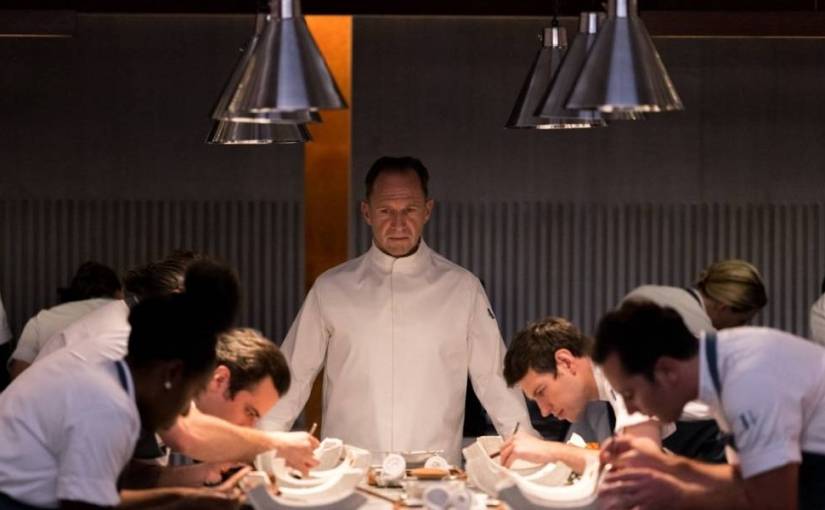
THE MENU

By Marc S. Sanders

Whether you’re the storyteller or the viewer/reader, you take a chance with satire.  The darker the satire is, the even greater the risk you take. A film like The Menu, from director Mark Mylod, is one such example. You’ll hate it…like my wife did, despite the lively conversation we had afterwards.  On the other hand, you might love its invention to strike back at an upper class that lacks any clue or respect for the talents of others. Then again, you just might only like it.  Well…at least I liked it.

Ralph Fiennes’ résumé has earned a reputation to intimidate an audience. He is a superb actor who can be absolutely frightening as a Nazi in Schindler’s List, or heartbreaking as a torn affiliate of a deceitful plot like in Quiz Show. He can also go toe to toe as a Greek god against Liam Neeson, or he can demand that James Bond “Stand down!” and strike with snake like glee at Harry Potter. He can also teeter along the antics of the devil himself as he portrays the world’s most esteemed chef in The Menu.

A collection of guests is escorted by boat to a remote island where the finest restaurant is located and run by Chef Slowik (Fiennes), with assistance from Elsa (Hong Chau).  There’s Tyler (Nicholas Hoult), a die-hard fan of the chef’s craft with his date Margot (Anya Taylor-Joy), who is nowhere near as impressed.  Tyler has to remind Margot not to smoke, otherwise it’ll destroy her palette for taste.  There’s an older couple who has frequented the Chef’s dining establishments before and are back for another visit.  There are a pair of restaurant critics. There’s a movie star (John Leguizamo) with his young assistant.  Finally, there is a trio of sophomoric, yuppie businessmen who are here because their last monthly commission likely afforded this exclusive opportunity, and their favorite hockey team was out of town.

When the guests arrive on the island, Elsa gives them a tour ahead of the restaurant where they will eventually dine.  A cabin is displayed to show how the meats are aged over a period of 152 days. Quite specific! One of the yuppies has the audacity to ask what happens if you age it to day 153. I don’t recall Elsa’s response.  I do remember her disdain for the question though. They walk through the lodge where Elsa explains that the entire staff reside and sleep in the one room together. One cot for each person. Odd, but okay. Moving on is a quick pass by the cottage where the Chef resides, and no one is permitted to enter. Oooo!!!! I know one thing I expect to happen.

It is important to note that I opted not to read up on anything The Menu was about.  I didn’t know if I was to see a comedy, drama or horror film.  As this tour continued though, I had eerie recollections of the film Midsommar, directed by Ari Aster. That movie still gives me the bejeebees.  So much so that I could not bring myself to write an article about it.  Like that film, our cast has become isolated in a desolate locale, and the guide could not be more unsettling.  When they arrive at the restaurant, a large horizontal door is thunderously closed behind them. Margot gives a quick look back over her shoulder. This cannot be good.

Lending to the structure of the film, courses are presented with a startling clap of the hands from Chef Slowik. Mark Mylod executes a nice pattern of gracefully displaying text across the screen describing what the next featured course is, along with its fine ingredients.  It is elegant but also only partially revealing of some of the guests. Tyler isn’t the kind of fan that Chef would welcome.  After a request has been made not to take pictures of the dishes, he does so anyway.  He is uncouth with his commentary and clumsy as well.  Additionally, bewildering for Chef Slowik is the presence of Margot. He was not expecting her to attend. Yet, here she is and he cannot understand why.

The Menu does not deviate from its intent to be strange. A bread dish is presented without any bread! Only the dips. Tyler is absolutely impressed. Margot thinks it is ridiculous. By the time, the fourth course has arrived, a shocking presentation is exhibited to the guests and that is where the film takes a graphic turn.

It’s best not to reveal much about the movie.  Its features work if you share the perspective of the guests, particularly Margot. What you are left to decide though is if you accept that dark satirical nature of the piece.  You will or you won’t.

I did not find The Menu to be very symbolic, allegorical, or even a reflection of the natures of social classes who partake in exclusive high-end cuisine.  Chef Slowik has prepared a specific plan for this assortment of guests. The execution and outcome cater to his personal satisfaction and no one else’s.  I guess that’s why I only liked the wit behind the message of the film.  I just could not fully embrace its invention.

My experience with satire typically allows me to think about how people behave and what they can learn from outrageous proposals or extreme actions. Network explores how the world responds to what is proposed for satisfying television audiences while generating business profits.  A film like The Menu delves into grandiose, unheard of actions that will satisfy the one puppet master behind everything you are seeing.  Maybe I was looking for the message the Chef delivers to include my own misgivings and sins and temptations in his overall delivery.  Instead, his machinations rely on these specific guests on this particular night, and so I kind of felt left out of the circle. As the guests are specifically affected by the developments of the evening, I can’t say I had any care or sense of suspense for them.  Nor did I care for Chef’s own satisfaction as the evening carries on.

The cast is a terrific eclectic assortment. Anya Taylor-Joy is a smart and forthright hero against Ralph Fiennes’ antagonist. A well written conclusion that made me applaud is included by her character’s deductive reasoning. The other players though are not given much fat to chew on in terms of dialogue or scenes.  Their purpose is specifically explained, and then they are left to watch and wait for the climax of the film. I like the veil that is lifted from Margot’s character.  I would have welcomed a little more subtext on the other characters, however. Again, their purpose is laid out, but I think the film, which clocks in at around an hour and forty-five minutes, could have dug a little deeper into the guests sitting at the other tables. Not to mention those few who also serve on the Chef’s cooking staff.

The Menu is an unusual film, like an episode of Tales From The Darkside or The Twilight Zone.  It is limited like a TV episode. I just think it needed two or three more courses to savor just a little more meat on the bone.
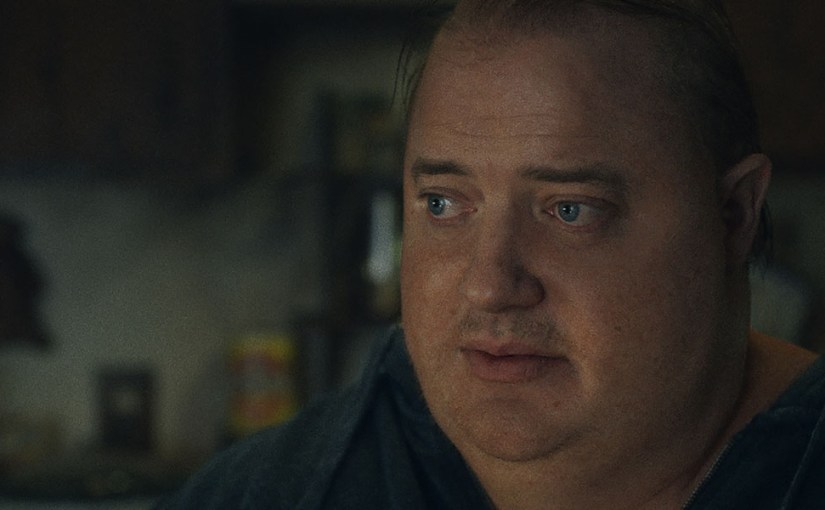
THE WHALE

By Marc S. Sanders

I still have a lot of catching up to do, but arguably the best performance by any actor in 2022 comes from Brendan Fraser in Darren Aronofsky’s The Whale, an adaptation of the stage play written by Samuel D. Hunter.

Fraser plays Charlie, an intelligent online writing professor.  His course is done online as he has become an enormously overweight recluse, following the loss of his boyfriend, circumstances to be revealed over the course of the film.  Charlie is so obese that he can barely walk, and he confines himself to the left side of his sofa with the television in front of him and his laptop nearby to conduct his courses or to pleasure himself with gay pornography.  He has a walker to get himself on to his feet and carry his bulk, but showering is not easy.  Even picking a key up off the floor is an impossibility.

He receives visits from his only friend, a nurse named Liz (Hong Chau).  When she arrives on Monday, she discovers that his blood pressure is indicative of congestive heart failure and urges him to go to the hospital.  He insists he can not afford the bills and has no insurance.  He also receives unwelcome visits from a young man named Thomas (Ty Simpkins) spreading the word of God with brochures from the local church.  Lastly, the visits Charlie treasures the most are from his cruel and mean-spirited daughter Ellie (Sadie Sink) who takes no reservations with berating Charlie as a deadbeat dad and only comes to him because she practically demands he write her essays to avoid dropping out of school.  She also rudely takes pictures of Charlie at any given moment.  Each time she raises her cell phone for a click, it feels like she is giving her father the harshest middle finger imaginable.

Much like an earlier film, known as The Wrestler, Darren Aronofsky explores what comes after the main character has tormented himself into a destiny difficult to escape or be rescued from.  Aronofsky is frank about offering up helpless souls only now living with everyday ongoing pain both physically and, as we discover, more importantly, mentally.  Highlights of Charlie’s day are when the pizza is delivered and he shouts through the door that the money is in mailbox.  The delivery guy knows the routine all too well by now and the best he can offer is to ask if Charlie is okay while never seeing his grotesque appearance.

Aronofsky doesn’t offer much variety on the surface.  The film takes place entirely in Charlie’s apartment.  Sometimes we go down the hallway and see another room or we get a conversation between Liz and Thomas on the front porch.  The cast only boasts seven actors.  Yet, Hunter’s screenplay is not limited to what Charlie is having to endure.  There is also an unexpected backstory to Thomas and there’s more to uncover with Liz and Ellie. The pizza delivery guy, who we never see, even discovers something.  One particular essay about Moby Dick that Charlie desperately urges Thomas to read out loud early on has a surprising significance that I didn’t see coming. 

Still, the film belongs almost entirely to Brendan Fraser and how he enhances the performances of his cast mates, particularly Sadie Sink.  Their scenes are so well performed.  She is an outstanding young actor working on a manic level.  I imagine Sadie Sink had to come down from the hyper activeness of her scenes.  She is uncompromisingly mean. When the director yells, there is no way she could just turn that characterization off.  I bet she walked away from the set to catch her breath.  Opposite her, Fraser’s character has no choice but to be more restrained.  Physically, it is hard for him to breathe and therefore speak at times at a high octave.  He cannot stand up very well and rush to embrace his daughter even if he wanted to try.  She is mean enough to challenge him though.  The outcome of that moment will have you hate her character for sure.  Yet, you don’t forget she’s a kid and her current state is a product of something else, perhaps from Charlie’s past misgivings.

Timewise, they are also on uneven playing fields.  Hunter’s script counts down the days as the top of some scenes depict it as Monday and then Tuesday and so on.  Charlie is running out of time and has a lot of hanging threads to tie off.  Ellie has an entire life ahead of her to name call and scream at him and hurt him, but Charlie cannot afford to upset someone and work on apologies later.  The best he can take advantage of right now is to appeal for all the wrongs he’s committed or been accused of.  Most importantly, can he fix his relationship with his daughter?

Liz is a health care professional by trade and knows what is best for Charlie, but likely also knows it’s too late and rather hopeless, considering his current condition.  So, it only makes sense to surrender to his needs by bringing him meatball subs and barbecue ribs.  What she is determined to do is to keep his daughter and ex-wife away from him.  It’s a conflict that Charlie has no choice but to allow.

Thomas is that last new person to ever enter Charlie’s life.  Yet, what is his gospel of God and salvation going to do for Charlie now?  Charlie can’t keep this kid from coming over, but is he really going to listen and take any of it seriously? 

Brendan Fraser’s performance is so limited to the setting of the film and the physical restraint of being a large man with no flexibility.  However, he provides so much in the pain his character has suffered long before the current week captured on screen.  It’s an astonishing achievement in acting.  Within the bulbous head depicted in so many closeups are tired eyes that have gone through so much like toiling with leaving a marriage in exchange for a homosexual relationship, and weakening a connection with his child.

Beyond the enormous weight he lives with, Charlie also lives with an unhealthy food addiction.  Just ahead of the last act of the film, Aronofsky is relentless in showing how Charlie responds to personal suffering, not physical, by drowning himself in enormous amounts of sloppy and messy food as Fraser guzzles everything into his mouth.  Charlie suffers from so much more than just being morbidly obese.  He could live with that.  It’s other moments and people and losses in his life that are hard to continue to live with.  The difficulty of those things is cursed upon by Charlie with uncontrollable amounts of food.  Some people who suffer with difficult matters might hide in bed all day or binge watch television for an entire week.  Some turn to drugs and alcohol.  Charlie binges on food.  He doesn’t love his food.  He only uses it to drown out his pains.

I imagine it’s hard to learn about people like Charlie who are held down by the challenge of extreme obesity.  They have become so physically large that they literally can not get up from their sofa without help and therefore never leave their homes.  Because they never go outside, we are unaware of people like this.  I once had a neighbor that I never, ever saw.  I could hear their TV in the apartment next door but I never saw them.  How is that possible?  Why is it that they never revealed themselves?  There’s a story there.  Maybe a terrible or uncontrollable dilemma.  Darren Aronofsky, Samuel D. Hunter and Brendan Fraser offer a glimpse into what goes on behind this closed door.  It’s heartbreaking. 

Maybe it is so tragic because of why Charlie is shown within his confines by Aronofsky, written within the circumstances that Hunter offers and most importantly demonstrated by Fraser as a man ready for his life to end.  If only he can resolve a final digression with his teenage daughter suffering from a pain of anger likely instigated by him. 

Again, Brendan Fraser’s performance is the best one I have seen this year, and with no doubt in my mind, he should absolutely win the Oscar.  This could go down as the best accomplishment is his colorful career.