BOBBY (2006)

By Marc S. Sanders

There’s the distinguished doorman who is retired now but returns each day to play chess with a colleague in the hotel lobby.  There’s the open-minded girl who is inspired to prevent a young man from getting drafted into the Vietnam War by marrying him.  Her hairdresser is married to the hotel manager, who happens to be having an affair with the beautiful switchboard operator.  As well, the dining manager is a bigot who will deny his Mexican employees enough time to leave work and exercise their right to vote.  A busboy will have no choice but to miss what will likely be Don Drysdale record breaking sixth shut out game in a row.  A drunken night club performer can hardly stand up straight while she is completely dismissive of her caring husband.  A wealthy man is ready to introduce his trophy wife to an eventful evening in modern politics.  Two young campaign workers sneak away to drop acid for the first time.  A black man is at a loss following the recent assassination of Dr. King. Though he has hope that at least Bobby Kennedy will uphold his faith for a promising future in America for African Americans to carry equal rights. 

So, what does any of this have to do with Robert F Kennedy?  Not much I’m afraid.  Writer/Director and star Emilio Estevez tells us that all of these stories occur in the Ambassador Hotel on the fateful night when the Senator was assassinated in the hotel kitchen by Sirhan Sirhan.  In Bobby, the only character that is not a character is Bobby Kennedy and that is unfortunate.  More to the point, all of these short stories and other characters are precisely boring.

Estevez committed himself to grinding out stories that occur in the Ambassador that would lead up to Kennedy’s tragic death.  He’s admitted that they are all fictional. Based on his research and photographs, these characters are very loosely inspired by those that were there that night.  Before gathering in the ballroom to hear Kennedy’s victory speech after winning the California primary, these people were going through own personal ordeals.  If Emilio Estevez was not so personally inspired and researched in Robert Kennedy’s purpose to American history and politics, then perhaps Arthur Hailey (Hotel, Airport) would have pieced together this script of anecdotes and vignettes.

I commend Estevez’ efforts here.  The film looks great and even though the Ambassador was being demolished at literally the same time as this film was being shot, the scenic designs are very authentic.  The cast is even more impressive as the director reunites with many co-stars that he’s worked with before including Demi Moore, Anthony Hopkins, Christian Slater and his real-life father Martin Sheen, a lifelong loyalist to the Kennedy family.  The “importance” of this movie seems to sell itself.  Yet, everything is incredibly mundane and of little interest.  When your cast and your characters are just items on a grocery list to check off, there’s not much that’s interesting beyond the coupons.

The juicy gossip that surrounds the real-life actors is more captivating. Estevez cast Ashton Kutcher (Demi Moore’s real-life husband at the time) to play the drug dealer who provides acid to the campaign workers (Shia LeBeouf, Brian Geraghty).  Moore is also Estevez’ ex-girlfriend.  Yet, to watch Kutcher, LeBeouf and Geraghty experience an acid trip with weird visions they see when they open a bedroom closet is unfunny and not captivating.  Emilio Estevez is not living up to the Coen Brothers (The Big Lebowski).

A tryst with the boss (William H Macy) and his young, attractive and naïve switchboard operator (Heather Graham) is nauseatingly hokey.  The aged wife who works in the hotel salon (Sharon Stone) turns it all into squeamish soap opera tripe.

Bobby has an alarming opening.  A false alarm fire call is wrapping up at the Ambassador Hotel and you may feel like you are entering the middle of a panic storm, but things quickly calm down and the film resorts to cookie cutter editing to introduce its all-star cast.  None of what they say matters.  This is a game of who you can recognize.  Joshua Jackson, Nick Cannon, Harry Belafonte, and eventually the guy with the most significant role, Laurence Fishburne, is given his moment, the best scene of the whole film.  Fishburne is the kitchen chef who allegorically uses his creations in cuisine to compare the black man’s experience to the brown man’s, or Mexican. 

Having finished a trip to Martha’s Vineyard, I wanted to show my wife the under-the-radar and captivating film, Chappaquiddick, which covers Ted Kennedy’s personal story of controversy.  (My review of that film is on this site.) To continue on the Kennedy parade, we were motivated to follow up with Bobby.  Yet, this picture offers very little to the significance of Senator Robert F Kennedy.  There are samples of news reports complete with Cronkite.  Plus, the Senator’s own words ring through the epilogue of the picture.  Yet, I felt cheated of learning nothing new about the historical figure. 

Reader, you may tell me to kick dirt and go find another movie or read a book.  Fair!  However, this is film is called Bobby, and if I’m not going to learn about Bobby Kennedy from the man himself, then allow me to get to know the man through the eyes of these individuals.  Who hates him?  Who loves him? Who has a crush on him?  Who is inspired by him?  Who wants him dead and why? 

Estevez’ script does not allow enough material to describe what Kennedy meant to these campaign workers or hotel workers or guests.  They are primarily self-absorbed in their own personal battles to think enough about the fact that Bobby Kennedy is expected to make an appearance later this evening.  Again, their personal concerns for each other is very dull.  I don’t want to be around a drunk and obnoxious Demi Moore.  I don’t want to drop acid with some guys who hide behind a façade for caring about the candidate they are supposed to be serving.  I feel sorry for the busboy who will miss that big game, but that’s not enough to get me engaged in the entirety of the picture.

Bobby lends very little to the confusing times of the late sixties when an unwinnable war was persisting and championed leaders were being killed for others’ agendas.  Any of these stories could have been yanked from this script and slotted into a disaster flick like The Poseidon Adventure or The Towering Inferno

Bobby only picks up momentum when it arrives at its end that many of us learned about in school or witnessed firsthand in documentaries or directly from that very sad and unfortunate evening, June 4, 1968.  This day in history is so much more important than a Helen Hunt character trying to convince her Martin Sheen husband to let her buy a new pair of black shoes.  Bobby Kennedy deserves more recognition than what Emilio Estevez offered.

SIX DEGREES OF SEPARATION

By Marc S. Sanders

John Guare adapted his celebrated Broadway play Six Degrees Of Separation into a screenplay directed by Fred Schepisi.  Having never seen a stage production of the show, I can still see how well it would work in live theater.  It’s a talking piece with colorful dialogue and fast paced monologues revealing the true nature of people whether they are telling the truth, exaggerating, or simply being lied to.  Can a piece of writing succeed at showing the phoniness of people while at the same time displaying the authentic nature of a con man and a liar? 

In a very early career performance, Will Smith plays a young man named Paul.  One night, he stumbles upon the Park Avenue apartment of Ouisa and Flan Kitteridge (Stockard Channing, Donald Sutherland), wealthy art dealers ready to make a multi-million-dollar deal with a South African guest, named Geoffrey (Ian McKellan).  Paul is a handsome black man in a navy blazer and college tie, with a knife wound in his side.  He has just been mugged while on his way to pay the Kitteridges a surprise visit.  They welcome him inside, clean his injury and loan him a freshly clean pink dress shirt from their son’s closet. 

Talking and interaction take effect.  Paul describes how he intimately knows the couple’s children away at college.  He segues into an insightful literary evaluation of Holden Caulfied from Catcher In The Rye, and he eventually makes his way into the kitchen where he impresses the high society people with his exquisite dinner preparation and his immense background of being the son of celebrated actor Sidney Poitier. 

By the end of the evening, Geoffrey is ready to sign the deal and the Kitteridges are over the moon with the dumbfound luck of meeting this young man, who is now going to arrange for them to be extras in the film adaptation of the musical Cats, soon to be directed by Sidney, himself.  It’s all too good to be true.  The next morning, after insisting that Paul stay over for the night, surprises abound and perhaps Ouisa and Flan don’t know everything they should have known about Paul.

The couple meets up for lunch with Larkin and Kitty, another high society couple (Bruce Dern, Mary Beth Hurt) who can’t wait to share an unbelievable story with them.  Only their anecdote is eerily similar to the experience they had with Paul.  Could these people have been duped?  The only option is to go to the police, and yet was there really a crime ever committed?  Fifty dollars was leant to Paul to get back to school, and he made off with the pink shirt, but that’s it.  All of their prized artwork and collectibles remained.  No one was physically harmed.  Nothing was stolen.  Still, the four people are insistent on uncovering the mystery of this man. 

Ouisa, Flan, Larkin and Kitty eventually catch up with their children to see how they had come to meet Paul.  The kids have no idea what their parents are talking about and are downright resentful of mom and dad.  Ouisa and Flan’s son (Jeff Abrams, as in eventual director JJ Abrams) is especially hurt they gave Paul his pink dress shirt.  The horror!  Their daughter describes them as ignorant and uncaring simply because of their wealth.

While I can’t describe the structure of the play, Schpisi’s film does a back and forth of Ouisa and Flan gleefully telling their tall tale to anyone who will listen.  While guests at a wedding reception, the crowd of listeners seem to grow around the pair, eventually to the point that the bride and groom are even listening.  Their story spreads at a funeral and dinner parties and on and on.

Later, a young couple (Heather Graham, Erik Thal) enter the frame to share their encounter with Paul after meeting him in Central Park.  Their tale is not as similar as the others, but there is enough to determine that they met the same “Paul” in their experience.

Paul’s existence seems to grow and grow, but not necessarily because of Paul.  Rather, it is because of how widespread his various intrusions become.  While making efforts to pursue the mystery, Ouisa and Flan get interviewed for the paper.  Even more people within New York City (revered for having eight million stories) reveal their own encounters. More people, especially their peers, become even more fascinated by the outrageous anecdote, and it becomes the centerpiece of dinner conversations and social gatherings.  People can’t get enough of the night Ouisa and Flan met Paul and what happened afterwards.

Guare’s script is focused not so much on dimension and character change, as it is in demonstrating what can happen when one story blossoms into a multitude of others.  The title follows the idea that every person on the planet can somehow be connected within six different people of one another.  What I took from the film is how inauthentic the ones who were duped actually are.  Flan wants nothing ever more to do with Paul, repeatedly declaring a fear that he may come back and “slash their throats.” Yet, he can’t resist sharing the story and what happened after that and then after that.  Ouisa follows along, until perhaps the end of the picture.

Stockard Channing plays the most dynamic of all the characters thanks to moments offered in the script where Ouisa begins to contemplate how fascinating it is how many people have come in contact with Paul and thus lending credence to the film’s title.  A memorable monologue towards the end earned her Oscar nomination for the film. 

Will Smith is the con man at the center of the script.  It’s an extraordinary performance and it’s an insightful character as well.  Paul is a con man.  That is the one sure thing that viewers assuredly walk away with from the movie.  It may be the only genuine fact in the film.  The people he seduces are eventually revealed to be fake for the sake of laying impressions upon their peers or for exacting aggravation, as the spoiled college age children seem to do.  Nothing that Ouisa, Flan, Larkin, Kitty or any of their high society friends and children come off with genuine affection and care for one another.  Their tales are told simply to impress and uphold relevance.  Only as the credits roll, does Ouisa perhaps have a revelation of how she behaves with her friends, and her children, particularly when in company with her husband, Flan.

Film Critic Roger Ebert didn’t care for this film as he asked what are we supposed to gain from this picture; that everyone in the world is a phony?  Maybe so.  The irony for me however, is that Paul is nothing but a con.  He never deviates from that pattern during the course of the picture all the way to his final scene when he’s alone on the street speaking with Ouisa on a pay phone. He still insists on being Paul Poitier, son of Sidney.  Therefore, let’s at least admire Paul’s consistent behavior of lying, while turning our backs as we realize how artificial the well to do folks really are.  Irony is thought provoking, and I think John Guare’s script at least succeeds in that respect. 

BOOGIE NIGHTS

By Marc S. Sanders

Boogie Nights was director Paul Thomas Anderson’s second feature following a very different and very quiet film debut with the gambling addiction piece Hard Eight.

Heck, it’s fair to say all of Paul’s films are very different; here is the seediness of porn while later in his career he will focus on the ruthlessness of a wealthy and angry oil man and then an obsessed dressmaker devoid of care for the models who parade his accomplishments. (See There Will Be Blood and Phantom Thread.). Paul was definitely striving for recognition with his familial depiction of life in the California pornographic film industry.

What I’ve always liked about Boogie Nights was Anderson’s intent to show the naive innocence of this large cast of characters. Filming blatantly oblivious awful porn scenarios can still be regarded as very proud efforts by its talent.

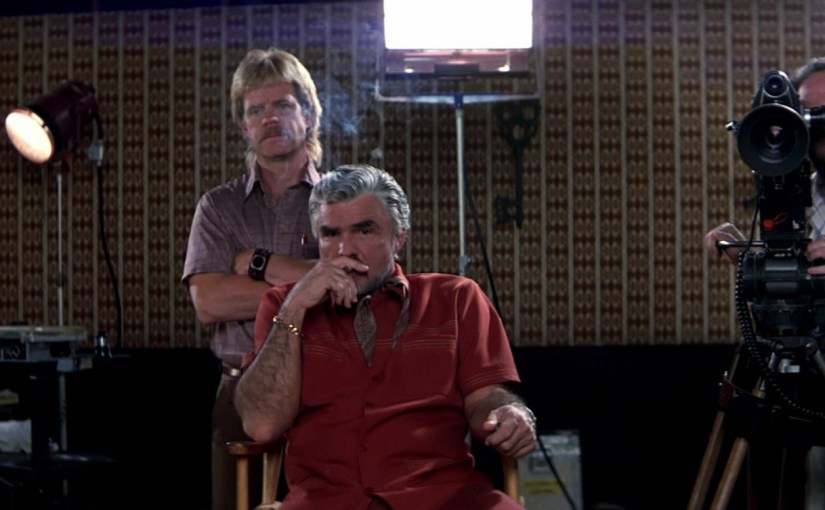
The main character is Eddie Adams (aka the amazing Dirk Diggler) played with macho pathos by Mark Wahlberg. It’ll likely be the best role of Wahlberg’s entire career. Dirk is proud of his natural talent in front of the camera. He’s even more proud of what God has gifted him. Don Cheadle is another porn star named Buck. He’s also proud of his accomplishments and simply a kind fellow looking to make country cowboy a trendy look for a black man while selling the “Hi-est Fidelity” in stereo equipment on the side. Julianne Moore is Amber Waves, the maternal porn mom of the bunch; very affectionate, very comforting and very reassuring when Dirk shoots his first porn scene. The one individual who really holds all of these misfits together is Burt Reynolds as Jack Horner, the porn film director. He’s the paternal one who believes in his artistic merits of shooting porn but with a story, and only with the integrity of film, and never the cheapness of videotape. So, Jack is like any artist who insists on a certain type of canvas. It might be smut, but he has principles, and he has pride.

Anderson is wise in how he divides up the developments. The film begins in the late 1970s during evening night life and decadence and everything seems fine and innocent and right despite the endless debauchery of reckless sex and drug use on a Disco backdrop. Wahlberg’s character is welcomed lovingly into this world, and nothing appears wrong. It all seems to stay that way for Dirk until New Year’s Eve, 1979. The 80s begin with a gunshot and then Anderson’s cast must pay for the revelry of their sins. A great moment presented on this night is where Amber Waves introduces Dirk to cocaine. Dirk has been thriving, making money, developing a following and now it is jeopardized in one moment thanks to his naivety. Julianne Moore is superb in this particular scene against Wahlberg. She’s the mentor with the peer pressure to pass on her high and keep it running.

Drug addiction, violence, sexual abuse and even changes in pop culture lead to hard times for these likable people.

It’s a hard life. It’s a complicated life. Yet it’s not all necessarily illegal. Morally, it might appear wrong, but it’s a life nonetheless.

Anderson was wise to use (at the time, relatively new) filming techniques of Martin Scorsese with rocking period music and fast edits along with savored moments of great steady cam work. One long cut especially works when the film first begins on the streets of Reseda and on into a crowded night club. This industry doesn’t sleep. So, neither will the camera that follows it. The music must also be celebrated. I do not listen to Night Ranger’s Sister Christian without thinking of firecrackers and a dangerously drug addled Alfred Molina playing Russian roulette. Though I know which came first, I also wonder if Three Dog Night’s Momma Told Me Not To Come and Spill The Wine by Eric Burton & War was written to enhance the celebratory introduction for Dirk when he attends his first party at Jack’s house. It’s another great steady cam moment from a driveway, followed by steps in and out of Jack’s house to simply a bikinied girl’s dive in the swimming pool. As a viewer I was absorbed in the California haze. Superior camera work here.

The cast of unknowns at the time were a blessing to this film. Anderson writes each person with care and attention and dimension. They have lives outside of this world like Amber’s child that we never get to meet, thanks in part to her lifestyle. She might be maternal but that doesn’t make her a good mother. Julianne Moore should have won the Oscar she was nominated for. Burt Reynolds’ own legacy seems to carry his role. His distinguished silver hair and well trimmed beard earn him the respect of every cast member and he performs with a quiet grace of knowledge, and insight, even if he will inevitably be wrong with how things turn out. Phillip Seymour Hoffman plays the dumb kid Scotty insecure and unsure of his homosexual attraction to Dirk. It’s not easy to play a dumb character when you are not doing it for laughs. Hoffman makes a huge impact with little dialogue but Anderson is wise enough to capitalize on him.

Boogie Nights offers one of the best cast of characters and assembled talents in any film ever made. An individual movie could be made about each of these people, and it’d be interesting and entertaining.

Try to avoid a blush and mock at the industry depicted because then you’ll see how another walk of life truly lives day to day. It might be porn. It might be smut. Yet, it’s still a thriving industry.