
42nd STREET (1933)

by Miguel E. Rodriguez

DIRECTOR: Lloyd Bacon (with choreo by Busby Berkeley)
CAST: Warner Baxter, Bebe Daniels, George Brent, Ruby Keeler, Una Merkel, Ginger Rogers, Dick Powell
MY RATING: 9/10
ROTTEN TOMATOMETER: 92% Fresh

PLOT: The unglamorous side of life on Broadway is laid bare in this unexpectedly enthralling musical from Hollywood’s golden years.


I’ll admit it: I was a victim of my own expectations.

For decades, I assumed that Lloyd Bacon and Busby Berkeley’s 42nd Street was your standard Hollywood fluff musical from an era when the genre had been beaten nearly to death, filled with wall-to-wall corny songs and even cornier story lines.  I was aware of the famous line from the film: “Sawyer, you’re going out a youngster, but you’ve got to come back a star!”  I was certain I knew everything I needed to know about the movie right there.  Unknown chorus girl gets a lucky break, becomes a star, a little song, a little dance, happy endings for everyone.

I’ve said it before and I’ll say it again: I love it when I’m wrong.  42nd Street defied all of my expectations, and even when it felt like it was caving to the genre, it did it so exuberantly that I caved into it myself.

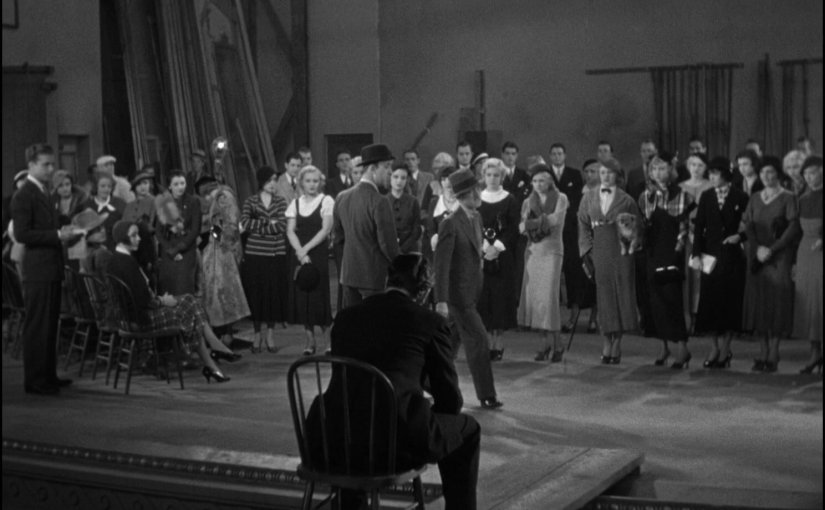
The story is ancient: A Broadway show is holding auditions at an unnamed theater on New York’s famed 42nd Street.  A rookie actress, Peggy Sawyer (Ruby Keeler), is one of scores of hopefuls at the cattle call, among them seasoned veterans Lorraine Fleming (Una Merkel) and Ann Lowell, played by Ginger Rogers the same year she was first paired with Fred Astaire in Flying Down to Rio…a legend in the making.  The show’s director, Julian Marsh (Warner Baxter), is a taskmaster who wants this show, “Pretty Lady”, to be his final masterpiece before he retires on advice from his doctors.  Then there’s Dorothy Brock (Bebe Daniels), the diva whose sugar daddy ensures she will get the plum role; Pat Denning (George Brent), Dorothy’s penniless paramour; and Billy Lawler (Dick Powell), the show’s “juvenile”, aka “mangenue”, who takes a shine to Peggy Sawyer when she interrupts him in his underwear in the dressing room.  Long story.

So, all the stock characters are here for a plot that was probably old even before the introduction of sound.  But 42nd Street subverted my assumptions by doing several things.

First, it is definitely NOT wall-to-wall with song and dance.  In fact, before we hit the final tune-filled 15 minutes, only one full number is performed.  Everything else is rehearsals, endless rehearsals with masses of dancers in their practice clothes or solo singers at the piano.  The backgrounds of the main characters are fleshed out in several scenes outside the theater, but the filmmakers were smart enough to keep those scenes to a minimum.  The real drama is on the stage, where it belongs.

(I loved those rehearsal scenes.  As an amateur actor in community theater myself, I had all sorts of flashbacks to my first shows as an ensemble member of big shows like The Music Man and Camelot, going through endless repetitions of musical numbers or just SEGMENTS of musical numbers until the director was satisfied.  I particularly loved one number being rehearsed on stage while the camera showed most of the cast and crew watching from the wings.  Pitch perfect.)

Second, the screenplay was not as cornball as the plot summary makes it sound.  I expected kitsch, but instead I got unexpected drama and grittiness, interspersed with comic relief and some outstanding zingers.  (“It must have been tough on your mother, not having any children.”)  Peggy Sawyer, the rookie, faints during rehearsal; Julian, after first making sure she’s not dead, yells at the stagehands to remove her from the stage so rehearsals can continue.  And they do.  When Julian learns of Dorothy Brock’s affair with Pat Denning, an affair which could jeopardize her participation in the show, he reaches out to an unsavory connection who agrees to rough Pat up as a warning.  Granted, this is all handled with a light touch, but this is serious business.  Putting a “hit” on someone?  Would a Broadway director ever actually do such a thing?  (Spoiler alert: probably.)

Third, by easing off the musical numbers until the last reel, 42nd Street positively had me eager for a full-blown song and dance.  And, brother, does it deliver.  The mythical Busby Berkeley pulls out all the stops for three sensational numbers that begin within the confines of a Broadway stage, and then magically “open up” into a cinematic tour de force.  I especially enjoyed the number where Ruby Keeler is clearly doing a complicated tap dance for real, but the best of the three is the film’s namesake, “42nd Street”, which is basically a travelogue of NYC, and which contains wild mood swings and some show-stopping choreography.  Watch for the moment when a young woman escapes a bad situation in her tenement apartment by running to the 3rd floor fire escape and then leaping to the street below.  I’m sure there were safety measures in place just out of camera range, like Harold Lloyd dangling from that clock, but in the moment, it genuinely looks like the cameras captured an actress leaping to her death.  Not to mention the sequence where the chorus transforms into the NYC skyline.  (In fact, I’d say the movie’s worth watching just for that final dance sequence…it’s astonishing.)

Fourth, the very end of the film took me totally by surprise.  At the risk of spoiling it, I’ll say that it takes place after I thought the movie WOULD end, and that it perfectly captures the combination of emotions that go through a stage director’s mind and soul after a show goes up and is an apparent success.  It’s another moment that felt absolutely real, with no overcooked dialogue or mugging.

It’s said that, before the release of 42nd Street, the movie musical was dead in the water.  Too many musicals had come before it, musicals that overdid the song and dance or had a half-baked story, etc.  Not only did 42nd Street singlehandedly revive the genre for decades to come, it also apparently saved Warner Bros. Studios from bankruptcy.  As someone who is not a particularly huge fan of older movie musicals, I wholeheartedly recommend this movie to anyone who is like me and has put off watching it because you think you already know everything about it you need to know.  I’m here to tell you: you probably don’t.  (And I especially recommend it to theatre aficionados who are familiar with the stage musical “42nd Street”, which pads the running time with dozens of additional songs, most of which were taken from Gold Diggers of 1933 [1933].)
THE MAJOR AND THE MINOR (1942)

by Miguel E. Rodriguez

DIRECTOR: Billy Wilder
CAST: Ginger Rogers, Ray Milland, Rita Johnson, Robert Benchley
MY RATING: 9/10
ROTTEN TOMATOMETER: 100% Fresh

PLOT: A frustrated city woman disguises herself as a 12-year-old girl to get a cheaper train ticket, but her plan backfires when she winds up befriending a very adult Major on the train.  Risqué hilarity ensues.


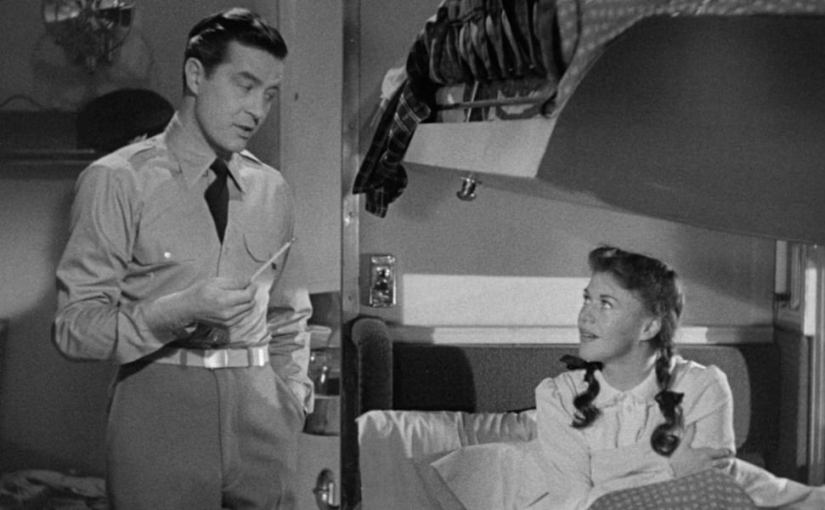
Billy Wilder’s The Major and the Minor, contains big laughs, true love, and comic/cosmic misunderstandings – in other words, it’s a classic farce from the fledgling career of one of Hollywood’s true legends.  However, there are certain plot elements that I suspect would make this movie virtually unfilmable today, at least not without tinkering with the structure here and there.  I think the plot points in question will be glaringly apparent to any reasonable viewer, so if I acknowledge them with only the occasional eye roll in my review, I hope readers will forgive me.  It is not my intention to prepare a compare/contrast treatise on prevailing attitudes towards women during the 1940s versus today.  You don’t need me to tell you that the very concept of an adult male bunk-bedding with a strange 12-year-old girl he just met (among other plot devices) raised my eyebrows.  It is firmly a product of its more innocent time. But the whole endeavor is so breezy and carefree that I think it would be a shame to give this film a pass without hearing more about it.  So, here goes.

Ginger Rogers plays the lead, Susan Applegate.  Having only seen Rogers in the occasional dance film with Fred Astaire, I was bowled over by how naturally comic she is.  Based on this movie alone, she could have given Lucille Ball or Rosalind Russell a run for their money.  Anyway, Susan Applegate is fed up with living in NYC.  Tired of being besieged by lechers at every turn, she quits her job – her 25th in a year! – and tries to buy a train ticket back home to Iowa.  When she finds herself short on cash, she dresses up as a 12-year-old girl to get a ticket at half price.  Her real troubles begin when the train gets underway, as the conductors are not movie-dumb enough to fall for her act.

She winds up hiding in the compartment belonging to Major Philip Kirby (Ray Milland in a mildly uncommon comic role).  Because he has a bum right eye, he falls for Susan’s story (she calls herself Su-Su to complete the façade) and takes it upon himself to be her impromptu guardian.  Through an unfortunate series of events – a blocked train track, the unexpected arrival of Kirby’s beautiful fiancé, Pamela, and some ill-timed misunderstandings – “Su-Su” finds herself being whisked away to a military school with Major Kirby promising to get her on the next available train back to Iowa.  Trust me, it all makes sense, I’m leaving a lot of details out, otherwise we’d be here all night.

The rest of the film involves Su-Su’s misadventures on the military school campus, surrounded by three hundred school-age boys who are inexplicably attracted to this girl who somehow has the presence of an adult woman.  They like her, but they’re not quite sure why.  The same phenomenon begins to afflict the Major himself, which makes him extremely uncomfortable (understandably so), which makes things more complicated for Susan because SHE’S beginning to fall in love with HIM, and meanwhile Kirby’s future sister-in-law sees right through Susan’s disguise and wants Susan to help her break up the impending marriage, and 20 different cadets show up to escort Su-Su to the school dance, and so on and so on and so on.

This was only Wilder’s second film, but already we can see ideas and situations that he would return to in some of his future films.  The woman disguising herself as a girl is a funhouse-mirror version of the men disguising themselves as women in Some Like It Hot.  We get the reverse situation, a girl becoming a woman, in Sabrina.  The idea of how tough it is to live in the big bad city is echoed in The Apartment.  And if you really squint, you might even see an early forerunner of Norma Desmond in Major Kirby’s beautiful but devious and controlling fiancé…it’s a stretch, but I think it’s valid.

The performance by Ginger Rogers in this movie was a revelation to me.  I had absolutely no idea she could play this kind of character.  She plays everything so believably, whether she’s Susan or “Su-Su.”  In scenes where she’s near Major Kirby, her longing for him is palpable, but her outward reactions are perfectly subtle: a slight pause before a reply, a constant gaze, only occasionally a little mugging when he’s not looking at her, and always making sure to keep her brassy voice in a higher register to sound more girly.  I learn from IMDb that she was anxious to play this role because she was able to draw from her own experiences: as a younger woman, when she toured vaudeville halls with her mother, she would often make herself appear younger to get cheaper train tickets.  Who knew?

Ray Milland had a trickier time of it in this movie.  He manages to pull it off, but imagine the minefields he had to navigate.  He plays a grown man who is the self-appointed guardian of a 12-year-old girl who, by his own admission at one point, looks like a full-grown woman in the right light.  There’s a scene where he feels compelled to at least try to explain the facts of life to Su-Su so she’ll understand why all the cadets are attracted to her like a moth to a light bulb.  (In one of the less-enlightened moments of the film, he advises her: “Maybe if you made yourself a little less attractive…”  HUGE eye-roll.)  Now, we as audience members know there’s really no problem with his mild flirtations because, of course, Su-Su is really Susan.  But HE doesn’t know that.  Wilder has the good sense to pull everything back from the brink before anything unsavory occurs.  It’s one of the best high-wire acts I can think of in a comedy.

(I’m itching to relate all the hilarious Wilder-esque bits peppered throughout the movie, like finding the occasional burnt end in a delicious brisket, but I am anxious to avoid spoilers.  There’s the tap dance, the Veronica Lake look-alikes, “the Maginot Line”, the cigarette on the train…oh, too many to list.  They’re wonderful.)

As with the best farces, a crisis occurs and it seems as if all is lost, but fear not.  Wilder is not known as a genius for nothing.  If you think this romantic comedy from the early forties is not going to have a happy ending, you need to see more movies.  The Major and the Minor is a delight from start to finish.  And if the last line doesn’t quite come up to the standards of “Well, nobody’s perfect!”…well, I mean, what does?

[Note: It’s also interesting to know that The Major and the Minor was filmed and released in 1942, it’s set very specifically in May of 1941, before Pearl Harbor.  Here and there are in the movie are references to Kirby’s desire to be stationed abroad in case war breaks out.  There’s a moment when he confesses that no woman would want to marry a military man stationed overseas, only getting a letter from him once every two weeks.  The reply he gets is very direct, clearly indicating where Wilder stood on the matter: “I think you underestimate us, Mr. Kirby.  Perhaps all a woman wants is to be a photograph a soldier tacks above his bunk or a stupid lock of hair in the back of his watch.”  Sexist?  Or patriotic?  Discuss.]