
THE MIST

By Marc S. Sanders

I’m tough to satisfy when it comes to monster movies.  Too often they all look the same, or they behave with similar instincts and motives.  There’s a new dinosaur movie coming out this year where they apparently stalk a military unit.  So!  I’ve seen seven Jurassic Parks.  About the only monster that still gets under my skin are the acid pumping, knives for teeth xenomorphs of the Alien franchise.  Everything else is been there, done that, and this includes the insect like pests found within the mist of Steven King’s The Mist, directed by Frank Darabont.  Fortunately, there’s a better and much more engaging attraction to this eat ‘em up blood fest.

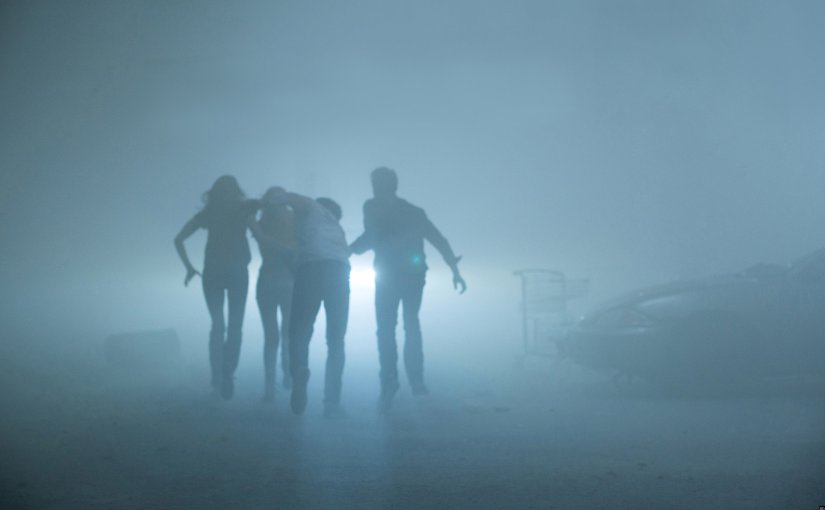
Within another small fictional town in Stephen King’s version of Maine, a dark and stormy night kills the power within the area.  The next morning large fallen trees appear to have damaged the homes of David Drayton and Brent Norton (Thomas Jane, Andre Braugher).  Phones and power remain out, but a curious cloud of mist grows over the lakeside area.  

The gentlemen decide to go into town for supplies with David’s son Billy (Nathan Gamble) in tow.  The checkout line of the supermarket is crowded with tourists and residents when a similar mist envelopes the building and clouds up the expansive front window of the shop.  An elderly man runs through the parking with a bloody nose and urges the shoppers to lock the doors because there are things within this unwelcome mist that are terrifying and bloodthirsty.  I’ll spoil this for you. The old coot is right.  The creepy crawlies are thirsty for blood and hungry for flesh.

You’ve seen much of what Darabont’s screenplay adapts from King’s novella in similar iterations of horror.  The wheel is not reinvented here and though an explanation of this mist and the organisms it conceals is spelled out, nothing is jaw dropping.  Seems similar to how King’s The Stand opened.  The cast of this B movie is what needs to be talked about.

Sure, there are doubters of things terrorizing the community just before the blood is spilled.  Some characters make hard decisions despite the urging of others not to leave the store.  Yet, when these flesh eaters become evident, then the end of days gospel of Mrs. Carmody (Marcia Gay Harden) permeates through the populace of the supermarket.  That’s when The Mist grows a brain to demonstrate the power of fear, threat, and especially influence.  The disturbing Mrs. Carmody exaggerates the purpose of this phenomenon with select biblical scripture both documented and I believe conjured on the fly by her.  Now I am reminiscing back to tenth grade English when I studied Lord Of The Flies.  A tribe forced to live together will ultimately divide.

Darabont so wisely reads a collection of different walks of life forced to either work together or work against each other, both sides with desperate means to survive.  William Sadler is a dimwit mechanic who goes through three different modes of purpose during the film.  He starts with a tough guy mentality, then on to timid fear and regret, and lastly, he’s reawakened to echo the call of Marcia Gay Harden’s religious zealot.   Truly insightful because I often wonder how any person can so easily succumb to the influential beliefs of someone else.  I mean you would have to be dense to allow that to alter your mindset, right? Well Stephen King and Frank Darabont remind me that there’s more dense people on this planet than wise.  A dread of cabin fever only exacerbates to succumb to what someone will tell you. Therefore, let’s observe how the morons respond to the dominant personality.

The action for the sake of jump scares and expected horror does not disappoint too much.  There’s screaming. There’s lots of blood. There’s lots of running too, and monsters and webs and teeth and claws.  A sneak away trip to the pharmacy next door is neat centerpiece, but you’ve seen stuff like this so many times before. Frances Sternhagen gets the opportunity to use a makeshift, bug zapping, flame thrower that made me laugh and cheer.  

The jump scares are not very effective, though.  One bug thuds against the window pane. Otherwise, there’s monster stuff to absorb like tentacles, claws, teeth and webbing. I don’t go for slasher flicks and endless bloodletting gore like most movie makers of this genre attempt to achieve.  Too much blood is boring and a sign of a lack of story.

I was invested in uncovering why this all started.  I was taken with how a small group of people quickly engages in a mob mentality because their individual desperations refuse to satisfy. What instincts will undo people when hope dwindles and your companions turn on you?  Darabont presents some effective moments for these questions. However, once the exposition was out of the way, I didn’t care who lived or died.  My concern was knowing how whoever survives gets out of this dilemma.

The answers come and there is an unexpected ending tacked on by Darabont that is not recounted in King’s work.  Trust me when I say I’ll never forget the conclusion of The Mist.  Same as I’ll never forget the ending to The Sopranos.  That’s not necessarily a compliment though because I think Frank Darabont was only adding unnecessary insult to injury. He resorts to using a terrible psychological epidemic for one last twist of his gleeful, mischievous knife in my back.  I am not spoiling anything for you dear reader, but James Cameron went this route during a sequence in Aliens and it made much more sense, while offering convincing justification.

While you might like the chills and thrills of The Mist, be warned that it’s the ending that’ll leave you angered for days and nights thereafter. I had a furious urge to throw my popcorn at the screen.  

Popcorn can be found on aisle 5 by the way.  Bug spray on aisle 9.
MISERY

By Marc S. Sanders

The worst thing that could have happened to Paul Sheldon is that Annie Wilkes saved his life.

Rob Reiner breaks away from innocent romantic comedy to deliver a violently cruel kind of intimacy. He directs his second Stephen King adaptation, Misery.  (His first was based off King’s novella The Body, which became Stand By Me.)  With next to no prior record with horror or disturbing psychosis, Reiner achieves greatness with this film.  Much like Martin Scorsese, he focuses quite a bit on props that offer no dialogue but say so much.  A cigarette, a match, a champagne flute, a bottle, a beat-up briefcase, a clunky Ford Mustang, along with a gun, a two by four block of wood, a portable grill, a knife, a syringe, a sledgehammer, and a porcelain penguin.  Barry Sonnenfeld is the cinematographer offering brilliant clarities of color for mundane and endless discomfort.

Before leaving his mountainous Colorado cabin, Paul has smoked his cigarette and savored his glass of 1982 Dom Perignon.  He has just completed a new manuscript; a big departure from his best-selling series of novels focusing on his beloved heroine Misery Chastain.  Lady Misery is not how Paul wants to be entirely defined as an author.  

Unfortunately, on his way back down the snowy mountain, he veers off the road and lands upside down in his Mustang, buried within a blizzard.  A hulking figure carries him back to a peaceful, isolated cabin in the woods.  When he awakens two days later, he meets Annie who has already begun to nurse him back to health following two very damaged legs and a popped shoulder blade.  By his grogginess, he might have had a concussion too.  Lucky for Paul because apparently, he cannot reach a hospital or get a call out to his family or literary agent (Lauren Bacall) due to the harsh weather conditions.

It’s also convenient that Annie is quite the fan of Paul’s work, particularly his series of Misery novels.  She has a maternal bedside manner, but oddly enough she becomes irascible at any given moment.  After honoring Annie’s request to read his untitled manuscript, Paul realizes that might have been a mistake.  Annie can easily get unhinged to say the least, and that temper…

Paul Sheldon is portrayed by James Caan, and he was one name on a long list of leading actors considered for the role including Warren Beatty, Robert Redford, Harrison Ford, Robert DeNiro, and Jack Nicholson.  Any one of these guys could have done the part.  However, I can now only see James Caan.  He beautifully plays stationary vulnerability as he’s anchored to a bed for most of the film.  Ironically, for a writing master of words, Caan’s dialogue is not even half of the script that belongs to his counterpart.

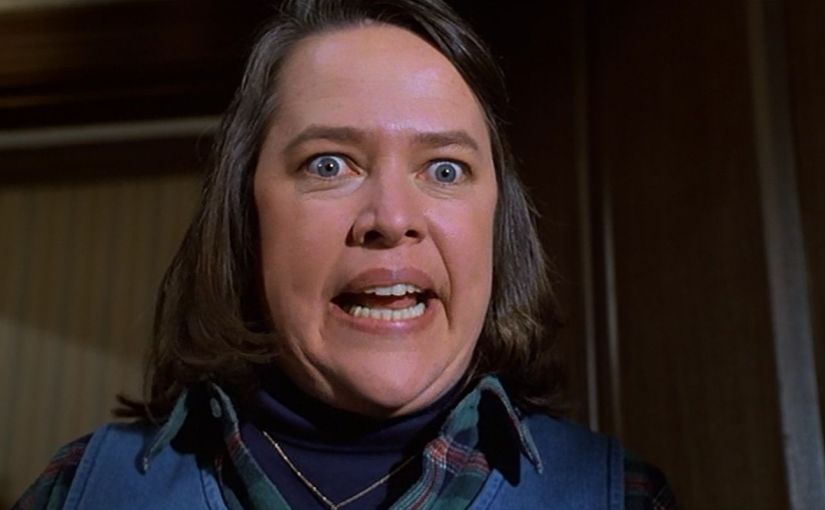
Kathy Bates was deservedly awarded the Oscar and a slew of accolades for her role as Annie Wilkes.  This role put Bates on the map.  Her portrayal is timed so authentically with changes in tempo from childlike enthusiasm to demented rage that she only makes Stephen King seem like that much better of an author than he already was at the time.  Actually, I’d argue that before Misery hit theaters, the Stephen King factory of film adaptations was churning out subpar products like Cujo, Firestarter, Christine, and his own film that he directed Maximum OverdriveMisery elevated the author’s brand back to when it was celebrated with Brian DePalma’s Carrie and Stanley Kubrick’s unforgettable interpretation of The Shining.

I believe what helps is that of all the varieties of horror the author was delivering, Misery did not hinge on the supernatural.  Annie Wilkes is a very real embodiment of capable terror and disturbing psychological handicap.  Kathy Bates effectively demonstrates byproducts of schizophrenia and obsessive, compulsive disorders.  Living alone in the woods with the subconsciousness of an author speaking to her through the pages of his fictional hardcover novels only feeds the beast that she’s become. 

I’m not a big fan of Stephen King’s works.  Often, I find his material of gore stretches too hard for shock value, and hardly ever achieving insightful originality.  To the best of my recollection, I’ve only read Misery, The Stand and It.  That’s enough for me.  I read that as he was writing Misery, he was emoting his alcoholic demons that left him obsessively challenged.  Annie Wilkes developed into that tangible, physical fiend.  This story takes a far step away from the macabre world that built his literary empire.

Rob Reiner does not go for any kind of novel inventions with his film.  He’s simply telling a story with the tools provided by celebrated screenwriter William Goldman (The Princess Bride, Butch Cassidy & The Sundance Kid, All The President’s Men) and his wise adjustments from King’s piece.  Goldman and Reiner wisely cut out a lot of King’s gory schlock.  (That foot scene, for example.  Either way?  YEESH!!!) Smart move, because Annie Wilkes is such force of power personified by the hulking physicality (by choice of Reiner’s lens) and range of Annie Wilkes.  Even though Kathy Bates is short, she is a hulking menace here. Kathy Bates is doing stage work in front of a camera.  I’d argue her performance inspired the idea of eventually converting Misery into a Broadway play that featured Laurie Metcalf and Bruce Willis in the roles.  I wish I could have seen that. 

Goldman wisely allows the picture to move on with another perspective in the form of two characters that were not part of King’s story.  A perfect casting of Richard Farnsworth and Frances Sternhagen as the local sheriff and wife advance the curiosity of Paul’s absence from the world.  They speak for the surrounding areas that don’t reveal what is beneath the blankets of snow where few clues remain, and not even a missing 1965 Ford Mustang can show itself.  They’re funny, quirky, and unusual, almost like a combination of Jessica Fletcher or Miss Marple seeking to resolve the mystery.

Props like a gun and a knife along with visuals like uncontrollable fires and fight scenes are nothing new.  However, it’s when these scenarios are paired with Kathy Bates to victimize a small, weakened James Caan that these items become well filmed properties of Rob Reiner.  So again, I focus on the inanimate objects of Misery because Reiner lends a lot of footage to all of these working pieces.  This revolver suddenly has dialogue of its own through one of Annie’s personalities.  The knife works like a guard dog for Paul.  The aluminum can of lighter fluid sadistically squirts itself to tickle or tease an extreme point for Annie.

The cigarette and champagne flute emote those small, cheating, harmless vice escapes from commitment that awards Paul. 

The sledgehammer puts its foot down.

The match plays both sides of the duality during different points of the film.

Misery is that film that works with a small cast, but with a wide population of environment, in a snug, confined space.  I describe the picture this way because like Annie Wilkes, this exploration in psychological terror operates without fair balance.  When an animal cannot control and subdue its instincts, there’s no telling what to expect, and an unpredictable Annie Wilkes might be one of the scariest personifications any one of us could ever encounter.