
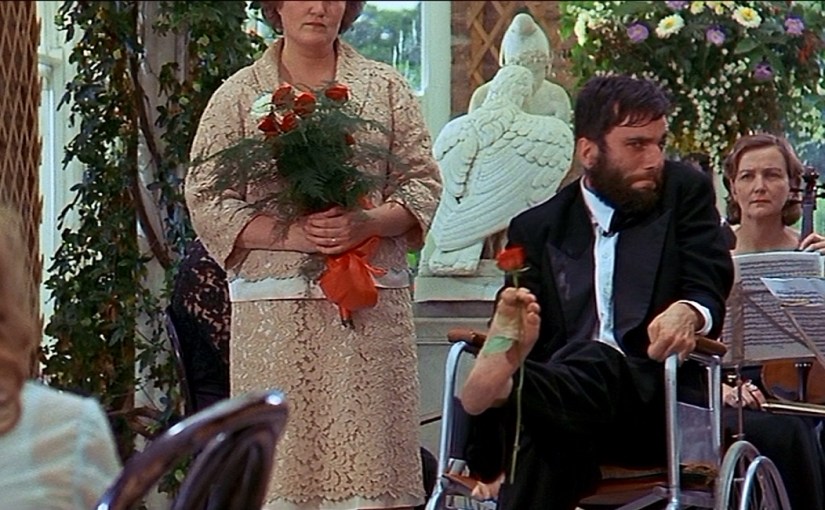
by Miguel E. Rodriguez
DIRECTOR: Jim Sheridan
CAST: Daniel Day-Lewis, Brenda Fricker, Fiona Shaw
MY RATING: 10/10
ROTTEN TOMATOMETER: 98% Certified Fresh
PLOT: Christy Brown, born in 1932 with cerebral palsy, learns to paint and write with the only limb under his full control – his left foot.
For so many years, I have admired Daniel Day-Lewis as an actor, especially his performance in There Will Be Blood, which is the only performance I’ve seen on screen that has ever really motivated me to be a better actor myself. However, I never got around to seeing his breakout movie, My Left Foot, until just recently. All I can say is: WOW. I had always assumed (big mistake) that this film would be a long, dark journey of the soul leading finally to an uplifting climax, but not after a lot of scenes of heartbreak and pathos and general gloom. I could not have been more wrong. There is as much heartwarming joy in My Left Foot as it’s possible to contain in any film, and it’s balanced by acknowledgement of Christy Brown’s condition and his down days and his struggles. It’s a brilliant high-wire act, flawlessly performed both in front of and behind the camera.
Christy Brown is born with cerebral palsy in Ireland in 1932 to a Catholic family that grows in number almost through the entire film. In a day and age that was simply not equipped to handle disabled children, Christy’s father is blunt: “He’ll go in a coffin before any son of mine will go in a home.” While his motives were probably more about saving face in his community than anything altruistic, it’s this attitude that most likely saved Christy’s life. Christy is brought home where his parents and his many sisters and brothers acknowledge and learn to work around his condition, but they refuse to treat him as anything other than a “normal” playmate and sibling. Some of the happiest scenes in the film are when the children push Christy around in a wheelbarrow, racing up and down their street, as much for his enjoyment as for theirs.
Christy’s mother (Oscar-winner Brenda Fricker) patiently learns how to interpret young Christy’s unintelligible grunts and constantly shifting facial expressions, so it seems as if they’re communicating with each other in a secret language. When young Christy shocks the family by picking up a piece of chalk with his left foot and writing “MOTHER” on the floor, the father’s response made me smile and smile: he carries Christy to the local pub and announces, “This is Christy Brown! My son! Genius!” If this didn’t happen in real life, it bloody well should have.
(I also loved the bit where the older Christy plays soccer with his friends. As a very capable goalie, no less. When the time comes to take a penalty kick, his brothers line him up carefully on the ground so he can use his deadly left foot to rip the back of the net. Or storage shed, whatever.)
I mention all these moments and interactions between Christy and his family because they are at the core of what makes this movie special. Yes, Day-Lewis’s performance is the stuff of legend, there’s no denying that. But the screenwriters are very careful to let us see that, despite his literally crippling affliction, Christy never lacked an unshakeable support structure. I found myself wondering if I had the kind of fortitude, not to persevere like Christy, but to go all in on supporting a sibling or any loved one, loving them, and always being there for them. It’s easy enough to say I am willing to do things like that. I only hope, if I were ever faced with that kind of challenge, that I would meet it with the same kind of unconditional grace and love exhibited by the family of Christy Brown. Here endeth the introspective portion of this review.
I can’t tell you enough how enthralling and well-balanced this film is. In my experience, most movies about characters with terminal illnesses tend to wallow too deeply in the grief and sorrow associated with that illness. My Left Foot makes a conscious decision to establish the illness, lay down the boundaries, and then move forward as if the main character weren’t ill at all. In a sense, that is the case with Christy Brown in the first place. As brilliantly portrayed by Day-Lewis, you can always see the mind at work behind the uncontrollable gestures. There is nothing at all wrong with his mind, only his body, which betrays him and frustrates him.
There is one specific scene that seems to stick in the mind of everyone who sees the film. Christy has been taken under the wing of a doctor, Eileen Cole (Fiona Shaw) who specializes in treating his condition. His speech improves, his painting improves. He falls in love with her. In an agonizing scene, he confesses his love to her in a restaurant while several other associates look on. She mistakes his declaration of affection and informs him of her engagement to another man at the table. After a stunned silence, Christy uses his loudest speaking voice and carefully and very slowly says, “Congratulations.” Director Jim Sheridan points the camera, not at Christy, but at the horrified and embarrassed dinner guests at the table, and at the other restaurant patrons who stop and stare in disbelief at the noises Christy is forcing into the air. He has some other choice words regarding platonic love, and the scene ends with him pulling the tablecloth off the table with his teeth.
The emotions on display in this scene were so raw and honest and painful that I found myself covering my eyes a bit. I felt every bit as embarrassed as those dinner guests. But I also felt enormous empathy for Christy. He is raging, not only at Dr. Cole and her rejection of his affection, but at the fates that locked his soul away in a body that was a constant reminder of his “differentness.” Later scenes show us that he was able to make peace to a much greater degree in later life, but these scenes and others reveal the unimaginable conflict in his sharp mind.
I’m rambling, I think. I don’t feel I have successfully conveyed how joyous My Left Foot truly is. I had a goofy smile on my face for the first half hour of the movie. I laughed out loud many times, especially at Christy’s father’s wake, a scene I vividly remember seeing at the Oscars that year. Christy Brown was not a perfect man, and the movie does not pretend that he is. But the movie does end on a wonderful high note that would be crushingly melodramatic in almost any other film. My Left Foot earns it by showing us his journey, completely, concisely, and with enormous understanding.
 2 UNPAID MOVIE CRITICS!!!!