
By Marc S. Sanders
Claus Von Bülow was not a well liked man. In the 1980s he was put on trial for the attempted murder of his wife Sunny Von Bülow and was found guilty in a courtroom within the state of Rhode Island. However, even guilty men need a lawyer. Alan Dershowitz accepted Claus’ invitation to be his appellate attorney and successfully won the case with the assistance of the best students to come out of his law school classes. Reversal Of Fortune directed by Barbet Schroeder documents the month and a half that Dershowitz had to make a case for overturning Claus’ conviction. The film is based on Dershowitz’ book Reversal Of Fortune: Inside The Von Bülow Case.
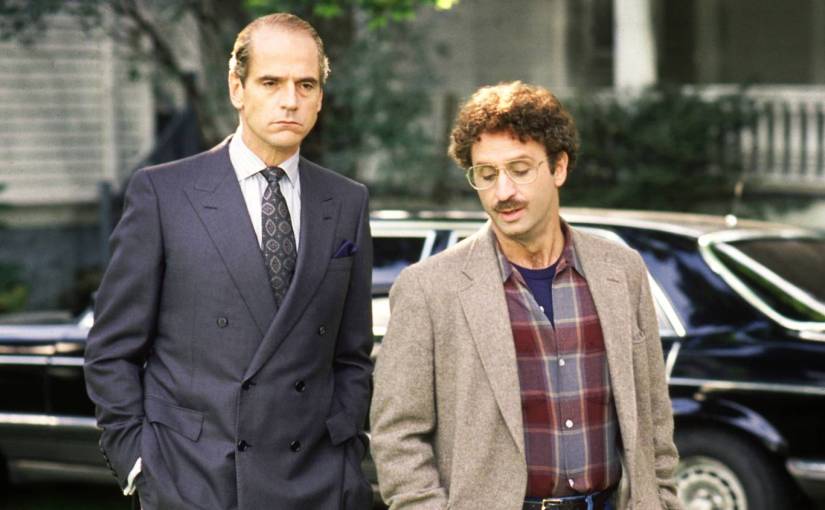
Jeremy Irons won the 1990 Best Actor Oscar for portraying the cold and cavalier Claus. He plays the part as if he looks so completely guilty that it’d be foolish to actually think he committed any sort of crime. It’s too obvious to seriously jump to that conclusion.
Glenn Close is Sunny, Claus’ wife. She serves as a narrator from her permanent, seemingly brain dead comatose state. She also appears in flashback moments that account for either her perspective, or Claus’, or the suppositions of Dershowitz (played very effectively by Ron Silver) and his young legal team. Sunny’s voiceover asks the viewer early on “What do you think?”
Sunny was hooked on various pills, chain smoked, ate an abundance of sweets and drank very heavily. She preferred to stay in bed for most of her days. One instance seems to show her in a comatose state lying next to an unalarmed Claus. The maid is disturbed by the nonchalance of the aristocratic husband. A doctor or the police have yet to be phoned. Sunny comes out of that episode but a year later falls into another comatose state. Flashbacks hint at the theory that perhaps Claus was poisoning Sunny to obtain her fortune and keep up with his extra marital affairs. Following her second coma, Sunny’s children hire a private investigator to obtain evidence that was eventually used against Claus in his trial. As an honorable servant of the law, this infuriated Alan Dershowitz who believed this private investigation was biased from the start. Schroeder uses a debate scene with a student (a young Felicity Huffman) for the lawyer to justify his choice to fight for such a hateful man’s appeal. Why were private investigators permitted in the trial? Where’s the public investigation? It also helps that Claus agrees to a large fee to help Dershowitz fund the defense of two brothers on death row for a crime they did not commit.
Schroeder’s film does not make its own claim on the case or the circumstances that accompany it. Rather, he shows you a process. Dershowitz knows that Claus Von Bülow is a “very strange man.” Claus responds to him by saying “You have no idea.” Yet, that doesn’t add up to guilt. A victim can be a victim by means of numerous possibilities and a court of law is fallible. Dershowitz wants to be sure.
Jeremy Irons’ performance is that of a gentleman of an aristocratic and well dressed nature. He finds the humor in being considered the villain. Irons plays the role with determined vagueness. Vague does not account for guilt.
Glenn Close is very good too. Her intoxicated episodes are so delirious that it seems to work in favor of Claus’ innocence. Yet her voiceover narration is sober and clear, but not necessarily accusatory. So it’s hard to know what to believe.
Ron Silver as Alan Dershowitz only focuses on the law and commanding a team of the best legal minds he ever taught. He turns his two story home into a headquarters where his students are compartmentalized into different aspects of the case from the drugs that Sunny took to the background of the Von Bulow’s turbulent marriage. As a means to keep them alert, the departments have basketball tournaments in his driveway. Dribbling the ball and slam dunking while still weighing evidence and legal precedents. Dershowitz is only interested in seeing if there is a case that shows Claus could have been innocent beyond a reasonable doubt. The case swept the nation and in the court of public opinion this creep was found guilty. Ironically, the one who is closest to him now is the one who does not see guilt, despite disturbances in his client.
Reversal Of Fortune is a different kind of mystery caught up in possible outcomes and nothing else. Barbet Schroeder with the help of Dershowitz’ case notes, book and public records made certain to offer all avenues for what really led to Sunny Von Bülow’s vegetative state.
The only concrete fact that this film does offer is that Claus Von Bülow was an untrustworthy creep draped in elegance and formality. There’s no crime in that. Is there?

 2 UNPAID MOVIE CRITICS!!!!