THE HURT LOCKER

By Marc S. Sanders

Often the most effective war movies hardly focus on the enemy.  It’s the environment that keeps us on our toes.  Like Oliver Stone’s Platoon, Kathryn Bigelow’s The Hurt Locker is a widely acclaimed depiction of the Iraq War, centrally located in Baghdad in 2004. Her film follows a frighteningly tense perspective of three members of Bravo company – a bomb disposal team.  

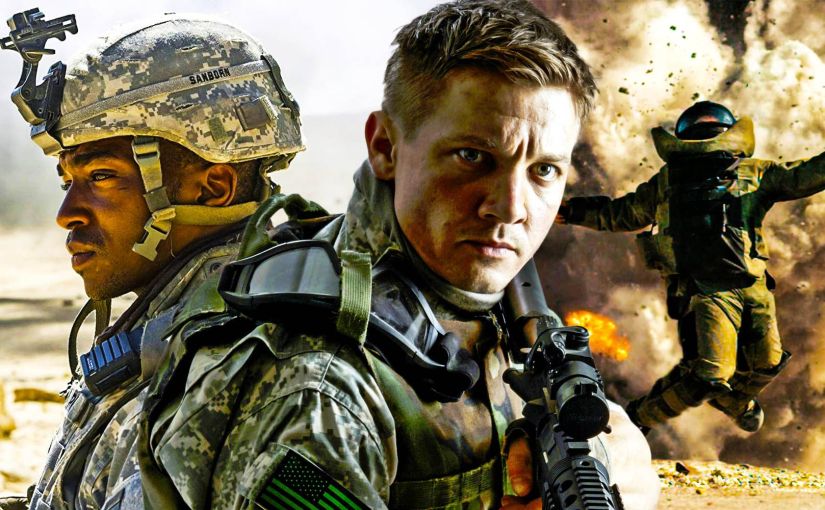
After their leader perishes in a surprise attack, Sergeant J. T. Sanborn and Specialist Owen Eldridge (Anthony Mackie, Brian Geraghty) welcome Sergeant First Class William James (Jeremy Renner) to the squad for the remaining thirty-eight days of their rotation. Beyond evading suicide bombers and questionable Iraqi civilians who observe from the sidelines, Sanborn and Eldridge fear they’ll have to survive James’ maverick approach to deactivating sophisticated bombs that hide in the scorching hot desert area. William James claims to be responsible for shutting down eight hundred and seventy-three explosives in his young career.  He’s good at what he does but he disregards the best interests and care for others within his vicinity.

The art direction for The Hurt Locker is most impressive.  The expected sand rubble and distressed tenement buildings are convincing as Jordan stands in place for the film’s Baghdad. Bigelow’s team goes to great lengths with sophisticated explosives.  An early moment has James gently tugging on a red cord that eventually leads to other cords and then what comes out of the desert sand is six identical underground bombs surrounding him from all sides.  With her camera positioned overhead, pointing down, this feels like a monster movie with tentacles springing out in a circumference around the hero.

Another early scene has James recklessly undressing from his bulky, anti-bomb suit, and disassembling an abandoned car to look for the suspected device that’s hidden inside.  With Eldridge and Sanborn remotely demanding updates, the wild man chooses to toss his headset away to focus on his dire circumstance, solo.  

Ahead of the film’s thrilling opening, a quote from someone named Chris Hedges appears: “The rush of battle is often a potent and lethal addiction, for war is a drug.”  A more appropriate phrase would not describe Jeremy Renner’s character any better.  There’s no denying this guy is an expert and the best of the absolute best.  However, he’s positively the worst at accounting for his team or the environment around him.

Kathryn Bigelow is an outstanding director who gets better with each passing film.  The Hurt Locker elevates her finished products that began with cops and robbers fare like Blue Steel and Point Break.  Bigelow is not aiming for laughs or Hollywood shootouts.  With Mark Boal’s Oscar winning script, the filmmaker zeroes in on how someone so proficient with dangerous work pushes beyond limits of caution.  The three characters covered within this tiny sliver of a larger war find themselves tested with each passing day.  

There’s a routine to these guys as they respond to other desert platoons as the sun rises. They are summoned to come upon bombs and mines and people strapped to bombs and mines.  They load up in their Humvee, drive to the next site and do what is expected of themselves like firefighters would in any neighborhood. The conflict is these guys just do not work in sync with each other.  At night, they return to base following a full day’s work to play shoot ’em up video games, drink, and roughhouse with each other as a means to grasp who is the dominant one of the trio.  

Psychologically, James, Sanborn and Eldridge are not on similar planes.  Eldridge is the frightened one who confides in a Colonel with an empathetic, bedside manner.  Sanborn is the sensible levelheaded one.  James seems to lack priority for anyone including his on again/off again girlfriend back home (Evangeline Lilly) and the child they share together.  He’s bent on conquering the next sophisticated, wired device.  It only gets personal for him when one of the few kids in the area meets a gruesome demise and James goes lone wolf at night, within the towns, even though he’s not covert ops. His risks are too great for this war, his squad, and maybe himself.

Kathryn Bigelow effectively sets up environments that’ll rattle your nervous system.  Using handheld cameras, this film often works like documentary footage with quick cuts to citizens of Baghdad who may be staring at what this squad is doing, or maybe they are waiting for their cue to detonate something nearby and trap them.  A local butcher with a cell phone in his hand feels like the worst kind of threat.  A kid with a soccer ball seems untrustworthy.  A guy in a suit pleading for desperate help at the other end of the street is a person I wouldn’t want to stand next to.  There’s an abundance of desert citizen extras to look for and hypothesize about.  Is it that guy with the trigger or maybe it’s that kid or that woman?  Most of these people do not even speak.  Their glazed, war torn and dusty expressions say so little while the powerful machine guns held by the Americans will not do much to prevent a horrifying possibility.

The extensive footage of explosions is very impressive.  I read that Bigelow wanted to display what a real detonation would look like, and not with Hollywood fireball extravagance.  Accompanied with Oscar winning sound editing and mixing, the bombs in this movie lift the dirt and dust particles off the ground, building and automobile surfaces and then plume into mushroom clouds that expand beyond the limits of city blocks. The Bravo Company men even predict how the blasts will take off and where exactly the shrapnel and debris will reach and descend. They think they have this down to a science. This material is entirely different than what other action or war pictures typically show.  

Sniper fire comes at unexpected moments.  An open desert plain actually has an enemy concealed somewhere and quick pierces of sound drops a someone who you might think controls the scene. Then the next someone. The shock of how quickly it’s edited together plays with your senses. Bob Murawski and Chris Innis are the award-winning film editors of this piece. They complete their job to the fullest. This all looks so real and not a product of art.

The Hurt Locker is term to describe where a militant solder will go to when living with internal pain and conflict.  The soldier goes to his hurt locker. This war puts each of these three guys in their own kind of hurt locker, but perhaps they force their situations upon themselves and each other. Mark Boal and Kathryn Bigelow’s film do not just devote time to the three characters who are most at play, but also to devices of war and destruction that drastically change these men.

The Hurt Locker is one of Kathryn Bigelow’s best films.
ANT-MAN AND THE WASP: QUANTUMANIA

By Marc S. Sanders

Ant-Man And The Wasp: Quantumania is a fun frolic through the Quantum Realm, another dimension that was uncovered in previous chapters within the Ant-Man series of films.  I’m not watching a potential Best Picture nominee for 2023.  I’m watching a glorious kaleidoscope of colors and visual effects with likable characters, and the setup of a new big bad villain for upcoming installments for the Marvel Cinematic Universe.  It’s not a perfect movie.  It’s corny and hokey at times, but I was with the picture the whole way.

I do believe these sci fi superhero franchise films are getting way too diluted.  I think there are more Marvel films now, all working within a shared universe, then there are episodes of single seasons of television shows.  A lot of these films do not stand apart any longer and hinge on events or hanging threads that occur in prior installments.  It makes for a lot of homework and time spent on the consumer to keep track of everything, and where everyone was last left off.  With Disney + adding in multiple Marvel streaming series to watch as well, I’m sorry but my days feel like they need to be extended beyond the standard 24 hours.  The economic term known as “The Law Of Diminishing Marginal Utility” hearkens back to me at this point, all these years later after we first met Robert Downey Jr. as Iron Man in 2008.  Are viewers getting tired of the superhero phenomenon?  Superhero movies rule the box office these days.  Westerns did it four or five generations ago.  How many new westerns do you now see each year?

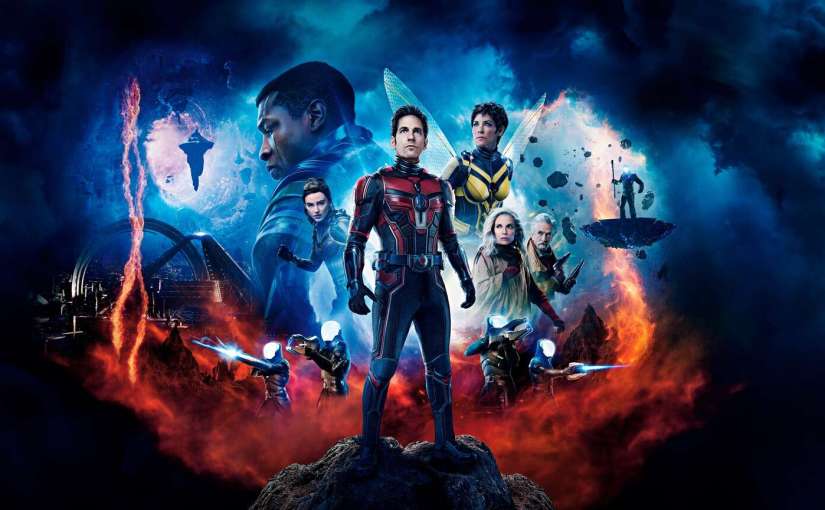
The blessing of Quantumania is that it does not rely abundantly on other material in the Marvel Cinematic Universe.  Scott Lang (Paul Rudd) reintroduces himself in a very adoring Paul Rudd-like way with a voiceover and thereafter, he is unexpectedly sucked into the Quantum Realm, along with his daughter Cassie (Kathryn Newton), his current partner Hope Van Dyne (Evangeline Lilly), aka The Wasp, and his mentors Hank Pym and Janet Van Dyne (Michael Douglas, Michelle Pfeiffer).  The gang must primarily depend on Janet to navigate them through this world of inconsistency and oddball inhabitants where no two characters seem to look alike.  Janet was marooned in the Quantum Realm for thirty years before finally being rescued.  What concerns her the most is one who is first referred to as “The Conqueror,” and later identified as the frightening superman known as Kang (Jonathan Majors), who was mysteriously exiled to this place.  As Janet describes, Kang has made the prison of the Quantum Realm his empire and now he wants to use the technology that our heroes possess to break free of this dimension and cause all kinds of chaos in the real world and other parallel universes.

The best assets to the film are the scenes between Jonathan Majors and Michelle Pfeiffer.  Granted, their dialogue could apply to any other kind of movie.  A lot of ping pong arguments between the villain and hero, which if I remember correctly go something like “You don’t understand.” and “I’ll never let that happen.”  This verbiage could also be suitable in a Meryl Streep tearjerker or a courtroom drama.  It’s pretty standard.  We’ve seen discussions like this a million times before.  Fortunately, my state of mind was not demanding of thought-provoking conversation.  The magnetism of their acting in front of the expansive CGI environment kept me hooked.   Jonathan Majors simply looks like a very frightening threat.  He’s calm at one point and later raging like a lunatic.  The man has levels.  If he were reciting the ingredients of chocolate chip cookies, I’d be on pins and needles. 

I do not think Quantumania is going to wow most audiences.  In fact, it’ll be a divisive film.  It’ll go half and half.  Though I really do not like to rank films any longer because it feels so pointless, I got into a debate with my wife and daughter about which one was better.  Quantumania or Wakanda Forever.  Both films have their merits, but I left the latest Black Panther film feeling a little depressed and exhausted.  That was a long time to feel morose for a superhero film.  The ladies, however, appreciated the story of that film over this one.  (I wanted to see the Black Panther suit a lot sooner.  I wanted a handful of people to be cut from the film, and I thought the Namor character was very boring.  Look for my review on this site.)

With Quantumania, audiences are either going to like the weirdness that is splashed all over the screen.  Splashed is not a strong enough word.  Try SPLATTERED!!!! Everywhere you look there is something abnormal to see from one corner to the next.  On the other hand, viewers will think the Quantum Realm and its inhabitants are just too bizarre, and the Marvel filmmakers are scraping the bottom of the barrel in imagination.  Sorry, but I got a kick out of the tall stilt guy with a spot light lamp for a head.  I thought the pink goo guy was cute.  I also giggled at the fat head henchman, with scrawny arms and legs, known as M.O.D.O.K. (with Corey Stall, making an MCU return).  The functionality of this character is deliberately lacking and comes off like Looney Tunes cutting room material, but that’s also why he is here.  If there was anything looking remotely normal in the Quantum Realm, well then it isn’t the Quantum Realm, I guess.  Bill Murray even shows up, but if you need a bathroom break, this is when you should go.  All of this looks way too stupid, yes!  Then again, stupid can be entertaining and stupid is often taken with subjectivity. So, I’m just one guy’s opinion. 

Quantumania is maybe the most unsophisticated of all the Marvel films.  More so than the Guardians movies, or the most recent Thor installment.  With a happy go lucky Paul Rudd, an army of ants and some of the most bizarre CGI extras found anywhere it proudly stands tall on that pedestal of ultra, ultra, ULTRA weird.  I think director Peyton Reed accomplished what he set out to do with this film.  The question is will the film win majority of approval within the nerd land of keyboard warriors like myself, who share their perspectives on the internet.  Well, the movie gets my vote at least.

ANT-MAN

By Marc S. Sanders

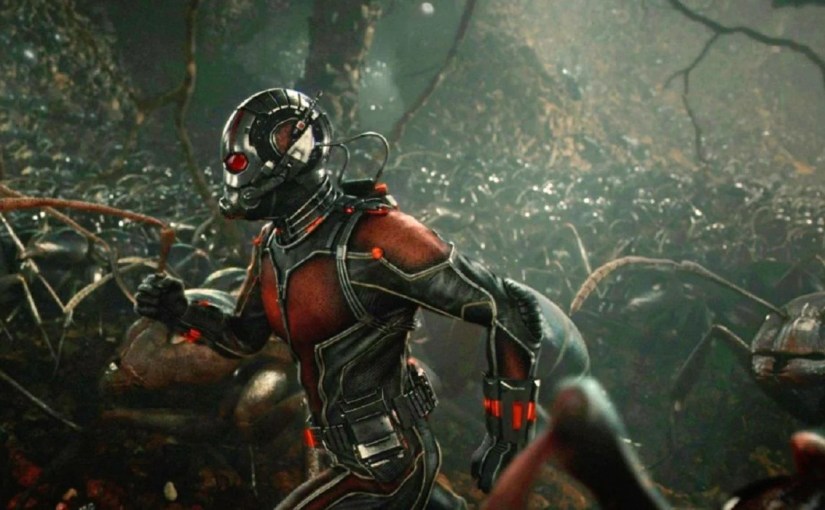
Peyton Reed not only capitalizes on Edgar Wright’s interpretation of Marvel’s Ant-Man, but also on the first chapter of the MCU, Iron Man. The similarities in the two films are so familiar that Ant-Man seems a little boring and redundant. You’ll turn to your seat mate midway through and say “We’ve seen this.”

Nevertheless, Reed’s film is saved thanks to a likable Paul Rudd, a welcome Michael Douglas and a scene stealing Michael Pena. Evangeline Lilly is here but she’s as useful as Gwenyth Paltrow has been. Corey Stoll is the bald villain, like Jeff Bridges before him, and well… LOOK!!! You just needed to find someone to be the villain; the guy interested in stealing technology to use for making a lot of money and other nefarious purposes. You’ve seen it all before.

Pena is given the best stuff to do as Reed takes advantage of visually recounting a “telephone game” story of what he and then what she said and then what he said after that. Michael Pena is a really funny guy who deserves more work. He’ll likely get a lead in an ABC family sitcom one day called Pena or Michael!, let’s say.

Rudd has fun with the stupidity of his superhero name and abilities. Let’s face it. Controlling the minds of ants is not as flashy as Batman and his gadgets or Spider-Man web slinging through the city. Rudd smirks through all of it. So, I felt okay to smirk as well.

The film suffers from a lot of exposition and a few too many characters. In a flashback 80s scene, Douglas’ character (the original Ant-Man) breaks some SHIELD agent’s nose. What’s so special or offensive about this guy? I don’t know. Also, Bobby Cannavale is a pain in the ass cop for Rudd to deal with, but more or less you’d have the same film if he was excised from the final cut.

Reed saves his movie with a really fun ending consisting of a battle involving shrinking and enlarging and shrinking again aboard a Thomas The Train Engine toy playset. It’s Rudd as Ant-Man vs Stoll as Yellowjacket (very cool looking and not used enough). As well, you can’t help but smile when you see a fifty foot high toy train crash through a house.

This is a scrappy little film in the Marvel Cinematic Universe and not much seems original, but you got a cast that’s likable and an ending to be entertained by.

Nothing special, but nothing terrible either.

AVENGERS: ENDGAME (2019)

By Miguel E. Rodriguez

Directors: Anthony Russo & Joe Russo
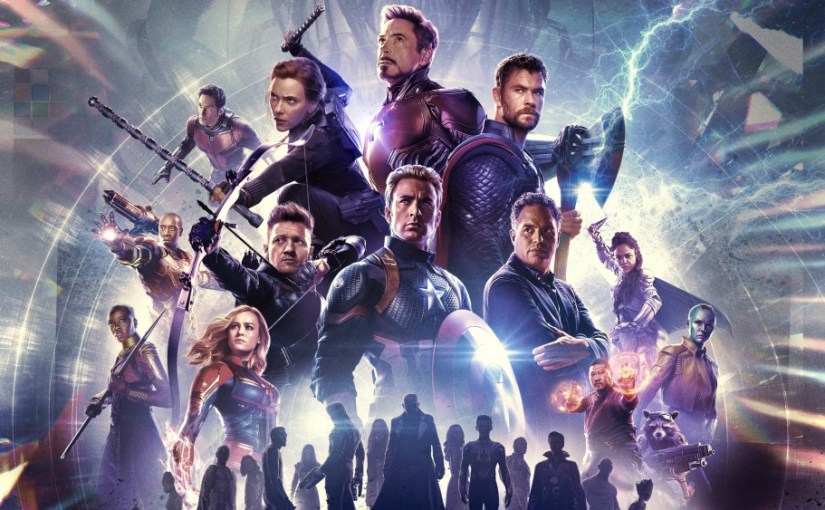
Cast: Robert Downey Jr., Chris Evans, Mark Ruffalo, Chris Hemsworth, Scarlett Johansson, Jeremy Renner, Don Cheadle, etcetera, etcetera…
My Rating: 10/10
Rotten Tomatometer: 96% Certified Fresh

PLOT: After the devastating events of Avengers: Infinity War, the universe is in ruins. With help from some of their remaining allies, the Avengers assemble once more to try to undo Thanos’ actions.


I have tried several different drafts of this review, and I simply am unable to write a decent review without necessarily revealing spoilers.

So…

DO NOT READ ANY FURTHER IF YOU HAVE ANY INTENTION OF SEEING AVENGERS: ENDGAME IN THE FUTURE.  SPOILER ALERT!!!

SPOILER ALERT!!!

SPOILER ALERT!!!

You have been warned.

For starters, Avengers: Endgame is not my favorite movie in the MCU.  (That title still goes to the incredibly complex, endlessly debatable Captain America: Winter Soldier, the superhero movie for people who hate superhero movies.)  BUT…Endgame contains my single favorite moment in the entire franchise.  It occurs during the climactic battle, and it involves…hardware.  YOU know what I’m talking about.

That aside, while Endgame is a more-than-worthy sendoff for the 11-year-long story arc, and is Hollywood spectacle at its best, I gotta be honest and say that the 3-hour running time was starting to get to me around about the 2-hour mark.  Yes, the plot threads all had to be woven together to bring everything to a head for the ultimate showdown, and I wouldn’t dream of eliminating anything that I saw, but it just was feeling a little slow.

Other than that…it gets all A’s across the board.

  • ACTION – I haven’t seen CGI action on this scale since the Battle of the Pelennor Fields in The Lord of the Rings: The Return of the King.  Or Avengers: Infinity War, take your pick.  I can only imagine the headaches and nervous breakdowns experienced by the hordes of CGI artists who painstakingly created the outstanding battle scenes.  They were incredibly dense, but I was never unable to see any of the key moments involving key characters.  Nothing was too dark or murky.  It was an event.
  • HUMOR – In spite of the heaviness of the proceedings, the filmmakers never lost sight of their origins: COMIC books.  From the first appearance of Thor in residence at New Asgard, to Stark’s never-ending supply of dry one-liners, to Hulk’s selfie in the diner, the audience is always kept from falling into major depression, even after some really, REALLY dark moments in the story.
  • CLOSURE – The film ends the way it does because it HAD to.  Some of the original actors are just getting too old to do it anymore, folks, that’s just the way it is.  Hugh Jackman hung up his claws on Wolverine because he was getting too old to get into that kind of shape anymore.  And some other actors are just ready to move on.  It’s time.  Regardless, though, the way that certain characters were granted their own particular curtain call…it was IMMENSELY satisfying, not a bit gratuitous, and even noble for everyone involved.  I wasn’t moved to tears myself, but there were audible sniffles in the movie theater.

(I did also REALLY like the abandoned New York cityscapes after we jump ahead in the timeline a little bit.  I’ve always LOVED the concepts of modern edifices and cities left to ruin after abandonment.  That’s one of the reasons I really love I Am Legend.  BUT I DIGRESS.)

So, yes, it’s worth the hype.  They got it right.  It is a fitting final chapter to one of the most amazing cinematic achievements in history.  It IS a little long, but I can get over that.

And I am stoked to see what comes next.