ON THE WATERFRONT

By Marc S. Sanders

Terry Malloy innocently calls up to his friend Joe’s window and tells him to go to the roof of his apartment building to check on the pigeons.  Only what happens to Joe when he gets there is not what Terry expected setting off a complex dilemma of morality and preservation of life.

In one of Marlon Brando’s most famous roles, Terry Malloy is an ex-prize fighter who now carries out menial tasks for the New Jersey mob bosses that have a foothold over the longshoremen and their union contracts.  Terry listens to what his mobster brother Charley (Rod Steiger) tells him to do.  As long as he keeps his mouth shut, he’ll be selected each day on the dock for work and he’ll never have to lift a finger.  Just let things be and keep quiet.

Charley’s boss is Johnny Friendly (Lee J Cobb), who is ruthless with his control over the area. The guys have to surrender to the demands of Johnny and his toughies because it is no secret what really happened to Joe and who was responsible.  The cops can investigate and ask questions, but they’ll get nowhere.  It’s up to Father Barry (Karl Malden) to talk some sense into the fellas, and considering Terry was one of the last guys to see Joe alive, he’s the best option to overthrow Johnny’s reign.  If Terry shows up for a subpoena, it could put Johnny and his goons out of business.

Another conflict of interest for Terry is that he has taken to Joe’s sister Edie (Eva Marie Saint) who also knows of Johnny’s corruption.  She just has not realized that Terry might have been indirectly responsible.

Marlon Brando looks everything like a movie star should.  His slicked back hair and dark eyes shadowed by his thin eyebrows and the way he carries himself in a plaid winter coat is held in a permanent memory just as James Dean and later pop culture figures like Fonzie, or Tom Cruise and Brad Pitt evolved.  It sounds silly but there’s a reason Madonna lends recognition to the classic actor in her club song Vogue, and this is one of many films in his early career to reference for the honor. 

Eva Marie Saint is wonderful as the young woman in pain and confusion following the death of her brother.  Edie is as least as conflicted as Terry due to her immediate attraction to the tough guy’s charms while still bent on discovering who had her kind brother killed and why.  Brando and Saint have a magnificent scene together when the truth comes out and Leonard Bernstein’s music comes to a halt of silence.

On The Waterfront has an irony of life imitating art.  Mind you, I’m not here to provide a history lesson and wallow in political divisions.  I find it interesting that Terry Malloy’s dilemma is whistle blowing the corruption that occurs, while also being intimidated to keep quiet.  Patterned similarly is what director Elia Kazan infamously became known for when he testified during the Joseph McCarthy hearings against people in Hollywood suspected of having communist ties.  A Union community is designed to protect its members, but sometimes the dynamics lead to just one who is singled out to expose what is not cooperating legally and accordingly.  (Some of the actors were against working on this film because of what Kazan committed but they were bound by studio contracts.)

I am aware of how much On The Waterfront is hailed as a perennial classic.  The cast is an outstanding collection of actors beginning of course with Brando, Malden, Steiger and Cobb.  Following television appearances, this was Eva Marie Saint’s first film, and there are other uncredited actors who had not made their mark yet including Martin Balsam, Michael V Gazzo, and Fred Gwynne.  The film boasts Oscar nominations for five actors (two wins, for Brando and Saint respectively) as well as wins for Best Picture, Director and Screenplay.  All that being said and yet I cannot say I felt invested in the film. 

The characters’ plights and pains simply did not connect with me.  Actually, while I believe I’m expected to yearn for Terry Malloy’s pain and regret where he declares he “…coulda been a contender…,” I felt sorrier for his brother Charley. 

In that well-known scene between the two brothers in the back of the cab, it is Charley who is really torn.  Charley is tied to his mob boss, Johnny Friendly, but he has to convince his brother to do what is best to protect the mob he’s committed to, or it could get both of them killed.  That famous scene is owned more by Steiger than Brando.  An interesting fact is that Rod Steiger had to perform most of that scene without Marlon Brando there.  The lead actor would leave the set at 4pm sharp each day, leaving Steiger to do his half of the scene with a stand in reading Brando’s lines.  It caused a bitter rift between the two actors.  Yet, the next time you catch the film, have a look at who is really doing the heavy lifting.

I might have gotten trapped trying to understand the way the union operates and how the mob manipulates everything to their advantage.  I’m lost in some of the early dialogue and how people go about doing what they do.  Maybe what I should have done is relax my train of thought and take in how the protagonist is pulled in many different ways, none of which seem like a winning solution. 

Out of context there is a selection of great scenes on display.  Karl Malden is magnificent when he urges the longshoremen to stand up to the brutality and intimidation they are under.  His concentration is amazing as he is pelted with trash while holding his composure.  This scene won him his Oscar nomination.

Lee J Cobb is a memorable antagonist. The concluding scene between his Johnny Friendly and Terry stands as a final battle between hero and villain and the residual effects of what was shot of that bout have been honorably repeated in many films thereafter. 

There’s an obvious influence that stemmed from On The Waterfront.  Clearly, much of the material had an enormous influence on future filmmakers like Lumet, Scorsese and Coppola.  Perhaps that’s the reason it did not grab me.  Those future directors turned the motifs that Kazan provided into flashier segments of color and trick camera work.  Even the inclusion of harsh language in those grittier, later films left me with a more convincing authenticity.  Then again, I was shocked to see Terry Malloy tell Father Barry to go to hell.  Pretty bold for 1954, and still somewhat shocking within the context of the piece.

On The Waterfront is actually based on fact from happenings at the docks off of Hoboken, NJ where most of the film was shot.  To watch it today is to look back at what high stakes dramatization and dilemmas of ethics surrounded by death and crime must have looked like.  It does feel outdated to me, showing a period that is long past, but it paints its truth very, very well. 

THE RUSSIANS ARE COMING. THE RUSSIANS ARE COMING.

By Marc S. Sanders

Farce works best when the serious explodes into the outrageously absurd.  When Jonathan Winters is a lawman who insists to Brian Keith “We gotta do something! I mean we really gotta do something!” you should know that whatever needs to be done has got to be out of unreasonable paranoia.   Yet, the desperation and nonsensical fear is something you can empathize with because if I were told the states were being invaded, I’d surely think twice as I reach for the tennis racket in the back of my closet to use as a weapon.

Norman Jewison set aside his penchant for intense drama, socially reflected in films like In The Heat Of The Night, to direct a madcap satire imagined from the very real threats of The Cold War of the 1960s.  At a time when submarines were being used for silent spying and espionage, a Russian sub gets stuck on a sand dune within the shallow ocean waters just beyond the New England town of Gloucester.

Alan Arkin as Rozanov leads a squad expedition off the vessel and intrudes upon the vacation home of Walt and Elspeth Whitaker (Carl Reiner, Eva Marie Saint).  With a pistol pointing at the family of four, all that is really needed is a boat to nudge the helpless submarine back into the water.  Yet, as word spreads of who has arrived, that’s not what the townsfolk will have you believe.

Before the age of the internet, hysteria still managed to catch fire with word of mouth.  Reader, perhaps you heard of what happened when Orson Welles aired his radio show of H.G. Wells’ The War Of The Worlds.  Yes!  Apparently, an alien invasion was really happening.  What amuses me about Jewison’s film is that only a very few people even get an opportunity to see the Russians in person.  Still, the fear overcomes everyone in town.  The battle crazed old codger named Fendall (Paul Ford) dons his sword, and because he carries said sword, he seems most fitting to lead the charged brigade.  

The Russians Are Coming. The Russians Are Coming. works like a pre-cursor picture to what the team of ZAZ would later do with Airplane! and The Naked Gun.  The town switch board gets overrun.  The men take hold of their rifles, but stop at the bar for a belt first. Two of the wives board a motorcycle with a side cab waving a poster that says “Alert” in front of their faces so they can’t see where they’re going.  What’s anyone supposed to gather from saying “Alert,” anyway?  It’s ridiculous, but the palpable tension of these fine folks is convincing when they come alive on this sleepy Sunday morning off the northeast coastline.

As comedic as Jonathan Winters always was, he takes it seriously as a deputy who does his best to lead while wearing his badge.  Brian Keith is great at just being Brian Keith, the grump who tries to keep things in perspective but can’t because everyone else is ready to take up arms.  Carl Reiner doesn’t have to do anything but occupy the screen and he’s funny.  He’s the antsy father to an eleven-year-old boy who he chooses not to believe.  In all seriousness, are we ever to take Carl Reiner seriously when he tries to offer a sound explanation for the Ruskies’ arrival?

Alan Arkin is just lovably speaking fluent Russian at times while trying to navigate his team around the island with no idea of what to do or what to say.  He might be the most sound character of the whole picture. He’s lovable and hilarious.

The film takes place in one day and it’ll leave you curious with how it all gets resolved among the two misunderstood factions.  Just when Norman Jewison ably reaches the highest summit of intensity, the oddest occurrence happens to shift the tide of the film’s characters and comedy.

Like other satire, particularly Sidney Lumet’s Network, The Russians Are Coming.  The Russians Are Coming. stands prophetically.  It was released in 1966, at the height of The Cold War with very fearful circumstances occurring in the news such as The Bay Of Pigs invasion.  Earlier this year, a sense of nervousness arrived when it was announced that Russian submarines have docked themselves outside of Cuba, seemingly lined up with Florida.  Anything could suddenly turn into a sad reality.  Still, how we respond to scary possibilities is how we live through these moments.  

You can laugh at The Bay Of Pigs crisis now.    Could you do it back when it was actually happening?  I wouldn’t know.  Yet, that doesn’t mean we shouldn’t make light of the situation.  Hogan’s Heroes, The Three Stooges, Mel Brooks, Charlie Chaplin and even the Looney Tunes ably served the purpose of needing to self deprecate our innate fears that would get all of us into nonsensical tizzies.  The Russians Are Coming.  The Russians Are Coming. was one of the best films to accomplish that feat.  

We gotta do something! I mean we really gotta do something!

NORTH BY NORTHWEST

By Marc S. Sanders

A story of mistaken identity becomes one of the grandest adventures on film with Alfred Hitchcock’s North By Northwest. The movie plays at such a fast pace, moving from one locale to the next and it all feels convincingly possible.

Before James Bond, there was the dashing Cary Grant in his sharp, fitted light grey suit (the best suit to ever be shown on film) portraying advertising executive Roger Thornhill who simply raises his hand in the air while meeting some colleagues at The Plaza Hotel in New York and is suddenly mistaken for a man named George Kaplan. Soon he’s forced into a car by two men and driven to an estate property belonging to someone named Townsend (James Mason) who implores “Mr. Kaplan” to cooperate or else. Suddenly, Thornhill who continues to insist he’s not Kaplan is on a cross country journey while escaping the authorities who want him for murder while he tries to prove his true identity and exonerate himself.

Cary Grant is dashingly fun with Hitchcock’s camera. It’s refreshing for a change to watch an innocent protagonist not lay on the heavy drama and panic so much. Hitchcock with Grant were going for a sweeping story of cat and mouse play.

What Alfred Hitchcock does best is put the viewer right in position of Thornhill. For the most part (definitely through the first forty minutes) the viewer only knows what Thornhill knows. We know he’s been mistaken for someone else and we are only given the opportunity to put a few names with faces and get a hold of a crumpled photograph. That’s all we and Thornhill have to go on.

Later on, it’s only fortunate that Thornhill comes upon one of Hitchcock’s celebrated blond actresses he was always reputed to cast. This time it is the incredibly striking Eva Marie Saint as Eve Kendall who becomes a willingly helpful train companion for Thornhill. Cary Grant and Eva Marie Saint make for a spectacular on screen couple. Their chemistry is so natural together.

Not much else should be said about the story of North By Northwest. The entertainment comes from what each new scene reveals. Hitchcock incorporates all the expected twists and makes sure to use a MacGuffin, of course. This time it involves a statue and microfilm. What’s on it? That does not so much matter really. It’s the need to pursue it that’s important. The pursuit is what drives the picture from New York City to the United Nations, all the way to a curious auction house for fine art and then on to the four famous faces of Mount Rushmore in South Dakota.

Naturally, Hitchcock is the master once again as he points his camera up close on Grant, Mason and Saint and then quickly will cut to one of their points of view to lengthen the suspense. Running after or away from something in the moment is where Hitchcock is very strong as a storyteller. It keeps you alert as a viewer. Very alert!!!

James Mason makes for a terrific villain as Townsend, or could he be someone else? He’s got that sneaky inflection in his voice and short build that makes for a great antagonist against Cary Grant’s tall stature. Mason’s sidekick, Leonard (a mysterious looking Martin Landau) is also a spooky guy to keep your distance from.

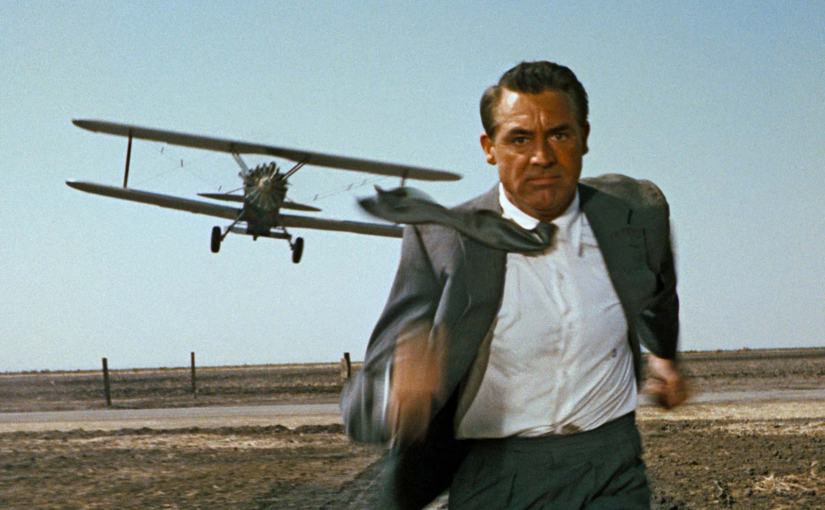
The most celebrated scene probably also contains one of the best captions caught in film. I speak of the very surprising crop duster chase. As Roger Thornhill finds himself in a quiet, Midwestern dirt road intersection, an airplane crop duster turns into a frightening menace. The best shot occurs as Grant runs quickly towards Hitchcock’s camera and the plane flies overhead rapidly getting closer in the upper left side of the screen. As Grant runs and runs, he fills more of the screen, but so does the crop duster. The editing alone is spectacular, as an oil rig eventually comes into play with Grant about to get run over. Story wise, I adore this scene as somehow the life of a man who routinely gets in taxicabs and hob nobs through New York City on a daily basis suddenly has found himself in a dusty field running for his life. What was never expected is suddenly all that matters to this ordinary man.

Hitchcock plays with what’s around to play with. Other than a quick gag in Superman II, l don’t recall many films incorporating Mount Rushmore as such an important element to its picture. Every crevice or ledge or finger hold is important to the edits of the climax in North By Northwest. When Eva Marie Saint is holding on for life, I truly believed she could actually fall. [SPOILER ALERT] Actually, Hitchcock wanted you to believe that as the very last scene doesn’t even truly reveal the solution to her predicament. I like his method of editing this way. Hitchcock seemingly offers no option for survival as Grant and Saint’s hands barely hold on to one another. The editing is just so damn good here.

I’d be remiss if I also didn’t recognize one of the greatest orchestral scores in film. Bernard Hermann’s stirring, fast paced rhythms keep the running man theme in play. The movie seems to play by the beats of Hermann’s conduction. Action films of the future seemed to adopt some measures from he did with this film.

North By Northwest will always remain as one Alfred Hitchcock’s best films. There is not one error in the picture. Every shot is done with deliberate intent to sustain the mystery of suspense. Humor is included even at times on a risqué and subtle measure. Alfred Hitchcock again invites the simplicity of storytelling to introduce the complexity of fear and mystery and outstanding suspense. Not many films compare to North By Northwest.