
MY WEEK WITH MARILYN

By Marc S. Sanders

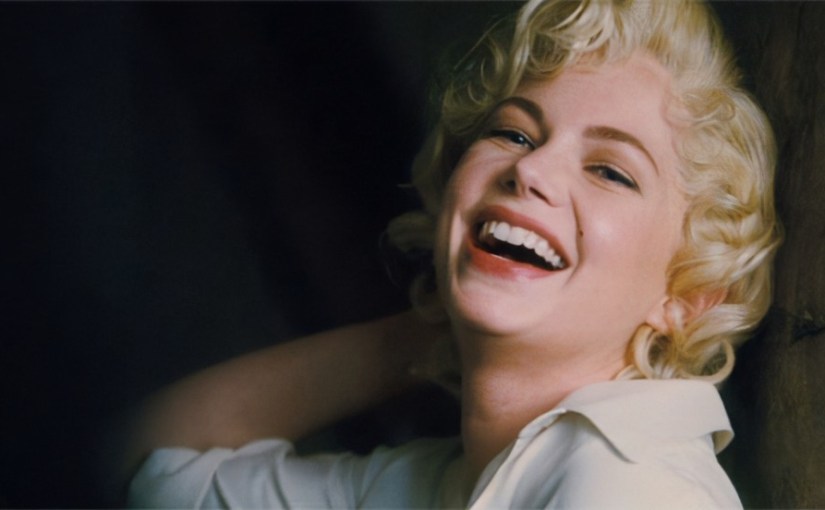
Simon Curtis directs a glimpse into the life of Marilyn Monroe with an exquisitely cast Michelle Williams in the title role of My Week With Marilyn.

The film is told through the perspective of 23 year old Colin Clarke played under dream like naivety from Eddie Redmayne. Clarke embarks on joining the production crew of Sir Laurence Olivier’s (pompously over played by Kenneth Branagh) newest film that he is directing and starring in, opposite Monroe. When Marilyn’s new husband, playwright Arthur Miller, returns to the states, Colin is drawn into Marilyn’s seduction; protecting her from an intimidating Olivier and tolerating her drug and alcohol use.

This film features an outstanding cast of who’s who from Dame Judi Dench to Emma Watson to Dougray Scott, Julia Ormand (playing a past her prime Vivienne Leigh), Toby Jones and Dominic Cooper. An amazing cast and amazing performances all around.

Still, I just wasn’t wild about the film. With her life startlingly cut short, Marilyn Monroe is arguably one of the biggest enigmas to come out of Hollywood, and yet this tiny glimpse into her life just wasn’t interesting enough for me.

Fully aware of her impending doom to come, the sad foreshadowing of pills on her dresser, and her unfamiliar stupors didn’t drive anything for the character. It all becomes repetitious with nothing new to say. Colin’s virginal experience with this celebrity tryst never drives anywhere but back into Marilyn’s bed after he’s requested to appear at any given hour. This occurs again and again. The film just doesn’t progress past these moments. I found myself saying “I’ve seen this already!”

Did Marilyn learn anything from this fleeting moment in her lifetime? Did Colin? Maybe Colin got to witness the dichotomy of the privately ill Marilyn versus her ability to turn on the public charm with curvaceous ease and a wide lipstick smile. Yet, I have to wonder what came of it for Colin, thereafter.

Redmayne is quite good in his naive innocence. He inhabits nearly every scene since the story is told from Colin’s experience. Storywise though, what was the point of all this really?

Williams as Marilyn is astonishing. As good at playing a Hollywood legend as when Cate Blanchett deservedly won her Oscar for playing Katherine Hepburn in The Aviator. My one wish is that Williams accepted the role with a much more dimensional and nuanced script.

Perhaps because of the mystery that always seemed to surround Marilyn, Williams will never get the chance at playing the bombshell in something better. Marilyn’s life was so dubious and questionable. What filmmakers would be brave enough to truly make claim of how the starlet lived and how she died?

I can wish for another Marilyn portrayal to come one day, with Michelle Williams in the role, but alas I won’t hold my breath.
HARRY POTTER AND THE GOBLET OF FIRE (2005)

By Miguel E. Rodriguez

Director: Mike Newell
Cast: Daniel Radcliffe, Emma Watson, Rupert Grint, Ralph Fiennes, Brendan Gleeson
My Rating: 9/10
Rotten Tomatometer: 88% Certified Fresh

PLOT: A young wizard (Radcliffe) finds himself competing in a hazardous tournament between rival schools of magic, but he is distracted by recurring nightmares.


[DISCLAIMER: This review will more than likely contain spoilers, as well as Potterhead references galore.  I apologize in advance.]

When I first saw this movie, I grieved over how much of the enormously entertaining book had been sacrificed on the altar of box office viability.  Why not make two films out of it?  (Which they did later on with the final book, of course.)  What happened to Winky?  What on earth is going on with the tournament scoring?  (Seriously, try to keep track of it…it makes no sense in the film.)  Where’s the subplot about how Rita Skeeter obtains her inside information?

Watching it again years later, for perhaps the 6th or 7th time, I think I’m a little mellower.  Comparing a movie to its source material is a fool’s errand.  There’s a great story about how, years ago, someone complained to Raymond Chandler how Hollywood had ruined his book, The Big Sleep.  Chandler calmly pointed to a bookshelf, and said, “Well, there’s my book right there.  Hollywood didn’t ruin it.  It still exists.”  (I’m paraphrasing, to be sure.)

So.  Movies and books, apples and oranges.  To quote Carl Weathers in Predator: “It comes with the job.  I can accept it.”

Having said all that, I think the best way to give my impression of the film of H.P.a.t.G.o.F. is to list what it gets right and what it gets wrong.

RIGHT: The second task, involving hidden treasures in the Black Lake.  I loved the look of the mermen and mermaids and the hinkypunks.  This scene managed to captured almost exactly what I saw in my head when I read the book.

WRONG: The first task, involving retrieving a golden egg.  We see FAR too little of how the other contestants fared in their attempts, jumping right past the first three just to see what Harry does.

RIGHT: “Mad-Eye” Moody.  I’ll never be able to read the books again without seeing Brendan Gleeson’s magnificent performance in my head.  That amazing enchanted eye, the facial tics, the glee with which he transforms a student into a ferret…it’s perfect.

WRONG: The Yule Ball.  As it appears in the film, it literally brings the movie to a halt.  It’s all about the interpersonal relationships between Ron, Hermione, and Harry, but nothing happens to move the plot forward.  I can’t help thinking there was a better way to stage this pivotal event.

RIGHT: The events in the graveyard.  I can recall vividly the moment when I read the words, “He was dead” in the book.  I sat up on the sofa, my eyes grew wide, and I exclaimed out loud, “Holy s**t!”  The movie gets this entire sequence right.  As I recall, the graveyard covered two or three entire chapters in the book, and the film condenses it nicely into a 10-minute sequence.  (Approximately.)  It’s the moment, in both the books and the films, when the franchise became much more than “kid stuff.”

WRONG: Snape’s role in the film.  The movie curiously omits the incredibly relevant moment in the book when, after Dumbledore observes the Dark Mark on Snape’s arm, he tells him, “You know what to do.”  And Snape nods curtly and leaves the room.  That comes into play to a GREAT degree in the latter stages of the franchise.  Ah well.

And I’ll leave it there.  I could go on.  All in all, it’s a good film, a great spectacle, and a turning point for the series.  They could have called it, Harry Potter and the Advancement of Maturity.