BOBBY (2006)

By Marc S. Sanders

There’s the distinguished doorman who is retired now but returns each day to play chess with a colleague in the hotel lobby.  There’s the open-minded girl who is inspired to prevent a young man from getting drafted into the Vietnam War by marrying him.  Her hairdresser is married to the hotel manager, who happens to be having an affair with the beautiful switchboard operator.  As well, the dining manager is a bigot who will deny his Mexican employees enough time to leave work and exercise their right to vote.  A busboy will have no choice but to miss what will likely be Don Drysdale record breaking sixth shut out game in a row.  A drunken night club performer can hardly stand up straight while she is completely dismissive of her caring husband.  A wealthy man is ready to introduce his trophy wife to an eventful evening in modern politics.  Two young campaign workers sneak away to drop acid for the first time.  A black man is at a loss following the recent assassination of Dr. King. Though he has hope that at least Bobby Kennedy will uphold his faith for a promising future in America for African Americans to carry equal rights. 

So, what does any of this have to do with Robert F Kennedy?  Not much I’m afraid.  Writer/Director and star Emilio Estevez tells us that all of these stories occur in the Ambassador Hotel on the fateful night when the Senator was assassinated in the hotel kitchen by Sirhan Sirhan.  In Bobby, the only character that is not a character is Bobby Kennedy and that is unfortunate.  More to the point, all of these short stories and other characters are precisely boring.

Estevez committed himself to grinding out stories that occur in the Ambassador that would lead up to Kennedy’s tragic death.  He’s admitted that they are all fictional. Based on his research and photographs, these characters are very loosely inspired by those that were there that night.  Before gathering in the ballroom to hear Kennedy’s victory speech after winning the California primary, these people were going through own personal ordeals.  If Emilio Estevez was not so personally inspired and researched in Robert Kennedy’s purpose to American history and politics, then perhaps Arthur Hailey (Hotel, Airport) would have pieced together this script of anecdotes and vignettes.

I commend Estevez’ efforts here.  The film looks great and even though the Ambassador was being demolished at literally the same time as this film was being shot, the scenic designs are very authentic.  The cast is even more impressive as the director reunites with many co-stars that he’s worked with before including Demi Moore, Anthony Hopkins, Christian Slater and his real-life father Martin Sheen, a lifelong loyalist to the Kennedy family.  The “importance” of this movie seems to sell itself.  Yet, everything is incredibly mundane and of little interest.  When your cast and your characters are just items on a grocery list to check off, there’s not much that’s interesting beyond the coupons.

The juicy gossip that surrounds the real-life actors is more captivating. Estevez cast Ashton Kutcher (Demi Moore’s real-life husband at the time) to play the drug dealer who provides acid to the campaign workers (Shia LeBeouf, Brian Geraghty).  Moore is also Estevez’ ex-girlfriend.  Yet, to watch Kutcher, LeBeouf and Geraghty experience an acid trip with weird visions they see when they open a bedroom closet is unfunny and not captivating.  Emilio Estevez is not living up to the Coen Brothers (The Big Lebowski).

A tryst with the boss (William H Macy) and his young, attractive and naïve switchboard operator (Heather Graham) is nauseatingly hokey.  The aged wife who works in the hotel salon (Sharon Stone) turns it all into squeamish soap opera tripe.

Bobby has an alarming opening.  A false alarm fire call is wrapping up at the Ambassador Hotel and you may feel like you are entering the middle of a panic storm, but things quickly calm down and the film resorts to cookie cutter editing to introduce its all-star cast.  None of what they say matters.  This is a game of who you can recognize.  Joshua Jackson, Nick Cannon, Harry Belafonte, and eventually the guy with the most significant role, Laurence Fishburne, is given his moment, the best scene of the whole film.  Fishburne is the kitchen chef who allegorically uses his creations in cuisine to compare the black man’s experience to the brown man’s, or Mexican. 

Having finished a trip to Martha’s Vineyard, I wanted to show my wife the under-the-radar and captivating film, Chappaquiddick, which covers Ted Kennedy’s personal story of controversy.  (My review of that film is on this site.) To continue on the Kennedy parade, we were motivated to follow up with Bobby.  Yet, this picture offers very little to the significance of Senator Robert F Kennedy.  There are samples of news reports complete with Cronkite.  Plus, the Senator’s own words ring through the epilogue of the picture.  Yet, I felt cheated of learning nothing new about the historical figure. 

Reader, you may tell me to kick dirt and go find another movie or read a book.  Fair!  However, this is film is called Bobby, and if I’m not going to learn about Bobby Kennedy from the man himself, then allow me to get to know the man through the eyes of these individuals.  Who hates him?  Who loves him? Who has a crush on him?  Who is inspired by him?  Who wants him dead and why? 

Estevez’ script does not allow enough material to describe what Kennedy meant to these campaign workers or hotel workers or guests.  They are primarily self-absorbed in their own personal battles to think enough about the fact that Bobby Kennedy is expected to make an appearance later this evening.  Again, their personal concerns for each other is very dull.  I don’t want to be around a drunk and obnoxious Demi Moore.  I don’t want to drop acid with some guys who hide behind a façade for caring about the candidate they are supposed to be serving.  I feel sorry for the busboy who will miss that big game, but that’s not enough to get me engaged in the entirety of the picture.

Bobby lends very little to the confusing times of the late sixties when an unwinnable war was persisting and championed leaders were being killed for others’ agendas.  Any of these stories could have been yanked from this script and slotted into a disaster flick like The Poseidon Adventure or The Towering Inferno

Bobby only picks up momentum when it arrives at its end that many of us learned about in school or witnessed firsthand in documentaries or directly from that very sad and unfortunate evening, June 4, 1968.  This day in history is so much more important than a Helen Hunt character trying to convince her Martin Sheen husband to let her buy a new pair of black shoes.  Bobby Kennedy deserves more recognition than what Emilio Estevez offered.

THE SUBSTANCE

By Marc S. Sanders

It’s no surprise that a science fiction gore fest would make its way on the silver screen intent on enhancing our lives as we grow out of adult youth.  Plastic surgery and bust enhancements, unwanted hair removal, butt lifts and Botox are common vernacular discussed in magazine articles, infomercials and talk shows.  Well known actors rely on beauty preservations and enhancements to uphold their careers or give themselves a needed boost to stay relevant.  I mean come on, Tom Cruise wouldn’t naturally look like that.  Still?  Let’s get real.

What I admire about Coralie Fargeat’s The Substance is how she applies her updated Frankenstein experiments within the boundaries of Hollywood glitz and glamour.  Her film starts out ironic, then reflective and concludes on B level satire.  Wasn’t this how The Toxic Avenger came to be?

Fortunately, the brains of the writer/director overcome the beauty that’s attempted.

Elisabeth Sparkle (Demi Moore) is an obvious nod to Oscar winner Jane Fonda.  She is unbelievably gorgeous and physically fit, especially for a fifty-year-old award-winning starlet. (Incidentally, Demi Moore is over age 60.) She has found a second career success as a daily TV workout video hostess. Yet, she senses that her expiration of youth is quickly approaching.  It could not be more apparent from what her sleazy producer Harvey shares with her.  This jerk has no filter and tells it like it is. Audiences want younger and curvier, and Elisabeth ain’t it.  Harvey is played by Dennis Quaid and Farageat is not shy about presenting this guy with every priority of superficiality.

Elisabeth gets axed from her show.  Fortunately, she comes upon a possible remedy for her aging dilemma known as The Substance.  After some toiling about, Elisabeth agrees to try this clandestine idea out promising a better, more improved version of herself.  

The kit to make this all happens is delivered.  First is a needle injection and further instructions mandate without compromise that every seven days Elisabeth must return from the alter ego that spawns from her.  Except this is not so much an alter ego as it is alter body.  Literally from behind Elisabeth’s back enters Sue (Margaret Qualley).  Both Elisabeth and Sue are reminded by the mysterious voice on the phone that they are “one,” and they must use the contents of their kits to nourish one another’s bodies daily plus, and without fail, surrender to a seven-day hibernation while the other roams the earth.  Every seven days they must alternate.

Sue, with Elisabeth’s psyche, gets the job as the replacement hostess and Harvey goes nuts for her as the ratings and her popularity soars.  The Substance is serving its purpose.  

Yet, what happens when the two egos do not cooperate with the program’s mandates?  Well, you find out with an assortment of grotesque and ugly side effects that develop both mentally, and especially physically.  The Substance tackles some extraordinary consequences ranging from multiple personality disorders that joust with one another, and insecurities that even beauty enhancements could never resolve.

Amid all of the ugly gore of blood and fluids and stitching and rotted, infected skins is a jaw dropping performance from Demi Moore.  The Substance is deliberately not big on dialogue as it depends more on perception and facial response.  The best example is when Moore as Elisabeth prepares herself for a date and builds up an unnerving frustration as her character focuses on her reflection in the mirror.  I read that Demi Moore slapped and rubbed the skin of her face raw while shooting this scene in take after take.  Her commitment to the scene could not be more evident.  A later scene with her adorned in offensively aged makeup is at least as aggressive for the actress.  A food binge goes maniacal, and Demi Moore is sensationally focused on its messiness and engorgement.

The Substance is very smart from beginning to end.  Yet, the conclusion is outright ridiculous, and Coralie Fargeat clearly wants it that way.  It’s not only that Elisabeth and Sue suffer at the punishments of their own hubris, but Harvey and those that put appearances over any kind of, well, substance must succumb to their own superficial priorities.  Fargeat takes what could have been a comparable messy Three Stooges pie in the face route where everyone’s dignity has to be shed.  The blinders of beauty get washed away in an overwhelming deluge.

The Substance is elevated to an absurd narrative as quick as it begins.  No one is glamorized even if this is Hollywood.  We get close ups of Harvey gorging himself on sloppy, saucy cocktail shrimp while Elisabeth watches in disgust.  Later, the physical side effects go by way of famous makeup artist’s Rob Bottin’s work on films like John Carpenter’s The Thing.  The director tosses obvious nods to Stanley Kubrick’s The Shining with a ghastly orange hallway and reminiscent geometrically zig zag carpeting.  Even a men’s room designed in cherry blood red harkens back to that film.  Food is repulsive in this film that focuses on body image.  Colors of all kinds are loud, garish, and bright.  The director doesn’t want you to wince at only the very graphic details of Elisabeth and Sue’s ongoing transformations.  If these characters are going to feel or behave ugly, then the world they live will feel at least as repulsive.

A friend of mine who takes to curious kinds of horror and fright fests was eager to see The Substance.  She watched the night before I did and was angered by the ending that she found ridiculously over the top.  Definitely no argument there.  Yet, because this is satire offering a reflection of truth, as gross as the film is and as absurd as the ending gets, it logically adds up.  

We can try all we want to hold on to our youth and outer appearances.  However, either we must learn to become satisfied with the limitations that science can offer or we will pay penalties for defying what is instructed of ourselves.  The Substance is beyond any sense of science.  This film tosses hints at the viewer that Elisabeth, and later Sue, should think twice about what they choose next.  Then again, whoever thinks twice in one these B movie schlock fests, anyway?  

I even think this film goes a step further.  In cancer patients, chemotherapy remains the leading remedy for treatment of the illness.  We turn to its resolve despite the sickening side effects that stem from its program.  We want to live and we will compromise our ways to go on living.  Elisabeth Sparkle needs to remember though that she does not suffer from cancer.  She’s an insecure woman who isn’t ready to face change.  I’m not minimizing how the character feels.  I can relate.  She is facing a hard, agonizing truth from her perspective. I took steps in my lifetime to enhance my appearance and mentally and physically it was not the best option for me.  

It’s fortunate that Demi Moore allows me to relate to what’s traumatizing her.  Margaret Qualley does well holding up the other half of the picture as her side of this one personality gets drunk off the attention and perfection she’s entered into this new world.  

Commonly speaking, I also thought of the Queen from Snow White And The Seven Dwarfs.  An elegant woman so insecure with her beauty against that of a young girl and she sees no other way to come out on top than to change into an ugly, old hag.  Like Elisabeth in The Substance, the Queen in Snow White will accept a notion of looking worse before it gets better.  Since this film is satire, don’t we all go through experiences like this at one time or another?

Some of us learn.  Some of us persist and persist though.

GHOST

By Marc S. Sanders

For a perfect blend of the supernatural, suspense, mystery, drama, romance and comedy, the first film that will always come to mind is the surprise hit film Ghost from 1990.  One of the zany Zucker brothers, Jerry to be more precise, who introduced the world to slapstick spoof (Airplane!, The Naked Gun) directed this film turning Demi Moore into a ten-million-dollar actress, placing Patrick Swayze ahead of his Dirty Dancing looks and earning Whoopi Goldberg a very well-deserved Academy Award.  Ghost was a film for all kinds of movie goers.

Sam Wheat (Swayze) is an up-and-coming New York City business executive who loves his new live-in girlfriend, Molly (Moore) even if he can only say “Ditto!” when she tells him she loves him.  Shortly after the picture begins Sam is gunned down following an evening at the theatre.  Unbeknownst to Molly and anyone else living on earth, Sam’s spirit lives on though, and he realizes that he was not the victim of some random mugging/murder.  Now, Sam must find out who arranged to have him killed and why, while also protecting Molly from becoming a victim.

Along the way, Sam crosses paths with a phony con artist, working as a medium, named Oda Mae Brown (Goldberg) who turns out to be the real thing when she can actually hear Sam’s voice and communicate with him.  Sam must recruit Oda Mae to be a go between for him with Molly and everyone else necessary to follow up on in order to resolve the mystery of his sudden death.

Ghost succeeded in every category of filmmaking.  Rewatching the film decades later, I believe Demi Moore should have gotten an Oscar nomination.  Her close ups on camera with beautiful, muted colors from Adam Greenberg’s cinematography are masterful.  Greenberg should have been nominated too.  He’s got perfect tints of pearl whites both on the cobble stone streets of New York with the outer architecture of the apartment buildings, as well as within the studio apartment where the couple lives.  He strives for an ethereal look with his lens. Gold often occupies Molly’s close ups with dim lighting.  Blues and blacks and steel glinting shines follow Sam’s trajectory. 

Look at the lonely scenes that Moore occupies in the couple’s apartment.  There’s a haunting image of isolation with no dialogue capturing the young actress at the top of a staircase when she eventually rolls a glass jar off the top and it shatters below.  It’s one of the moments that defines a sorrowful character, and not many cry on screen better than Demi Moore.  Later, Sam is engaging in a pursuit through the subway system and races down a steep blue escalator in the dead of night.  Zucker places Greenberg’s camera at the bottom of the escalator to show the depth of hell that Sam may be risking continuing his chase.  The images and transitions of this whole movie from scene to scene are stunning.

I mistakenly recall Whoopi Goldberg as just a comedienne doing her stand up schtick in this film.  Not so.  Goldberg looks radiant on film and while she starts out comically as the script calls for, she eventually resorts to sensitive fear of what her paranormal partner demonstrates as real within this fantasy.  There are so many dimensions to this character.  She’s silly.  She’s exact in her nature for what’s at stake and the dialogue handed to her from Bruce Joel Rubin’s Oscar winning script compliments the actress so well. Goldberg never looks like she’s working for the awards accolades. Yet, she earned every bit of recognition that followed her.

Patrick Swayze makes more out of the straight man role than what could have been left as simple vanilla.  His spirit character uncovers more and more about his afterlife and what happened to him as the film moves along. With each discovery, you’re convinced of Sam’s surprises and what he becomes capable of as a ghost.  Long before superhero films became the novelty, Sam Wheat operates like one who has to learn of his origin and then acquire his new talents and powers to fend off the bad guys.

Jerry Zucker, working with Rubin’s script, Greenberg’s photography and Oscar nominated editing from Walter Murch, along with haunting yet sweet scoring from Maurice Jarre, builds a near perfect film.  The narrative of Ghost shifts so often from comedy to crime to drama to romance and the various natures of the piece hinge so well off each other.  That’s due to storytelling and the editing necessary to smooth out any wrinkles.  You become absorbed in Jerry Zucker’s direction, especially with the movie’s most famous scene where Demi Moore and Patrick Swayze are sensually doing pottery together accompanied by Bill Medley’s rendition of “Unchained Melody.”  Watch that scene with someone you love or take it in on a late Saturday night by yourself with no one to distract you with cackles and eye rolls.  You’ll see how effective Zucker’s work is along with Swayze and Moore upholding the scene in a dark, empty apartment.  Take it as seriously as the scene was originally constructed.  (Then go watch Zucker’s Naked Gun 2 ½ for a chuckle.)

The mystery of Ghost works well with surprises if you are watching it for the first time.  You build trust with a character only to realize it is a ruse for something else.  I do not want to give too much away.  For viewers who have never seen the film, maybe you’ll see an early twist as soon as the film begins.  Maybe not.  Either way, Ghost performs very naturally, unlike a forced kind of twist that M Night Shyamalan too often relies upon.  I do advise that you not watch the trailer that was used for Ghost as I believe it deals out too many of the film’s secrets.

There are movies that I watch over and over again because I love to relive the special moments they offer.  Ghost has those kinds of gifts and yet I have not seen it in ages.  I’m glad.  To experience the picture again was such a treat.  While I recalled all of its secrets, this time I was able to take in the various technical achievements and the assembly of the piece, along with outstanding performances. 

I have no problem saying that Ghost possesses the best performances within the vast careers of Demi Moore, Patrick Swayze and Whoopi Goldberg.  Ghost still holds up. It deserves a rewatch and an introduction to new generations.

MARGIN CALL

By Marc S. Sanders

Could it have been possible that a rocket scientist and a bridge engineer uncovered one of the biggest market crashes in American history?  Writer/Director J.C. Chandor’s first film, Margin Call, will have you believe that.  It makes sense when you think about it.  Numbers and bar graphs and pie charts and zig zagging lines become so complex with themselves that you have to wonder how people wearing $1500 designer suits and selling products over the phone could decipher such nonsense.  So, it would take a rocket scientist to unravel such an exceedingly large ball of rubber bands in only one night.  Yet, how does a rocket scientist and a bridge engineer come to encounter this predicament.  Easy.  It’s all about money.  You might be the greatest scientist in the world, but if the pay isn’t right, is the science really worth it? 

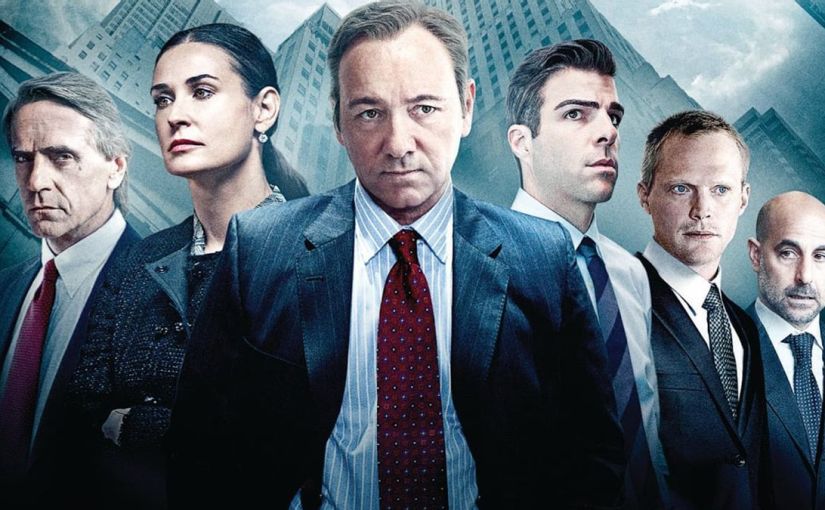
Zachary Quinto plays Peter Sullivan, the rocket scientist from MIT.  Stanley Tucci plays Eric Dale, the bridge engineer.  They abandoned their college majors and specialties to go where the earnings are much more lucrative.  They both work in the risk management department for a large, unnamed New York investment bank.  On a Thursday afternoon, along with a whole slew of other people, Eric is fired.  His company cell phone is immediately shut off and he’s escorted quickly out of the building along with his personal belongings.  Before he leaves, he’s able to pass off a computer file for Peter to have a look at.  Eric was close to completing something deeply impactful, but didn’t get a chance to finish.  When Peter stays late after work to download the file, a stunned look eventually appears across his face, and he’s quickly calling back his workmates at 10 o’clock at night.  Those guys were getting hammered at the nightclub downtown, celebrating that they were not on the chopping block earlier in the day.

The cataclysmic results of Peter’s discovery is first passed on to his buddy Seth (Penn Badgely), then to the next level up which is Will Emerson, supervisor of trading (Paul Bettany).  Will then tosses it over to the higher risk supervisor, Sam Rogers (Kevin Spacey), who then passes it on to the Jared Cohen (Simon Baker), maybe the company’s second in command.  Jared assembles the men to meet with Sarah Robinson and Ramesh Shah (Demi Moore and Aasif Mandvi), who compute risk at even high level. 

Chandor is so genuine with his script and characters that as the earth-shattering news gets shared and then shared again and again, each higher up the food chain demands that it be explained to them in simple English.  By the time, Jared passes on this news to the head, HEAD Honcho, John Fuld (Jeremy Irons in a thankfully scene stealing performance), it is being requested of Peter to speak to John as if he were a golden retriever.  I guess in the corporate world, the sharper your clothes and hairstyle are, as well as the more formal your position title is called, the simpler the explanations need to become.  The ones who earn the big bucks don’t sit on the top floor to be belabored with charts and graphs that lack prestige and personality.

I want to point out a symbolic sequence here as well.  Each higher up seems to work on a higher floor than the other.  So, Seth and Peter accompany Will and Sam up an elevator to where Sarah, Ramesh and Jared are located.  After this meeting, Seth, Peter and Will go up on the rooftop of the building to smoke and commiserate.  Will even considers jumping.  They are then interrupted from an even higher level beyond the pinnacle of the building.  A helicopter arrives with John in tow.  God has descended at this inconvenient hour to tend to his prophets and their disciples.

Margin Call might sound like a complex assembly of numbers and math.  It really isn’t though, because Chandor approaches his film without ever really giving away how complex the issue is.  Instead, he demonstrates how deep it is.  Sam focuses on a computer screen and asks “Wait, is that number right?”  Peter’s nervousness is enhanced with his hands laced behind his head as he paces back and forth.  Will has been chewing on Nicorette gum up to this point.  Midway through the film, he’s back to smoking.  Seth understands that the mass firing he just survived hours earlier will inevitably catch up to him and all he can do is cry on the toilet.  Sarah comforts herself by asking Peter if the report he’s laid out is his work.  She wants to be excluded from being a cause of the crisis.  The best indicator of how serious and intense this has become is when an ice cool looking and handsome Simon Baker (even the blue tie he wears says icy cool) as Jared asks for the time.  It’s 2:15am.  He mutters to himself “Fuck me,” and then asks again for the time.  It’s 2:16. “Fuck me,” with a leap off the chair and a distant stare out the window.

The nature of the problem isn’t so important to grasp.  What’s necessary to take away from Margin Call, is that the gods of currency have irresponsibly and deliberately neglected the warning signs.  The returns have just been too damn good.  Now the boat has taken on too much water to stay afloat, though.  Chandor opts to focus on the response and behavior to the dilemma at hand.  There’s whispered blame to be exchanged.  There’s the need to stay silent.  When Jeremy Irons eventually comes into the fold, he holds a board meeting and calmly asks for someone to explain the situation.  Chandor points his camera on concerned close ups of middle age men not willing to speak up; messengers who truly believe they’ll be killed for delivering the dire news.  Even Jared can’t speak.

The sad outcome of the film is actually how the crash of 2008 with Collateralized Debt Obligations and Sub Prime Mortgage Defaults (see Adam McKay’s The Big Short) played out on the eve of its first day.  The investment bank in the film opts to sell off its worthless assets that enormously exceed the entire net worth of the billion-dollar company.  Chandor’s film reminds us that it’s legal to do so, and the buyers of this “odorous bag of excrement,” are John and Jane Q. Public.  At 9:30am, these brokers will put on the charm and sell at a price of $100/share knowing that by 2:00pm, it’ll be worth .65 cents/share, if they’re lucky.  Their customers paid for porterhouse, but went home with a cold burger in a doggy bag.  It’s the only way to survive. 

There are no heroes in Margin Call.  There are only profit makers.  Profits that are earned at the expense of everyone else on the planet.

A FEW GOOD MEN

By Marc S. Sanders

A Few Good Men really does hold up.

Anyone with even minimal movie going experience can predict how it is going to end almost as soon as it starts, but that doesn’t take away from Aaron Sorkin’s first screenplay based on his original stage play.

It is well cast. For the film, no one else could ever play the intimidating and terrifying Colonel Nathan R Jessup other than Jack Nicholson. It’s not that it is just him in the role. It’s really Nicholson’s whole career legacy against the arguably still ripening careers of Demi Moore, Kiefer Sutherland, Kevin Bacon, Kevin Pollack and Tom Cruise. Nicholson’s timed grandstanding is necessary for the role to work.

Cruise on the other hand left me feeling a little too overplayed. The role calls for cockiness, yes, but is Cruise too cocky? Some of the gags he does work. Some don’t, like impersonating Nicholson momentarily (leave that for the guys on SNL, Tom), or when he’s poking fun at Moore’s character to his own delight. It’s a little too much. Still, his courtroom scenes are like watching the best in live theatre. Those scenes play like great sport, notably thanks to Tom Cruise.

Major props go to JT Walsh as a conflicted witness. When I say conflicted, I mean he authenticates a seriously valid and personal dilemma beautifully. Had it not been for Jack Nicholson, Walsh might have had an Oscar nomination. A shame he didn’t come close to such recognition while he was alive. He was such a great character actor.

Recognition also goes out to Kevin Bacon as a well versed prosecutor/Marine. His timing exudes the experience his character has, despite his youthful appearance.

Demi Moore might be caught trying too hard, I think. Kevin Pollack is the wise mentor sitting quietly waiting for his great moments. Kiefer Sutherland is great in almost anything he does. He doesn’t ever steal the spotlight like Cruise, Nicholson or Moore but he makes a great presence; conniving and bold.

The direction is nothing special really. Rob Reiner does fine but honestly Sorkin’s script sells itself.

Yeah, yeah. “You can’t handle the truth.” Great line, but I got news for you. I’d argue there’s even better lines in this 1992 film. It’s worth revisiting.