LEAP OF FAITH

By Marc S. Sanders

You never know when God may come knocking.  You never know when Jonas Nightengale may come knocking either.  If you’re fortunate enough to reside in small town Rustwater, Kansas, you sir, or you ma’am, or you dear child may be blessed by the healing powers of Reverend Nightengale. 

On the surface, Jonas appears like a comedic role for Steve Martin, but in actuality it is not aiming for laughs at all.  When it comes to the confidence scheme that Reverend Jonas offers the townsfolk of Rustwater, Steve Martin plays the phony preacher with nothing but a serious operandi. 

Jonas and his crew travel the states from one big city to the next where he preaches his gospel of deceitful hope in exchange for donations to his traveling church that supposedly serve the almighty lord.  When one of their trucks breaks down in Rustwater, Jonas and his top aide, Jane (Debra Winger) use it as an opportunity for easy cash.  This Kansas town relies on harvests and the infrequent rain that feeds the crops.  Otherwise, this sleepy town has one diner, a movie theater, and a sheriff named Will (Liam Neeson) who is out to reveal the false Oz behind the curtain.  At the same time, Will is romancing Jane who has been eagerly seeking out a flame that never had a chance to flourish because she is on the road so often.

Jonas is wooing Marva (Lolita Davidovich), a waitress at the diner who is also skeptical of the whole act and is protective of her younger handicapped brother, Boyd (Lukas Haas) who suffered a permanent leg injury in a car accident that killed their parents.  Boyd was once told by a preacher that there is not enough faith in his heart for him to be the receiver of healing powers.  Lukas Haas was not just cast because he’s a talented actor.  He also has that angelic face that suggests he’s never committed a sin.

The tricks of Jane and Jonas’ trade are all revealed here.  Jane hides in the back feeding information about certain audience members and their ailments into Jonas’ earpiece.  Eavesdropping by the crew (including an early appearance by Phillip Seymour Hoffman) ahead of the show provides Jane with all the data.  It’s neat to see and it is likely how these outrageous televangelists pull off their miraculous “gifts.”

There’s an interesting argument to Leap Of Faith.  Jane defends Jonas’ façade to Will by him just selling fairy tales that make people feel good and fulfilled.  Will sees the obvious moral dilemma.  Jonas offers another defense.  Is this any different than a circus act that presents the fantastic for an audience to witness. Personally, I think Jonas and Jane’s defense is a bunch of hooey.  Yet, the residents of Rustwater buy into the act and soon people from all over the Midwest are lining up to listen to the gospel and witness the miracles of Reverend Nightengale. 

Jonas has a dilemma himself though.  He has a fondness for Marva, and he likes Boyd.  Boyd is not a plant in the audience to go along with the healing power showmanship.  So, how is Jonas going to explain his position?  He’s quick on his feet to fend off public accusations from Will, but how can someone who is not a miracle worker perform a miracle while maintaining his illusion.

I like the set up and questions that Leap Of Faith asks.  It’s the story of the arriving snake oil salesman which I do not see too often in films.  The showy pieces of the movie are wonderful with terrific singing from the choir under the big top circus tent with the enormous crucifix of Jesus in the center.  There’s also an enthusiastic supporting cast from Phillip Seymour Hoffman, as well as Meat Loaf as the church keyboardist.  The crowd extras are wonderful with their vocal responses.  I also especially love how Jonas ups the ante with a terrific sight gag to silence his biggest doubter, namely Will. 

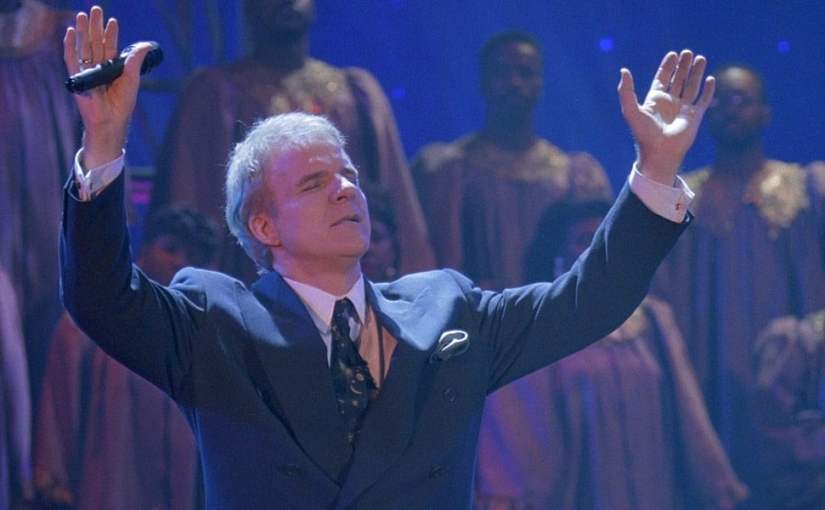
The film is different, especially for Steve Martin.  He’s a ball of energy on the stage. He does his one-foot slide that was often seen on Saturday Night Live and his stand-up acts, but here it is not done for laughs.  Instead, Martin’s recognizable schtick upholds the public persona of Judas, and it works. 

Still, I do not think I got what I would have prayed for from the film.  I could not get past how Liam Neeson does not work as a Midwest sheriff in this Podunk town.  His boyish good looks from the early 1990s are right for the romance, but he makes no effort to hide his native Irish dialect.  He just doesn’t blend into the Americana canvas very well.  Debra Winger is great and it’s a shame I do not see her in enough films.  Almost everything she does I like.  She just has a natural vibe about her.  She has good scenes with Neeson, but just like his character, their storyline belongs in another movie very distant from the prime directive of Leap Of Faith.

The romance between Martin and Davidovich does not amount to much either. Frankly, it feels as if the story editors opted to abandon this angle midway through the making of the film. I do not recall how the relationship resolved itself and the ending certainly does not generate any kind of response for how either character regards one another. 

Towards the end of Leap Of Faith, the unexpected occurs twice, sort of like what happens in the end of Magnolia.  I found it interesting, but then the credits roll and the gospel choir sings on until the screen goes dark.  I’m leaping from my chair asking but wait, what about this and what about that.  Nevertheless, the choir keeps on singing, deafening my concerns.  Janus Cerone’s script seems to paint itself into a corner just when a brilliant irony arrives and hardly an acknowledgement, and certainly no explanation, is offered for the new phenomena that occurs. 

Leap Of Faith begins with a prologue between Jonus and a traffic cop.  It’s a brilliant scene demonstrating right away how smooth this “preacher” is when it is a one on one grift.  (Celebrated trickster and former con man Ricky Jay was a consultant on the film.) Later, we see how mesmerizing Jonus is in front of hundreds of people.  I was very excited during the first hour and a half of the picture, but then the movie gives up on itself.  The best way to describe this viewing experience is to say that Leap Of Faith simply loses faith in itself.

AN OFFICER AND A GENTLEMAN

By Marc S. Sanders

You ever feel proud of a character in a movie?  Like you walk out, and you say to yourself, “Well done, Rocky!  You did it!!!”  That’s how I feel about Zack Mayo, the Navy enlisted candidate who has to survive his first 13 weeks of basic training on his way to eventually obtaining his dream of flying jets.  Just as important though, Zack has to mature as a responsible young man with a commitment to caring at least as much for others as they already care for him.  Richard Gere plays the guy who must become both An Officer And A Gentleman.

Director Taylor Hackford goes deep into the bottom of the well to show what makes Zack such a loner.  His Navy enlisted father (Robert Loggia) abandoned him and his mother, and only reenters Zack’s boyhood life once his mother commits suicide. Zack spends time growing up on the Philippine Islands Naval base where he gets bullied while remaining unloved.

Years later, after college graduation, not knowing of any other direction to take with his adult life, he opts to go down the same path of his bum of a father and join the Navy where he’ll perform basic training when he arrives at a coastal Seattle base. The enlisted men do not have a good historical reputation in this area.  Many are known for bed hopping with the local factory girls, and then they relocate to where they are going towards next in their servitude, leaving the girlfriends behind and forgotten.  Zack’s father was one of these guys. The ladies in the area also have a stained legacy.  Many of them will deliberately get pregnant or even lie about missing their period to keep these enlisted men from leaving them.

Sergeant Foley (Louis Gossett Jr, in his unforgettable Oscar winning role) oversees Mayo and his class, specifically warning all of them that these trends occur over and over again.  When he’s not cautioning them, Foley attacks the character traits that weigh Mayo and the others down.  If they had a rough childhood or checkered background, Foley will not hold back.  He has to prepare these men and women for a possible war or a position of captivity behind enemy lines.  If these young folks can endure Sgt Foley’s cruel mind games and unforgiving, hard-hearted nature, then they are more prepared for any worst-case scenario that can come while performing military service.  

Mayo is a leading candidate in his class.  He has the potential to break the record on the brutal obstacle course, and he’s secretly resourceful with selling polished boots and belt buckles to his classmates ahead of bunk inspection.  Not bad.  However, he’s not mature and he doesn’t even realize it.  The first time he completes the obstacle course he sits over on the side, proud of himself, rather than joining his teammates in cheering each other on to finish the job.

Love is also not something Mayo is experienced with. He meets Paula (Debra Winger in a superb Oscar nominated performance) who is ready to love Zack but he’s not ready to open up to her.  Perhaps he never wants to love or commit to anyone to save himself from loss or further abandonment because it’s all he’s ever known.  An Officer And A Gentleman is very good at subtly covering what makes a loner a loner.  

Contrary to Zack’s background is the best friend he makes, Sid Worley, a fellow classmate (David Keith).  Sid is a happy go lucky fellow, but eventually the film shares what motivated him to enlist and how his relationship with a local girl pans out. Perhaps there’s some sense to what Foley has been warning these people about.  

An Officer And A Gentleman is sad at some points and very uplifting as well.  Sometimes it’s hard to watch the encounters that Zack and company must endure during these first thirteen weeks of a committed six-year servitude to the Navy.  The glamour of flying jets can only arrive once you shed away the person you once were by developing maturity, respect, resilience and honor.  

I love the way Taylor Hackford’s film tests Zack.  He’s tested by Paula, by Sergeant Foley and even by his own father.  Can he let go of the drunken whore parties arranged by his dad? Raised by a guy who might have worn the officer rankings and uniform, but now beds the women he picks up in bars only to finish it off with a drunken vomit session in the morning.  

Foley puts Zach to his mental and physical limits after he catches him in violation.  The sergeant then insists on the kid’s DOR (“drop on request”).  It’s up to Zack if he wants to take this seriously or simply quit and remain a loser like his father.

Then there is Zack’s commitment to Paula.  Can he trust Paula will not trick him or let him down, again like his father, then his mother, and followed by his father all over again?  

Richard Gere is sensational at balancing two stories at once.  This remains the best role of his career.  It’s a dynamic, multi layered performance.  First, the physicality he devoted to the role is impressive.  That is Gere doing the obstacle course and cockpit test crash dives in the swimming pool.  Gere is the one doing endless pushups in the mud and running in place with a rifle above his head while Gossett’s character torments him with his abusive yelling and a dribbling water hose.  Gere is also the one riding Mayo’s motorcycle.  The actor is completely absorbed in this divided character.  Arguably, he should have been considered for an Oscar nomination.  

Zack Mayo is not always likable.  The purpose of the film is to discover what is to admire about the conflicted loner who never had anyone to care for him or anyone for him to lend sincerity towards.  If joining the Navy can pull this guy towards a meaningful life that can be purely earned and not cheated or circumvented, then it’s possible to feel proud of what this man becomes.  

An Officer And A Gentleman is now over forty years old. So, it might feel dated. Yet, the traits that make a man and a woman good, honorable, and loving people has never lost their immense value.  If you have never seen this movie, it’s time you did, and if you have seen it, it is due for a rewatch.  

The last line of the picture, depicted in one of the greatest endings ever to close out a film, is “Way to go Paula!”  Allow me to also say “Way to go Zack!”

LEGAL EAGLES

By Marc S. Sanders

In Legal Eagles, Robert Redford plays a promising district attorney named Tom Logan, who becomes ensnared by Debra Winger, playing a private defense lawyer named Laura Kelly.  Laura is representing Chelsea Deardon (Daryl Hannah), a mysterious, but alluring twenty-something accused of stealing a priceless piece of art.  Murder eventually comes into play.  Romance does as well.  Unfortunately, none of it works in what should have been a charming comedy from director Ivan Reitman (Ghostbusters, Stripes, Meatballs).  The casting is solid.  The script is not.

When this film was released in 1986, Robert Redford looked like the best option for the standard romantic comedy, to lead the fraternity of male actors eventually to come by way of Billy Crystal and Tom Hanks.  Debra Winger was well known with a collection of Oscar nominations for more serious subject matter.  However, she has always possessed that smart yuppie look; aggressive, professional, and ready for love.  Redford and Winger make a perfect pair.  The flirtations between the actors’ characters in Legal Eagles work quite successfully.  The regret is that a flat, boring mystery for them to tackle is always getting in the way. 

During Chelsea’s eighth birthday she is presented with a painting by her renowned artist father at a lavish party.  Later that night, a fire ravishes through their apartment.  Her father perishes in the flames and the painting along with other priceless pieces of art were thought to go up in flames.  Jump eighteen years to present day 1986, and Chelsea insists to both Laura and Tom that some of those paintings, including her father’s gift to her were stolen before the fire occurred.  Suspects are interviewed.  Danger gets in the way and so on.

The problem with this initial set up is that this conundrum is pretty stale.  It doesn’t offer enough to keep me interested.  What do I care about a stolen painting?  Moreover, I could care less about the fate of Daryl Hannah’s character.  She’s designed to be the standard Olan Mills Photography glamour model of the 1980s, and she is most certainly beautiful, but she is written with as much dimension of what a thumb tack does when you push it into a wall.  She just sticks there. 

There are some usual suspects for the lawyers to pursue like Terence Stamp, an interesting character actor by reputation.  Regrettably, his art dealer portrayal is not written with much logic.  The two lawyers follow him to a warehouse and find themselves in danger when Stamp traps them inside with a ticking time bomb that will not only kill them but destroy his immense collection of assets and records.  Why go through all this trouble?  You’ve got some of the most valuable, sought after pieces of art tucked away in here. 

Brian Dennehy is a cop who welcomes himself into the story and the “intuitive lawyers” happily accept his trust when he offers his file on the fire investigation from eighteen years prior.  He just turns up at random, odd moments.  Do Tom and Laura even think to wonder why this guy is so interested in assisting them all of the sudden?

What really sends Legal Eagles off the rails though is a step away from the narrative so that Robert Redford and Daryl Hannah can be caught in bed together.  This serves no purpose.  It’s a scene that screams of a producer demanding this happen to sell movie tickets and it betrays the intelligence any of us would expect of a sharp-witted New York City District Attorney.  Even more absurd is when Redford and Hannah are awakened the next morning, she is arrested for murder.  So the lawyer sleeps with the client, but no concern regarding ethics is ever questioned.  As well, Winger’s character just delivers an eyeroll response to Redford’s error in judgment, but the two continue to work in flirtatious harmony.  That doesn’t offer much respect for the aptitude of Winger’s character.  She should be repulsed by this transgression.

Legal Eagles contains more charming and mature humor than Ivan Reitman was recognized for by this point in his career.  It’s a yuppie ‘80s film.  I only wished for a more insightful pursuit and storyline for Redford and Winger to be focused on while they fall for one another amid the scenic backdrop of a bustling New York City. 

Daryl Hannah looks like she’s in another movie altogether.  Yes, she sleeps with Redford’s character, but I don’t think Hannah has more than five lines of dialogue exchanged with either Winger or Redford.  She’s expendable here.  You practically forget that she’s the accused client the lawyers are working to exonerate.

The value of the missing painting is hardly stressed upon.  The motive for murder really isn’t either.  There are not one or two fires in the film, but rather THREE!!!! Did the craft of invention just stop after page one of the screenplay? 

From a marketing standpoint, based on casting alone, this film had such potential.  The movie features some of the best working talent going for it.  Sadly, it gave all the players nothing to do, and what little was done lacked any kind of foresight or wit.

On the subject of Legal Eagles, my motion stands.  This movie is inadmissible in court!

TERMS OF ENDEARMENT

By Marc S. Sanders

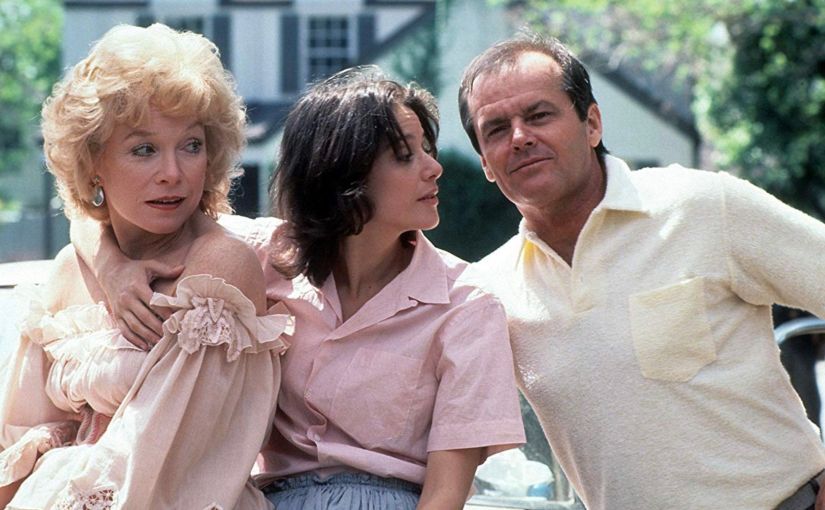
Acclaimed television writer James L Brooks’ first feature film was the 1983 Best Picture Winner Terms of Endearment.  The movie succeeds in more ways than one because of its varied relationships among the characters.  You have Aurora Greenway (Shirley MacLaine) and her daughter Emma Greenway-Horton (Debra Winger).  There’s Emma and her husband Flap Horton (Jeff Daniels).  There’s Aurora and Flap, and then there is Aurora and her neighbor Garrett Breedlove (Jack Nicholson).  Sounds like a lot to take in for a two hour picture, and yet Brooks manages to adapt a script from Larry McMurtry’s novel that smoothly covers realistic depth and dimension among these characters, and how they connect with one another.  Brooks is at least an incredibly efficient writer/director.  Honestly, I’m not complimenting him nearly enough.

Shirley MacLaine provides one of the best female performances to ever grace the silver screen.  She doesn’t have to utter a word of dialogue to say so much about how Aurora feels.  One of her greatest facial expressions is when she is addressed by her grandson as “Grandma!”  This moment is so utterly hilarious that the studio selected it to close out the original theatrical trailer.  If anything is going to get you in the seat at the theatre it’s this moment.  Aurora is a widow who can be difficult to please, judgmental and always conscious of her part in the world-even while she is hosting multiple gentlemen suitors in her Houston, Texas home.  This character is so powerful that it is hard to understand why Hollywood really never followed suit with presenting more films focused on the middle age woman or man.  There are still interesting things to be found in being a widow and dealing with ageism, motherhood and a resurrection of sexuality.  Think about The Golden Girls which dominated television sets on Saturday nights for most of the decade.

Aurora disapproves of Emma marrying Flap.  Flap has no imagination or drive and is as devoid of affection as his name suggests.  Best he can do for Emma and their three children is find whatever college professor job he can muster and uproot his family from one mid-western state to another.  Emma knows of her mother’s disdain for Flap, and can’t disagree with her.  She knows Flap is a loser, but if it means aggravating her mother then it is worth it at least to marry him.  Early in the film it amuses Emma to frustrate her mother a little more and a little more.  Contrary to Aurora’s instincts, Emma is naively unaware that life settles in soon enough and the happy nuptials fade away.

Still, Aurora and Emma have a strong mother/daughter relationship where numerous phone calls each day happen between them.  These conversations consist of Emma reluctantly telling her mother that she may be pregnant, yet again, or that Aurora is proud to let her guard down and approach the boorish, drinking next door neighbor astronaut, Garrett, played with a devil may care seductiveness from Jack Nicholson.  Aurora’s serene peacefulness in her beautiful backyard garden and home is always disrupted by Garrett’s loud bellow before diving into his swimming pool.  Still, she can’t help but be attracted to him while putting on a façade of disapproval in his presence.  The first lunch date that Aurora and Garrett share must be one of the best dates ever depicted on film.  The scene might have been written and staged by Brooks, but it is thankfully hijacked by Nicholson and MacLaine.  One of the funniest moments to ever come out of 1980s cinema for sure.  There’s much reason that MacLaine won Best Actress and Nicholson won Best Supporting Actor.  These actors easily stage a scene of realistic comedic chemistry while later expressing deep rooted drama and affection with one another.  Not easy to do all in one film.

Brooks masterfully writes these characters with such authenticity that you find yourself legitimately laughing at a scene or a piece of dialogue, while the person sitting next to you might embrace the dramatic element of the very same moment.  Both responses to random moments in Terms Of Endearment allow varied reactions like that.  When Emma suspects Flap of committing adultery, pay attention to the dialogue and the performance from Winger and Daniels.  Emma allows Flap to dodge a lie he’s about to tell by warning him that he may have just lost his senses, but if he continues down a wrong path, then he will end up worth less than he already is.  He doesn’t fight her on that observation.  Hard to explain here but listen to the vocabulary Brooks applies to Emma’s dialogue and watch how Winger traps Daniels.  You may nod with a smirk, or you may feel frightened for Emma and her marriage. 

I always say Terms Of Endearment is a comedy first and a drama second.  The film steers towards a frightening fate for the Aurora and Emma.  However, before that third act sequence there is so much to treasure, love and laugh at in the film.  When a cloud of imminent loss feels like it may approach, that is when the dramatic elements step forward.  To truly feel loss, you had to treasure wonderful moments with a loved one or a friend.  You had to value something important in your heart and soul to feel so terribly frightened and mad and hysterical when days might seemingly appear numbered.  James L Brooks and Larry McMurtry remind us of that.  Every person on the planet is destined for this feeling at one point or another.  What happens when the inevitable arrives is what sustains Terms Of Endearment to it’s satisfying end.  A character may appear on a hotel staircase to reconnect with support.  A hug goes a little longer than expected, and for the first time the one who normally lets go first actually tries to keep the moment frozen in time.  A gift from long ago is recovered to touch someone emotionally.  Brooks includes all of these moments in his film and that’s what I embrace most importantly.  Cinematically speaking, these points in the film are heightened by a memorable soundtrack of quirkiness and passage of life from composer Michael Gore.  His music is so effective that it has been used countless times over to enhance trailers for other films marketed at audiences that this picture was catered for.

Yes, after numerous viewings, Terms Of Endearment never fails to me put me in tears.  Like ugly crying!  I prefer to watch it alone actually, because I connect with the characters differently than most people I know, including my wife.  It’s a very personal film for me.  It reminds me of loss that I have felt and experienced.  More importantly though, it reminds me of all I’ve had, and all I continue to hold on to.  Terms Of Endearment is one of my favorite films.