RUSTIN

By Marc S. Sanders

I’ve heard of Martin Luther King Jr.  I’ve heard of Rosa Parks.  I’ve heard of Malcom X.  I’ve heard of Medgar Evars. 

I had never heard of Bayard Rustin. 

I guess there’s just a lot of history left out of the books.

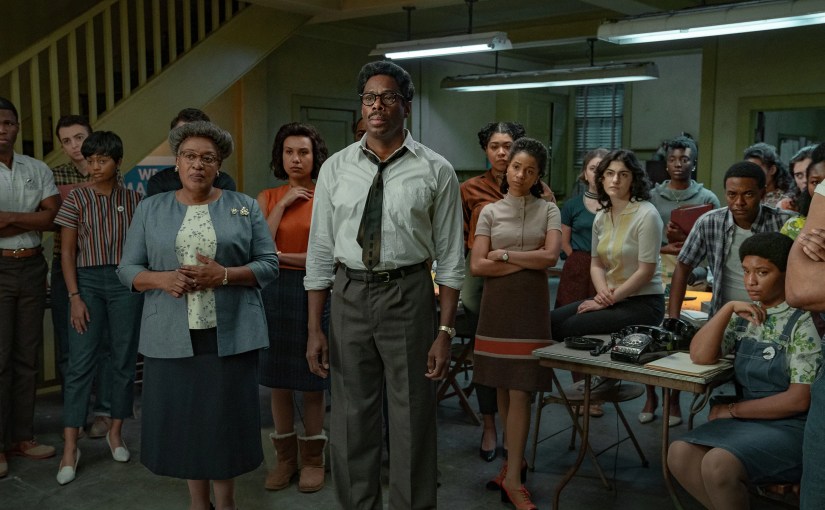
Rustin tells the story of Bayard Rustin (2023 Oscar nominee Colman Domingo) who was treated as an outcast by his friend Dr. King and the NAACP when he attempted to think of the grand possibilities of organizing the largest civil march ever to happen.  The secretly homosexual civil rights organizer eventually did see his vision come to light, however, but he had to get started with very little support or resources.  Director George C Wolfe with screenwriters Dustin Lance Black and Julian Breece use this film to depict how it all came together.

When I saw George C Wolfe’s Ma Rainey’s Black Bottom (with Oscar nominee Chadwick Boseman) my take was that it worked like a stage play on a unit set.  The sensational cast of Rustin perform in the same way, catering to what would be a live audience.  However, the unit set has been expanded to a headquarters office on the second floor, as well as Rustin’s bedroom, and the steps of the Lincoln Memorial and the National Mall in Washington D.C.  While the CGI background of the nation’s capital do not appear seamless against the cast, it is fortunate that very little of it upstages the performances from Domingo, Chris Rock, Glynn Turman, CCH Pounder, and especially Aml Ameen as Martin Luther King Jr.

Colman Domingo portrays this individual with unwavering confidence in his character.  Rustin insists on a non-violent two-day march, despite the local authorities who only grant him one day and limited resources.  One problem is that there are not enough hotels that will accommodate black guests.  Segregation might have ended in 1954, but in 1963, you would believe otherwise.  While debating with the police captain in front of Lincoln Memorial, Rustin is accused of raising his voice and yet he reminds the captain that he’s never changed the volume of his tone.  Rustin vows that this march will exceed 100,000 people from all different states.  He’s also adamant about the police authorities not carrying their service weapons to steer clear of any reason to incite violence. 

A bigger problem is bubbling within his own community of civil rights leaders.  He’s no longer associated with the NAACP which has Roy Wilkins (Chris Rock) leading the charge. Still, he needs their support. Because he does not have the respect, charm and arguably the good looks of Dr. King, Bayard’s passion falls on deaf ears and a lack of motivation from these powerful men of influence.  A large challenge comes from the arrogant Representative Adam Clayton Powell (Jeffrey Wright) who will proudly sit at the other side of the table with his long cigarette, pressed suit and pencil thin salt and pepper mustache.  With a gruff tone in Wright’s voice, this is a marvelous antagonist.

Over the radio airwaves, Senator Strom Thurmond, who was still in office at close to age 100, all the way through 2003, is building a campaign against Bayard Rustin.  Rustin has a past of suspected ties to the Communist Party, and it will also not bode well if his closeted homosexuality is revealed.  On top of that, Mr. Rustin lives with personal problems and imperfections just like anyone else.  He is trying to balance a relationship with Tom (Gus Halper) a young, white gay man and strong supporter of the cause, but Bayard is also involved with a married, closeted man as well.  None of these issues can be afforded to weigh down what Mr. Rustin and his team of youthful, optimistic volunteers are striving for.

Wolfe’s film is less than two hours, though I wish it could have been longer.  It is very engaging and certainly not difficult to follow, especially when text appears on screen to tell us who everyone is from the start.  The movie efficiently incorporates all of these dimensions into isolated episodes for Baynard Rustin to confront.  Primarily, it reflects the debates he has with the civil rights leaders and the naysayers.  There are wonderful moments shared between Colman Domingo and Aml Ameen.  Domingo also has great scenes with Gus Halper who plays Tom as someone uncompromised in the mission even if his lover is unfaithful.  Domingo is the more compelling scene partner with Chris Rock, though, who I have never considered a strong actor. A good effort is made here, but Rock is not altogether convincing as an NAACP leader. 

What I wish for, however, is some more reenacted footage of the actual historic event that famously included Martin Luther King’s “I Have A Dream” speech.  There’s a slight tease of that speech but King was so appealing in that moment that it could never be recreated so well.  It was already perfect.  What I wanted to see was some other happenings going on during this event.  We see buses arrive, chairs getting set up, people gathering, mostly black, but other races as well. What other speeches occurred on that day?  What else was said? 

I recall an episode of The Cosby Show where Theo and Cockroach had to write a school paper about the event and their parents and grandparents talked about how they drove down from New York to D.C. in buses and how hot it was that day. They described people who wore pins that said “Kiss Me I’m Black,” “Kiss Me I’m Jewish,” “Kiss Me I’m Irish,” and so on.  It might have been said to lean into Cosby’s brand of humor, but I also believe it was true.  That episode seemed much more descriptive in about ten minutes of sitcom dialogue than the film Rustin depicted. 

How was the audience on the National Mall responding?  Were people fanning themselves from the heat?  What were they saying to one another?  What songs were they singing?  Wolfe’s film only gives a tiny glimpse of this groundbreaking moment in time when 250,000 people assembled. The picture just doesn’t appear entirely painted.  Perhaps budgetary reasons were the cause of that.

Rustin is a good film and does a fine job of depicting this unsung man’s achievements despite the challenges he always faced with a smile.  Domingo is great at donning the grin with missing teeth and clumsy black framed glasses, and a loose tie with a wrinkled shirt.  He is positively absorbed in this period of time.  Still, it would have been welcome to see more of his end results. 

The picture concludes on a terrific beat before the inevitable footnote text arrives with most film biographies.  I have just observed a man who will not shut up and never tire from pursuing his seemingly impossible dream.  Baynard Rustin was likely considered a pest who would not let up.  Yet, the script closes on the fact that in spite of all I have witnessed, Bayard Rustin was likely the humblest of all of these civil rights servants.

Go learn more about our Civil Rights history and allow yourself to see one of the best performances of the 2023. 

THE HOLDOVERS

By Marc S. Sanders

Alexander Payne’s The Holdovers plays like a modern-day Christmas Carol.  Paul Giamatti is the Scrooge of the story set during mid-late December in 1970.  He’s an arrogant, unforgiving and unlikable teacher at Barton Academy, an all-boys Massachusetts boarding school.  Two other Scrooges round out the headlining cast.  Da’vine Joy Randolph is a cafeteria cook at the school.  Dominic Sessa is senior student – very bright, but also a troublemaker.  With uninvited circumstances facing the trio, they are the holdovers at the snow-covered school campus during the Christmas break, and they’ll have no choice but to get along or at least tolerate one another.

Alexander Payne often specializes in bringing attention to sad sack lonely souls like in Sideways, The Descendents, and About Schmidt.  His films begin with the characters seeming to accept their fates which lack a desire to smile and be cheerful.  Death or abandonment are common sources for their conditions.  Yet, with each of his wonderful films, it’s always fresh and new.  After an endless series of superheroes, I’m glad I get an occasional reminder of the humanity that can be found and treasured within entertaining films like The Holdovers.

Giamati is Paul Hunham.  Paul is disliked by everyone including his colleagues, the dean of the school (who was a former student of his), and especially the students.  Sessa is Angus who has a discipline problem but normally gets good grades. It’s most impressive that his B+ in Mr. Hunham’s class is leagues ahead of his classmates.  Randolph is Mary who recently lost her son, a recent graduate of Barton, after his entry in the Vietnam War.  These very different individuals have to share their lonesome disregard for one another.  Eventually though, their shields will whittle away and perhaps a couple of viewings of The Newlywed Game will open themselves up to each other.

I would be doing a great disservice to spoil the character backgrounds of these three who stem from different worlds and have nothing in common.  However, a theme found especially in Angus, and surprisingly in Paul, is a tactic of lying and exaggerating.  Within the context of the script written by David Hemingson, the untruths his characters tell work because it opens up further revelations that color in Paul, Angus and Mary’s current states.  The goal of The Holdovers is to scrape away the dirt on the surface in order to uncover the likable or sad nature hidden within. During a trip to Boston, Paul and Angus visit a museum and the irascible teacher finds an opportunity to remind his student that we do not study the past to only see what once was.  Paul tells Angus “…history is not simply the study of the past. It is an explanation of the present.” If The Holdovers were to have a mission statement, this is what the film stands upon.  Angus, Paul and Mary may all be a variation of a Scrooge, but this story explores what precisely added up to their respective states of misery.

The performances in The Holdovers are perfection.  Dominic Sessa offers one of the best film introductions in history.  This actor looks as if you have seen him before and it’s surprising that his only experience ahead of this picture were school plays, he’s done at his own Massachusetts prep school where he was discovered by the filmmakers who were scouting locations for this film.  He ranks up there with the debut performances of Whoopi Goldberg in The Color Purple and Lukas Haas in Witness.  Da’Vine Joy Randolph is heartbreaking, yet lovable as a grieving, chain smoking widow and mother.  Having also watched her bring out her acerbic funny side in Only Murders In The Building, she’s now one of my favorite eclectic character actors working today.  She is wonderful with either natural comedy and drama or just broad, satiric humor.  Arguably, Paul Giamatti occupies the best role ever written for him.  He finds the right beats during different plot points in the movie.  He’s positively unlikable but there’s an understanding to be found amidst the carnage of his past and present.  The sensitivity of Mr. Hunham eventually shines through, but Giamatti keeps it blended with the angry grouch he’s introduced as in the first few scenes of the film.  It’s a dynamic portrayal.

Alexander Payne reminds me once again that everyone we encounter in life is going through some form of turmoil and suffering.  Some of us can hide it well.  Others have given up concealing what’s not attractive or pleasing to our peers.  If we only take the time to look beyond what’s in front of us then maybe a person’s past will justify their present heartache, and we can either grieve, lend support or simply listen.  Payne will have you convinced to do anything except give up on a person.

As I write this last particular paragraph, I recall when Da’Vine Joy Randolph’s character prepares to attend a Christmas Eve party.  She lays out a nice dress.  She does her hair up attractively.  She puts on makeup.  She brings fresh baked brownies and gives them to the hostess with a welcome smile.  A few minutes later though, poor Mary is breaking down in the kitchen and Paul and Angus are seeing a colleague at her weakest when she was doing her best to uphold a semblance of strength.  Mary’s past defines her present to both Angus and Paul.

Alexander Payne is a genius storyteller of the human heart.  He’s already been quoted as saying The Holdovers is not a Christmas movie and he despises the reference.  Mr. Payne will simply have to forgive me though.  His Oscar nominated piece is a wonderful film to watch ritually during the year-end holidays.  Christmas and New Year’s may be a time to celebrate with our loved ones and the fact that we’ve lived through another year gone by.  However, it is also the loneliest for many of us who can no longer celebrate with a family or friends.  It’s important to acknowledge the pain that comes with living under that circumstance.  Fortunately, Payne, with David Hemingson’s screenplay, finds the humor needed for these souls to shed their agony and proudly reveal the faults they carry and the suffering they had no choice but to endure.

The Holdovers is funny, touching, insightful and it’ll leave you embracing a new collection of characters that will not soon be forgotten within the enormous lexicon of memorable movie roles.  

This film will likely win Oscars for screenplay, supporting actress and actor.  A shame that Dominic Sessa was not nominated as well.  There could never be too many accolades for this picture.  It’s marvelous.

The Holdovers is another wonderful film.  Another best of 2023.

THE LOST CITY

By Marc S. Sanders

Sandra Bullock’s film The Lost City is nothing more than rollicking fun at the movie theater.  A popcorn movie.  You can simply focus on gorging yourself with endless amounts of popped kernels and large fizzy drinks and you’ll never find yourself lost in a complex plot.  It’s a screwball adventure in the same vein of Romancing The Stone.  What I appreciate is that it is not a duplicate blueprint of Romancing The Stone.  Maybe just the opening scene, but no matter.

Bullock is Loretta, a reclusive romance novelist, who knows that her books are nothing more than cheesy pulp material to the umpteenth degree.  Her agent Beth (Da’Vine Joy Randolph) keeps a positive attitude as she encourages a book tour to promote Loretta’s newest installment in a series that follows the adventures of Loretta’s fictional swashbuckler.  That hero is preserved on the covers of her novels in the image of fashion model, Alan (Channing Tatum) – a Fabio inspiration.  Alan dons the gorgeous blond locks wig with the beefcake chest and the fans seem to go wild for him more than they do for Loretta’s work.  Even the glittery purple jumpsuit with stiletto heels that Loretta dons for an appearance at a book fair doesn’t deter the screaming fans away from Alan’s muscular build and chiseled chin.

When Loretta is captured by a spoiled brat of a villain known as Abigail Fairfax (Daniel Radcliffe), she finds herself having to research the location of a lost city on a remote island rumored to possess treasures beyond anyone’s wildest dreams.  Somehow, within Loretta’s fiction she implied the actual location of this place.  Abigail needs her to delve even further towards the destination.

This all sounds cliché.  It is, actually.  So what!

What saves The Lost City is the screwball comedic approach to the film.  Bullock and Tatum are nearly twenty years apart in age.  Yet, they make a great pair in the same way that Hepburn and Grant did in Bringing Up Baby.  I could care less about the actual lost city and whatever treasure was there.  The symbols etched on an old piece of parchment that Loretta attempts to decipher never mattered to me.  Two days after seeing the movie, I don’t even remember what the lost city revealed when they eventually got there.  I did like the endless pratfalls of Tatum and Bullock, however. 

Channing Tatum looks like the adventurer of a romance novel.  Yet, he’s nothing more than a pretty boy or a “mimbo” as Jerry Seinfeld might describe him.  He’s actually got a crush on Loretta and upon determining that she’s been kidnapped, he recruits the legendary problem solver Jack Trainer (who could only be encapsulated in the form of a gorgeously blond, tan and muscular Brad Pitt) to rescue Loretta.  It’s important to Alan, though, that he gets recognized as the savior.  So, he kind of learns as he goes. 

Adventures in the jungle abound.  There are bad guys on motorcycles.  Guns, of course.  Fires within Alastair’s luxury SUV. Rock climbing.  Rivers with leeches.  Dark caverns and on and on and on.  Yeah.  I’ve seen this all before.  Again, I say so what!  It’s just a fun time at the movies that brought me back to the fast-paced escapades found in the 1980’s films I grew up on.  Yet, it has its own spin thanks to the relationship of Alan and Loretta.

Daniel Radcliffe and his beard are also great characters.  It’s a nice departure from the shoe horned role that’ll never leave him as a certain boy wizard who will not be named here.  He just brings out his fun bratty side.  His beard seems to wink along with him.

A better side story could have come with Da’Vine Joy Randolph though.  As the agent goes from one traveling step to the next as she attempts to find Loretta herself, Randolph just doesn’t look comfortable in the role with her sky-blue pant suit and big breasted physique that is intentionally in your face.  Where’s the slapstick that should be accompanying her?  She’s specifically made up to look like diva luxury and you’re waiting for one disaster after another to befall her. Beyond having to fly on a puddle jumper plane carrying farm animals, she simply survives her trek unscathed.  Either this storyline should have been excised all together, or it should have been rewritten to be just as silly as what Bullock and Tatum are delivering.  A flop in the mud or a slip in the river would have helped this plotline. 

The Lost City is just a cute film for Sandra Bullock and Channing Tatum to look…well…cute together, and in a world where celebrities are slapping each other silly on live television, isn’t this a much better escape on a Saturday afternoon?