
by Miguel E. Rodriguez
DIRECTOR: Anatole Litvak
CAST: Olivia de Havilland, Leo Genn, Celeste Holm, Natalie Schafer [aka Mrs. Howell on Gilligan’s Island…how about that?]
MY RATING: 8/10
ROTTEN TOMATOMETER: 100%
PLOT: A young woman’s life is torn apart when she suffers a mental breakdown and is admitted to an institution.
For much of its running time, The Snake Pit remains firmly in the realm of reality without succumbing to melodrama, as was symptomatic of so many film dramas of the 1940s. That’s what makes it mildly disappointing when, in the last reel, we get a nice little summation of the origins of our heroine’s dilemma, and she bravely makes a series of decisions that result in a happy ending. Naturally, that was the case in real life, as well. The film is based an autobiographical novel by Mary Jane Ward, who spent eight months in a mental institution after a nervous breakdown. I don’t begrudge the happy ending, you understand. I just wish it didn’t feel as rushed as it does.
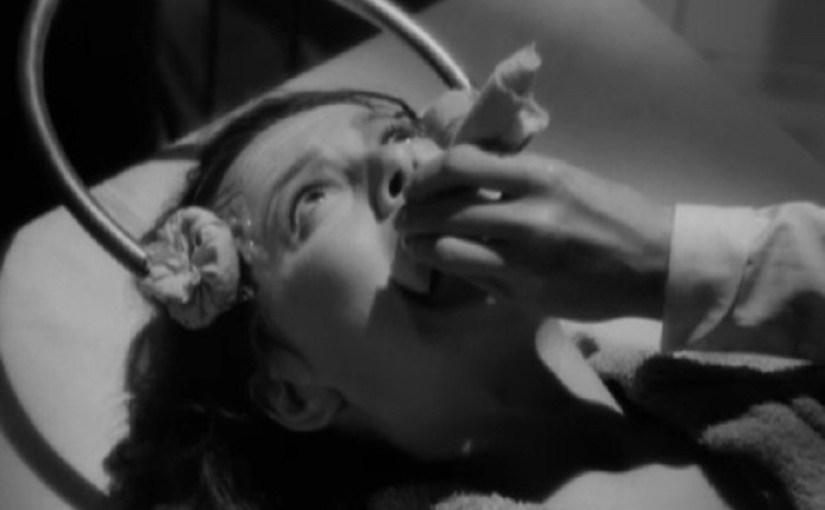
But I’m quibbling. This is a fine film. The Snake Pit was another in a series of Daryl F. Zanuck productions intended as “message pictures”, movies that addressed real issues in contemporary society. The Grapes of Wrath (1940) dealt with the Dust Bowl and harsh labor conditions. Gentleman’s Agreement (1947) was one of the first films, if not THE first, to openly condemn casual anti-Semitism in “polite” society. The Snake Pit is said to be the first mainstream film to realistically depict conditions in America’s mental institutions at the time. If so, the filmmakers really went for the jugular in their first at-bat. In its own way, this is as harsh and unforgiving a film as One Flew Over the Cuckoo’s Nest. There’s even a sequence involving shock treatments that are as effective as anything else I’ve seen along those lines.
The story begins intriguingly, as we open on the lovely open face of Virginia (a deliberately un-made-up Olivia de Havilland) as she wonders mentally what she’s doing outside on this bench. A man we don’t see asks her a series of questions, and she has little mental conversations with herself before she answers. Then the camera pulls out, and there is no man, just another woman telling her it’s time to go back inside. Inside where, she wonders? Then she’s herded with a bunch of other women back into the main hall of the Juniper Hill State Hospital. She starts to panic. What is she doing here? Is she crazy? She doesn’t feel crazy. The reasons for her stay provide the central mystery to the film.
(Incidentally, Stephen King apparently saw this film on TV as a youngster…which may account for the numerous appearances of the Juniper Hills psychiatric facility that appears in many of his novels and stories, including It, The Dark Half, and Needful Things. When you win on “Jeopardy”, I’ll let you know where to mail my half of the winnings.)
De Havilland’s performance is extraordinary. Her talent is undeniable, but it’s notable that one of the silver screen’s great beauties went without makeup, wore clothes two sizes to big, and even dropped some weight to make her look more fragile. This was my first time watching the movie, and I was astonished at her appearance. When she flies into rages, or pleads for mercy, or desperately tries to remember her past, you really believe it.
In a series of flashbacks, we discover that Virginia Stuart was a frustrated author who met her future husband in Chicago, in the offices of the company that had just rejected her manuscript. There was a whirlwind romance that ended when she simply ran out on him and disappeared, only to show up six months later in New York, where he had moved…six months previously. (I don’t know about you, but that’s red flag territory in my mind, but whatever.) Their romance picked up where it left off, there was a ceremony at City Hall, and they enjoyed married life…for about a week. At which point Virginia behaved erratically, declaring that she will never love any man, that no man can love her, and flatly denying that today is May 12th, no matter what it says on the newspaper. Virginia’s husband admits her to Juniper Hill, and it’s here where her troubles REALLY begin.
The film’s depictions of life on the various wards of the asylum are tame by today’s standards, but they are no less disturbing. There are the usual cast of off-kilter characters wandering the halls, mumbling to themselves or being unreasonable, but there is something indefinably…I don’t know, squirmy about seeing this kind of behavior in such an old movie. At least for me. When it’s played for real and not for laughs, in black and white, in 1948, something about that place and those people became much more real to me, at least as real as McMurphy’s fellow travelers, or maybe even more so. I’m unable to put it into words. When someone in Cuckoo’s Nest dances by themselves in a corner or wants his cigarettes, it’s kinda funny. In The Snake Pit, when a woman dances by herself, or another covers her face with her hair and paces around muttering that it’s her right to cover her face…it was creepy. Is it the black-and-white cinematography? Is it the shortage of comic relief? Is it because they’re women instead of men? Discuss.
(There’s even a head nurse who seems like the prototype for Nurse Ratched: a no-nonsense, by-the-book authoritarian who makes no bones about disliking Virginia. When Virginia is given a typewriter for therapeutic reasons, the nurse reminds her: “Don’t go thinking you’re better than the rest of us just because you’re a writer.” Talk about terrible bedside manner, geez…)
Interestingly, I didn’t find Virginia’s behavior all that “crazy.” She has problems with her memory, she tends to fly off the handle at trivial matters, and she once bit the finger of an arrogant doctor who was waving it in her face unnecessarily. Frankly, that sounds like something I would do on a bad day. Virginia’s conversations with her doctor, Doctor Kik (Leo Genn), are the only things that keep her tethered to reality. These conversations are handled extremely well. I found myself thinking of another famous movie about psychiatry in the ‘40s: Hitchcock’s Spellbound (1945), which was not so concerned with legitimate psychiatry as it was with making sure Bergman and Peck wound up together at the end. In that film, the conversations between doctor and patient are full of double-speak and heavy-handed metaphors. In The Snake Pit, I found it interesting that, whenever Dr. Kik makes a small breakthrough with Virginia, he never pushes the matter. He simply calls it a day and picks it up tomorrow, armed with new information. I’m no doctor, but that seems way more realistic to me.
I went into The Snake Pit expecting a semi-watered drown treatment of insanity and mental institutions. Instead, I got a film that is remarkably effective and powerful, containing a performance from Olivia de Havilland that might seem like a lot of histrionics at first, but which is the very definition of someone completely at the mercy of mood swings beyond her comprehension. They say that only the insane never wonder if they’re crazy. If that’s the case, Virginia is as sane as they come, wondering over and over again why she does what she does, why she’s been thrown into this place. She comes across as someone who desperately wants someone to listen to her. Thankfully for her, someone does. If everyone were as lucky as she is, maybe there’d be a lot more happy endings in the world.
 2 UNPAID MOVIE CRITICS!!!!