MAESTRO

By Marc S. Sanders

Bradley Cooper’s second directorial film suffers from the same ailments as his first film.  Like his interpretation of A Star Is Born, Maestro is not as good as the sum of its parts.

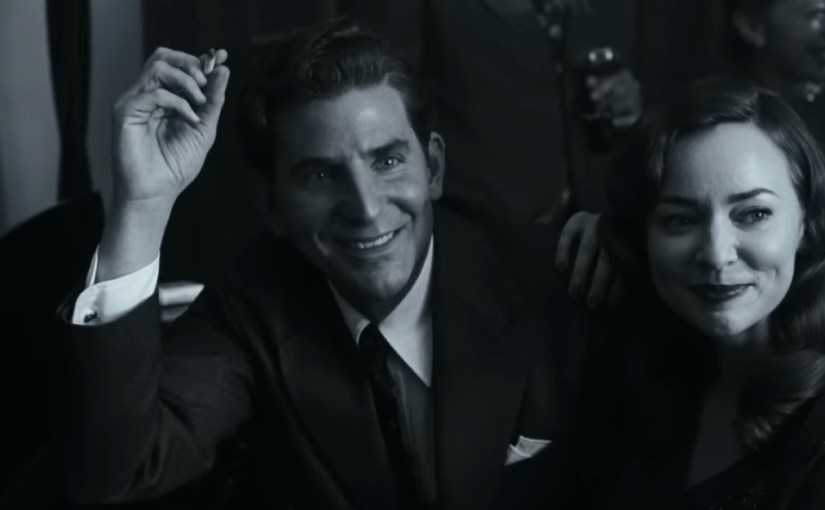
Constructively speaking Maestro is a gorgeous looking picture with a first half in a comfortable, historic black and white followed by its second half in vibrant colors.  The acting from Cooper, as Maestro Leonard Bernstein is well performed.  Carey Mulligan is sensational at no matter what age she is portraying actress Felicia Montealegre, the conductor’s wife.  Within the scenes they share together there is a beautiful rhythmic exchange of dialogue, written by Bradley Cooper and Josh Singer.  Cooper also looks powerful as he reenacts the conductor in front of his choruses and orchestras.  There are also inspiring shots that start out vague and unclear only to come into a full blossom as Cooper’s camera maintains an unbroken focus on an image. 

All that being said, none of it matters because the script from Cooper and Singer is muddied.  While Mulligan and the actor/director are in the midst of marital argument on Thanksgiving day, much is hard to understand as they naturally speak over one another, and what can be made out seems to mean nothing as they fight over people and issues that I do not believe are ever touched upon in the picture.  A scene like this looks like an actor’s dream piece, but it is hollow of substance. 

Like A Star Is Born, there are characters that enter Maestro for long winded scenes and then are never heard from again.  Either Bradley Cooper does not feel the weight of their importance, or he mistakenly presumes the audience will catch on.  An outdoor brunch with Felicia, Leonard, another couple and I believe a mentor or agent of Leonard’s seems well written, but I have no idea who those people are or what kind of influence they carry.  I was hoping to realize later, but those three amount to nothing.  Was the other couple supposed to be Leonard’s parents, and perhaps they were meeting Felicia for the first time?  I’m just not sure.

Bradley Cooper is a master with his camera.  An important moment in Bernstein’s life is when he gets the call to perform at Carnegie Hall when the other conductor calls in sick.  With its black and white imagery, a young and enthusiastic Leonard answers a phone call while a black square, with light from behind, occupies three quarters of the screen.  I was wondering if that was a stage curtain that needs to be lifted.  I was half right.  It’s a window curtain to the apartment Leonard shares with his gay lover.  The film moves into high energy as the would-be composer slaps his lover’s bottom and leaps down the stairs with a quick edit into the theater.  Mike Nichols would be proud. 

Another moment that struck me was Cooper pointing his camera up into the tall reaches of his apartment building staircase.  It’s quite dark.  You may have trouble realizing what you are looking at but then his son drops a paper airplane “good luck” note down to his father on the bottom floor.  These images blossom into something as alive as I would imagine the director/co-writer/actor regards Bernstein.

So, there is much to praise in Maestro.  Unfortunately, the assembly of these shiny, inventive, and magnificent pieces of film do not mesh very well together.  Bernstein led a homosexual lifestyle, even going so far as to welcome a lover into the home he shared with Felicia.  Carey Mulligan is excellent with expressions of resentment towards this other life that her husband follows.  However, the storyline never feels fully fleshed out.  We never get an opportunity to see the value or the menace of the other relationships that Leonard holds on to.  A so-so moment is accompanied by Bernstein’s saxophone opening to West Side Story.  The piece is used as a subtle tool of deceit and ignorant cruelty by Leonard while escorting his apprentice/lover in the home he shares with an angered Felicia in the foreground.  We presume the threat that Felicia likely feels, but it never comes to the surface. 

Bernstein’s career is glossed over as well.  Who pushed him to move on to bigger moments and acquire greater crescendos in his life?  I’d like to think it was Felicia, but I’m not certain.  Felicia has conversations with Leonard’s sister (Sarah Silverman) and other acquaintances, but what is she really alluding to or really talking about?

The most impressive moment in the film is when the Maestro conducts the London Symphony Orchestra at Ely Cathedral.  (I’ll own up and say I looked up what this scene was on IMDb.)  Bradley Cooper does a masterful reenactment of Berstein, dripping in shaggy grey hair sweat, dressed in a three-piece tuxedo with baton in hand.  This is a major multi talent working in films today.  Cooper studied film footage of the scene over a six-year period to get this six-and-a-half-minute unbroken moment caught on film.  It’s positively mesmerizing and I could watch this over and over again.  I’m waiting for the side-by-side comparison to appear on You Tube soon. It is reminiscent of what Rami Malek did as Freddy Mercury at the Live Aid concert at Wembley Stadium in the film Bohemian Rhapsody

Still, this scene much like a lot of the footage in Maestro seems to just be wedged in there.  There’s a balletic flow to some moments in Cooper’s film and then there are times that come out of nowhere and I’m left to wonder how exactly we arrived and what was truly going on in Bernstein’s life when he conducted at this historic moment time.  I’m watching a blazingly fine impersonation of Bradley Cooper doing Leonard Bernstein but I’m lacking the sub conscious dimension a biographical film should have at this point in a historical figure’s life.

Carey Mulligan is laying everything out to portray Felicia and her best moments come in the last third of the picture when the poor woman is struck with breast cancer that has spread to most of her body. We witness how she lives with the illness along with her separated husband by her side.  I’ve seen ill women before in films.  I know I sound crude by saying it’s nothing new.  I’m still allowed to be impressed though.  It’s a huge feat to bring a performance to this kind of level.

The makeup work is marvelous too.  Raw footage of the real Leonard Bernstein is shown before the end credits, and I’m impressed with how much Cooper looks in comparison.  The aging of him and Mulligan over the decades since the late 1930’s all the way through the mid 1980’s is perfectly captured.  At one moment, Carey Mulligan looks just like my mother.  I choked up a little bit when Felicia gazes upon Leonard at the Ely Cathedral.  Same hairstyle.  Same eyes.  Same expression.  Mom would have even worn a soft blue evening gown like that in the mid-1970s.

I wanted to like Maestro more than I did.  I almost feel guilty for not liking it as much.  There is magnificent camera work, sensational acting, wonderous music and perfect impressions on display, but the puzzle just did not have all of its pieces assembled together properly.  Sadly, Maestro lacks the focus it needs, either for the famed conductor’s amazing career or for his relationship with Felicia with his not so concealed homosexual lifestyle on the side.  Bradley Cooper put together a million magnificent moments, but it caused him to overlook the enduring structure of his subject.

MAESTRO (2023)

by Miguel E. Rodriguez

DIRECTOR: Bradley Cooper
CAST: Carey Mulligan, Bradley Cooper, Matt Bomer, Sarah Silverman, Maya Hawke
MY RATING: 8/10
ROTTEN TOMATOMETER: 80% Certified Fresh

PLOT: This love story chronicles the lifelong relationship of conductor-composer Leonard Bernstein and his wife, actress Felicia Montealegre Cohn Bernstein.


Bradley Cooper’s Maestro is a film of scope and depth and tremendous technical artistry, both in front of and behind the camera.  The performances from the two leads contain some of the best acting I’ve ever seen, especially their argument during a Thanksgiving Day parade.  But I cannot deny that, for reasons I’ll try (and probably fail) to explain, I did not feel emotionally invested in the story until the final two or three reels, when something occurs that, if it were fiction, could easily be dismissed as a shameless attempt at Oscar-baiting.  The fact that this really happened lends these final scenes an emotional weight that was missing from everything that came before.

The story is straightforward, but beautifully told, visually.  After a brief prologue, we meet a young Leonard Bernstein (Bradley Cooper), in bed with his male lover (hope that’s not a spoiler), as he gets an early morning phone call that will change his life forever.  This opening scene sets the visual tone for the first half of the film: standard 1:1.33 framing as opposed to widescreen to give it a classic feel, as well as gorgeous black-and-white cinematography.  Indeed, this opening shot alone looks like it could hang in a museum of modern art and not look out of place.

Everything proceeds breathlessly from there, with some conversations held at speeds that would make the Gilmore Girls dizzy.  After a series of early musical triumphs, he meets the woman that will become the polestar of his personal life: actress Felicia Montealegre Cohn (Carey Mulligan, in a performance that will almost certainly win her an Oscar nomination).  After some verbal sparring/flirtation, it becomes clear to them, and to us, that they are meant for each other, despite his later dalliances with male fans and hangers-on.

I especially liked a scene during this early section where Felicia and Lenny – as his friends and family called him – dine with some older friends (or family? I can’t quite remember), and an older gentleman gives him some advice: “They’ll never give Leonard Bernstein an orchestra in America.  But Leonard S. Burns…”  I loved that scene because I loved how Bernstein’s entire career is a rebuke to that well-meant but wrong-minded sentiment.

This gentleman advises Bernstein to give up writing scores for musicals, but Felicia disagrees.  That sets up a wonderful sequence where Felicia and Lenny watch a rehearsal of the stage musical On the Town, with sailors leaping balletically, and then in a fantasy reminiscent of The Red Shoes, Bernstein himself becomes one of the sailors, and the dance becomes a micro-miniature of their relationship and his early successes.  It’s a thrilling little cutaway that had me grinning the whole time.

From there, the movie jumps forward chronologically in leaps and bounds, giving only a cursory glance at the 1960s before settling more or less for the rest of the film in the mid-to-late 1970s, with Bernstein’s face becoming the craggy icon that I personally remember from my own youth, while Felicia Bernstein somehow looks just as beautiful as she did thirty years and four children ago.  I would blame that on movie magic, but I mean, we are talking about Carey Mulligan here, so they get a pass.  And then the last act of the film arrives and we get a glimpse perhaps of why Mulligan receives top billing over the actor-star-director Cooper.  And that’s all I’ll say about that.

As I said, the movie looks amazing.  Obviously the period décor and costuming are all spot on, but the cinematography and direction – what theatre or film studies majors would call mise-en-scène – are just incredible to behold.  Another shot that stands out in my mind is a scene where Bernstein is conducting, and we get an angle where we are looking into the wings, but his undulating shadow looms large, and standing in that shadow, but still illuminated, is Felicia.  Verbal descriptions won’t do them justice, just see for yourself.

But as I mentioned, I just wasn’t invested in the story from an emotional standpoint.  I felt like I was watching an extremely inventive and ingenious exercise in moviemaking.  I suppose I could compare it to the recent sci-fi film The Creator, if that doesn’t get me accused of hyperbole.  Both films show supreme confidence in staging, cinematography, and direction.  But like The Creator, Maestro feels like something is missing where its heart should be for the first 75% of its running time.  Things happen, arguments take place, children are born, Lenny gets a little sloppy with his paramours, but I never felt like any of it really meant anything to me as the viewer.

I tried asking myself, “What statement is the film making?”  And I couldn’t answer that question, aside from fulfilling its purpose in presenting the facts of a story in almost documentary-like fashion.  But the performances and cinematography are so stunning that I must acknowledge that fact with a higher rating than I would normally give a film that doesn’t really grab me emotionally.  (EXCEPT for the last 25%, I mean…I don’t want to give anything away, but the last reels are heart-tugging.)

So, do you want to see this movie?  Well, certainly not if you are an absolute acolyte of Leonard Bernstein.  You’ll see some pretty cool stuff musically, but Maestro does not paint an altogether flattering picture when it comes to his personal life.  But if you want to see one of the best-acted, best-directed, best-LOOKING films of the year…Maestro is your ticket.

SHE SAID

By Marc S. Sanders

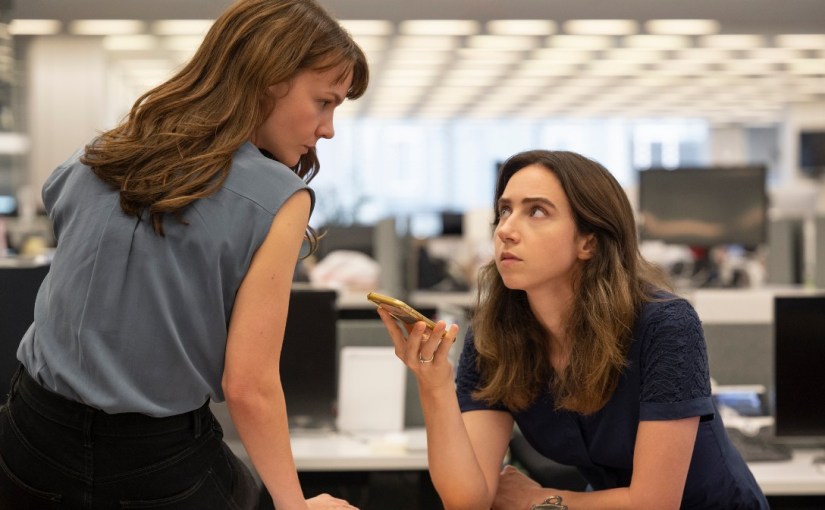
I get high off movies about journalism.  All The President’s Men and Spotlight are at the top of this pillar.  The main characters seem to be moving a hundred miles per hour even if they are reserved to their cluttered desks and phones, or if they are talking delicately, and slowly, with empathy as they carefully approach a potential, yet frightened source.  She Said is a 2022 film about how the New York Times reporters, Megan Twohey and Jodi Kantor (Carey Mulligan, Zoe Kazan), exposed the systemic process of sexual harassment and rape that was running rampant through Miramax Films.  The accused was always its CEO, Harvey Weinstein.

It’s extraordinary that this film got produced so soon after the MeToo movement and Weinstein’s downfall occurred.  All of it seems like it just happened yesterday.  In fact, Harvey Weinstein is still going through court procedure and trials for sexual crimes he’s accused of that occurred in London, New York and Los Angeles.  There might even be more locations.  New developments hit the internet all the time.  This guy just never stopped.  So, there’s much for the courts to process and try.  This was a terrible black eye, not only for Miramax’s reputation (at the time owned by Disney), but on the entire film industry in Hollywood.

She Said explores not only Twohey and Kantor’s relentless pursuit of the truth and various descriptions of Weinstein’s method with young women, but also how corrupt non-disclosure agreements (NDAs) were used.  The NDAs contained unreasonable demands for hush money provided.  Mandates such as speaking with a therapist or other professionals and close-knit relatives were never allowed lest they suffer consequences.  The victims would get paid, but would also be denied of a copy of the contract, and thus Weinstein found a way to allow his constant grooming and sick pleasures of perversion to carry on. 

The reporters concluded that these victims had no money or resources to stand up to the kind of bullying and harassing that Weinstein’s power exerted.  Quitting or getting fired for fighting for their rights or just refusing his advances left these women out of an industry in which they were trying to elevate their careers.  They lacked proof of the occurrences.  They had to fight a he said/she said scenario.  They were victimized by a man who associated with some of the most powerful people in the world.  It happened to known actresses like Rose McGowan and Ashley Judd (who plays herself in the picture).  It nearly happened to Gwyneth Paltrow (providing her own voice on the phone) as well.  Even worse, it happened to women who didn’t even have the luster of celebrity brand name recognition to help them in their cause.    Nevertheless, it practically destroyed McGowan’s reputation in Hollywood altogether as she was labeled a crazed pariah for declaring her truth.  The tolerance and strategic payoffs were perhaps just as overwhelming as the attacks by Harvey Weinstein.  (Forgive me, I say perhaps because there is no way I am qualified to empathize, measure, or relate to what these victims endured or continue to survive through.)

Maria Schrader’s film does a good job at explaining the risks these reporters take.  A brief prologue shows Megan Twohey getting death threat calls for her write up of Donald Trump’s accusations of sex crimes.  A very convincing Trump vocal impersonator even calls her to tell her she’s a disgusting human being and how he must be innocent simply because he does not know any of these women.  Reader, it bears repeating that many rapists and harassers never know their victims.  When Twohey teams up with Kantor, the intimidations don’t stop and their supervisors and editors in chief (Patricia Clarkson, Andre Braugher) lend support.

Paltrow’s ex-boyfriend, Brad Pitt, was a producer on this film and it’s gratifying to see him lend the support.  I recall reading how he confronted Weinstein following attempts of harassment upon Paltrow shortly after they began dating and making the film Seven together.  Looking back to those years of the mid-1990s, I’d argue that Pitt and Paltrow were taking enormous risks with their careers.  They were just becoming marquee names. Yet, they could have still been ruined within the industry.  This is an environment synonymous with putting blinders on to systemic offenses that occur while lending praise to those that’ll eventually grant them potential Oscar winning roles or twenty-million-dollar paychecks.  

When Matt Damon, Ben Affleck, George Clooney, and Quentin Tarantino say in interviews that I’ve seen that they had no idea what was occurring with Harvey behind closed doors, my reaction has always been skeptical to these claims.  At one point in this film, Twohey and Kantor refer to Harvey’s antics as the worst kept secret in Hollywood. It is sad to say that these marquee names will always owe their careers and success to Harvey Weinstein, criminal rapist or not.

I do have some reservations with She Said, though.  Often the reporters are typing and quick close ups or glances at their monitors are edited into the film, but I can’t read what they are documenting, and I believe the film was assuming I could.  At one point, Braugher’s character announces that Weinstein spoke to Variety magazine and another competitor to share his side of the story and declares “This is bad.”  Yet, we never find out what Weinstein said, and we just get the “Oh shit!” expression from Twohey and Kantor.  Why leave us in the dark on subjects like this?  Why is this so bad? 

The film is fast paced, but many of the scenes are identical to prior ones.  As the reporters speak with victims, they break down their own story.  I believe Weinstein practiced a similar method each time, but the dialogue in these accounts seems redundant.  I get that we are to understand how excessive his predatory actions were, but I was hoping for fresh angles to their ongoing investigation.

The cast is spectacular, particularly Mulligan and Kazan who make a great pair. I really like the dialogue written and delivered by Andre Braugher.  I always thought I don’t see that actor enough in films.  He’s sensational in everything he does, and he carries a real strength to his authority in the New York Times offices.  A championing moment occurs when he cuts in on Harvey’s call with the reporters to give an ultimatum and hangs up.  He just told Harvey, “ENOUGH ALREADY!”

She Said relies on prior knowledge that you must have before watching the film.  You must know who Harvey Weinstein was and the large space he occupied within Hollywood and the film industry.  You need to know who these actresses were, and you have to be familiar with the overwhelming female response to Donald Trump’s agendas which set up the picture.  Unless you’ve been hiding under a rock, it’s hard not to be aware of what’s occurred in the last 5-6 years. 

However, as this film is discovered by future generations, long after Weinstein and Trump, and these victims are passed on, future generations like our children’s children may not fully understand the terrible conspiracies that transpired. 

She Said is a good movie and it holds significant importance.  However, I imagine the book written by Twohey and Kantor provides more details and exposition that I wish the film adaptation offered.  The pace and performance of the picture work very well.  I’m just afraid the script relies a little too much on assuming we know the whole backstory as the film carries on to its triumphant ending.

Watch it anyway, though.  It’s a bravely daring film to say the least.

AN EDUCATION (2009, Great Britain)

by Miguel E. Rodriguez

Director: Lone Scherfig
Cast: Peter Sarsgaard, Alfred Molina, Rosamund Pike, Dominic Cooper, Olivia Williams, Emma Thompson, Carey Mulligan
My Rating: 9/10
Rotten Tomatometer: 93% Certified Fresh

PLOT: A coming-of-age story about a teenage girl in 1960s suburban London, and how her life changes with the arrival of a playboy nearly twice her age.


Lone Scherfig’s An Education, written by famed British author/screenwriter Nick Hornby, is yet another example of how my preconceived notions of a film are often very wrong.  Based on the plot description above, I assumed I was in for what I call a “spinach movie”: something that’s good for you, but not a lot of fun to eat.  I thought the film would be dark and deep, delving into unsavory territory involving a predatory older man putting the make on an underage girl.  Lessons would be learned, but it would be an uncomfortable watch.

For about the first half of the film, I felt I was mostly right.  It’s 1962 in England, and Jenny (Carey Mulligan in her first major role) is a sixteen-year-old student who is studying hard to pass her A-levels – I think I got that right – with flying colors, which she hopes will give a favorable impression to the admissions board at Oxford.  Her father (Alfred Molina) supports her plans…or rather, he supports HIS plans for her.  He gives several impassioned speeches about the importance of getting a higher education, making sacrifices, dropping her cello hobby, etcetera, all in the service of getting those Oxford-level grades.

One day, Jenny gets caught in the rain and is rescued by David (Peter Sarsgaard), a charming older man driving an irresistible maroon sportscar.  He isn’t just charming, he’s effortlessly charming, turning the exact right phrases to put Jenny at ease.  The morning after he drives her home, he leaves a bouquet of flowers at her doorstep.  He bumps into her again quite by accident, or “accident”, and asks her on a date for dinner and a concert.  For this, he must convince Jenny’s very suspicious father…which he does with silver-tongued ease.

Jenny is caught up in this whirlwind of attention from a much older man who is clearly well off with sophisticated friends, Danny and Helen (Dominic Cooper and Rosamund Pike).  Jenny’s father, Jack (Alfred Molina), is torn between his protective instincts and the idea that Jenny might have met a man who could make her dreams of Oxford…moot.  Why worry about the expense of university when a rich husband can keep his daughter well cared for?

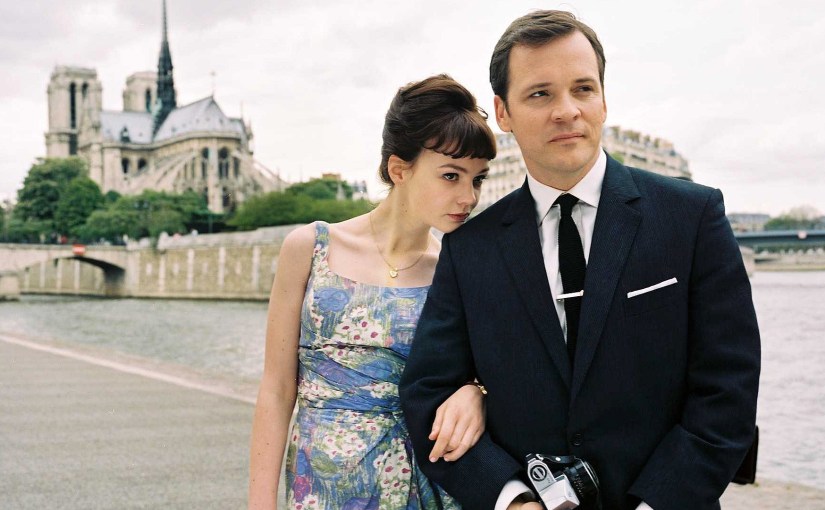
Despite the father’s (and my own) forebodings, Jenny is genuinely enjoying herself.  She loves music, so David takes her to a concert.  She loves art, so David takes her to an art auction.  She loves learning and speaking French, so David takes her to Paris.  His method of getting Jenny’s father to agree to this overnight trip is simultaneously simple and diabolical.  Jenny is having fun for what seems to be the first time in her life.

She’s having so much fun that, for a while, I wasn’t quite sure what the movie was advocating.  Is it supporting this relationship?  She has a very frank conversation with David regarding her wish to remain a virgin until her seventeenth birthday.  David agrees…then, in one of the ballsiest (and creepiest) moves I’ve ever seen from a guy in a movie, he asks her to give him a “peek.”  What is going on?!?  This guy is clearly a cad.  But he’s so nice to her…and she’s having fun…!

Put it this way: I was prepared to throw something at the television by this point.

Around the midway point, though, the movie finally makes its true purpose known.  It’s not about judging Jenny, which is too easy to do, or even judging David, which is ridiculously easy to do.  The film is based on a memoir by a British journalist named Lynn Barber, which made some of the revelations about David’s past and how he makes a living easier to swallow, knowing that it’s based at least partially on fact.  It also made all the “icky” parts in the first half of the film a little more palatable.  When you realize that someone really went through this, it puts everything in a different light.  I had the same epiphany during Schindler’s List; the concept that this all actually happened brought a deeper level to the viewing experience that I hadn’t expected.  (It’s also what made Fargo so much more entertaining than your average crime film, but that’s another story…)

Anyway, this happens and that happens, and before you know it, Jenny has made the kinds of decisions that would make grown men and women tremble with anxiety. The movie’s title takes on a whole new meaning.  It’s not just about Oxford anymore.  It’s about studying at the University of Life, where the only way to know if you passed your test is if you’re still willing to take the next one, and the next, and the next.  Even David learns a thing or two.  Maybe.  It’s a little inconclusive when it comes to that guy.  What a jackass.

So…is it any good?  Yes, it is.  It’s got brilliant performances working from a Nick Hornby script that switches easily among pathos and embarrassment humor (witness the predicament of Jenny’s other suitor at her 17th birthday party) and even a little suspense.  I tend to think of Hornby as Britain’s answer to Cameron Crowe.  Hornby’s books and screenplays walk that same tightrope time after time (About a Boy, High Fidelity, the original Fever Pitch – soccer, not baseball), just like Crowe’s best work (Jerry Maguire, Say Anything, Almost Famous, which I don’t particularly love, but I do acknowledge its craftsmanship).  By the time I got to the end of An Education, the double- or triple-meaning of the title is fully realized.  Everyone has learned something.  Not all of it has been good.  It doesn’t all tickle.  But, except possibly for David, everyone has taken what they’ve learned, good or bad, and put it to good use.  That’s a satisfying ending.

[Side note: after this movie was over, I found myself thinking of Licorice Pizza and its plot regarding an underage boy and an adult woman. I can imagine my friend and partner-in-crime reading my favorable review above and asking me, “If you like this movie, how can you not like Licorice Pizza?” (He really loved Licorice Pizza.) The difference is that, by the time An Education is over, the characters have EVOLVED. Discuss.]

PRIDE & PREJUDICE (2005)

By Miguel E. Rodriguez

Director: Joe Wright
Cast: Keira Knightley, Matthew Macfadyen, Rosamund Pike, Carey Mulligan, Donald Sutherland
My Rating: 9/10
Rotten Tomatometer: 86% Certified Fresh

PLOT: Jane Austen’s immortal novel receives yet another makeover, with Keira Knightley as the headstrong Elizabeth Bennet, who finds herself reluctantly falling for the brooding, distant Mr. Darcy.


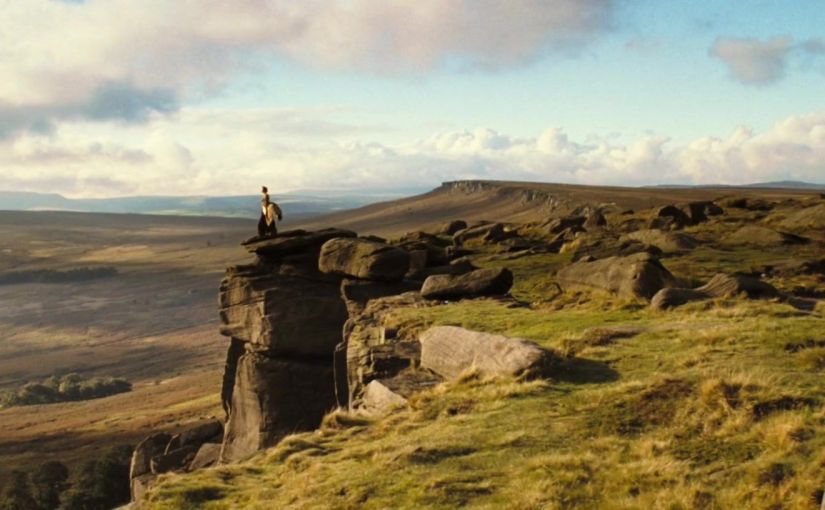
The words “sumptuous” and “painterly” came to mind repeatedly while watching director Joe Wright’s delightful version of Pride & Prejudice.  Much like Kubrick’s Barry Lyndon, the images in Pride & Prejudice appear lifted from paintings of landscapes and portraits you’d find hanging in any given museum.  The details are as stunning as anything you’d find in a Merchant Ivory film.  It’s just gorgeous to look at.

The screenplay clips along at a nice pace, and the English accents are a tad thick at times, so you’ll definitely want to be paying close attention to the dialogue.  While the cinematography is masterful, this is above all a film of words.  It’s not exactly Shakespearean, but there are times when sentence construction coils on itself like a highway cloverleaf.

Other random thoughts:

  • The casting of Keira Knightley is utterly perfect, but Matthew Macfadyen looks JUST a shade too old for her, although it’s entirely possible that was normal for the period.  Who WOULDN’T fall in love with this woman?
  • Carey Mulligan makes her screen debut in this film as one of the Bennet sisters.  Both she and Jena Malone are suitably obnoxious and giggly playing teenage girls, but they do look a little too old for the part.  Just sayin’.
  • Donald Sutherland is magnificent as the patriarch of the Bennet family.  His love for his wife and daughters is supremely evident, as is his frequent exasperation at their nattering and chattering.  His somewhat frazzled wardrobe is the perfect indicator of his inner self.
  • I just have to mention the cinematography again here.  There are one or two long takes (not Goodfellas long, but long nevertheless) that are like a master class in conveying information using minimal dialogue.  It doesn’t hurt that the costuming and production design are flawless.
  • Two words: Judi Dench.  Reportedly, the director convinced her to be in this movie by writing her a letter in which he stated, “I love it when you play a bitch.”  She delivers in spades.
  • In today’s world, I wonder what folks would think of Mr. Darcy’s actions.  He falls for Elizabeth, but she rebuffs him when she believes he ruined her sister’s prospects of marriage.  He then proceeds to assist her family enormously, but behind the scenes, and then tells her, “Surely you must know…it was all for you.”  Today’s PC watchdogs might call that stalking.  Discuss.

As a general rule, I am not a huge fan of Jane Austen adaptations.  It is a measure of the quality of this movie that I felt compelled to make it part of my collection (along with Ang Lee’s Sense & Sensibility and Patricia Rozema’s under-appreciated Mansfield Park).  As period pieces go in general, I would rank it comfortably with Amadeus and Barry Lyndon.  It’s a gem.