WAKE UP DEAD MAN

By Marc S. Sanders

Benoit Blanc is back with a new mystery to solve in Wake Up Dead Man.  With three films, all directed by Rian Johnson (Knives Out, Glass Onion), Daniel Craig’s eccentric detective now belongs in the ranks of Sherlock Holmes and Hercule Poirot.  He’s a pleasure to watch with a smirk on your face.  Ironically, he doesn’t make his entrance until at least a third of the picture is complete.

Josh O’Connor is Father Jud Duplenticy who first reveals a wide berth of exposition ahead of the murder mystery that awaits us.  He’s a catholic priest who works hard to contain his temper that might resort to raising his fists.  He’s been assigned as the assistant minister to a church in a small New England town where everyone knows one another, especially repulsive Monsignor Jefferson Wicks (Josh Brolin).

Whodunit mysteries should never be spoiled.  I certainly wouldn’t imply how this film wraps up.  I also do not want to reveal who the victim(s) is/are.  I urge you to see Wake Up The Dead Man because this puzzler of a story is as gleeful as the title itself.

Like the Agatha Christie film adaptations from the 1970s, Rian Johnson does his best to provide a lineup of suspects with celebrity familiarity including Brolin, O’Connor, Mila Kunis, Kerry Washington, Thomas Hayden Church, Cailee Spaeny, Jeremy Renner and a standout performance from Glenn Close who steals much of the film away from the rest of the cast.  After seven nominations spanning over forty years, give her the Oscar already.  She’s eerie and needling, spooky and fun.  As Detective Blanc continues his investigation, a character tells him this all seems like something straight out of Scooby Doo.  Glenn Close, donned in black with an elderly bleached facade certainly feels like she’d come in contact with the animated pup and those meddling kids.

Rian Johnson writes with that classic narrative that Agatha Christie or Arthur Conan Doyle adopted, only it’s modernized.  The director of The Last Jedi even throws in a Star Wars reference and the joke soars.  The writer/director crafted this script as an invitation for hair raising merriment with his design.  If you can’t be a part of a mystery dinner theater party, he ensures that you can participate in this one.

An old church, priests who curse, habitually pleasure themselves and confess to an abundance of sins, a gothic tomb, a dark basement with a repulsive bathtub, a bar with a photograph of clues, startling entrances, unconventional dialogue and a quizzical murder weapon function like page turning literature.  Even better is to understand how impossible the first murder can be under the limitations of a locked door mystery.  How can someone be killed right in front of our eyes when no one else is in room?  The answers await and thankfully the revelations are not far-fetched.

Wake Up Dead Man is a fun time at the movies.  It’s coming to Netflix on December 12, 2025.  Nevertheless, I encourage you to go your local cinema.  The crowd we saw it with was responding consistently with us, and that only enhances the experience.

ALIEN: ROMULUS

By Marc S. Sanders

To make an effective horror film requires the necessary scares to startle an audience, but it doesn’t stop there.  The story has to work. Still, it doesn’t stop there.  You also have to care about the characters of the piece.

I guess one out of three is not bad for a new installment in a nearly fifty-year-old science fiction/monster movie, horror franchise.  However, with Fede Alvarez’ Alien: Romulus, I left wanting more.

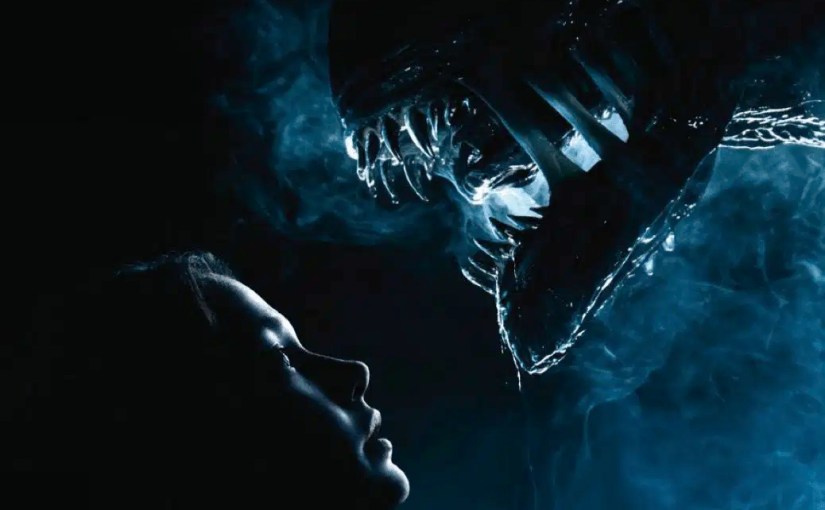
I have no doubt I was the loudest, perhaps most frequent screamer in the Dolby theater last night.  Knowing what I know about Alien, I still get terribly nervous when watching a picture of these grotesque-like creatures, originally designed by H. R. Gigar.  The assortment of Xenomorphs in this film is a faithful treatment to what the monsters should look like.  Teeth, slime, black skeletal frames with scaly limbs and tails.  What these monsters do is another story. It is primarily the same old routine of the creatures from the other films.  Their quiet behavior ahead of their ritual attacks leaves me very nervous and anxious.  I’ve gotta scream at the screen to help me overcome what scare tactics Alvarez and his crew have in store for us.  

Alien: Romulus follows a Michael Myers/Friday The 13th blueprint.  In basic terms, a handful of twentysomethings board a deserted space station as a means to getting off a mining colony overseen by the franchise corporate antagonist Weyland/Yutani.  An audience familiar with the franchise knows this is not going to go well, and soon will expect the clawlike facehuggers, phallic shaped chestbursters and fully developed aliens, aka Xenomorphs, to run around trying to slash, eat, cocoon and build up their population.

Upon attending a screening with my Cinemaniac pals, the guys will testify to my shock and horror at what popped out on screen.  I was terrified for what was coming out of Fede Alvarez’ dark and disturbingly silent settings.  I was nervous when the cast crawled through narrow crevices or stepped into various labs, only to get stuck behind a jammed door or commit a clumsy trip into knee high, unclear water.  Cocooned bodies representing an aftermath of violent carnage sent a doomed message too.  The atmospheric sets alone work well at being terrifying.

Yet, for all of these technical achievements in luridly dark scenic design, jump scare editing, gross looking attacks along with alien “deliveries” and terrifying pursuits and chases, my friend Anthony said it best.  He didn’t care about one single character.  Same for me.  I can’t deny how accurate he is. Like a slasher movie, I could care less if any of the players lived or died.  Even with a periodic countdown during the course of the film, I also didn’t care if they got away from the deserted ship.  So, the suspense never sustained. I was only anxious for when the next monster was going to make an appearance. In the third act, many of the jump scares were nil and upstaged by machine gun shooting and acid (for blood) splashes.

I also didn’t care for the expository scenes either because the information presented was nothing new.  Anything that this gang learns they are suddenly up against has been told to me in all of the other films.  There’s some wink and nod material to salute the other pictures with famous line send ups and even one broad character salute.  It’s fun for a moment but what about this movie and this story

I was also quite bothered by the convenient “just made it out alive” encounters that the main character played by Cailee Spaeny survives over and over.  Anytime danger was knocking at her door her means of survival were not consistent with the long-established fiction of the Alien science of it all.  When I wasn’t screaming, I was asking myself, how is she getting away.  That’s the script not respecting the story elements, the universe or what is presented to an audience, and what they clearly know after almost a dozen pictures.

None of the characters have a personality.  One is Asian with a buzzcut, two are English, and one is pregnant.  The only interesting portrayal is an android named Andy (David Jonnson) who is a sidekick “brother” to Spaeny’s character, and behaves like an autistic savant, until a change comes over him, causing him later to operate like HAL 9000.  Jonnson is really good in this role, and it is unfair that his cast mates were not as fleshed out like most of the other franchise films depicted in portrayals by such actors Ian Holm, Yaphet Kotto, Paul Reiser, Bill Paxton, Lance Henrickson, Charlize Theron, Noomi Rapace, and of course Sigourney Weaver. The characters in this new picture are entirely forgettable and carry no value.

Jump scares with things that come out of dark corners or when crusty hive like walls come alive only go so far.  To effectively win over horror, I need to also care when the next victim is taken down, or about to go through a near death experience on an even playing field.  Romulus comes up short in that department.

Alien: Romulus is decent, but not great as it opts to only think with one side of its brain primarily focused on sneaking up to shiver you in hopes that you’ll pee a little.

NOTE: I knew what not to expect out of this film.  My wish was to see a book end to the last two films that Ridley Scott helmed (Prometheus and Alien: Covenant).  Questions were presented within those films that seemed to promise answers with a later film installment that has yet to come to fruition.  So, the production company seems to have abandoned what they started in response to lackluster box office revenue and a divisive audience response.  Therefore, reinvention came into play once more.  I was always on the enthusiastic side of the divide with those two films. I carry great appreciation for what was done with them, and I was eager for how a prequel trilogy (now remaining incomplete) would wrap up. Alas…

As well, at close to fifty years, if you’re going to keep this up, I believe it’s time to reveal more about the villainous puppet masters, namely “The Company” or to be more specific, Weyland/Yutani.  It has always been supposed how people who work for them may be expendable. Researching and controlling weaponized biological organisms is the company’s main priority.  Yet, how, who and why are these ideas being set in motion?  Does anyone at the top question the company’s practices and look at the moral and ethics of their functions?  Even the Marvel Cinematic Universe has approached these kinds of angles already.  Star Wars as well.  Regrettably after several decades though, the Alien franchise segues away from those perspectives.  This is my take only of course. Yet, I think it’s time to show who else is performing within this house of horrors universe.  Prometheus and Covenant were moving in that direction but sadly they seemed to run out of road. 

CIVIL WAR

By Marc S. Sanders

On the drive home, my wife and I left saying that we could not recall this country existing on a such a divisive plane within our lifetimes as it is currently.  Maybe we were not paying enough attention as we were growing up.  With that in mind however, it’s not unreasonable to see a possible future coming to life from Alex Garland’s Civil War.  What’s clear is the vitriol displayed in Garland’s film is not surprising.

Civil War is an observational piece as it is told through eyes of photojournalists who function with no stake in the conflict.  Lee (Kirsten Dunst) has become a legendary war photographer.  Along with Joel (Wagner Moura), who’s a reporter, they intend to journey through the Northeastern battlegrounds from New York City to Washington D.C.  As they believe, the seceded states of California and Texas are close to overthrowing the government, they are determined to interview and photograph the President (Nick Offerman) before he’s taken prisoner or more likely, assassinated.  An old-time New York Times journalist named Sammy (Stephen McKinley Henderson) and Jessie (Cailee Spaney), a young photographer who idolizes Lee, tag along.  To do this trip is a crazy undertaking, but Lee and Joel know what importance their purpose serves and the fact that they have press passes should uphold their survival amidst violence and chaos. 

My wife asked which side does writer/director Alex Garland lean towards politically and I said I do not know as he’s primarily known for science fiction movies (Ex Machina, Annihilation).  Garland likely wants his political leanings to remain unknown as it upholds what Civil War deliberately steers its focus away from.  We never learn what policies each side of this war stands for or what instigated it.  In fact, it is quite intentional of Garland to make what are arguably the bluest and reddest states in the United States the united seceders who lead one side of this bloody chess board. 

This fictionalized war is well established when the picture opens.  The President attempts to deliver a speech that is clearly uncertain despite the staple resilient vocabulary he includes.  Nevertheless, buildings on fire randomly appear, looters are bloodied pulps who are strung up by random factions, downed helicopters are the carnage occupying a parking lot in front of a JC Penney.  Nothing that anyone says, much less the President of the United States are going to sway this country into a state of comfort.  That time has passed.

The production value of Civil War is astonishing.  Sometimes it looks just like photographic accounts of what we see on the evening news coverage from the Middle East.  Garland also never forgets that his main characters are photographers as he captures in freeze frame people being randomly shot or beaten or simply screaming at one another.  The film abruptly turns off the sound and a black and white photograph interrupts the chaos for you to catch a freeze frame glimpse.  The editing lends to the character designs of the story’s four main players.  I did question, however, why video footage was not also taken beyond just photographs.  Cell phones are not used or mentioned in this picture.  The inconvenience of Wi Fi on a laptop is however. 

The sound design of the film is spectacular and reminiscent of how powerful it served in the Oscar winning film The Zone Of Interest.  As the characters set up camp for the night, rapid pop pop pops are heard in the distance.  On multiple occasions, Garland gets you right in the middle of the various firefights that occur in and around office buildings or what were once shopping districts.  The machine gun fire and rubble blasts are all around you.  The cinematography is also quite eye opening.  I like to think of areas like Virginia and the Carolinas as beautiful American spots during the summertime, and that is when these events unfold. Yet, to see how ugly it is amidst endless debris and bloodshed is an awful, still convincing effect.

My Cinemaniac pal Thomas made a good point about Garland’s approach.  Out of nowhere a needle drop of songs will intrude on the picture and often I found them to be overly distracting and definitely unnecessary.  One such number is a hip hop tune with samples from an 80s tune (I can’t remember which one now) that plays over a gunfire scene.  Regrettably, it takes me a little out of the picture.  Thomas is entirely correct in this area. This technique is not effective as when Oliver Stone or Francis Ford Coppola included The Doors in their set pieces. 

Kirsten Dunst is quite good in her role.  Lee knows where to point her camera, and Dunst lives up to the legendary status that her character is supposed to have.  You can feel the exhaustion that teeters on her mental stability, especially as the story reaches its third act.  Lee has been doing this for far too long and the horrors are a part of her now.  Her trauma can never be erased or covered.  Cailey Spaeny is the standout performer though as Jessie, the young girl who is eager to reach the levels of her idol.  Lee wishes Jessie would just not tag along.  Alex Garland writes good characters, but they are not what stayed with me following the conclusion of the film.  What upholds Civil War is the depiction of this all too convincing reality. 

I write this article the morning after Iran delivered missiles and drones in the direction of Israel and with every article I’ve read, I ask myself again and again what is the purpose.  These efforts are not done for strategic overthrow.  Rather, actions are executed with hate and revenge and the only ones who are paying for it are those that are not arguing; those that are just trying to raise families and live in peace.  Alex Garland might know what finally began his fictionalized American civil war, but none of that matters any longer.  It’s what the pawns do to one another in place to place to place.

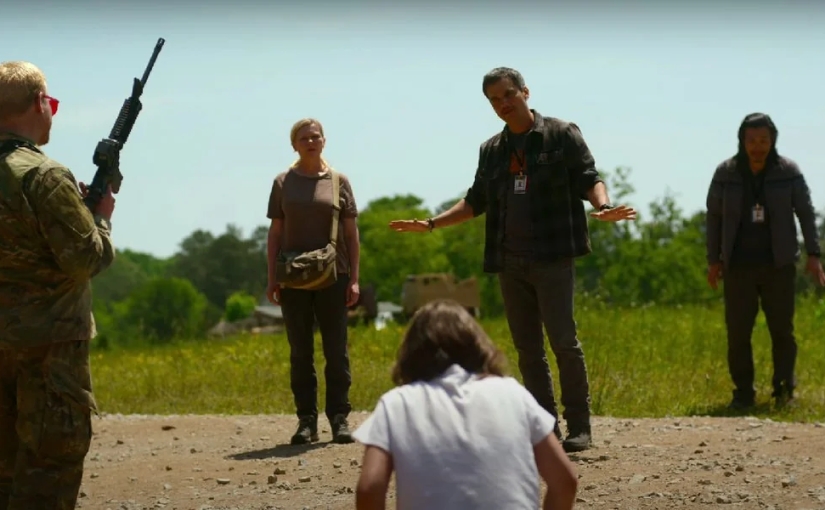
The fighters and individuals you meet in his film all move with their own ulterior motive.  A chilling scene includes Jesse Plemons (Dunst’s real-life husband) dressed in camouflage fatigues who does not even have a statement or a cause to deliver.  His minimal dialogue is nowhere near as expressive as the vast graveyard of Americans he’s sprinkling with lye and burying. When the press team comes upon him, nothing they say matters or motivates him to lower his machine gun.

Fighting, fighting, fighting.  That’s all you see in Civil War.  You don’t even know the position that the President holds, or even what his name is.  You never learn what party he represents either.  I salute Alex Garland for not leaning one way or another.  It is the divide that is tearing our country, our world, apart and not what we stand for. 

Sadly, some commentators on social media have already devised in their own minds that Civil War is a “woke film” (whatever the fuck that means) simply because of the pink (HOT PINK!!!!!) sunglasses that Plemons’ sadistic character wears.  Reader do not listen to the voices in your head.  There is no political agenda to this film.  Rather, Civil War shows us what occurs when political agendas have been entirely deafened by gunfire.

ON THE BASIS OF SEX

By Marc S. Sanders

Director Mimi Leder provides a biopic on Supreme Court Justice Ruth Bader Ginsburg in On The Basis Of Sex. The movie is worth a view even if it is nothing very special.

Felicity Jones plays Ginsburg capably, even if her British accent keeps intruding into her performance. If Jones raises her voice in a debate with her daughter, all I’m hearing is Jyn Erso from Star Wars.

Leder’s film opens in 1956 as Ginsburg is depicted dressed in blue as a lone woman walking the campus of Harvard among a sea of male law students dressed in black. I’ve seen symbolism like that before. Nothing inventive here. From there, we learn she is entering the school as of one of nine women in the student body.

Ginsburg is married to fellow law student sophomore, Martin Ginsburg, played by Armie Hammer. I’m convinced if a film takes place at Harvard, Armie Hammer is going to be cast. He’s become a poster boy for the institution. When Martin is diagnosed with testicular cancer, Ruth accepts the challenge of not only attending her classes but Martin’s as well so he does not fall behind. Ruth then requests to finish her law degree at Columbia University to be with her husband. This is her first challenge as she is denied the request and its apparent because she is simply a woman. She perseveres and goes anyway. From there, Leder depicts a setting where even if you are at the top of your class at both Harvard and Columbia, if you are a woman, a mother and Jewish, then there is no job available to you as an attorney. Therefore, Ruth must settle for being a law professor.

The film jumps to 1970. Ruth’s daughter, Jane played by Cailee Spainee is a preteen ably ready to debate with her mother about the merits of Atticus Finch while Ruth continues to fall second to the male population mostly reliant on laws seem directed in preference to men over women. Don’t be too hard on our forefathers. Times have changed! Eventually, Martin introduces a case that would be perfect for Ruth to champion. An unwed man is denied a tax deduction for nursing expenses for his elderly mother. Had he been married or divorced or widowed or even if he’d been a woman, then the deduction would qualify. After all, single adult men should be out hobnobbing and earning a wage, or fighting in a war. So, if we can’t convince our lawmakers that a woman deserves the same equal rights as man, how would it appear if men were not entitled to certain rights equally? The case makes its way to the Supreme Court as Martin and Ruth team up for the cause.

All of this very inspiring and really should be seen by young students to open their minds to what they as people and American citizens are entitled to. However, I worry that if I were to show this film to my daughter, for example, she’d just get bored. Yes. You have to stick to the facts of the story and how it all played but the case that Ruth represents is kind of stale I’m afraid. If I, as a banker by day, find this case uninteresting, what should I expect of other adults and young viewers alike.

As well, Leder and screenwriter, Daniel Stiepleman (Ruth’s real life nephew), portray the opposition as tough minded, stubborn and bullish. Stiepleman might have been pushing this portrayal a little too far though. Were these great minds of debate and justice really this foolhardy and mean, or is this all for cinematic effect?

Ruth Bader Ginsburg is a hero because she’s an agent of change. Many of our current laws and those that continue to be updated must be credited to her efforts. The film primarily focuses on this one case which blazed the trail for her legacy to come. I would have rather have seen the legacy though. I bet that is much more exciting than listening to an exchange of tax law between Martin and Ruth. It just doesn’t make for good movie material and admittedly I got lost in some of the legal jargon speak. What happened exactly?!?! What now!?!?!

Jane and Ruth’s relationship kind of plays like an afterschool special. Jane did follow in her mother’s footsteps but it came off kind of hokey to me how Jane eventually participates in Ruth and Martin’s legal team. Still, this is a device that can attract young students to the material. I just think it’s kind of cheesy. There was better adult/kid chemistry and writing in Iron Man 3, for example.

Kathy Bates and Justin Theroux were kind of distracting to me as individuals who allied with Ruth. They are larger than life in this film and really they shouldn’t be. This film is about Ruth Bader Ginsburg, no one else.

On The Basis Of Sex won’t put you to sleep. I learned about Ginsburg’s beginnings a little bit. So I’m grateful for that, but as far as entertainment and insight, I’d turn to another source. Perhaps, I will seek out the 2018 Oscar nominated documentary RBG that is gaining massive positive response. I expect I’ll take away more from that film than just a dried up tax case that’s detailed over two hours.

VICE

By Marc S. Sanders

Christian Bale is one of the greatest method actors working today. He’ll put on muscle mass for Batman. He’ll shrink himself down to a skeletal 100 pounds for roles in The Mechanic and his Oscar winning turn in The Fighter. In Adam McKay’s new film, Vice, Bale puts the weight to present an uncanny resemblance to former Vice President Dick Cheney. Without Bale and co-star Amy Adams as wife Lynne Cheney, Vice would not succeed. Both will be nominated for Oscars this year. McKay can expect nominations for himself and Best Picture.

McKay approaches Vice similarly to his winning film The Big Short, where a historical debacle of great proportions is told from a comedic approach. However, the gags of Vice don’t necessarily measure up to the absurdity of the real estate investment collapse of The Big Short. Cheney’s accomplishments were just too sad, too tragic, too shocking to laugh at entirely.

Dick Cheney was a drunk who suffered multiple heart attacks. He got kicked out of Yale University. His daughter, Mary, is gay. His other daughter, Liz, went into politics herself and dismissed her sister’s sexual orientation. Dick has remained married to his very wise and very aggressive wife Lynne who more or less rescued him from a wasted life. Dick Cheney shot his close friend accidentally while hunting, and never apologized for it. He was fortunate to receive a heart transplant that continues to prolong his life, and Dick Cheney became Vice President of the United States for two terms. You don’t have to like the guy but you have to admit he’s got a colorful past.

It’s all in the movie. Immediately, McKay puts in a few words of a byline that this film is based on fact to best of their knowledge but they more or less tried their fucking best.

My impression of what could be considered a very divisive film was actually not divisive to me at all actually. Bale along with McKay’s screenplay show a Dick Cheney who truly sees no other way to carry on a political career than with a silent yet ruthless touch. Later, it required more aggressive tactics not labeled as torture and not appearing beyond his authority even if he is only the Vice President. Bale has the voice down, the walk and as noted before the appearance. This film will likely win Best Makeup.

Having recently seen three potential nominees for Best Actress in The Favorite, I have to say Amy Adams as Lynne Cheney beats them all. This is not an Amy Adams we’ve seen before. Lynne is depicted as smart, aware in a mindset of no nonsense bullshit. She gets the job done, and if she had her way she’d take the job herself but she’s aware of her limits as a woman. Adams easily shows her Lady Macbeth in a scene where daughter Mary reveals herself as gay. Dick promises to love Mary no matter what. Adams as Lynne does not. Adams offers an expression that kills. Right there in this scene is her Oscar moment. This is one of the best performances I’ve seen all year.

Back to Macbeth for a moment, McKay has a great imagination for gags including elevating the fantasy of Dick and Lynne reciting MacBeth to each other in bed while mulling the possibility of becoming George W Bush’s running mate. It’s more than that for Dick. Both know this is absolute power…finally. I’d accept if their decision to run came down to something like this. It takes an ego trip to obtain power after all. If you’ve already been denied power before, the power trip only becomes more powerful on another occasion.

The Shakespeare gag works. Some others fall a little flat. Some really win. Out of the blue, prior to running on Bush’s ticket, McKay wraps up the first portion of Cheney’s life and literally rolls end credits. Then a phone rings and Cheney’s biggest story begins. The end credits moment is a great psyche out.

Vice is not a perfect movie. A huge misfire occurs midway through the end credits that derails McKay’s best effort at a neutral point of view for the Republican. It’s a moment that screams of present day chaos of opinion. McKay said screw it and folded his hand to take advantage of showing how he really feels. Before this scene, McKay and his cast embraced the Cheneys despite their hard to swallow viewpoints and actions. If you are going to make a movie about Dick Cheney or Barack Obama or Mickey Mouse you, as the storyteller, have to develop an appreciation for the centerpiece. If all you are going to do is bash and mudsling, then perhaps you are not qualified to tell the tale. McKay failed at the finish line.

Still, the journey is always interesting. There are things to learn here, things to recollect and things to question how it all came to be a reality.

A good cast is offered including a surprising appearance by Tyler Perry as Colin Powell; make a movie about this guy and get Perry back. Steve Carrell plays a buffoonish Don Rumsfeld. Was Rumsfeld this stupid and this haphazard? I don’t know. McKay uses him to play the fool and the jester. I doubt Rumsfeld has a loyal fan base ready to wave pitch forks. So who cares, really? It’s in the past.

A casting misfire is Sam Rockwell. Moviegoers are too familiar with the real George W. Bush especially in 2018 following the loss of his parents and his deeply appreciated eulogies. Rockwell teeters on 12:45 am Saturday Night Live material, as he chomps down on chicken wings, with a good ol’ boy Texas dialect. I know people want to believe Bush 43 was this stupid. I’m just not ready to accept that. Ironically, a producer on this project is Will Farrell, widely known for his George W Bush on SNL. Farrell would have been a better George here.

Compliments also go to Jesse Plemons as a narrator with an unknown connection to Cheney. Plemons’ delivery plays well on an even keel.

Vice is a complicated film about a hard man to like with little to know redeeming qualities. Adam McKay is cornering the market on films about American absurdities of the past. He’s good at this kind of filmmaking. This isn’t his best film but it still works. Just get ready to leave the theatre as the real end credits roll. Again, it’s a moment that serves the film’s worst flaw as McKay leaves his imagination at the door. Everything before that was right on track. Adam McKay…next time, don’t think too hard.