
by Miguel E. Rodriguez
DIRECTOR: Mike Hodges
CAST: Michael Caine, Ian Hendry, Britt Ekland, John Osborne
MY RATING: 8/10
ROTTEN TOMATOMETER: 87% Fresh
PLOT: When his brother dies under mysterious circumstances, London gangster Jack Carter travels to Newcastle to investigate.
While watching 1971’s Get Carter (Caine, not Stallone), I was reminded of so many other later films that I began to wonder what gangster/crime films weren’t influenced by Get Carter. Throughout the picture, I could see hints and whispers of Bugsy, Beverly Hills Cop, Carlito’s Way, and the John Wick franchise, among others. I probably missed some. Maybe I’m wrong. Maybe those films weren’t paying homage to the best British film ever made (according to a 2004 poll), at least not consciously. But its DNA is there for anyone who knows where to look.
(To be sure, Get Carter was itself influenced by earlier authors and films. In very broad strokes, the plot of Get Carter resembles The Big Sleep. In both films, a hard, cynical man tries to get to the bottom of a mystery that no one else is particularly interested in solving. They both even involve pornography, though to be sure that was more implied in the older film, while in Get Carter we are left in no doubt.)
The tone of Get Carter matches its protagonist: cold, flat, uninflected, violent only when it has to be. Michael Caine’s performance is a masterpiece of understated, simmering viciousness. He only gets really angry a few times in the film, and he doesn’t smile, not genuinely, until the very end. I read on IMDb that Caine’s intention was to show a more realistic, less sensational kind of violence than had been seen in earlier gangster films, “never using thirty punches when one would do.”
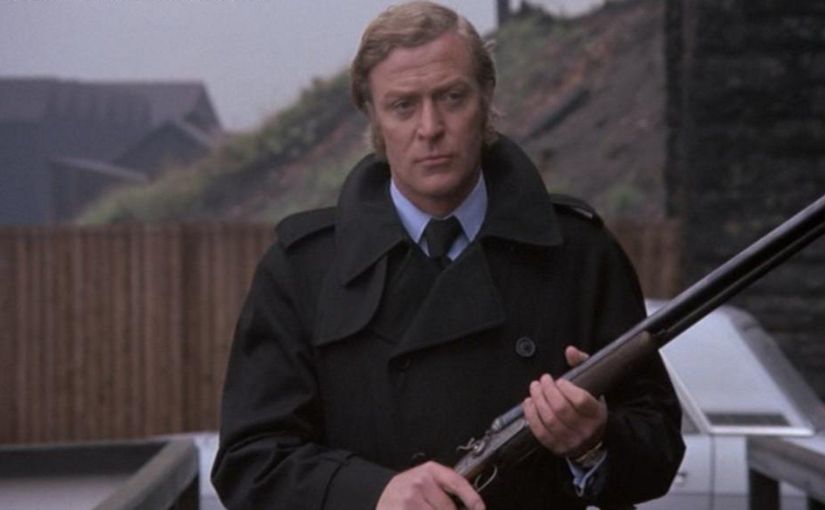
This is also an echo of a French film, Le samouraï, in which a professional killer shows absolutely no expressions the entire film, even with a gun in his face. Carter is equally cool under pressure, as in the scene when he is surprised in the act of “lovemaking” (love has nothing to do with it) by two gangsters. He registers surprise and little else, pulling a double-barreled shotgun from under the bed and, while stark naked, marching his would-be attackers out of the flat at gunpoint. In a movie with little to no humor, there is a welcome double-take from the nosey next-door neighbor, not to mention the children’s parade taking place down the street. (In this scene, there is something very Bond-like about Carter, mixing deadly danger with borderline slapstick.)
1971 was not a year for shrinking violets at the movies. It saw the release of Dirty Harry, A Clockwork Orange, and The French Connection, among others. Into this mix comes Get Carter with its casual violence and frequent female nudity, profanity, and so on. Even so, there were a couple of moments that got a little shock out of me. One was when a car is disposed of while Carter knows what precious cargo is in the trunk, but the bad guys do not. Watch Carter’s utter impassiveness; he could have raised a warning, but he doesn’t. There’s cold, and then there’s cold. Another shocking moment is when Carter absentmindedly turns on a film projector and watches the amateur porn film displayed on the wall. Watch his face again as he slowly realizes the identity of one of the actresses in this tawdry film. A tear rolls down his face. Because of what we already know about Carter, that tear doesn’t just mean he’s grieving. He’s so boiling mad that I feared for the life of the woman in the next room. It’s a great moment because of how rarely we see emotion on his face.
Get Carter is classic noir, just in color and with more adult situations. Carter may not be a cop, but he has a code, nonetheless. He absolutely will not stop digging until he solves the question of his brother’s death. He defies his own bosses in London, ignores many warnings, survives several attempts on his life, but he just can’t help himself. His obsession trumps everything else, just like Bogey in The Big Sleep or William Hurt in Body Heat. There are hints of tragedy at every turn, but Carter presses on, whatever the cost, even if he thinks he might not like what he finds. These are the qualities of any great noir hero, and Carter exemplifies them all.
***SPOILER ALERT AHEAD, YOU HAVE BEEN WARNED:***
I feel obligated to mention my reaction, at least briefly, to the film’s ending. At first, I threw my hands in the air, much as I did at the ending of…well, another very different film from the late ‘60s. But as I thought back to the events of the film leading to this moment, I had to shrug and say to myself, “Well…it’s not like they didn’t warn him.” At least it’s motivated by something, and not just random fate. I can accept it. It’s not something you would see in a conventional Hollywood film today, that’s for sure. Look at John Wick.
 2 UNPAID MOVIE CRITICS!!!!