
MEET THE PARENTS

By Marc S. Sanders

Am I the only one who used to get tired of feeling sorry for Ben Stiller?  The go to formulas of his earlier comedies made him the unfortunate stooge.  The best of that batch was The Farrelly Brothers’ hilarious There’s Something About Mary.  Every gag, every cast member, every storyline was straight up side splitting.  Late last year, during the hurricane chaos in Florida I got around to watching Along Came Polly.  Poor Ben had to play basketball defense against a bare chested wookie hairball of a guy and his close up of misfortune carried the advertising campaign for that movie. 

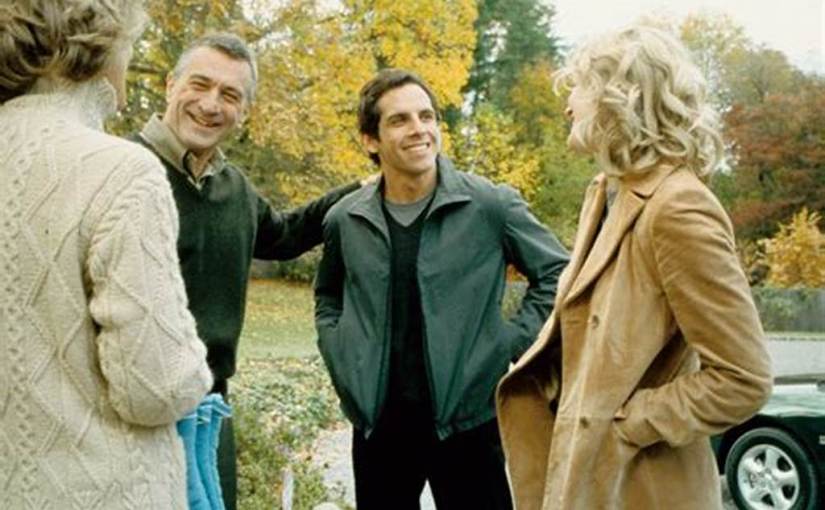
Back in the year 2000, Stiller suffered through a terrible weekend with an intimidating Robert DeNiro frowning on his every move in Meet The Parents, also known as the first of a “Fockers Trilogy.”  Yeah, Meet The Parents is funny.  You shake your head at the absurd comedy that befalls Stiller’s character, Greg Focker. Though that isn’t even his real name at birthright.  Still, I can’t recall feeling so guilty for one guy’s misfortune that he can hardly ever help to avoid.  This guy is destined to never win, to never overcome, to never live without self-consciousness.

Greg Focker is ready to propose to his loving girlfriend Pam Burns (Teri Polo). First, he has to survive a weekend at her parents’ house where the other daughter is getting married.  Not so easy because first the airline loses his luggage and poor Greg has no clothes to wear, other than what Pam’s pot head brother can provide. Baggy jeans and baggy sweatshirt on a short and svelte Ben Stiller is one sight gag of many.  The guy also has to nonchalantly dismiss his uninviting surname and the fact that Pam’s father Jack (DeNiro) is unimpressed with his occupation.  Greg is not a nurse.  Greg is “a male nurse,” who opted not to go all the way for the MD, even after taking the exams. 

Jack and his wife Dina (Blythe Danner) are less than impressed with Greg’s housewarming gift.  Jack’s precious cat Mr. Jinx is a bit of a problem because Pam can’t keep her mouth shut that Greg is not fond of cats.  Doesn’t make him a bad guy, but does her cat loving father need to know this interesting tid bit, right away?  Pam’s ex-boyfriend Kevin (a hilarious Owen Wilson against Stiller’s pitiful expressions) can do absolutely no wrong – like nothing at all.  The biggest challenge for Greg though is Jack.  Whether it’s Taxi Driver or Meet The Parents or Rocky & Bullwinkle, Robert DeNiro is the embodiment of intimidation. 

Meet The Parents is funny, and it serves no purpose to surrender the many sight gags or one liners that are offered in the film.  I laugh.  I laugh hard when I watch this movie, but I hardly ever feel good about myself.  Poor Greg never catches a break.  He’s in a no-win situation and I’m just uneasy about the whole thing.  The guy chooses not to go swimming because he has no swimsuit. Then Kevin offers one and well…yeah…I’m on Greg’s side and it’s not funny for Greg.  If I was a guest in someone’s home only to wake up late when the whole family is dressed and finishing breakfast, and I’m wearing my girlfriend’s dad’s PJs, of course I’m going to feel insecure.  For the sake of the comedy in Meet The Parents, the set ups are simply awkward situations to laugh at that one guy in the room.  Poor Greg.  Poor, poor Greg. 

In fact, the real villain of Meet The Parents is not even DeNiro’s Jack Burns who has some secrets to hide.  Actually, the unsympathizing bad guy is Teri Polo’s character.  Pam never makes it easy for her boyfriend.  Greg rightfully asks why didn’t she wake him up or why didn’t she tell him her dad is not a florist, or why this and why that, and Pam is naïve to Greg’s justified concern, never empathizing with his position.  In fact, when he tries to explain his feelings, she’s nothing but insensitively dismissive. 

Yes.  It’s a comedy, but I was begging and begging and BEGGING Greg to just leave.  Leave this place.  LEAVE PAM FOR GOOD AND GET OUT OF THIS HOUSE.  You know, like we would tell the counselors in a Friday The 13th flick?  It’s not so much the father as it is his girlfriend who quickly nosedives Greg’s comfort into an inescapable hell.  You know how people love to say Jenny is the villain of Forrest Gump?  Well, I got one better.  Pam Burns is an unthoughtful, uncaring, spoiled brat of a daddy’s girl with nary a shred of consideration for others. 

I despise you Pam Burns – daughter of Jack and Dina Burns, rotten and heartless girlfriend to Greg Focker!!!!! 
ANOTHER WOMAN (1988)

by Miguel E. Rodriguez

DIRECTOR: Woody Allen
CAST: Gena Rowlands, Mia Farrow, Ian Holm, Blythe Danner, Betty Buckley, Martha Plimpton, John Houseman, Sandy Dennis, Philip Bosco
MY RATING: 8/10
ROTTEN TOMATOMETER: 59%

PLOT: Facing a mid-life crisis, a woman becomes drawn to the plight of a pregnant woman seeking psychiatric help from the shrink next door.


Woody Allen’s Another Woman is the first movie I can remember that compelled me to do a little background research before writing about it.  It is moody, somber, theatrical, and by far the least funny of Allen’s films that I’ve seen (and I’ve seen Blue Jasmine).  It falls in that part of his career when he was delving into more dramatic fare; September had been released the year before, and Crimes and Misdemeanors would come a year later.  There is none of the charm and lightness of his earlier comedies, which may account for why I’ve never seen it mentioned alongside his other films whenever his filmography is discussed.  And yet, I was curiously drawn into this story to such a degree that when two revelations arrive almost on top of each other, I gasped.

Another Woman tells a brief chapter in the life of Marion (Gena Rowlands), a middle-aged woman married to Ken (Ian Holm).  Marion is Ken’s second wife; she was literally the “other woman” that caused Ken to divorce his first wife, Kathy, played by Betty Buckley in a single devastating scene that vividly showcases the guilt that Marion and Ken have both learned to live with in different ways: Ken gently accepts Kathy’s “condemnation”, while Marion buries the guilt deep.

Marion is a professor of philosophy at a local university.  To work quietly on a new book, she rents a small one-bedroom flat nearby and uses it as her office.  However, through a trick of acoustics, she realizes she can hear voices coming from the flat next door through an air vent on the floor.  It’s a psychiatrist’s office, and she is suddenly privy to intensely personal conversations with his patients.  (I was reminded for a minute of Rear Window.)  One such patient is Mia Farrow, playing a character whose name I won’t reveal because it’s barely mentioned in the film for a reason.  She is pregnant, and during her sessions, she reveals doubts about her identity and/or purpose in life.

For Marion, who has always been sure about everything and everyone in her life, Farrow’s confession strikes a nerve, and the rest of the film consists of Marion’s struggle to reconcile her perception of herself and her well-constructed life with how everyone else truly sees her.  Throughout the movie, people are telling her how wrong she is about her relationships with her divorced brother, with an old friend, with her own husband, with her best friend, even with the Mia Farrow character.  Has she been deceiving herself her entire life?

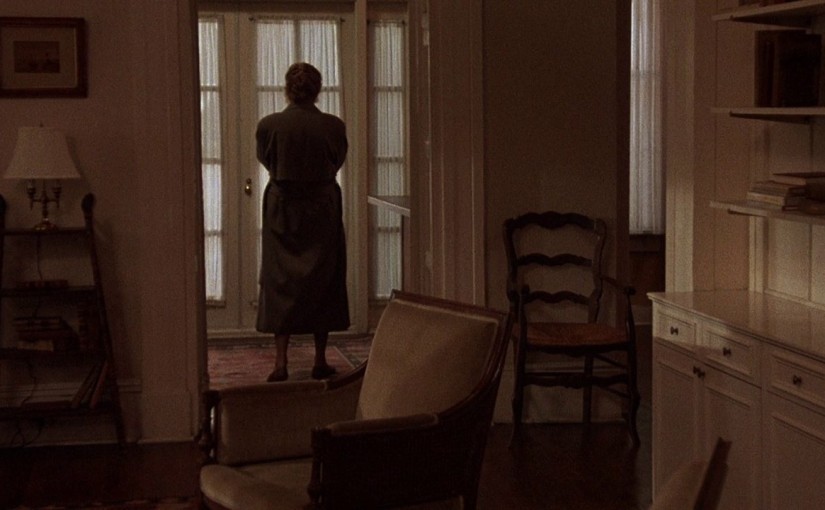
Okay, so this subject matter isn’t exactly a barnburner.  But consider how the movie looks and moves, and the performances from Gena Rowlands and her supporting cast (it’s Rowlands’s movie to win or lose).  Look at the warm, yet subdued lighting schemes, shot by Ingmar Bergman’s favorite cinematographer, Sven Nykvist.  (Allen is a huge Bergman fan – indeed, this film is actually a loose reinterpretation of Bergman’s film Wild Strawberries [1957].) Interiors look, not sad, exactly, but…lived in.  Bright sunlight is only ever seen from inside through a window.  Exteriors look as if Allen specifically waited for overcast days to shoot.  Everything matches Marion’s internal gloom as she re-examines her life.

At the center of the film is a dream sequence that feels more like a foreign film than anything I’ve ever seen from an American film.  Marion dreams she is in an old stage theater, where figures from her circle of family and friends are rehearsing a play based on moments in her life.  Is this self-indulgence from Allen?  Maybe.  The dialogue in this sequence is so formal and, I guess, elliptical at times that it almost feels as if it were something translated into English from another language.  Vincent Canby of The New York Times called this out, saying, “The rounded sentences sound as if they’d been written in a French influenced by Flaubert, then translated into English by a lesser student of Constance Garnett.”  I’ll probably understand this criticism more when I learn who Constance Garnett is, but I get his point.  However, while it was noticeable, I did not find it distracting.  I thought it was a fair interpretation of how our dreams rarely follow strict logic.  Marion’s dream is structured, but the content is skewed.  I was fascinated by it.

Do I think this is a movie you need to see?  Who can say.  I’m glad I saw it, at least.  It shows a side of Allen’s directorial psyche I had never seen before, even though I had read about it from many other sources.  And it inspired me to do a little introspection of my own, which is something, I guess.  The movie’s final scene includes a beautifully loaded question: “…I wondered if a memory is something you have or something you’ve lost.”  Marion has been asking herself this question the whole movie without realizing it.  I wonder if my answer would be the same as hers.  Or yours.