
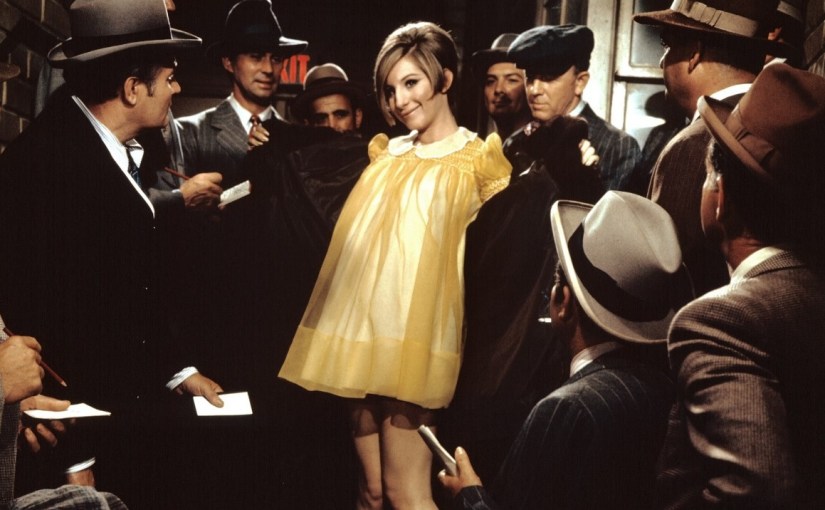
by Miguel E. Rodriguez
DIRECTOR: William Wyler
CAST: Barbra Streisand, Omar Sharif, Kay Medford, Walter Pidgeon
MY RATING: 7/10
ROTTEN TOMATOMETER: 94% Certified Fresh
PLOT: Barbra Streisand elevates this otherwise rote musical melodrama with her ultra-memorable star turn as real-life stage performer Fanny Brice.
There is nothing wrong with Funny Girl that couldn’t have been fixed by the film not taking itself so seriously. With its widescreen compositions and scores of extras and lavish stage productions featuring flocks of Ziegfeld girls in the most extravagant costumes imaginable, this should have been a romp, even with the serious bits in between. Instead, the movie sinks under the weight of its pretentiousness, short-changing the funniest bits and wallowing in pathos way more than is necessary. Thank goodness Barbra Streisand is there, giving a debut performance for the ages that is part Groucho Marx, part Debbie Reynolds, but mostly just Barbra. Come for the spectacle, stay for the songs.
The story begins with Fanny Brice (Streisand) walking backstage at a theater and delivering her immortal opening line to a mirror: “Hello, gorgeous.” From there, the rest of the movie is a flashback to the rise and rise of Fanny Brice, a plain-ish vaudeville chorus girl who is discovered by a roguish playboy, Nick Arnstein, played by Omar Sharif, who looks like a man whose last name would be anything BUT Arnstein. He cleverly gets her boss to raise her pay to $50 a week (about $800 in today’s dollars, so not bad), and in the process captures Fanny’s heart. Shortly after that, she’s invited to join Florenz Ziegfeld’s legendary troupe of dancing girls, where she manages to tweak his authority in probably the funniest number in the movie, “His Love Makes Me Beautiful.”
It’s in this number where the first tonal tug-of-war takes place between Streisand’s playfulness and the movie’s urgency to look “important.” There is an earlier number, “I’m the Greatest Star”, that really showcases Streisand, but the movie never gets that tone right for the rest of the movie. In “His Love Makes Me Beautiful”, she has these wonderful glances and occasional throwaway lines, but most of them are lost in medium or long shots that emphasize the extravagant Ziegfeld costumes and the expensive-looking set dressing. It’s like watching a play where the lights are shining everywhere except the stage.
Arnstein comes and goes, sometimes for weeks or months at a stretch, always making sure to see Fanny when he’s in town but repeatedly pointing out that he doesn’t want to be tied down by a relationship. Their “courtship” lasts through “People”, a song most people know without knowing what it’s from, and a curious number where Arnstein invites her to dinner in a private room upholstered entirely in red velvet, and we know and Fanny knows what’s going to happen, and she has a funny argument between her lust and her manners in “You Are Woman, I Am Man.” The song also contains a duet with Arnstein, and brother, if you haven’t seen Omar Sharif crooning, you haven’t lived.
Everything comes to a head at the finale of Act One when Fanny learns Arnstein is sailing to Europe and decides to join him instead of going to the Ziegfeld girls’ next port of call. Here is where Streisand really pours it on, proving her virtuosity with the classic “Don’t Rain on My Parade”, belting out note after note and ending on the iconic shot of her standing on a tugboat as it passes the Statue of Liberty. If anyone ever doubted she was the real thing before that moment and this movie, their doubts were certainly erased by intermission.
Alas, all good things come to an end, and Act Two falls into a predictable series of economic rises and falls as Arnstein’s volatile income stream finally goes south permanently, while Fanny’s career continues arcing upwards without looking back. It’s here where the pretentious sensibilities of the filmmakers finally take over for good. In a second number that could have been downright hilarious, “The Swan”, the movie once again keeps its distance from Streisand’s (appropriate) mugging, asides, and pratfalls…although, being a ballet, it is interesting to see her doing all the dancing herself.
I found myself committing a critical sin by comparing this movie to another widescreen, elaborate movie musical from around the same era, My Fair Lady. Here’s a movie shot on a grand scale with huge sets, lavish costumes, and big musical numbers, but instead of feeling ponderous, there is a lightness to it. It zings along, even during the long stretches between songs, thanks to its crackling pace, and gives us just enough pathos to appreciate why we need glee and glamour.
Everything that’s wrong with Funny Girl could have been fixed by just lightening the mood, man. You’ve got a star-making performance by an experienced theatre actress (Streisand is actually reprising the role she played on Broadway), you’ve got one of the most legendary directors of the time at the helm, William Wyler (Ben-Hur, Roman Holiday), and you’ve got some above-average songs that people can still hum over fifty years later. Why cloak everything in this gloomy overcoat of affectation and heavy-handed emotional beats that we can see coming a mile away?
When all is said and done, Funny Girl is by no means a bad film. Streisand is too good at what she does to let this movie fall by the wayside without recognition. But without her, it’s easy to imagine this movie sinking into near-obscurity, yet another maudlin melodrama that crams 100 minutes of story into a 2-hour-and-35-minute film. So, rather than mourn what could have been, let’s instead give thanks for what we’ve got: one of the last of the old-fashioned Hollywood musicals with a 24-karat-gold star at its center and a handful of memorable songs. I suppose it could have been worse. [insert shrug emoji here]
 2 UNPAID MOVIE CRITICS!!!!