
SHE SAID

By Marc S. Sanders

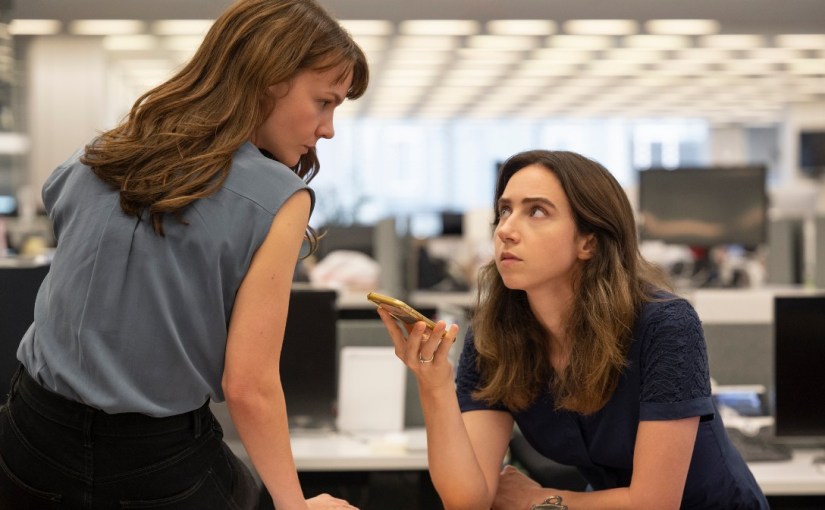
I get high off movies about journalism.  All The President’s Men and Spotlight are at the top of this pillar.  The main characters seem to be moving a hundred miles per hour even if they are reserved to their cluttered desks and phones, or if they are talking delicately, and slowly, with empathy as they carefully approach a potential, yet frightened source.  She Said is a 2022 film about how the New York Times reporters, Megan Twohey and Jodi Kantor (Carey Mulligan, Zoe Kazan), exposed the systemic process of sexual harassment and rape that was running rampant through Miramax Films.  The accused was always its CEO, Harvey Weinstein.

It’s extraordinary that this film got produced so soon after the MeToo movement and Weinstein’s downfall occurred.  All of it seems like it just happened yesterday.  In fact, Harvey Weinstein is still going through court procedure and trials for sexual crimes he’s accused of that occurred in London, New York and Los Angeles.  There might even be more locations.  New developments hit the internet all the time.  This guy just never stopped.  So, there’s much for the courts to process and try.  This was a terrible black eye, not only for Miramax’s reputation (at the time owned by Disney), but on the entire film industry in Hollywood.

She Said explores not only Twohey and Kantor’s relentless pursuit of the truth and various descriptions of Weinstein’s method with young women, but also how corrupt non-disclosure agreements (NDAs) were used.  The NDAs contained unreasonable demands for hush money provided.  Mandates such as speaking with a therapist or other professionals and close-knit relatives were never allowed lest they suffer consequences.  The victims would get paid, but would also be denied of a copy of the contract, and thus Weinstein found a way to allow his constant grooming and sick pleasures of perversion to carry on. 

The reporters concluded that these victims had no money or resources to stand up to the kind of bullying and harassing that Weinstein’s power exerted.  Quitting or getting fired for fighting for their rights or just refusing his advances left these women out of an industry in which they were trying to elevate their careers.  They lacked proof of the occurrences.  They had to fight a he said/she said scenario.  They were victimized by a man who associated with some of the most powerful people in the world.  It happened to known actresses like Rose McGowan and Ashley Judd (who plays herself in the picture).  It nearly happened to Gwyneth Paltrow (providing her own voice on the phone) as well.  Even worse, it happened to women who didn’t even have the luster of celebrity brand name recognition to help them in their cause.    Nevertheless, it practically destroyed McGowan’s reputation in Hollywood altogether as she was labeled a crazed pariah for declaring her truth.  The tolerance and strategic payoffs were perhaps just as overwhelming as the attacks by Harvey Weinstein.  (Forgive me, I say perhaps because there is no way I am qualified to empathize, measure, or relate to what these victims endured or continue to survive through.)

Maria Schrader’s film does a good job at explaining the risks these reporters take.  A brief prologue shows Megan Twohey getting death threat calls for her write up of Donald Trump’s accusations of sex crimes.  A very convincing Trump vocal impersonator even calls her to tell her she’s a disgusting human being and how he must be innocent simply because he does not know any of these women.  Reader, it bears repeating that many rapists and harassers never know their victims.  When Twohey teams up with Kantor, the intimidations don’t stop and their supervisors and editors in chief (Patricia Clarkson, Andre Braugher) lend support.

Paltrow’s ex-boyfriend, Brad Pitt, was a producer on this film and it’s gratifying to see him lend the support.  I recall reading how he confronted Weinstein following attempts of harassment upon Paltrow shortly after they began dating and making the film Seven together.  Looking back to those years of the mid-1990s, I’d argue that Pitt and Paltrow were taking enormous risks with their careers.  They were just becoming marquee names. Yet, they could have still been ruined within the industry.  This is an environment synonymous with putting blinders on to systemic offenses that occur while lending praise to those that’ll eventually grant them potential Oscar winning roles or twenty-million-dollar paychecks.  

When Matt Damon, Ben Affleck, George Clooney, and Quentin Tarantino say in interviews that I’ve seen that they had no idea what was occurring with Harvey behind closed doors, my reaction has always been skeptical to these claims.  At one point in this film, Twohey and Kantor refer to Harvey’s antics as the worst kept secret in Hollywood. It is sad to say that these marquee names will always owe their careers and success to Harvey Weinstein, criminal rapist or not.

I do have some reservations with She Said, though.  Often the reporters are typing and quick close ups or glances at their monitors are edited into the film, but I can’t read what they are documenting, and I believe the film was assuming I could.  At one point, Braugher’s character announces that Weinstein spoke to Variety magazine and another competitor to share his side of the story and declares “This is bad.”  Yet, we never find out what Weinstein said, and we just get the “Oh shit!” expression from Twohey and Kantor.  Why leave us in the dark on subjects like this?  Why is this so bad? 

The film is fast paced, but many of the scenes are identical to prior ones.  As the reporters speak with victims, they break down their own story.  I believe Weinstein practiced a similar method each time, but the dialogue in these accounts seems redundant.  I get that we are to understand how excessive his predatory actions were, but I was hoping for fresh angles to their ongoing investigation.

The cast is spectacular, particularly Mulligan and Kazan who make a great pair. I really like the dialogue written and delivered by Andre Braugher.  I always thought I don’t see that actor enough in films.  He’s sensational in everything he does, and he carries a real strength to his authority in the New York Times offices.  A championing moment occurs when he cuts in on Harvey’s call with the reporters to give an ultimatum and hangs up.  He just told Harvey, “ENOUGH ALREADY!”

She Said relies on prior knowledge that you must have before watching the film.  You must know who Harvey Weinstein was and the large space he occupied within Hollywood and the film industry.  You need to know who these actresses were, and you have to be familiar with the overwhelming female response to Donald Trump’s agendas which set up the picture.  Unless you’ve been hiding under a rock, it’s hard not to be aware of what’s occurred in the last 5-6 years. 

However, as this film is discovered by future generations, long after Weinstein and Trump, and these victims are passed on, future generations like our children’s children may not fully understand the terrible conspiracies that transpired. 

She Said is a good movie and it holds significant importance.  However, I imagine the book written by Twohey and Kantor provides more details and exposition that I wish the film adaptation offered.  The pace and performance of the picture work very well.  I’m just afraid the script relies a little too much on assuming we know the whole backstory as the film carries on to its triumphant ending.

Watch it anyway, though.  It’s a bravely daring film to say the least.
KISS THE GIRLS

By Marc S. Sanders

When you’re watching a movie and one character says “Now wait here. Let me handle this!” what do ya think is gonna happen? When you’re watching a movie and one character says “Kate, we’ve covered every inch of those woods. There’s no building there!” whatcha think? You think there actually is a building there?

Let me ask you this, what do you think happens in the film Kiss The Girls?

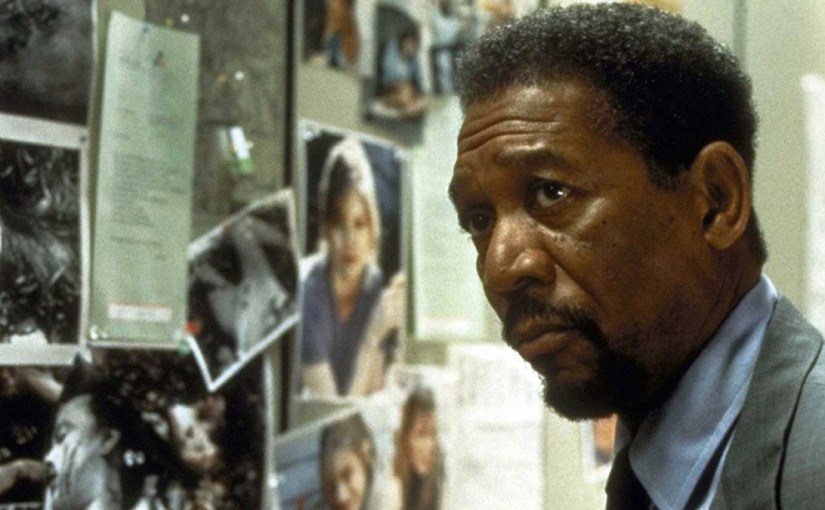
Yup! A whole lot of this nonsense and more that I could cover endlessly. Adapted from James Patterson’s best selling novel featuring his forensics detective hero Alex Cross, Kiss The Girls begins as an effective thriller focusing on the backgrounds of its two leads: dependable Morgan Freeman as Cross, and Ashley Judd as Dr. Kate McTiernan, a skilled surgeon with a specialty in kick boxing (that may come in handy later). At first, we see these characters handling snippets of storylines related to their careers. Cross defuses a suspenseful suicide situation. McTiernan has to console a family whose little girl was in a motorcycle crash. There’s good acting and emotion going on here and I was hoping the film would live up to the promise of these scenes; the characters’ expertise now being applied to Patterson’s main story. It doesn’t.

Instead, the movie just mires itself in plot holes and filler where one character insists on working alone while the other insists on not sitting idly by. This is not character development. This is ping pong volleying. Kate is kidnapped by a serial “collector” of smart, young, beautiful and highly intelligent women by someone regarded as “Casanova.” When Alex’ niece is one of the women taken, he travels from Washington DC to Raleigh, NC to join the investigation.

Soon after Kate has been taken, she manages to be the only one to escape from some hidden dungeon located in the woods. She joins Alex at every turn to find Cassanova and rescue the other captives. Okay. So that’s not a bad set up.

Where it falls apart is in the development. Kate managed to escape by jumping into a river where she’s retrieved by two kids. So wouldn’t law enforcement just sweep that entire area? I mean be really thorough, top to bottom! Surely, you’ll pick up footprints or scents from the dogs. Well, Alex says they did. Fortunately, his niece’s boyfriend finds the map. You know…the map that’s hidden in the library that no one else is aware of and shows this dungeon or whatever it is that’s there. Only one guy, ONE GUY, knows about this map????

When an hour and forty minutes has surpassed, you bet that map is gonna turn up. Remember, also when someone says wait in the car, the one thing you do is not wait. You know, this is a movie. So, Mr. Freeman, please spare me the act of surprise when Ms Judd walks into the bar you’re scoping out. This is all unnecessary, and boring and tired and old.

Kiss The Girls is another film with THAT TWIST! Was it really needed though? Just when the film apprehends the bad guy, and the ladies are recovered safely, there’s a gotcha moment in Kate’s kitchen with lots of knives and pots and pans to play with. Gary Fleder directed this 1997 disturbing thriller in a post age of The Silence Of The Lambs and Seven, which are far superior films. It’s not a film dependent on gore or torture porn, but it’s got the dark stone lined halls for haunted house creepiness. I’m good with that. It’s a thriller after all.

The film’s best assets, however, are Freeman and Judd. These are two top class actors who invest themselves in performance. If only they were working with a much more believable story.

It’s the implausibility in the script that make my eyes roll.

HEAT (1995)

By Marc S. Sanders

My all time favorite crime drama, as well another one of my most favorite films, is Michael Mann’s Heat which is widely recognized for the much-anticipated moment where Al Pacino and Robert DeNiro finally share the screen together for the first time. The Godfather Part II never counted as their characters performed in different time periods. Still, Heat has so much more going for it, beyond just its headliners.

Michael Mann wrote the screenplay he directed. It deeply involves both the thief, Neil McCauly (DeNiro), and the homicide detective who pursues him, Vincent Hanna (Pacino), with inspiration from two real life characters. Therefore, this film drives with more authenticity than a standard Lethal Weapon picture. Much more is at stake than a standard kill shot, arrest or the score to take down. The women and children and partners these guys become associated with carry a weight and sense of value. Even the hoods who betray them hold significance. How they matter and are part of the story is just as pertinent.

The story focuses on DeNiro, with Val Kilmer and Tom Sizemore taking down high stakes scores, not petty liquor store hold ups. An early armored truck hold up goes well until a new partner executes the three security guards in broad daylight on the street, at point blank range. Pacino takes the case along with his brilliant squad of detectives that includes great supporting performances from Mykelti Williamson, Ted Levine and Wes Studi. Then it becomes a cat and mouse tale where two equals match one another in wits, skill, and experience. To believe the equal match up though required casting Pacino and DeNiro. The film would not work with any other pair. Through their respective careers, their various performances came off different than one another. Yet, it has been often easy to imagine either one of them playing their classic roles instead. I could envision DeNiro as Michael Corleone or Serpico. I can also envision Pacino as Rupert Pupkin or Travis Bickle. The range of these actors is unlimited.

Diane Venora and Ashley Judd are two actresses not used enough in films. As the wife to Pacino’s round the clock detective, Mann provides time for Venora to show the pain of a woman in love with a man who can hardly ever be home because he’s always on the prowl of DeNiro’s professional thief and his crew. Venora is a likable woman in the role, only the circumstances of her marriage and the difficulties of dealing with a troubled pre teen (a fantastic Natalie Portman who will break your heart with just three scenes) are gradually making her cold. She has a great monologue midway through the film that is terribly dark, as she surmises Pacino’s cunning detective.

Ashley Judd is a different kind of cold as the wife of Val Kilmer’s gambling addicted sharpshooter. She’s a beautiful housewife and mother to a toddler that is trying to maintain a happy home. However, the balance of living with a career criminal is near impossible to maintain.

Michael Mann put so much thought into characters like this. Other directors and writers would keep the story on the streets and in the hideouts and city precincts. Mann goes not just for the low level criminal hoods who provide information in a night club at 2 AM. Mann allows his crime drama to spill over into the home.

He even allows a side story to occur with an ex con (Dennis Haysbert) out on parole trying to get his life back in order. What does this guy with his loving girlfriend have to do with anything else? Eventually, the bridge is connected, and it comes down to an emotional and heartbreaking conclusion.

Heat deliberately takes its time to flesh out a lot of great characters. The large cast are all given moments to stand apart from the rest. It is primarily a quiet, talking picture of careful planning and investigation. However, when the legwork is complete, Mann arrives at two scenes right in the middle of the film. The first is the now famous coffee shop sit down confrontation between Neil and Vincent. Mann did a masterful job of capturing the two actors doing some of their finest work with nothing tangible to aid them; no props or grand music or effects. Just a table in the middle of a crowded coffee shop. The professionals allow their history to show only so much but the cop and thief know this is not going to be easy from here on out. Mann did numerous takes, but with at least two cameras showing at each go round. So, if Pacino is talking, we see DeNiro’s facial reactions and vice versa. Pacino’s take #11 is also DeNiro’s take #11. It is one of the all-time great scenes in film history. Beautifully written. Beautifully constructed. Beautifully performed.

The next centerpiece is the bank robbery that occurs at midday in downtown Los Angeles. Neil and crew are almost scott free when Vincent and squad intercept them in the middle of the street. What sets this massive shootout (based on a real incident) above all others is that I actually get choked up and emotional over the moment. Characters that I have become acquainted with for the last 90 minutes are swept up in huge risks and danger of massive gunfire and ambushes. I even become terrified for the extras that Mann includes in this scene. I’ve watched this scene a hundred times and I can’t help but actually get tearful over it. Mann has the power to make me have an affection for these characters. As well, how will the spouses, who become aware of this matter, be going forward? That accounts for much of the latter half of the film.

Neil holds true to a philosophy he learned while doing time. If you spot the heat around the corner, allow nothing to interfere that you cannot walk away from immediately to avoid getting apprehended. He is put to the test of that motto when he falls in love with an introverted graphic designer played with quiet reserve by Amy Brenneman. This storyline will sum up the ending. Again, Mann shows the characters on the outside of these guys with their guns, working in an underworld environment. How do the risks of these guys play out on others?

Technically, Heat succeeds as well with brilliant blues, blacks and whites in cinematography. Major accolades for Dante Spinotti. Everything from the well-lit coffee shop to Neil’s unfurnished, ocean view apartment and even a blue Camaro that Neil drives away in through an underground tunnel are brilliant. Spinotti paid careful attention to the evolution of the characters. As Neil drives into that tunnel, the car turns white hot. He is on his way to escape with an unsure Brenneman by his side. Often in moments like this, the film tells more than any piece of dialogue could ever sum up.

Heat is a must watch film for genuine portraits of characters few of us will ever cross paths with. We should understand, though, they have more than just a drive to steal or to get an arrest. These guys exist for more than just the score. Few crime dramas ever approach that angle, and that is why Heat is such a special film.