
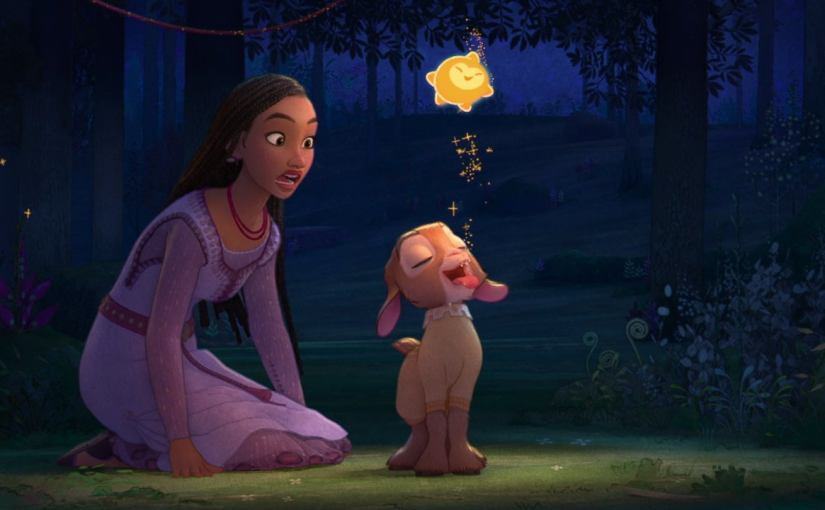
WISH

By Marc S. Sanders

Disney’s Wish seems to stand out from many other films within the studio’s vault because the lack of filmmaking confidence appears so obvious.  What does it tell you when a newly original story is continuously guided by winks and nods from past successes?  We see this thing can’t stand on its own two feet.  So, let’s dress a character up like Peter Pan and literally name a random deer Bambi.

A sorcerer trained in the arts of magic oversees his newfound Mediterranean island kingdom known as Rosas.  He is King Magnifico (Chris Pine) and he has attracted people from all over the world to reside under his rule on the condition that he collects their wishes to be held by him in glittering, floating blue bubbles.  The people of Rosas lose all memory of their respective wishes and now live month to month with anticipation that Magnifico will award them the wishes he holds as a kind of equity or collateral.   

Asha (Ariana DeBose) is a seventeen-year-old who is eager to finally witness her grandfather Sabino’s (Victor Garber) wish come true as his 100th birthday finally approaches.  She also aspires to meet the great sorcerer and hopefully become his apprentice.  As soon as she meets the King though, Asha realizes Magnifico is a greedy, selfish individual who thrives off the admiration of the people of Rosas while savoring the wealth of everyone’s longings.  In other words, Magnifico is a cult leader.

Chris Pine does good voice work here.  He’s gleeful and manipulative and uncaring and evil all at the same time.  Disney’s colorful animation lends to his vocal performance of course with Maleficent inspired glows of green spells which the character conducts.  Yet, my adult mindset could not get past the fact that I’m looking at an animated inspiration of David Miscavage, long time head of the Church Of Scientology.  Magnifico’s wife Amaya (Angelique Cabral) is the quietly naïve representation of David’s wife, Shelly (who has not been accounted for in years).  The poor people of Rosas are the brainwashed disciples believing in this false prophet.  I guess it’s not a terrible concept to apply to a fantasy, but once I see the allegorical connection, Wish makes me feel uneasy.  My fault I guess for watching too many HBO documentaries and listening to former Scientologist Leah Remini too much.

Asha is the hero of this story who makes a wish upon a star.  Actually, a literal character named Star enters the picture.  Star squeaks like a precious darling, ready to be your children’s next plush toy acquisition.  He shoots sparkling trails of gold out of his pointed appendages.  With Star’s help, Asha will reach the standard showdown with the villain by the film’s end and the awakening of the people below.  It’s all trite material that’s been done before.

Wish relies on the vast history of fantastical stories, believing you can fly and be heroic or simply a sidekick tagging along with the protagonist.  Asha has seven friends.  One is referred to as grumpy.  Huh!  How do you like that? Must it be so apparent so often though?  Thanks to Star, forest animals talk and one even makes an inside gag to Zootopia.  You’re practically asked “Get it?  See what I did there?” Magnifico bears a striking resemblance to Jafar and even resides in a similar castle to the Aladdin villain with stone spiral staircases to explore.

The colors and animation are just as engaging as nearly any other Disney film.  A few songs work, but there’s nothing on the level on what was accomplished during the days of Rice and Menken, or even more updated fare like Frozen.  I can’t recall the title of a single number from Wish.  Magnifico sings.  Asha sings multiple times.  The two duet together and it’s not terrible. Ariana DeBose could sing the phone book and I’ll feel swooned.  The supporting people of Rosa sing in choral support as well.

Still, what tainted my experience was turning a very real epidemic of cultish culture into a fantasy catered for all ages to enjoy.  The wishes the people offer up are the endless “donations” that a cult mentality always requests.  While I appreciate being accepted into a fraternity of Disney loving storytelling, I did not need to be banged over the head with so much saluting either.  The end credits contain one classic Disney character after another appearing next to the ongoing scroll.  Hi Dumbo.  Hi Genie.  Hi Peter.  Hi Belle. 

Disney always reminds us to believe our wishes will come true and yet with Wish the studio chose to go with what is blatantly familiar.  It’s time for some fresh ideas again that especially do not source themselves from the reality of harmful sects spreading false doctrines. 

NOTE: I still have a fresh idea from a very popular legendary story that Disney, nor Universal or Warner Bros has yet to touch.  Maybe it’s time I get it down on paper.  Hmm.
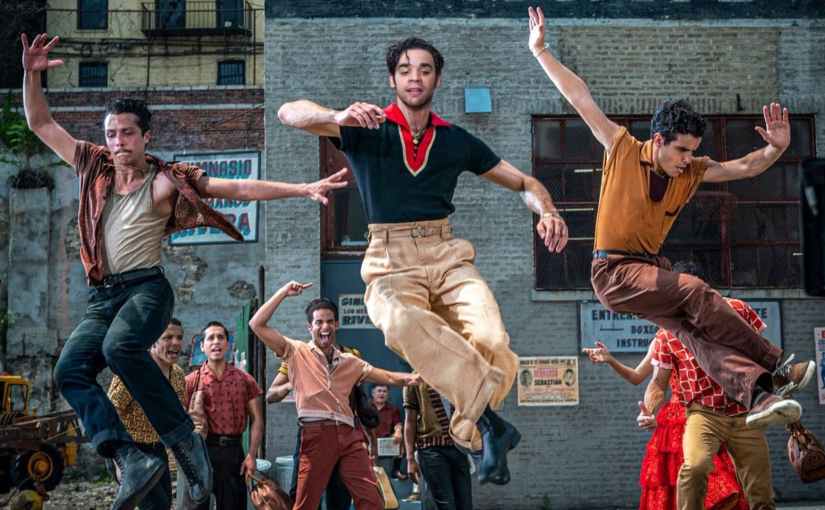
WEST SIDE STORY (2021)

By Marc S. Sanders

Okay!  Let’s get the comparison out of the way first.  Steven Spielberg’s interpretation of West Side Story far exceeds the original 1961 version from Robert Wise and Jerome Robbins that won the Best Picture Academy Award.  I strongly encourage you to see this new film in theatres before it’s gone.  If you miss it, be sure that when you watch it at home, you have the highest upgraded flatscreen with the most enhanced sound system imaginable.  West Side Story of 2021 is a gift of sight and sound.

What Spielberg accomplishes with an updated and outstanding script from Tony Kushner is a more fleshed out, grittier and honest account of territorial entitlement and heated prejudice when the west side of New York City was on the brink of catering to a wealthy white populace and the Puerto Rican community had become established as Americans, even if they were never considered equals.  )The best promise the Puerto Ricans have here for a life is to live as doormen and housekeepers.)  The music and lyrics are more meaningful than ever before.  The characters are given more depth.  The settings become characters themselves.

West Side Story is another example of solid evidence that Steven Spielberg is our greatest modern director.  He not only focuses on the positions his characters hold, allowing them to act with passion and humor and heartache and despair, but he also takes advantage of the props and settings allowed to him beyond limits.  To watch classic numbers come alive not just with the outstanding vocals and dancing, but to see everything in the frame serve a purpose is so gratifying. 

When the Jets strut and ballet down the city streets claiming their elite status in song, Spielberg makes sure these guys literally stop traffic.  Unlike the mundane placement of the winning song “Officer Krupke,” in the original film which only happens on a sidewalk, Spielberg place the boys in the police station where the props of papers and office supplies along with the furniture pieces serve to lampoon the city judge, the cops, the psychiatrists and even themselves.  Maria (20-year-old sensation, Rachel Zegler) owns her rendition of “I Feel Pretty” while the picture enhances the performance with a run through the dress department of Gimbell’s.  Clothes and accessories fly off the racks to send Maria’s enthusiasm of love and happiness into the heavens.  Kushner and Spielberg make a very wise modification to have “Cool” performed by the romantic lead Tony (Ansel Elgort) as a means to calm down his buddy, Riff – leader of the Jets (Mike Faist), before going into a head-to-head rumble with Maria’s brother, Bernardo, leader of the Puerto Rican gang known as the Sharks. Spielberg places these guys on a rickety old dock complete with wide gaps in the floor for the boys to leap over along with smooth planks to slide around on while tossing a gun around like it’s a football.  These characters teetering on manhood beautifully display their recklessness for danger and pride.

Rita Moreno is the significant attraction early on as she fills the Doc mentor role in the local drug store.  Wise & Robbins’ film never made Doc into much of a mentor.  Moreno fills that void.  She portrays a new character named Valentina, the widow of Doc, and the film’s tool of sensibility during these troubled times.  Kushner creates a fleshed-out character who explains that while she married a Gringo, she remains a Puerto Rican and there’s no room for bloodshed.  She has learned to live with others, and now Tony and Bernardo and Riff and the rest need to do so as well.  In another writer’s hands, this might come off preachy.  Not with Kushner’s dialogue though.  The background of Valentina is paved out early on and her elderly physicality can only do so much.  She can’t disarm the toughies, but she won’t stand for their stupidity either.  It’s Moreno’s presence that brings the chaos to a halt even if she knows it’ll never end the senseless war.  She is sure to get an Oscar nomination and like her win as Anita in the original film, she’s likely to win the award here as well.  (The only Hispanic woman to win an Oscar since 1961, and she’s likely to repeat that accomplishment again.)

Another fleshed out character that I really appreciated is that of Chino (Josh Andres Rivera), the nerdy student and best friend to Bernardo.  He’s studying accounting and calculator repair, but Chino wants to join the Sharks and fight for their cause. Bernardo, the tough guy boxer, wants none of that for his friend.  He wants Chino to date Maria.  There’s multi dimension to Chino now that I never saw before, and it is so very necessary.  The character puts a heartbreaking seal on the end of the film or play, whichever you are watching.  With Spielberg’s film, we get more of Chino’s motivation.  We now can understand why it is Chino that really delivers the final punch of the show.

Ariana DeBose plays Anita, Bernardo’s wife, and she’s spectacular as well.  I could watch her lead “America” through the colorful, daylight city streets over and over again.  In her yellow dress, with red lace underneath, and her magnificent energy, she’s a powerhouse of magnetism.  She leads a company of dancers with such a drive.  Again, Spielberg uses the environment of these characters to build them up and Anita dueling with Bernardo during this song in broad daylight (as opposed to just an evening rooftop from the original) is sensational.  Clotheslines and soft fabrics of pink, yellow and blue even sway to the pounding drum of the number from Leonard Bernstein, along with Stephen Sondheim’s original lyrics.

Having seen this film twice, I now recall when I watched it the first time how inappropriate it really was to have Natalie Wood cast as Maria in Robert Wise’s film.  Beyond the fact that she was never an accomplished singer or dancer, she is certainly not the correct ethnicity.  Her skin complexion was actually bronzed for the role and she lip synched her dialogue and singing.  Obviously, she was a marquee name at the time and the bills had to be paid while profits were collected.  Still, what an insult to point of the piece.  West Side Story’s conflicts hinge on racial and ethnic divides.  With Spielberg’s film, he went so far as to not even include subtitles for the Spanish dialogue.  I don’t speak Spanish, and yet while I can not translate, I could understand the emotions and motivations among the Puerto Rican populace.  Why should subtitles be provided?  Why should whites play Hispanics?  It’s a disgrace to consider, especially in a film that relies on ethnic identity.  Often, the Puerto Ricans are reminded by the cops or among themselves to speak in English.  Yet they continue on with the primary language.  Bravo.  Just because the soon to be famed Lincoln Center will be erected on these grounds doesn’t erase a heritage.  You can not whitewash a culture within a melting pot, and you cannot change a mentality that really doesn’t need to be altered.  Puerto Rico is America and Puerto Rico, within the confines of this film’s New York is here to stay.  Spielberg, the Jewish, typically non-musical director, ensures an equal playing field among the divided cast.

The chemistry among the cast has to be celebrated.  The Jets and Sharks work in pitch perfect precision with one another.  You only need to watch the high school dance to recognize that.  Moreover, look at the balletic fight scenes among the Jets in blue and the Sharks in red.  Elgort and the physically much shorter Zegler work beautifully as a couple forbidden to love, much less talk with one another.  Spielberg makes up the odd height differential by placing Tony on a ladder below Maria, who stands assuredly on a balcony or simply by seating Tony while Maria stands, thereby allowing their duets to work nicely in sync as they beautifully gaze upon one another.

2021’s version of West Side Story is an absolute masterpiece.  It is one of Steven Spielberg’s best films.  It’s entertaining, funny, celebratory and authentically heartbreaking. It’s the film I never, ever realized was needed to be conceived again.  West Side Story was the very first stage musical – Broadway musical – I ever saw and it always remained my favorite.  Yet, until I finally saw what Steven Spielberg could do with West Side Story, I actually never realized I hadn’t seen all of West Side Story.