
FURIOSA: A MAD MAX SAGA

By Marc S. Sanders

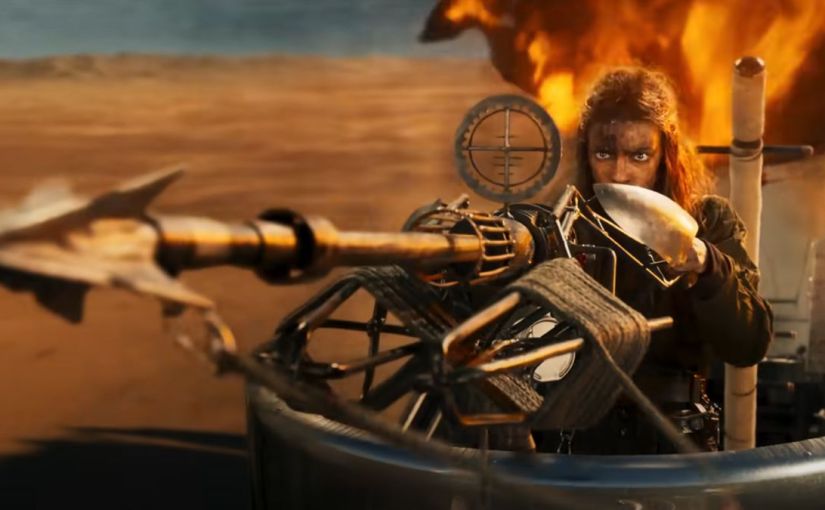
George Miller has never gone deep with his Mad Max movies.  The director treasures the inventions of his auto chases and the tricked out diesel junk contraptions that participate in high speed pursuits through his apocalyptic desert wasteland.  The more outrageous the vehicles and the crazier the stunts are, the more fulfilled Miller appears to be with his filmmaking.  However, the fifth film within this gonzo world of barbaric S & M dressed drivers invites us to explore the past of a surprisingly treasured character,  introduced in the prior film.  Her name is Furiosa and this time we see what she experienced as a young child (Alyla Browne), followed by what she learns as a young adult (Anya Taylor- Joy).  This fifth film in the franchise serves as a prequel to the last film, Mad Max: Fury Road.

As a pre-teen, Furiosa is abducted by the bandits who serve under the pompous and proud Dr. Dementis (Chris Hemsworth, playing his Thor role as if the Marvel character was a celebratory villain). A thrilling prologue covers this sequence of events with rescue efforts from the would-be heroine’s mother to save Furiosa and bring her back to their secret home of green vegetation located beyond the desert plains.  There are heart stopping motorcycle chases with the warrior mother bearing a sniper rifle and fighting with her last breath through the whole sequence.  Charlee Fraser portrays the title character’s mother. Thanks to her performance, she had me convinced me that the rescue will deem successful, accompanied by Miller’s reliable direction.  An absolutely thrilling opening.

Dementis rides his esteemed tri-motorcycle chariot steed, inspired by the sword and sandal adventures of Ben Hur and Gladiator.  A hilarious over the top vehicle to see Chris Hemsworth piloting.  His biker gang is in tow along with young Furiosa as they journey to the Citadel, first seen in Fury Road.  Dementis puts his conceit against that of Immortan Joe (Lachy Hume) the skeleton masked ruler of The Citadel for a chance at…what else?  Conquest and power.

Furiosa grows up a few years and gets mentored by a trucker named Praetorian Jack (Tom Burke).  I still love these character names by the way.  The truck chase is the highlight of the picture, with paragliding motorcycle riders swooping in like large attack birds trying to sabotage the weaponized rig full of delightful surprises that’ll make you shout “OH!!!” in the middle of the theater.  It is sequences like this that audiences adore in the Mad Max pictures. 

Unlike the other films though, Furiosa gets a little lethargic during the story set ups which are angles that never anchored the other better installments, The Road Warrior and Fury Road.  Reintroducing the Immortan Joe character is not as interesting this time and this desert picture gets a little too waterlogged when he enters the story.  He just doesn’t feel very necessary.  The two younger Furiosas and the self absorbed Dementis are plenty with just enough story opportunities to make a solid movie.  Retreading on other characters slow this fifth installment down a bit.

The whole cast looks great.  Anya Taylor-Joy is the best bad ass version of a younger Charlize Theron, who originated the role.  She hardly has any lines but her expressions on camera beneath the war paint, grease, dirt and long hair extensions look awesome.  Though the lead actress is hilariously dwarfed by Hemsworth’s Dementis, they make for a great dichotomy of hero vs villain.  She’s the quiet reserved David.  He’s the proud Goliath.  This is a dream casting pair.

Practical stunts are done once again and George Miller does impressive work with his camera.  His tactics for filming action scenes demonstrate why a Michael Bay normally fails.  Nothing is a quick take edit.  You watch these motorcycle riders and Furiosa hold onto to the bottom of the speeding truck and Miller will circle the camera, with no cuts in the take, so we see what is happening next to both sides of her profile.  The camera will then swoop up to see who’s running and holding on to the top of rig or who is parasailing from a great height while tethered to some kind of buggy vehicle below.  Amazing work.

However, seeing Furiosa on a large Dolby screen, it’s not hard to see a computer enhanced finish applied to the photography.  It’s very glossy and nowhere is it grainy like the very early Mad Max films from over forty years ago.  Yet, as dirty as these vehicles and characters are, the cleanliness of the cinematography sometimes does not clash well with what’s on the screen.  It’s a little distracting honestly and that was a surprise to me considering how perfect Fury Road looks on my 65-inch flat screen at home.  This one looks a little too perfect.  This might be that film where less may have been more.  

The background story work on Furiosa is not a terrible grievance.  The final print of the picture is acceptable.  All of it is definitely worth watching and I hope box office picks up following a sluggish opening weekend because I encourage anyone to see Furiosa: A Mad Max Saga on a big screen first.  I just think George Miller and company may have leaped much further than necessary this time around.
THE MENU

By Marc S. Sanders

Whether you’re the storyteller or the viewer/reader, you take a chance with satire.  The darker the satire is, the even greater the risk you take. A film like The Menu, from director Mark Mylod, is one such example. You’ll hate it…like my wife did, despite the lively conversation we had afterwards.  On the other hand, you might love its invention to strike back at an upper class that lacks any clue or respect for the talents of others. Then again, you just might only like it.  Well…at least I liked it.

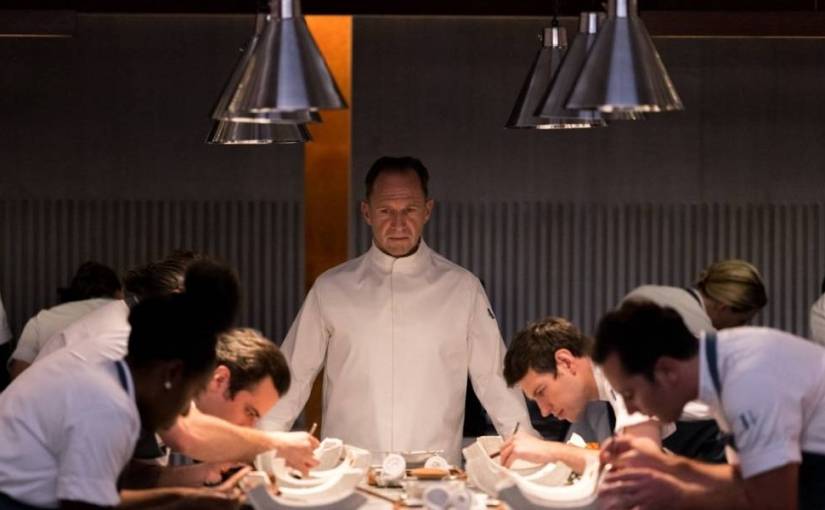
Ralph Fiennes’ résumé has earned a reputation to intimidate an audience. He is a superb actor who can be absolutely frightening as a Nazi in Schindler’s List, or heartbreaking as a torn affiliate of a deceitful plot like in Quiz Show. He can also go toe to toe as a Greek god against Liam Neeson, or he can demand that James Bond “Stand down!” and strike with snake like glee at Harry Potter. He can also teeter along the antics of the devil himself as he portrays the world’s most esteemed chef in The Menu.

A collection of guests is escorted by boat to a remote island where the finest restaurant is located and run by Chef Slowik (Fiennes), with assistance from Elsa (Hong Chau).  There’s Tyler (Nicholas Hoult), a die-hard fan of the chef’s craft with his date Margot (Anya Taylor-Joy), who is nowhere near as impressed.  Tyler has to remind Margot not to smoke, otherwise it’ll destroy her palette for taste.  There’s an older couple who has frequented the Chef’s dining establishments before and are back for another visit.  There are a pair of restaurant critics. There’s a movie star (John Leguizamo) with his young assistant.  Finally, there is a trio of sophomoric, yuppie businessmen who are here because their last monthly commission likely afforded this exclusive opportunity, and their favorite hockey team was out of town.

When the guests arrive on the island, Elsa gives them a tour ahead of the restaurant where they will eventually dine.  A cabin is displayed to show how the meats are aged over a period of 152 days. Quite specific! One of the yuppies has the audacity to ask what happens if you age it to day 153. I don’t recall Elsa’s response.  I do remember her disdain for the question though. They walk through the lodge where Elsa explains that the entire staff reside and sleep in the one room together. One cot for each person. Odd, but okay. Moving on is a quick pass by the cottage where the Chef resides, and no one is permitted to enter. Oooo!!!! I know one thing I expect to happen.

It is important to note that I opted not to read up on anything The Menu was about.  I didn’t know if I was to see a comedy, drama or horror film.  As this tour continued though, I had eerie recollections of the film Midsommar, directed by Ari Aster. That movie still gives me the bejeebees.  So much so that I could not bring myself to write an article about it.  Like that film, our cast has become isolated in a desolate locale, and the guide could not be more unsettling.  When they arrive at the restaurant, a large horizontal door is thunderously closed behind them. Margot gives a quick look back over her shoulder. This cannot be good.

Lending to the structure of the film, courses are presented with a startling clap of the hands from Chef Slowik. Mark Mylod executes a nice pattern of gracefully displaying text across the screen describing what the next featured course is, along with its fine ingredients.  It is elegant but also only partially revealing of some of the guests. Tyler isn’t the kind of fan that Chef would welcome.  After a request has been made not to take pictures of the dishes, he does so anyway.  He is uncouth with his commentary and clumsy as well.  Additionally, bewildering for Chef Slowik is the presence of Margot. He was not expecting her to attend. Yet, here she is and he cannot understand why.

The Menu does not deviate from its intent to be strange. A bread dish is presented without any bread! Only the dips. Tyler is absolutely impressed. Margot thinks it is ridiculous. By the time, the fourth course has arrived, a shocking presentation is exhibited to the guests and that is where the film takes a graphic turn.

It’s best not to reveal much about the movie.  Its features work if you share the perspective of the guests, particularly Margot. What you are left to decide though is if you accept that dark satirical nature of the piece.  You will or you won’t.

I did not find The Menu to be very symbolic, allegorical, or even a reflection of the natures of social classes who partake in exclusive high-end cuisine.  Chef Slowik has prepared a specific plan for this assortment of guests. The execution and outcome cater to his personal satisfaction and no one else’s.  I guess that’s why I only liked the wit behind the message of the film.  I just could not fully embrace its invention.

My experience with satire typically allows me to think about how people behave and what they can learn from outrageous proposals or extreme actions. Network explores how the world responds to what is proposed for satisfying television audiences while generating business profits.  A film like The Menu delves into grandiose, unheard of actions that will satisfy the one puppet master behind everything you are seeing.  Maybe I was looking for the message the Chef delivers to include my own misgivings and sins and temptations in his overall delivery.  Instead, his machinations rely on these specific guests on this particular night, and so I kind of felt left out of the circle. As the guests are specifically affected by the developments of the evening, I can’t say I had any care or sense of suspense for them.  Nor did I care for Chef’s own satisfaction as the evening carries on.

The cast is a terrific eclectic assortment. Anya Taylor-Joy is a smart and forthright hero against Ralph Fiennes’ antagonist. A well written conclusion that made me applaud is included by her character’s deductive reasoning. The other players though are not given much fat to chew on in terms of dialogue or scenes.  Their purpose is specifically explained, and then they are left to watch and wait for the climax of the film. I like the veil that is lifted from Margot’s character.  I would have welcomed a little more subtext on the other characters, however. Again, their purpose is laid out, but I think the film, which clocks in at around an hour and forty-five minutes, could have dug a little deeper into the guests sitting at the other tables. Not to mention those few who also serve on the Chef’s cooking staff.

The Menu is an unusual film, like an episode of Tales From The Darkside or The Twilight Zone.  It is limited like a TV episode. I just think it needed two or three more courses to savor just a little more meat on the bone.

GLASS

By Marc S. Sanders

M Night Shyamalan’s Glass is mind numbingly stupid and unbearably boring. A slow moving slog of a movie that scrapes the bottom of a barrel of wasted, rejected plot devices.

This is apparently the 3rd in a series of super hero comic book inspired movies from Shyamalan, but it seems to lack the research into the true construction of a standard comic book or graphic novel. If Samuel L Jackson as the title character declares this is an “origin story,” when it’s clearly not, well then Shyamalan expects you to believe that at face value.

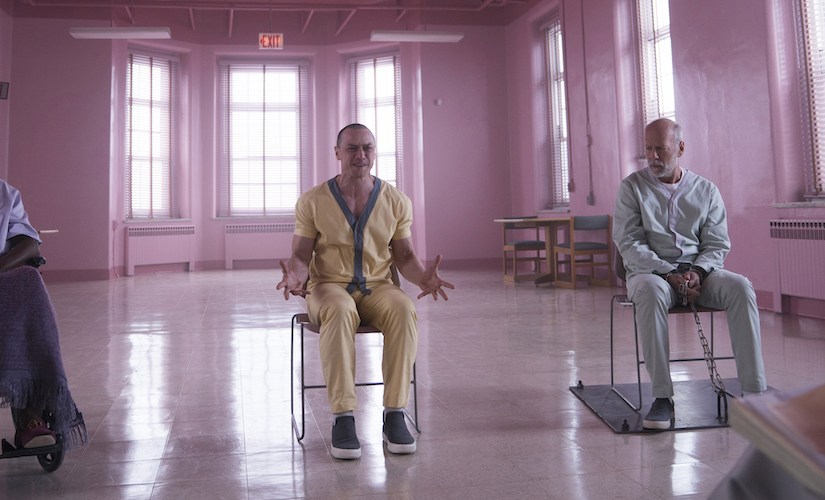
The three central roles played by Jackson, Bruce Willis and James McAvoy are meant to be super human beings. Sure, Willis as the hero David symbolized in green with a poncho has evident powers. Jackson as a villain in purple, however, does not possess any powers. He just masterminds disasters that in other films would be regarded as sabotage and terrorism. Where’s the super power in that? McAvoy as “The Horde” is just mentally ill who hulks out and climbs walls when his beast persona takes over. Yeah, that’s superhuman but for me it’s seems overshadowed by the mental ailments befalling McAvoy’s role as Kevin and 23 other personalities.

Shyamalan is ridiculously overconfident in being a comic book aficionado but has he ever read a comic book? Sorry but I didn’t recognize much in the form of a standard monthly super hero yarn here.

His script has no bite. It has no memorable moments and it has a 2nd act of 4 total that is simply Sarah Paulson sitting in a chair playing a psych doctor offering an explanation for the purpose of the three men. READER, this one has four characters sitting (never standing, never walking, never even turning their heads) in a large room listening to Paulson speak. I’d rather be at an insurance seminar. This scene goes on for a good 20 minutes and I dozed off and on. I literally could not keep my eyes open. Shyamalan typed a long monologue, for Paulson’s character to explain a theory, on a word doc and proudly never edited it.

Revelations are slapped on at the end because god forbid Shyamalan concludes a story without a twist. The ending is as dumb as the film’s 4 note string background which is as dumb as Shyamalan’s script and the film as a whole. It comes from nowhere. It offersno irony and it’s never implied anywhere.

There’s nothing that McAvoy, Willis, Jackson or Paulson should feel proud of here. They stare. They grimace. They make claims on a misguided screenwriter’s behalf that what’s presented is something grander than the absence of storytelling this film suffers from.

Glass is poorly written, poorly edited and poorly directed. It’s a film that’s about as necessary as a sequel to Top Gun.

(Oh shit!!!! Now I’ve done it!!!!)