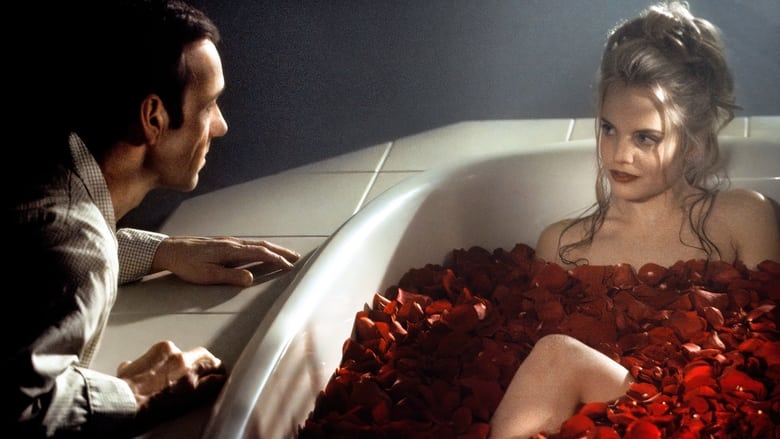
AMERICAN BEAUTY

By Marc S. Sanders

Lester Burnham declares in less than a year he’ll be dead.  When we meet him, he’s masturbating in the shower, sleeping in the back of the family vehicle on the way to work, and declaring that his wife Carolyn used to be lovely.  Heck, he’s acting like he’s dead already.  His life has nothing new or exciting to pursue.  His daughter, Jane, doesn’t give him the time of day.  He’s threatened with being laid off from his magazine call center job that he’s held on to for nearly twenty-five years.  What’s to live for anymore? 

I guess what’s complimentary about poor Lester is that at least he’s honest with himself.  All the other neighbors, except for the gay couple known as Jim & Jim, are just as unhappy it seems and might as well be dead too.  A common theme running through the suburban landscape of American Beauty centers on a sense of mental awakening. Who revives sad, lost folks like Lester and Carolyn?  Perhaps it’s the generation sneaking up behind them, who are on the cusp of taking their place in young adulthood. 

Lester is played by Kevin Spacey, in his second Oscar winning performance.  Carolyn is portrayed by Annette Bening who is way overdue for a trophy.  Jane the daughter is played by Thora Birch.  The headliners of this cast are outstanding in how different and disagreeable they portray a broken family that is forced to live in an unstimulating home while trudging through a lifeless marriage.  Look at the set designs within this film.  There’s an endless amount of blank walls within the interiors of the homes.  Almost no artwork or pictures are to be found. 

Lester pines and fantasizes about Jane’s best friend Angela (Mena Suvari) getting rained on with red rose petals while she lies naked in a pure white bathtub.  Carolyn, the real estate agent who can’t make a sale, sidles up to the dashing Buddy Kane (Peter Gallagher), her competition. Next door is Chris Cooper in a hospital cornered role as retired Marine Colonel Frank Fitts, with his near comatose wife Barbara played by Allison Janey, and their eighteen-year-old resourceful drug dealing son, Ricky (Wes Bentley). He takes advantage of his camcorder at any opportunity to collect the beautiful images found within the world he occupies and observes.  That could mean he’s capturing Jane in her bedroom window which faces his own.  Later, he’ll show you the freedom of a plastic shopping bag dancing within an autumn breeze.  An old shopping bag has more life among a breeze and brown leaves than Lester, Carolyn, Frank or Barbara.

There is a mystery to American Beauty that seems quite odd.  We know that Lester will die soon, but how and why? Maybe there’s a twist, because that outcome seems more and more impossible as we see Lester discover a spirited mindset to go after what he wants, when he wants and declare that he’s not going to allow himself to take shit from anyone particularly in his boring dead end job or from his unaffectionate wife.  Ricky, the kid with tons of money and electronics equipment, has nothing to lose because he’s not committed to anything at age eighteen and he can just quit an ordinary table-waiting job at any given moment.  Why didn’t Lester have the gumption to ever be like Ricky?   It seems so simple.

There’s a blink and miss it sign hidden in plain sight.  Pinned to the wall of Lester’s work cubicle is the message “Look Closer.”  Director Sam Mendes and writer Alan Ball gives the audience a subtle wink to dig within the cracks of suburban life sidewalks.  These homes may appear perfect on the outside, with neighborly neighbors, but if you watch with a more critical eye you’ll find an emptiness that has been unfilled for too long.  The filmmakers make it easy for you to uncover what eats away at the upper middle-class way of living.  Dinner with Lawrence Welk playing in the background is anything but uplifting.  It’s imprisoning.

When one member of this community opts to seize his moment, no matter if he’s motivated by a kid’s rebelliousness and the drugs he buys off of him, or the fact that he thinks a beautiful teenage blonde has the hots for him, he sets out to change.  He exercises and builds up his body, buys the dream sports car he’s always wanted, quits his job and grows to not caring how this may disturb his unloving wife. 

American Beauty seems to remind us how alive we can be when we are younger and not as restrained by the commitments it takes to live like adults with debts and parenthood and jobs and marriage.  Look closer though because couldn’t we live as well or more aggressively when middle age arrives?

The irony of Alan Ball’s script is that a boring guy like Lester Burnham discovers exciting things about himself just as the end of his life is approaching.  All he needed was stimulation.  He never saw his death coming, and you might forget he told you he will soon be dead, but American Beauty works to show how necessary it is to live each day to the fullest. 

I sound hokey.  I know.  Yet, that’s the direction of this film’s trajectory.  On the side, you observe those people who do not pursue what will fulfill their own lives and desperately need a modification.  Lester was limited to branch out. So is Colonel Fitts and his very sad wife.  So is Carolyn, and Jane and Angela, and maybe so is Ricky.  All of these people uphold facades about themselves to preserve a happiness on the outside when they really feel worse within. 

Sam Mendes is brilliant at drawing upon the subtle messages and insecurities of Alan Ball’s neighborhood characters.   About the only people that Sam and Alan do not dig deeper with is the gay couple.  I guess since they are happily out of the closet, what is left for them to conceal?

I could not help but compare Mendes’ Oscar winning film to Robert Redford’s.  American Beauty is more forthright than Ordinary People. Redford’s film draws out the ugly honesty of the family nucleus when an unexpected tragedy interferes.  Then it takes the entire film before the spouses take off their masks and truly declare how they regard each other.  It’s crushing to realize a sad truth. 

American Beauty rips off the layer right at the beginning, though.  A tragedy does not awaken these people to the natures that embarrass them.  Simply a hellbent, fed up mindset gets one guy going, and if that one member opens his eyes, then so will others because a simple disruption in ordinary life is next to impossible to live with.  Both films are so wise in how they criticize the very people these films were likely catered for.

What do these two Oscar winners say?  They tell the middle class, middle age American to simply look closer.

THE GRIFTERS (1990)

by Miguel E. Rodriguez

DIRECTOR: Stephen Frears
CAST: Anjelica Huston, John Cusack, Annette Bening, Pat Hingle, Charles Napier, J.T. Walsh
MY RATING: 9/10
ROTTEN TOMATOMETER: 91% Certified Fresh

PLOT: A small-time con man has torn loyalties between his new girlfriend and his estranged mother, a high stakes grifter working for the mob.


Imagine your favorite film noir from the 1940s and ‘50s.  The Big Heat, say, or Double Indemnity.  Now imagine someone remade it, set it in the modern world, retained most, if not all, of the hard-boiled dialogue and characters, threw in some gratuitous nudity, and added some Freudian subtext that would have made Oedipus blush.  Oh, and imagine David Mamet directed it.  Voila…you’ve got 1990’s The Grifters, directed by Stephen Frears and co-produced by none other than Martin Scorsese.  It tends to move just a tad slow at times, but all that simmering pays off in the movie’s phenomenal final reel.  I am going to have to tread carefully indeed to avoid spoiling some of the movie’s best surprises.  Here goes:

As the movie opens, we are introduced to three very different characters, at least on the surface.  Lilly (Anjelica Huston) works for the mob by visiting horse racing tracks across the country and laying pricey bets on long shots to bring the odds down just in case they pay off.  She also skims just enough off the top to stay under the radar.  Roy (John Cusack) is a young man pulling small-time cons of his own, like the one where he flashes a $20 bill at a bartender, then pays with a $10 bill instead, getting $20 worth of change at half the price.  And Myra Langtry (Annette Bening in her breakout role) is first glimpsed attempting a lame con at a jewelry shop that ends with her offering her body to the jeweler instead.  (I like the fact that nearly everyone calls her “Mrs. Langtry” even though no one seems to have laid eyes on her husband.)

Myra is Roy’s vivacious new girlfriend.  Lilly is Roy’s estranged mother; she had him when she was fourteen years old (yikes) and he left home at 17, as he puts it, “with nothing but stuff I bought and paid for myself.”  Roy values his independence above all else, maybe even more than the money he’s “earned” and stashed away behind the ugly clown paintings in his living room.  So, when Lilly unexpectedly drops by his apartment in Los Angeles (which she always pronounces “Los Ann-guh-leez”) on her way to the track at La Jolla, he lies about his livelihood.  The last thing he wants is a concerned grifter mother trying to partner up with him.  He learned that from a mentor years ago, seen in a flashback: “You take a partner, you put an apple on your head and hand the other guy a shotgun.”

Due to an injury sustained from a bartender who caught him in a grift, Roy winds up in the hospital, where Lilly meets Myra for the first time.  They are not impressed with each other; their introductory conversation is brief, but it plays like Bette Davis clashing with Joan Crawford.  We get a little more information about Myra’s situation when we see her go home to her apartment where she is met by her landlord, Joe, who demands payment on her outstanding bill.  Her response is to bat her eyes and launch into a patter of what sounds like a radio or TV commercial.  “You, too, could learn to dance!  All you need is a magic step!”  After some more back and forth, she lies down naked on her bed and offers Joe a choice: “Only one choice to a customer, the lady or the loot.  What’s it gonna be?”

What makes a scene like that sparkle, along with virtually every scene in the film, is the fierce individuality displayed by the characters.  They are each wholly original, not simply placeholders for foregone dialogue or plot developments.  In classic film noir, the lead character is usually a smart guy (or gal) who thinks he’s smarter than everyone else but gets caught off guard by his own desires.  In The Grifters, all the main characters are smart…and they stay that way the whole movie.  There is not one single plot development that evolves because anyone makes a dumb decision.  You can see that they all have a clear view of all the angles, and no one is going to make a stupid choice for the sake of the script.  I can’t tell you how rare that is.  The plot and the story unwind and are wound up like a precision watch.  By the time the credits roll, you can see exactly why each character made the decisions they did, leading them to the shocking finale in the last reel.

I really can’t say more about the plot without simply retelling scenes or giving away spoilers.  Throughout the film, Huston, Cusack, and Bening deliver performances that would be right at home in a Mamet film.  They’re allowed to show more emotion than can usually be found in Mamet (I’m thinking particularly of House of Games), but their pared-down, hard-boiled dialogue cuts to the heart of the matter without being flowery.  There’s a scene involving Lilly’s boss, Bobo, played by Pat Hingle with a flat-eyed menace that would make Sonny Corleone run for cover.  His deadpan dialogue with Lilly about oranges is one of the tensest gangland conversations I’ve ever seen, and he does it without ever raising his voice.  Brilliantly written.

If this review has been vague, it’s because I am trying to preserve the unexpected twists and turns about who’s who, and who’s hiding what, and why.  If you find yourself wondering why things are moving kind of slow in the first 30-45 minutes, just be patient and let your ears bask in the hum of the crisp dialogue; observe how each character behaves according to their character, not according to a script; and marvel how a movie set in modern day can still have dizzy dames and classy broads and world-weary heroes and not feel like a relic from the 1940s, but instead feels as fresh as a movie that was released yesterday.  The Grifters is nearly-buried treasure that deserves to be rediscovered.

NYAD

By Marc S. Sanders

When some people go through a midlife crisis, they might buy themselves a car, get a new job or opt to not get out of bed for several days.  When Diana Nyad goes through a midlife crisis in her early sixties, she motivates herself to swim 103 miles from Cuba to Florida.  She came up short at age 28, but over thirty years later no one is going to convince her she shouldn’t try again.

Annette Bening portrays the real-life swimmer whose determination will bear the brunt of self-torture to complete arguably the maritime equivalent of climbing Everest.  Jodie Foster is Diana’s best friend and coach, Bonnie Stoll.  As acting partners and the characters they play, the leading ladies make a good pair.  

My first compliment has to go to the makeup department led by Ana María Andrickson.  The actresses received Oscar nominations, but the work done on Bening to play Nyad is astoundingly convincing. Diana makes several attempts to try to complete this challenge that’s never been accomplished before.  With each try, the dried-up complexion, blistering sunburns, chapped lips and bloodied cracks that prominently show on her body are truly painful and awfully uncomfortable to gaze upon.  At times, I was not as focused on the dialogue shared between Foster and Bening as I was on Andrickson’s masterful work.  The makeup alone tells an impactful story. A clear oversight by the Academy.

Annette Bening is particularly good in her role.  At times she’s a terrible annoyance and unlikable.  Yet, a sixty something year old woman who wants to defy all logic and the literal forces of nature will have to be a certain brand of jerk to move forward with her goals. This also comes with the natural degeneration of a body of freckled dry skin, loss of muscle mass and arthritic bones. Bening is far removed from the glamorous roles of an impressively long career past (Bugsy, American Beauty) to get to a persistent, unwavering zenith that the real Diana Nyad had to emote.

Jodie Foster is fine as Nyad’s best friend and former lover now coach.  I’m not sure all the award nominated praise she’s received for this part is merited, but she’s worthy of falling in line with other celebratory coaching mentors like Mickey from the Rocky films and Mr. Miyagi from The Karate Kid.  The film focuses so much on Diana Nyad though that there’s not much depth to Foster’s role.  She does the job, but it did not feel like it demanded much.  Frankly, Viola Davis in Air and Maura Tierny in The Iron Claw left me with more of an impression in an astounding year of great films and performances from 2023.

The unsung cast member who’s getting next to no press recognition is Rhys Ifans as John Bartlett, an oceanographer recruited by Nyad and Stoll to gauge immediate weather patterns and what the currents of the Atlantic are expected to do during the swimmer’s trek.  Ifans is a fantastic supporting character actor who is tasked with finding that suitable small window of time for Diana to start her journey. Within the context of the script, he offers the suspense needed for this sports film.  Can Diana Nyad hold up against the very real and insurmountable warnings that John describes?

Swimming is quite boring to watch.  However, this venture has cause for concerns.  Brutal storms, stinging jellyfish with undetectable approaches, and sharks.  Salt water, weakness and fatigue, the chops of the tide and mental hallucinations are also bears of contention.  A charter boat with Bonnie and John on board with a watchful, supportive crew sail alongside the swimmer, but they can only do so much if she intends to achieve her seemingly impossible goal unassisted.

Elizabeth Chai Vasarhelyi and Jimmy Chin are the directing team for Nyad with a script written by Julia Cox based on Diana Nyad’s novel account.  Most of the film is patterned like many other sports films focusing on an underdog.  I knew nothing about this person or her accomplishments.  Frankly, what I’ve learned is unbelievably impressive beyond what this picture focuses on.  Naturally, you’ll get an idea of how the story is going to conclude.

To enhance the ho hum activity of the swimming scenes, the filmmakers incorporate some of Nyad’s dreamlike delusions to get inside her head.  Falling rainbow stars onto the ocean surface as well as a yellow brick road leading to the Taj Mahal look as fantastical as they should, even if they drift into sidebar distractions.  I appreciated the handful of scenes where Rhys Ifans lays out the desperate concern shared with Jodie Foster about a lack of progress where Diana is wasting strokes against a current as well as his fear of oncoming sharks.  He builds suspense to keep the film focused. It’s pretty cool by the way how the crew responds to the shark issue.  

In addition, as good as Bening and Foster are with enormous careers of outstanding roles, much of their shared dialogue often comes off a little too hokey.  Granted, it’s a standard sports film and it’s more impressive that it’s all true, but Nyad sometimes plays off like a cheesy TV movie lacking that cinematic edge I was looking for.

An unclear element offers glimpses of Diana’s past as a beginner child swimmer who suffered personal trauma. It’s clear what happened to her, but these quick flashbacks are also mixed in with an unclear picture of her parental lineage and other ingredients.  I still don’t know why there were snippets of Diana playing Parcheesi.  Nor do I know who she was playing with to uphold its significance in the final edit of the movie.

Nyad is a biography worth seeing. The endurance the central character sustains to achieve the impossible is tremendously inspiring.  The thought that was running through my mind over the course of the film is that this woman wants to dominate over a powerful Mother Nature.  By the end, you see real life clips of Diana Nyad insisting to audiences that no matter who you are or what age you’re at in life, nothing can defeat what you want to overcome.  As well, whatever you succeed at likely deserves enormous credit for the support team that accompanied you.  Often, I’m a naysayer of Diana’s mantra because I think I’ve chalked up at least five times more failures than successes in my life.  Still, here is the person who eventually proved me wrong.  I should also note that I learn from my failures and remain hopeful that it will lead to success.

I often tell myself never to argue with a woman. Well, at least now I know never to argue with Diana Nyad.  

DEATH ON THE NILE (2022)

By Marc S. Sanders

It’s time for the murder mystery to maintain an ongoing trend in modern films.  They’re just fun to watch and play with and deduce.  Why do you think the board game Clue has lasted so long in so many households?  Films like Rian Johnson’s Knives Out and a recent retelling of Murder On The Orient Express have already whetted our appetites for the “who done it?” tales.  Endless variations of Sherlock Holmes continue to appear.  Even Steve Martin and Martin Short have gotten in on the mystery circuit.  Adam Sandler with Jennifer Aniston, too.  Kenneth Branagh’s second time as Hercule Poirot (following …Orient Express), in an adaptation of Agatha Christie’s Death On The Nile, is proof positive that the sleuth is the next super hero that movie goers should follow.

Branagh returns to direct his detective character in Egypt, aboard a privately rented boat occupied by the newly engaged couple, Lynette Ridgeway and Simon Doyle (Gal Gadot and Armie Hammer).  As the luxurious yacht makes its way down the majestic river Nile, the couple suspects that someone, particularly Simon’s recent ex-fiancée, Jacqueline (Emma Mackey), is determined to cause harm or even murder towards them.  They ask for the sleuth’s services in uncovering who is scheming against them.  Poirot is on vacation, however, and tells them his services cannot be made available as no crime has been committed.  Yet, he accepts their invitation to board the boat and attempt to relax and recline. 

Naturally, a murder will eventually occur.

Hercule Poirot was not even a character in Agatha Christie’s original novel.  Yet, Branagh seamlessly weaves the detective into an elegant page turner on screen, with a script from Michael Green.  Branagh is a skillful actor/director. 

As this is a murder mystery, there are a wealth of characters with possible motives and red herrings to keep the journey down the Nile tense and engaging.  There’s the doctor (Russell Brand), an aunt (Annette Benning), a nephew (Tom Bateman, returning from Orient Express), Lynette’s housemaid (Jennifer Saunders), a speakeasy blues singer and her niece (Sophie Okonedo, Letitia Wright), as well as Lynette, Simon and Jacqueline, and on and on.  Branagh wisely moves his camera repeatedly at times across the boat panning over the faces of the cast, as if to the remind the viewer of who are the suspects.  There’s a wealth of information to take in, but this is not going to feel like you are cramming for a final exam the next morning. 

Because everyone could have a motive and/or a background with the murder victim, each actor within the colorful cast has various moments to shine.  There are some great acting scenes going on here that the players share with Branagh, and they don’t come off with similar formulas from one moment to the next.  Each character actor is thankfully unique in both appearance and personality.  It’s not hard to keep up, and while I may have known the ending before seeing the film (having read the book and seen stage adaptations over the years), I don’t believe it’s easy to deduce and solve as a viewer.  Different characters and moments that never occurred in the source material turn up.  There might even be few unexpected deaths along the way.  Branagh also keeps the picture alive with outstanding blues numbers that begin in an underground speakeasy bar in Paris and then play over transitional moments throughout the film.  This picture has a great period soundtrack.

Beyond the well diversified mystery, Branagh treats the viewers to gorgeous scenery aboard the boat, but even beneath the surface of the river and within the pyramids and sphinxes of Egypt.  There are spectacular starry night skies and breathtaking sunrises and sunsets to take in with palm trees and wildlife in the desert frames.  Sure, I imagine most of it is CGI, but it’s well done and nothing looks artificial.  Costume work is also magnificent as they lend to the distinctiveness of the suspects.  Whether it is evening wear, or casual garb for post-World War I, each character looks so intriguingly lively and different.

Michael Green’s script even delves further into the Poirot character.  There’s a background to that infamous mustache and tiny goatee.  I recall how people responded to the outrageously grotesque facial hair that Branagh donned in his first film as Poirot.  I appreciated it, however.  His appearance was as unforgettable as the red and yellow “S” on Superman’s chest.  Yet, why go to such great lengths, even if this is the early 1900’s amid an exaggeratingly glamourous murder mystery, to grow a mustache like that? Thankfully, there’s reason given here that draws out a dimension to Hercule Poirot both within a ten-minute prologue, and then implied periodically during the course of the film and wrapping up in a bluesy epilogue before the credits roll.  All I’ll say is that absurd mustache delivers a humanity to the film’s protagonist.

Death On The Nile has already suffered from negative publicity involving controversy with some of its cast members.  Its release was also postponed a number of times due to the pandemic.  Finally, it has arrived in theatres and what a refreshing experience it is to see on a big screen.  It opened to a modest box office response in its first weekend, though it finished at number one.  Normally, I don’t care about rankings at the box office.  How much money a film makes does not lend to the merits or faults of a piece.  However, for this film, I think I do care a little.  I hope it becomes a profitable success only to allow more films of the mystery genre to appear on screen in the future.  I’d certainly welcome another gripping yarn from Agatha, out of service from Kenneth Branagh.  Could And Then There Were None… be next?  That’s the real mystery.

CAPTAIN MARVEL

By Marc S. Sanders

Anna Boden & Ryan Fleck directed the Captain Marvel installment of the Marvel Cinematic Universe. The film has some successes, but some failures as well. Fortunately, where it lacks happens early on and then the film continues to get better.

Boden & Fleck must have directed a film that was never released because this Captain Marvel begins in the middle of a story with exposition that’s terribly hard to follow. I’ve seen it three times now, and it’s still hard to piece the first 40 minutes together. The title character is known as “Vers” (pronounced “veers”) played by Brie Larson. She dons a green uniform space suit and is part of a civilization called Kree. Her mentor is Yon-Rogg played by Jude Law. They head a team on a mission to rescue a spy of their own held captive by the shape shifting Skrulls. The mission goes awry and Vers is captured. Small snippets of a life lived on Earth flash in her subconsciousness as the Skrulls study her mind. When Vers manages to escape, she ends up on Earth in 1995. Gradually, with the assistance of a young Nick Fury (Samuel L Jackson with hair, a clean CGI complexion and no eye patch), Vers learns of her true history that she seems to have forgotten. Reader, I just summed up the first third of this film better than the movie ever did.

Boden & Fleck have some nice touches to this film but only in the second and third acts. Captain Marvel salutes the grunge music of the 90s while also taking inspired narratives from films like The Terminator. There’s some nice twists in the film too.

However, the whole first act should be thrown away and redone. It’s terribly confusing with dark cinematography on what is to be an alien planet at night and a dimly lit unfamiliar space ship. Hardly any characters are fleshed out yet but they talk in conversations that lose me. The Skrulls are shape shifters that can adapt the image of another person or creature but because it’s all so dark, it’s difficult to decipher who is who. Not much payoff comes when you are finally able to piece some material from this whole sequence later on, based on what Vers uncovers about herself, the Kree and the Skrulls.

Brie Larson is fine in the role while primarily playing it straight. Nothing special, but nothing terrible either.

Samuel L Jackson plays this Nick Fury with more naivety than seen before. He’s a younger version of himself after all. So that’s somewhat humorous, especially his chemistry with an odd cat called Goose.

Ben Mendelsohn continues to break into these mainstream film franchises as an antagonist of some sort but sadly no one remembers him, I would think. He needs to be regarded in the same league with guys like Gary Oldman and Christopher Walken. What’s next for him? How about a James Bond villain?

Annette Bening is a welcome presence as the “supreme intelligence” for Vers. Accompany her sashaying to Nirvana’s “Come As You Are,” and I’m entertained.

There was a better film here. Due to a weak beginning, I can only mildly recommend Captain Marvel. Pop culture references and a redeeming two thirds of the film rescue it from utter confusion. Still, if I have to pause the film on occasion to explain to my wife and daughter what is going on, I think that is more an issue with the film than with the viewer.