
I CONFESS

By Marc S. Sanders

Alfred Hitchcock’s 1953 film noir I Confess is an absolute must see. An underrated film that held my attention all the way to the end. Perhaps because of its subject matter and setting within the Catholic Church it didn’t hold the reputation of Hitch’s other more well known classics like Psycho, The Birds and North By Northwest. Those films played with their suspense. They had fun with humor and special effects to carry their adventures and horror. I Confess has a little more serious weight to its story, as it examines the scruples of its characters within a murder yarn.

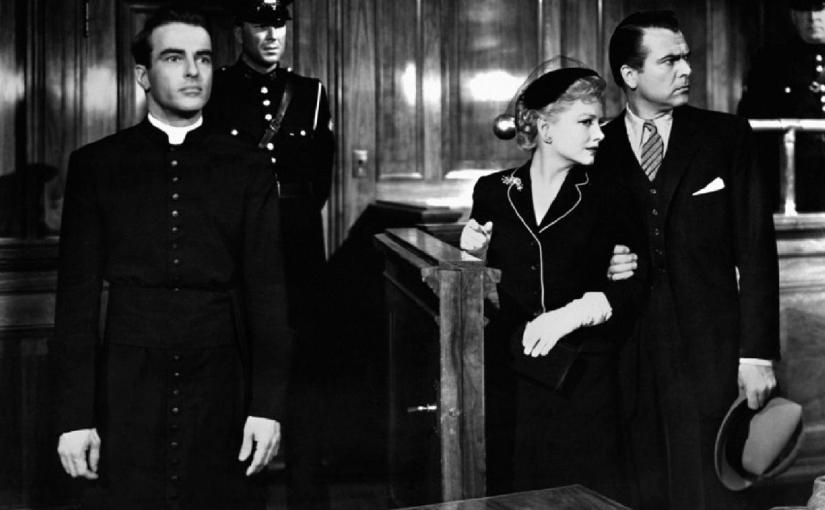
Montgomery Clift portrays Michael Logan, a Catholic Priest, who hears the confession of a murder from the church’s maintenance man (O.E. Hasse), late one night. Only now, sworn to his oath of confidence, he must keep it undisclosed. That might be a little challenging when it is gradually revealed that Fr. Logan might have a connection to the victim, a well known attorney.

Anne Baxter plays Ruth Grandefort, the wife of a politician, caught speaking with Logan just outside of the scene of the crime the next morning. Inspector LaRue (Karl Malden) has reason to follow up on these people. Immediately, your mind will likely go somewhere. When a man and a woman are caught whispering to one another in any murder mystery, well, what are you gonna think? Still, could it be something else entirely? Alibis are not quite solid and unlikely suspects are caught together. Why? What do they know? What’s the connection?

Hitchcock shoots a mystery turned inside out. You know who the killer is in the first five minutes. From there he pursues the red herring until it’s conclusion. The mystery isn’t really the issue here. The question is whether Logan and Grandefort will avoid a frame up. Can Fr. Logan maintain his oath while maintaining his innocence? Det. LaRue has every reason to believe he’s got his culprit, and yet he doesn’t.

Film noir set in Quebec sidles up to questions of morality beautifully here. I was truly wondering whether Logan was going to get exonerated. Hitchcock applies the suspense in that perspective. It’s a great twist on the traditional Agatha Christie motif. He’s got a great tracking shot (actually he was probably carrying the camera and walking on his own two feet) of the maintenance man walking at a fast pace alongside Logan down a hallway, reminding him of his commitment of confidentiality. “As long as you’re a priest…”. Hitch got my pulse racing at this moment.

The three principal players (Clift, Baxter and Malden) are very good here. None of the performances feel dated. As well, Hasse as the murderous German caretaker makes for a good, creepy foil, always looking in from the outside to make certain the investigation never sways away from Logan.

The set up is really well executed from Hitchcock using a script by George Tabori & William Archibald, adapted from an early 20th century play by Paul Anthelme. It’s a little surprising to see a priest caught up in a murder and perhaps some other sinful acts in a film from 1953. There were actually aspects of the original script that Warner Brothers insisted be excised.

However, had this film been made today, there’d likely be an uproar over a Catholic Priest being considered for murder or even participating in a possible affair.

The shock of it all still works in I Confess. A priest is a prime murder suspect? Never! How could it be? Yet, that’s what engaged me. We all are capable of carrying out the worst acts imaginable. The same could be said that we are all capable of holding true to our moral character. Our capabilities are embedded in our human mindset. The question is what is everyone willing to believe.
ALL ABOUT EVE

By Marc S. Sanders

Today’s actresses can lobby and vie to be Wonder Woman or Black Widow or Jane Bond. Yet, what so many filmmakers and actors fail to recall are the powerhouse performances of yesteryear that didn’t require guns and magic lassos. Movies shouldn’t simply be super heroes and villains in spandex and leather. No movie is a better example of this argument than Joseph L Mankiewicz’ 1950 Best Picture winner All About Eve.

This is also the only film in history to have four actresses nominated for acting awards – Bette Davis, Anne Baxter, Celeste Holm and Thelma Ritter. What an accomplishment!!!

Davis is Broadway legend Margo Channing, a sexy, tough, cigarette smoking broad who grew up and keeps her social life within the limelight. She’s a warrior among the Hollywood and New York elite. When her friend Karen Richards (Holm) welcomes a mousy young girl in a raincoat backstage to meet the famous Miss Channing, it becomes more than just a quick hello. This girl is Eve Harrington who proudly admits to following Margo’s career from San Francisco all the way to Broadway waiting outside the theatre on each performance night for that opportunity to meet the legend in person.

Upon introduction, Eve shares her tragic story of growing up poor and losing her husband in the war. Margo and Karen are taken with Eve, and now the young ingenue has wielded her way into the upper crust life among the pomp and circumstance. Margo’s test of her own celebrity seems to come unexpectedly as it occurs to her and her smarmy personal assistant Birdie (Ritter) that maybe Eve is angling for a way to fill Margo’s big shoes along with her wardrobe and stage costumes.

The elite are intruded upon by this outsider. Karen’s friendship to her playwriting husband Lloyd (Hugh Marlowe) and her friendship to Margo is tested by Eve’s surprising manipulations. As well, Eve is making herself more aware to Margo’s younger lover and stage director Bill (Gary Merrill). Eve also finds ways to build an acting career on the shoulders of these show biz upper class by eventually winning the opportunity to be Margo’s understudy.

The outsider who narrates these developments is the famed theatre critic, Addison DeWitt (a charming and cultured George Sanders who won the Oscar). DeWitt might not get welcomed to every exclusive black tie party in town as he’s “the critic” but that’s fine for it’s how he survives in his career. He’ll recruit a young naive actress like a newcomer played by Marilyn Monroe to maintain a stay within the social circle, and soon he’ll ride along on Eve’s journey for personal gain.

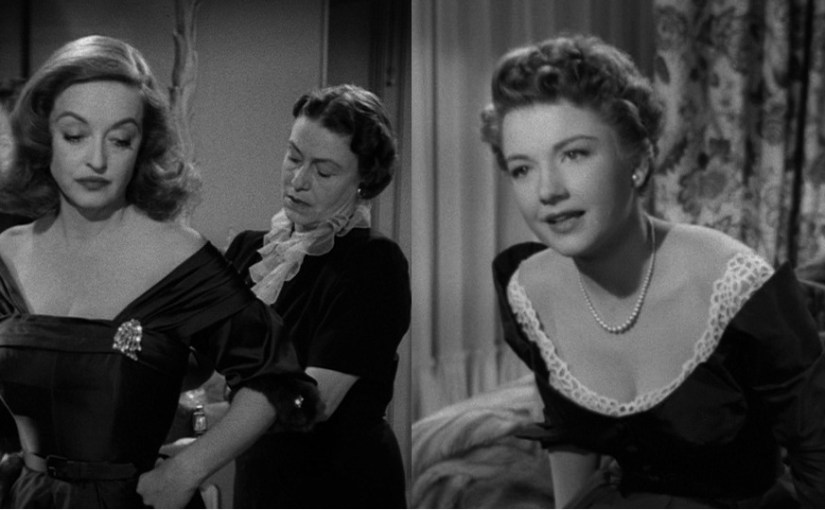
Mankiewicz’ script is brilliantly witty, absolutely biting and sharp. One of the best moments in film belongs to Bette Davis wearing a gorgeous dark evening gown designed by the legendary costumer Edith Head, and used as Margo’s armor ready for social battle. Davis declares “Fasten your seatbelts. It’s going to be a bumpy night.” No line could be so forthright in what to expect of a film like “All About Eve.”

This picture is ranked at the top of many “greatest film” lists. As it should be. This is not a sweeping biographical epic. Rather, it’s a lot of story branches that begin at the introduction of one character and expand in various directions among a handful of others who become disarmed by her ongoing presence. It’s not even that simple as Mankiewicz writes about Eve’s duplicity and how she manages to collide one piece of her destruction with another kind of destruction elsewhere, and the victims are simply blindsided.

Anne Baxter certainly had me fooled as Eve. She’s sweet and innocent on the surface and soon an inner and more evil shell emerges. Bette Davis looks spectacular and delivered one the best female performances of the last hundred years. She can carry herself and keep her guard up and authority in place. There’s a rich and commanding history about Margo that seems easy to believe. She is the queen of Broadway at the film’s beginning. Yet, for a moment her guard is let down and Mankiewicz gives us that window of time for his showcase.

Mankiewicz effectively opens his picture with Eve winning a very exclusive show biz award. She graciously approaches the podium to accept and deliver her speech. However, there are a select handful of individuals who withhold their applause of celebration. Then he flashes back to how we’ve come to this particular moment. It’s a great opening leaving me curious with a bunch of why questions. To watch this sequence the first time leaves you curious. To watch it on a second or third time is to be in on Addison DeWitt’s exclusive story of show biz scheming and diva one-upmanship. I only wonder if Joseph L Mankiewicz was as keen as George Sanders’ character to foresee how much life will come from Eve Harrington’s intrusion upon the lives of Margo & Bill and Karen & Lloyd. Before the age of desperate “if it bleeds, it leads” gossip rags, All About Eve was the real storyteller.