
by Miguel E. Rodriguez
Director: Todd Graff
Cast: Daniel Letterle, Joanna Chilcoat, Robin De Jesus, and introducing Anna Kendrick
My Rating: 8/10
Rotten Tomatometer: 64% Fresh
Everyone’s a Critic Category: “Watch an Early Film of a Famous Actor or Actress”
PLOT: Teen drama enthusiasts attend a summer drama camp and perform in several productions while dealing with an alcoholic musical director and their own messy lives.
Todd Graff’s film Camp plays like Meatballs [1979] crossed with Waiting for Guffman [1996].
A bunch of theatre-geek teens attend Camp Ovation, a summer drama camp where the campers rehearse and perform a different show every two weeks. And I’m not talking Aladdin Jr. or Annie. Among this camp’s productions are Follies, Promises Promises, and a color-blind presentation of Dreamgirls. (It’s exactly as weird as it sounds.)
A brief prologue introduces the main characters, including Michael (Robin de Jesus), a gay boy who gets beaten up by classmates when he attends his junior prom in full drag. Ellen (Joanna Chilcoat) is a plain-but-pretty girl with a self-image problem exacerbated by the fact she has to beg her brother to be her date to her own prom. The appropriately-named Vlad (Daniel Letterle) is a handsome young man who doesn’t seem to have any overt personal problems. At his camp audition, when he accompanies himself on guitar while crooning “Wild Horses”, one of the camp counselors is beside herself: “An honest-to-God STRAIGHT boy!”
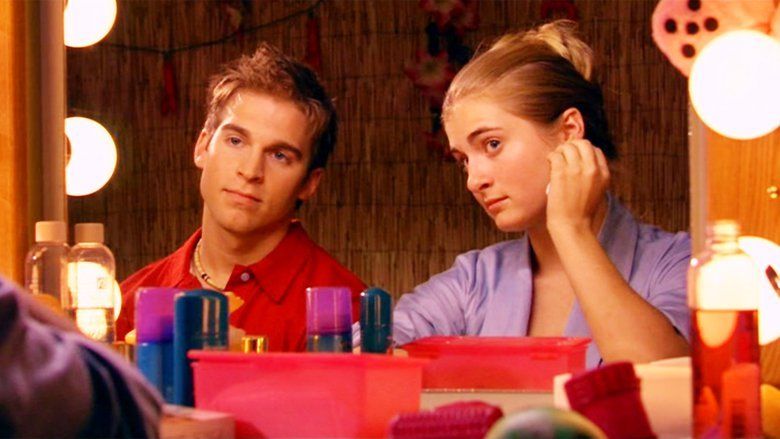
There’s also the introduction of a mousy young lady named Fritzi, played by a 16-year-old Anna Kendrick in her film debut. We all know how attractive she is in real life, but when we first meet her, she is in complete “Princess Diaries” mode: long straggly hair, flannel skirt, and acting as personal flunky for Jill, the blond camp floozy who doesn’t let anyone forget how pretty and talented she is.
Vlad is the eye of the storm at Camp Ovation. Ellen is attracted to him, Jill wants to make out with him, Michael is burning to know if he’s gay or straight, and he’s not afraid to speak his mind. He’s also an emotional demon-child, an incurable flirt in both directions, so everyone is off-center around him. That’s the “A” story.
One of the flaws of Camp is that there are one too many “B” stories. Maybe two too many. There’s Bert Hanley, who composed a musical decades ago that is still performed today, but who has not written anything since. He’s coming in to assist with the camp’s productions, but things look grim when he shows up two days late, drunk, and with a suitcase full of booze bottles.
There’s Michael’s ongoing issues with getting his unsupportive parents to attend one of the camp’s performances. One of the movie’s high points occurs when Michael is performing in Romeo and Juliet, sees the empty chairs in the audience where his parents are supposed to be, and launches into his own interpretation of Shakespeare’s tale. Bernstein and Sondheim would have approved.
There’s a hilarious subplot that is never fully explored where the camp introduces a sports counselor. At a drama camp. This bit is granted two brief scenes, then never heard from again. Alas.
There’s Jenna, a young girl whose parents wanted her to attend “fat camp” instead of drama camp, so they compromised: Jenna will attend Camp Ovation with her jaws wired shut. I will leave it up to you to discover how she performs onstage through clenched teeth. (This subplot does get a very satisfying resolution by movie’s end, it must be said.)
Most of these subplots are good enough to support an entire movie by themselves. In Camp, however, you get a little whiplash going from comedy to drama to teen angst to revenge back to comedy to performance and so on and so on. While watching it again, I noticed more than ever how many times the editing seemed to be working around chunks of dialogue that probably had to be cut for time. Somewhere out there is Todd Graff’s 3-hour director’s cut of this movie, in which every story is given enough time to breathe, expand, and evolve.
So…why do I give this movie an 8/10 rating with so much not going for it? Purely personal reasons.
Camp is a movie about theatre geeks, made by theatre geeks, for theatre geeks. The film’s director, Todd Graff – who coincidentally played “Hippy” in The Abyss [1989] – was a drama camp counselor himself, and the film is loosely based on his experiences. There is virtually zero crossover appeal for this film. Near the beginning of the film, Fritzi is trying to jog Jill’s memory where they’ve met before: “We were in Night Mother last summer, remember?” That joke only lands if you know how many people are in the cast of Night Mother, and what the plot is, and how ludicrous it is to imagine that show being performed at a summer camp.
For all his shortcomings, Vlad has a scene that speaks directly to me. He confesses to Michael that he has OCD. Without medication, he counts the letters in the words in people’s sentences. (I count syllables.) He talks about how his affliction is “always there.” But when he’s performing onstage…it’s not. Not only does that speak to me directly regarding OCD, it’s also a metaphor for anyone who has felt like an outsider for some reason or another. Offstage, you might have self-image problems or obsessive behavior or shyness. Onstage, those things magically fall away. I don’t use that term lightly: “magically.” I don’t know how else to describe what happens in that boundary between offstage and onstage. Anyway, that’s cool to me, personally.
The movie has a suitable climax, but for me, the real centerpiece of the movie comes when a group of the kids and some of the adult band members meet in secret to rehearse and perform a song that Bert Hanley (remember him from earlier?) wrote but never published. As they perform, the cynical Hanley overhears it and struggles with himself whether to let them play or to walk in and stop the performance. It’s a cliched moment, to be sure, but the song itself is rousing and borderline inspirational, and when the scene’s payoff occurs, it’s almost cheer-worthy.
And let’s not forget what happens between Fritzi and Jill. After some harsh words are said, Fritzi exacts her revenge and performs a show-stopping number from a Sondheim musical. It’s here where Anna Kendrick’s screen and stage presence are both on full display. For years afterward, Penni and I would see her in other movies and recognize her based solely on her performance in this movie, and particularly this scene. (Of course, we couldn’t remember her name for a while…she was always “that girl from Camp.” It wasn’t until after she appeared in Scott Pilgrim vs. the World [2010] that her name finally stuck.)
And, of course, there’s that cameo from a surprise audience member at the camp’s final production. (Hint: their car’s license plate reads 4UM.)
Camp may not have the name-recognition of so many other teen comedies, but this one speaks to me directly. I’m not any one of those kids at this camp, but there’s a part of me in all of them. I loved the musical numbers. I enjoyed the theatrical in-jokes. (“There’s this new thing called ‘drums,’ you’ll love it.”) And maybe there’s also a part of me that wishes I had attended one of these camps in the summer instead of Bible camp two years in a row. Just sayin’.
 2 UNPAID MOVIE CRITICS!!!!